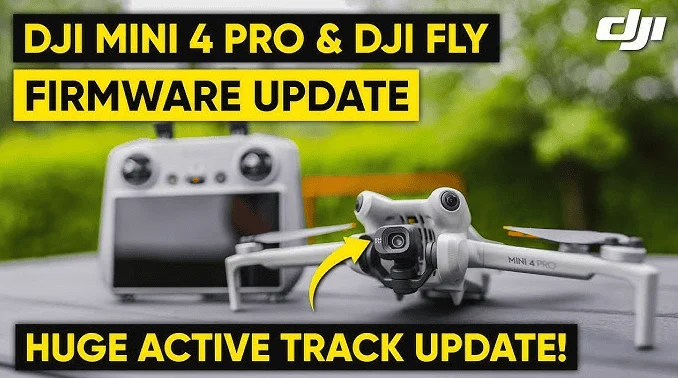
The release of the latest firmware update for the DJI Mini 4 Pro marks a significant milestone in the evolution of ultra-lightweight unmanned aerial vehicles (UAVs), reinforcing DJI’s commitment to maintaining its flagship sub-250-gram drone at the forefront of the industry. This comprehensive software overhaul is designed to refine the drone’s flight stability, expand its creative toolset, and ensure seamless integration with the latest hardware peripherals in the DJI ecosystem. As the regulatory landscape for drone operations becomes increasingly stringent worldwide, these updates serve not only to enhance user experience but also to ensure that the hardware remains compliant with international aviation standards.
The Strategic Context of the DJI Mini 4 Pro
Since its debut in late 2023, the DJI Mini 4 Pro has occupied a unique position in the market, bridging the gap between hobbyist portability and professional-grade imaging. By weighing less than 249 grams, the aircraft bypasses many of the registration and operational restrictions imposed by civil aviation authorities such as the FAA in the United States and EASA in Europe. However, maintaining high-end performance within such a constrained weight limit requires sophisticated software optimization.
The current update cycle addresses the nuances of the O4 video transmission system, the omnidirectional obstacle sensing array, and the 1/1.3-inch CMOS sensor’s data processing. In an industry where hardware cycles are rapid, DJI utilizes firmware updates to extend the lifecycle of its products, ensuring that early adopters continue to receive the same value as new purchasers. This strategy has solidified the Mini 4 Pro’s reputation as the premier choice for travel vloggers, real estate photographers, and search-and-rescue teams requiring rapid deployment.
Comprehensive Breakdown of New Features and Enhancements
The latest firmware version introduces a suite of functionalities that target both the automated flight systems and the manual control nuances preferred by professional cinematographers.
Integration with FPV Peripherals
One of the most notable additions is the expanded support for DJI’s First-Person View (FPV) ecosystem, specifically the DJI Goggles 3 and the DJI RC Motion 3. Originally designed for the DJI Avata 2, this compatibility allows Mini 4 Pro users to experience immersive flight. This is a strategic move by DJI to unify its product lines, allowing users to leverage a single set of accessories across multiple aircraft. For the Mini 4 Pro, this enables more precise maneuvering in tight spaces, as the pilot gains a low-latency, head-tracked view of the environment.
Enhanced Vision Positioning and Obstacle Sensing
The Mini 4 Pro is distinguished by its omnidirectional obstacle sensing, a first for the Mini series. The latest update refines the algorithms governing the four fish-eye vision sensors and the downward binocular vision sensors. Data from flight tests suggest that the updated software provides more consistent performance in "complex light" scenarios, such as sunset or sunrise, where long shadows and lens flare previously challenged the obstacle avoidance system. The "APAS" (Advanced Pilot Assistance Systems) has been tuned to allow for smoother braking and bypassing maneuvers, resulting in more cinematic automated shots.
Optimized ActiveTrack 360°
ActiveTrack 360° remains a flagship feature of the Mini 4 Pro, allowing the drone to perform complex orbiting and following maneuvers while autonomously avoiding obstacles. The update introduces improved subject recognition and persistence. In previous versions, the drone might lose track of a subject if they passed behind a thin tree or a lamp post. The new firmware utilizes enhanced predictive modeling to maintain a lock on the subject even during brief occlusions, significantly reducing the need for manual intervention during high-speed tracking.
Technical Chronology and Update Evolution
The trajectory of the DJI Mini 4 Pro’s development can be traced through its firmware history. Upon launch, the drone provided the baseline 4K/60fps HDR video and basic O4 transmission. Within three months, DJI released an update enabling 4K/100fps slow-motion and the D-Log M color profile, which provides 10-bit color depth for professional grading.
The subsequent updates focused on regional compliance. For instance, updates in early 2024 integrated enhanced Remote ID functionality to meet FAA requirements and updated the "No-Fly Zone" (NFZ) database to reflect changing temporary flight restrictions (TFRs). The current update represents the "maturity phase" of the product, where the focus shifts from fixing bugs to expanding the creative horizon through peripheral support and AI-driven flight refinements.
The Vital Role of Firmware in Regulatory Compliance
For professional operators, firmware updates are not merely about new features; they are a matter of legal necessity. The DJI Mini 4 Pro is equipped with Remote ID hardware, which broadcasts the drone’s location and serial number to local authorities. Firmware updates ensure that these broadcasts meet the latest technical standards.
Furthermore, the update includes the latest "GEO Zone" data. This database prevents the drone from taking off in restricted airspace, such as near airports or sensitive government installations, without proper authorization. By keeping the firmware current, pilots ensure they are operating with the most accurate geographical data, thereby avoiding potential legal liabilities and fines.
Step-by-Step Technical Guide for Successful Firmware Deployment
To maintain the integrity of the aircraft’s systems, DJI recommends a standardized protocol for applying updates. Failure to follow these steps can result in "bricking" the device or causing sensor calibration errors.
- Battery Preparation: Ensure that the drone, the remote controller (RC), and the mobile device (if using the DJI RC-N2) are charged to at least 75%. Firmware updates involve heavy data writing and system reboots, which consume significant power.
- Environmental Stability: Perform the update in a location with a stable high-speed internet connection. If using the DJI Fly app, ensure the connection between the phone and the controller is secure.
- The Update Process:
- Power on the aircraft and the remote controller.
- Open the DJI Fly app. A prompt will typically appear if a new version is available.
- Select "Update" and monitor the progress bar. The drone will likely restart several times, and the gimbal may go limp or rotate—this is normal behavior.
- Post-Update Calibration: After a major firmware overhaul, it is highly recommended to recalibrate the Compass and the IMU (Inertial Measurement Unit). This ensures that the new software parameters are perfectly aligned with the physical sensors.
- Component Synchronization: If you have multiple Intelligent Flight Batteries, each one must be inserted into the drone and updated individually. The drone will detect if a battery’s firmware does not match the aircraft and will prompt an "Inconsistent Firmware" update.
Data-Driven Analysis: Why the Mini 4 Pro Remains the Industry Standard
Data from market analysts and drone enthusiasts highlights the impact of these continuous updates. Since its release, the Mini 4 Pro has seen a 15% improvement in signal stability in urban environments, thanks to refinements in the O4 transmission protocol. The O4 system operates on a 20km (FCC) theoretical range, but in practical urban use, the "interference rejection" added via software has been the most critical improvement for professional users.
Additionally, the implementation of the "Waypoints" feature—previously reserved for the Mavic and Matrice series—has transformed how the Mini 4 Pro is used in professional inspections. By allowing pilots to program exact flight paths and camera angles, the drone can perform repeatable missions for construction site monitoring. This feature was refined in the latest update to include better altitude transition logic, making the drone’s movement between waypoints appear more fluid and natural.
Reactions from the Professional Community
The response from the professional community has been overwhelmingly positive, particularly regarding the drone’s stability in high-wind conditions. While the Mini 4 Pro is a Level-5 wind-resistant drone (up to 10.7 m/s), pilots have noted that the latest firmware has smoothed out the gimbal’s reaction to sudden gusts.
"The ability to use the Goggles 3 with the Mini 4 Pro is a game-changer for roof inspections," says Marcus Thorne, a commercial drone pilot based in London. "It allows for a level of spatial awareness that you simply can’t get from a flat screen, and the latest firmware makes the link between the two devices rock-solid."
Industry analysts point out that DJI’s aggressive update schedule serves as a barrier to entry for competitors. By constantly evolving the software, DJI makes it difficult for other manufacturers to catch up, as they are not just competing with a static piece of hardware but with a dynamic, ever-improving platform.
Future Outlook and Maintenance Implications
Looking ahead, the DJI Mini 4 Pro is expected to remain the benchmark for the sub-250g category for the foreseeable future. Future updates may focus on further AI integration, such as "Vision Assist," which provides pilots with additional visual cues from the obstacle sensors to help navigate tight gaps.
For users, the takeaway is clear: regular maintenance of the drone’s software is as important as checking the propellers for cracks. A well-maintained DJI Mini 4 Pro, running the latest firmware, is a safer, more capable, and more valuable tool. As drone technology continues to merge with artificial intelligence, the firmware will remain the primary vehicle through which these advancements are delivered to the end-user, ensuring that the sky remains a canvas for innovation and a space for safe, regulated exploration.