The Evolution and Market Context of Depositphotos
To understand the current pricing structure of Depositphotos, it is essential to examine its trajectory within the microstock industry. Founded in 2009 by entrepreneur Dmitry Sergeev in Kyiv, Ukraine, the company was established during a period of rapid expansion for digital media. While competitors like Getty Images focused on high-end editorial content, and Shutterstock pioneered the subscription model, Depositphotos carved out a niche by offering high-resolution assets with a focus on usability and international accessibility.
A pivotal moment in the company’s history occurred in October 2021, when it was acquired by Cimpress (the parent company of VistaPrint) for a reported $85 million. This acquisition integrated Depositphotos into a larger ecosystem of design and marketing tools, providing the financial backing to expand its technological offerings, including AI-driven search tools and automated image processing. Today, headquartered in New York, the platform operates in 26 languages, providing 24/7 support to a global demographic. This scale allows the company to maintain competitive pricing even as the cost of content production and digital rights management fluctuates.
Analysis of Subscription-Based Pricing Models
The core of the Depositphotos value proposition lies in its subscription tiers. These plans are designed for users who require a consistent stream of content for social media management, blogging, or ongoing advertising campaigns. The pricing is structured to reward long-term commitment, with significant discounts applied to annual billing cycles.

Small-Scale and Freelancer Tiers
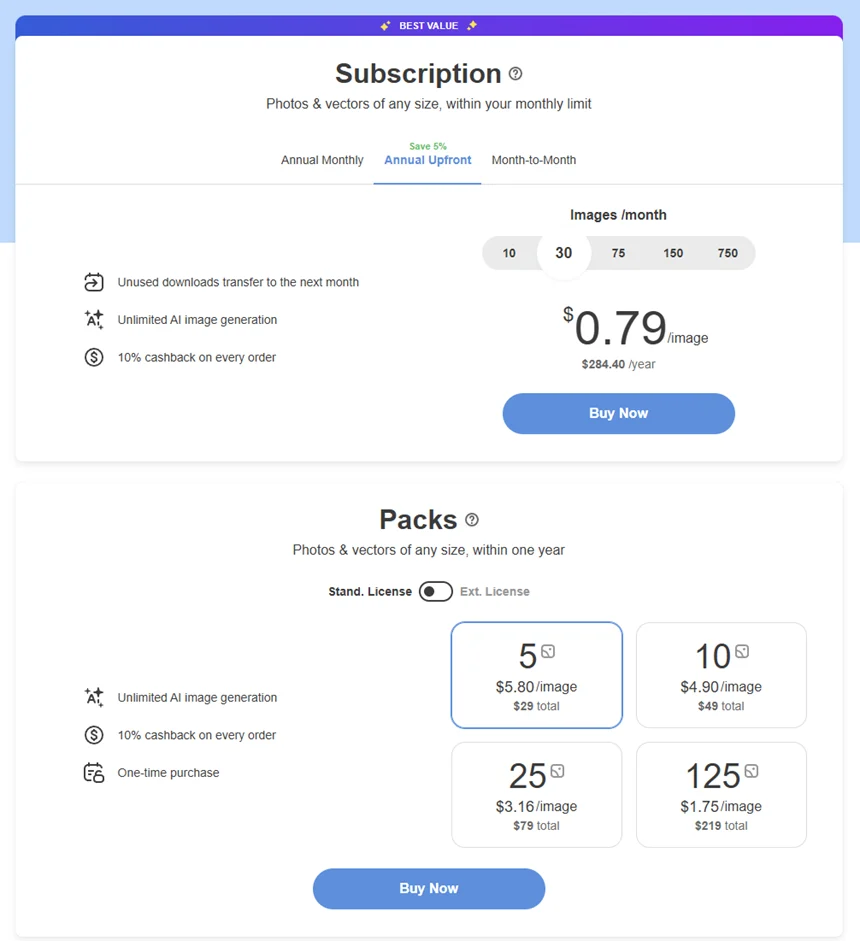
For individual creators and freelancers, the "10 Images" and "30 Images" monthly plans provide an entry-level gateway. As of early 2025, the 10-image plan is positioned at approximately $9.90 per month when billed annually, effectively pricing each high-resolution image at less than one dollar. This tier is particularly popular among niche bloggers and specialized designers who prioritize quality over quantity. The 30-image plan follows a similar logic, offering a mid-point for those managing multiple small projects simultaneously.
Professional and Agency Tiers
Larger-scale operations typically gravitate toward the 75, 150, or 750 images-per-month plans. The 750-image plan represents the most aggressive price-per-image value within the subscription model. When paid upfront annually at a rate of approximately $1,699 per year, the cost per asset drops to roughly $0.22. This tier is the industry standard for digital marketing agencies that must service dozens of clients with unique visual requirements daily.
Key Features of Subscription Plans:
- Unused Downloads: Unlike some competitors that utilize a "use it or lose it" policy, Depositphotos allows for the rollover of unused downloads to the next month for certain plan types, provided the subscription remains active.
- Asset Versatility: Subscriptions generally cover photos and vectors. Video and music assets often require separate specialized plans or credit-based purchases.
- Resolution: All subscription downloads include the highest available resolution, ensuring suitability for both digital displays and large-format print media.
On-Demand Credits: A Flexible Alternative
Recognizing that not every user requires a monthly commitment, Depositphotos maintains an "On-Demand" credit system. This model is ideal for corporate clients working on one-off annual reports or developers building a single website. Credits are purchased in packs and remain valid for one year from the date of purchase.
This model serves as a safeguard against the "subscription fatigue" currently impacting the SaaS (Software as a Service) market. While the price per image is higher in the credit model—often ranging from $2.99 to $4.90 per image depending on the pack size—the lack of a recurring monthly fee provides financial predictability for organizations with fluctuating creative budgets. Furthermore, "Extended Licenses," which are required for products intended for resale (such as t-shirts or mugs), are typically purchased using credits rather than subscription downloads.

Licensing Framework and Legal Implications
A critical component of the Depositphotos pricing debate is the legal protection afforded by their licensing agreements. The platform primarily operates under a Royalty-Free (RF) model. In a journalistic and legal context, "Royalty-Free" does not mean the content is free of charge; rather, it indicates that after a one-time payment, the user does not have to pay ongoing royalties for continued use.
Standard vs. Extended Licenses
The Standard License, included with all subscription downloads, allows for use in advertising, marketing, apps, and websites. However, it carries a limit on the number of print copies (usually 500,000) and prohibits the use of the image on items intended for sale where the image is the primary value.
The Extended License removes these print run limitations and allows for "Print on Demand" usage. From a pricing perspective, an Extended License is a premium product, often costing significantly more than a standard download. For businesses involved in merchandising, the cost-benefit analysis of an Extended License is vital to avoid copyright infringement litigation, which can result in damages far exceeding the cost of the original license.
Technological Integration and Value-Added Services
Modern stock photography pricing is no longer just about the image; it is about the tools that accompany it. Depositphotos has enriched its platform with several AI-powered features that enhance the value of its paid plans:

- AI Image Upscaler: Allows users to increase the resolution of downloaded images without significant loss of quality.
- Background Remover: A specialized tool that saves graphic designers hours of manual clipping path work.
- Search by Image: Utilizing neural networks to find visually similar assets based on a user’s uploaded reference.
These tools are often included as part of the ecosystem for paying members, effectively acting as a "force multiplier" for the subscription’s value. By integrating these utilities, Depositphotos competes not just on the price of the asset, but on the efficiency of the creative workflow.
Comparative Market Analysis: Depositphotos vs. Industry Leaders
When compared to industry giants like Adobe Stock and Shutterstock, Depositphotos often positions itself as the more budget-friendly alternative without sacrificing library depth. Adobe Stock offers the advantage of deep integration within the Creative Cloud suite, which allows designers to license images directly inside Photoshop. However, this convenience comes with a higher price point.
Shutterstock, while possessing a larger total library, often has more rigid subscription terms. Industry analysts note that Depositphotos frequently runs aggressive promotional campaigns, particularly during "Black Friday" or through partnerships with platforms like AppSumo. These "Lifetime Deals" or deeply discounted credit packs have historically allowed small businesses to acquire thousands of images at a fraction of the standard market rate, a tactic that has successfully disrupted the market share of more established providers.
Chronology of Content Acquisition and Growth
The growth of the Depositphotos library serves as a proxy for the broader explosion of digital content:

- 2009: Launch with a focus on high-quality photography.
- 2012: Surpassed 10 million files.
- 2017: Reached 60 million files and expanded heavily into video (4K and HD).
- 2021: Acquisition by Cimpress; library exceeds 200 million assets.
- 2024-2025: Library surpasses 300 million assets, with significant growth in AI-generated and AI-assisted imagery.
This chronology illustrates a shift from a simple photo repository to a comprehensive media powerhouse. The pricing has remained remarkably stable during this growth, a feat attributed to the platform’s ability to scale its infrastructure and automate contributor relations.
Impact on the Creative Economy and Future Outlook
The democratization of high-quality stock media through affordable plans like those offered by Depositphotos has had a profound impact on the creative economy. It has leveled the playing field for small businesses, allowing them to produce marketing materials that rival those of large corporations. However, the rise of AI-generated content poses a new challenge to traditional pricing models.
As AI tools like Midjourney and DALL-E become more prevalent, stock agencies are forced to adapt. Depositphotos has responded by launching its own AI image generator, ensuring that its contributors are compensated when their data is used to train these models. The future of Depositphotos pricing will likely involve a hybrid model where users pay for a combination of human-shot photography and AI-generated custom visuals.
In conclusion, the plans and prices offered by Depositphotos represent a calculated balance between affordability and professional-grade quality. By providing diverse options ranging from a $9.90 entry point to comprehensive enterprise solutions, the platform ensures its relevance in a market that demands both high volume and high aesthetic standards. For the modern professional, choosing a plan is not merely a matter of cost, but a decision on how to best support their creative workflow with a reliable, legally sound, and technologically advanced partner.