In the rapidly evolving landscape of digital marketing and content creation, the accessibility of high-quality visual assets has transitioned from a luxury to a fundamental requirement for businesses of all scales. Depositphotos, a major global player in the stock media industry, has positioned itself as a central repository for over 304 million files, serving a diverse clientele that exceeds 43 million users worldwide. As the demand for visual storytelling intensifies within the estimated $1.5 trillion creator economy, understanding the fiscal and operational nuances of Depositphotos’ subscription models and credit systems is essential for professionals seeking to optimize their production budgets.
The Strategic Evolution of Depositphotos in the Stock Media Market
Founded in 2009 by Dmitry Sergeev in Kyiv, Ukraine, Depositphotos quickly ascended the ranks of the microstock industry by prioritizing a user-centric interface and a robust contributor network. The platform’s growth trajectory reached a significant milestone in October 2021, when it was acquired by Cimpress (the parent company of VistaPrint) in a deal valued at approximately $85 million. This acquisition integrated Depositphotos into the broader Vista ecosystem, enhancing its ability to serve small business owners and design professionals through integrated creative tools and expanded asset libraries.
Today, the platform operates as a comprehensive creative hub, offering not only static photography and vector illustrations but also high-definition video footage and royalty-free music tracks. With a contributor base exceeding 100,000 artists, the repository is updated daily, ensuring that the content reflects contemporary aesthetic trends and technological shifts, such as the increasing integration of AI-generated imagery and mobile-first vertical video content.

Comprehensive Analysis of Subscription Models
Depositphotos utilizes a tiered pricing structure designed to accommodate varying consumption patterns, ranging from the intermittent needs of freelance designers to the high-volume requirements of global advertising agencies. The primary differentiator in these plans is the volume of downloads allowed per month and the duration of the contractual commitment.
Individual Subscription Tiers
The subscription model is divided into five primary tiers based on monthly image allotments. These plans are optimized for users who require a consistent stream of content for social media management, blogging, or ongoing marketing campaigns.
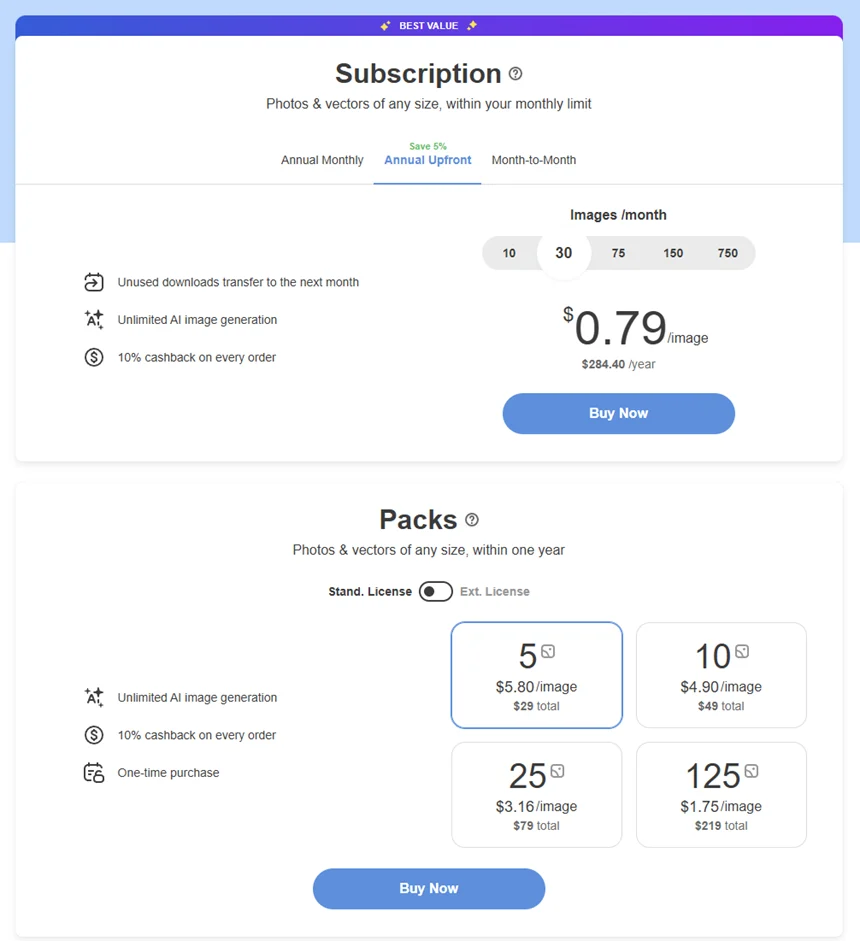
- The 10 Images Plan: This entry-level tier is priced at $10.90 on a month-to-month basis. For users opting for an annual commitment paid monthly, the price drops to $9.90 per month. This plan is specifically tailored for startups or individual creators with minimal but regular visual needs.
- The 30 Images Plan: Positioned for mid-level creators, this plan costs $24.75 per month under a flexible monthly billing cycle. Interestingly, the annual billing (paid monthly) is structured at $26.70 per month, reflecting different promotional weightings within the platform’s pricing algorithm.
- The 75 Images Plan: This tier represents the "sweet spot" for many boutique agencies. At $66.75 per month for flexible billing or $59.25 per month for an annual commitment, the cost per image significantly decreases compared to the lower tiers.
- The 150 Images Plan: Priced at $97.50 per month (flexible) or $88.50 per month (annual), this plan serves professional content teams.
- The 750 Images Plan: The highest volume tier is offered at $187.50 per month for flexible billing. For high-volume users willing to commit to an annual contract, the price is $172.50 per month, which reduces the per-image cost to approximately $0.23.
On-Demand Credit Packs
For projects with unpredictable timelines or specific one-off requirements, Depositphotos offers "On-Demand" downloads. Unlike subscriptions, which reset every month, these credits remain valid for one year from the date of purchase. This model is particularly effective for businesses that may need 20 images one month and zero the next. On-demand pricing is generally higher per unit but provides the ultimate flexibility for budgetary planning without the risk of "losing" unused downloads at the end of a billing cycle.
Licensing Framework and Legal Protections
A critical component of the Depositphotos value proposition is its legal framework. All assets are provided under a royalty-free (RF) license, which, in the context of professional journalism and commerce, implies a one-time payment for perpetual use across multiple platforms.

Standard vs. Extended Licenses
The standard license included with most subscriptions covers the majority of digital and print uses, including websites, advertising, social media, and editorial content. However, there are specific limitations regarding the "print run" (usually capped at 500,000 copies) and the use of images on products intended for resale (such as t-shirts or mugs).
For commercial entities producing merchandise or large-scale print campaigns, the Extended License is required. This license removes the print-run limitation and grants the right to use the asset on items for resale. While significantly more expensive than standard downloads, the Extended License provides the necessary legal indemnity for large-scale commercial ventures.
Technological Integration and Workflow Tools
Beyond the acquisition of assets, Depositphotos has invested heavily in "workflow efficiency" tools. These features are designed to reduce the time between asset discovery and final production, a key metric for modern creative departments.
- Advanced Search Algorithms: The platform utilizes AI-driven search filters that allow users to sort by color palette, orientation, location of "copy space," and even the number of people present in an image.
- AI Background Remover: A web-based tool that allows users to eliminate backgrounds from images instantly, a task that previously required manual labor in software like Adobe Photoshop.
- Image Upscaler: Utilizing neural networks, this tool allows users to increase the resolution of images without a significant loss in quality, facilitating the use of smaller files for large-format printing.
- API Integration: For large enterprises and tech platforms, Depositphotos offers API access, allowing developers to integrate the stock library directly into their own applications or Content Management Systems (CMS).
Comparative Market Analysis
When compared to industry titans such as Shutterstock and Adobe Stock, Depositphotos often positions itself as the more cost-effective alternative without sacrificing library depth. While Adobe Stock benefits from native integration within the Creative Cloud suite, Depositphotos appeals to the "platform-agnostic" creator who prioritizes a lower price point and a user-friendly experience.

Industry analysts note that Depositphotos has been particularly successful in the European and Asian markets, offering support in 26 languages and accepting various local currencies. This localized approach has allowed the company to capture market share in regions where US-centric competitors have historically struggled with localized customer service and regionalized content.
Impact of the 2021 Acquisition and Future Outlook
The acquisition by Cimpress has fundamentally shifted Depositphotos’ trajectory from an independent microstock site to a component of a global manufacturing and design powerhouse. This shift is expected to lead to deeper integrations with VistaPrint’s design tools, potentially offering "seamless" transitions from image selection to physical product printing.
Furthermore, the rise of Generative AI poses both a challenge and an opportunity for the platform. In response to the proliferation of AI-generated content, Depositphotos has implemented strict guidelines for AI submissions and has begun exploring its own proprietary AI tools. This ensures that the library remains "commercially safe," providing users with the peace of mind that assets have clear provenance and legal backing—a feature that free, unmoderated AI repositories cannot currently guarantee.
Financial and Operational Implications for Businesses
For procurement departments and creative directors, the choice of a Depositphotos plan should be dictated by a "utilization audit." Organizations that consistently use more than 50 images per month will find the 750-image annual plan provides the highest ROI, effectively lowering the cost of high-quality visuals to a negligible line item in the marketing budget. Conversely, for organizations focused on high-stakes, low-volume branding, the On-Demand packs for Extended Licenses offer the necessary legal protection for flagship campaigns.

The platform’s 24/7 support and multi-user account features further enhance its utility for remote and distributed teams. By allowing multiple seats under a single corporate umbrella, Depositphotos simplifies the administrative burden of license management and ensures brand consistency across various departments.
Conclusion
Depositphotos continues to solidify its position as a versatile and economically viable solution in the stock media sector. By offering a granular range of pricing tiers—from the $9.90 entry point to comprehensive enterprise solutions—the platform successfully bridges the gap between individual hobbyists and large-scale corporate entities. As the digital landscape continues to demand higher volumes of visual content, the platform’s combination of a massive asset library, competitive pricing, and advanced technological tools ensures its ongoing relevance in the global creative economy. For businesses navigating the complexities of digital transformation, Depositphotos offers a scalable resource that aligns fiscal responsibility with high-end creative output.