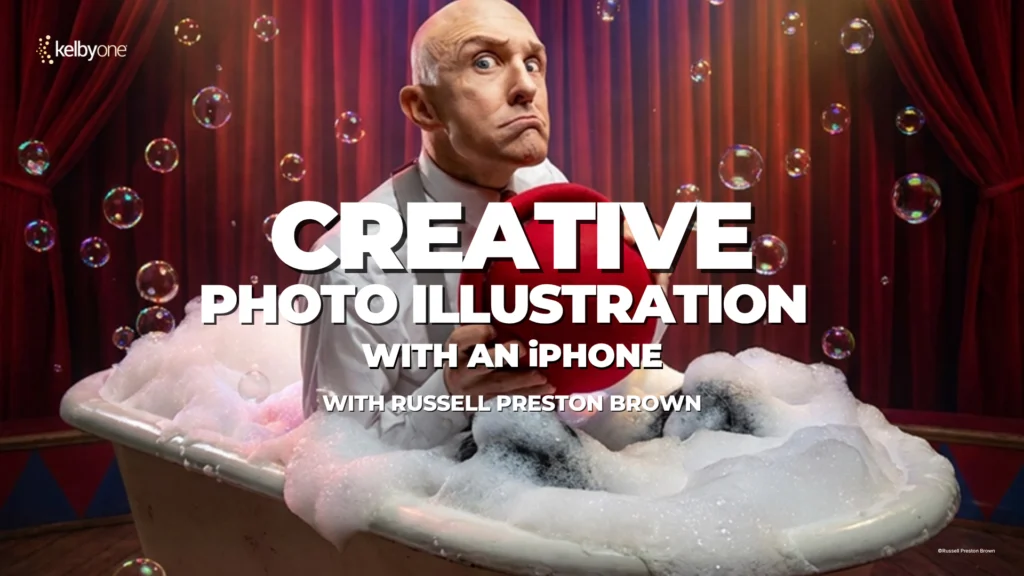
In a significant development for the creative photography community, Adobe’s renowned Senior Creative Director, Russell Preston Brown, has unveiled a groundbreaking new class designed to democratize high-level photo illustration. The course, titled "Creative Photo Illustration with an iPhone," challenges traditional notions of professional-grade image creation by demonstrating how exceptional results can be achieved with surprisingly minimal equipment: an iPhone, a single continuous light source, and a tripod. This innovative approach, culminating in sophisticated post-production techniques utilizing Adobe Lightroom, Photoshop, and the revolutionary Adobe Firefly with Generative Fill, marks a pivotal moment in making advanced creative workflows accessible to a broader audience while simultaneously showcasing the cutting-edge capabilities of modern photographic and AI tools.
The Genesis of Innovation: Brown’s Vision and Approach
Russell Preston Brown, a figure synonymous with digital imaging excellence and an engaging educator, has consistently pushed the boundaries of what is possible in photography and graphic design. His latest class is a testament to his philosophy that powerful creative tools should be within reach for everyone, not just those with extensive studio setups. Brown’s instruction begins with a practical demonstration involving professional bubbleologist Kirk Marsh as the model, illustrating how foundational photographic principles, combined with contemporary technology, can yield stunning results.
-
Capturing Excellence with Minimalist Gear: The iPhone as a Professional Tool
The class’s initial phase focuses entirely on capture using an iPhone. This choice underscores a broader industry trend where smartphone cameras have evolved from convenient snapshot devices to legitimate tools for professional content creation. Modern iPhones, particularly the Pro models, are equipped with advanced sensors and computational photography capabilities that rival, and in some cases surpass, entry-level professional cameras. Brown specifically leverages the iPhone’s capacity to shoot 48-megapixel raw files, a feature that provides immense flexibility and detail retention for post-processing. This high-resolution raw format captures a wider dynamic range and color information, crucial for intricate photo illustrations. The adoption of raw capture on smartphones represents a significant leap, allowing photographers to exercise greater control over their images, akin to traditional DSLR or mirrorless workflows. This accessibility means that aspiring photographers no longer face the prohibitive upfront costs associated with professional camera bodies and lenses, effectively lowering the barrier to entry for serious photographic pursuits. Data from industry analysts consistently shows that smartphones are the primary device for capturing images globally, and their increasing technical sophistication is enabling a new generation of visual storytellers.
-
Mastering Light: Foundational Techniques Made Accessible
A core tenet of Brown’s methodology in this class is the mastery of lighting with a single continuous light source. This minimalist setup forces a deep understanding of light’s properties—direction, quality, and intensity—and how it sculpts a subject. Brown meticulously demonstrates how to achieve classic portrait lighting patterns such as split, Rembrandt, loop, and butterfly lighting using only one light.
- Split Lighting: Characterized by half the face being lit and the other half in shadow, often used for dramatic effect.
- Rembrandt Lighting: Identified by a small triangle of light on the shadowed cheek, created by turning the subject’s face away from the light source, lending a painterly quality.
- Loop Lighting: Features a small shadow of the nose that loops down towards the corner of the mouth, creating a flattering and soft look.
- Butterfly Lighting: Positioned directly in front and above the subject, creating a butterfly-shaped shadow under the nose, ideal for accentuating cheekbones.
By teaching these fundamental techniques with limited gear, Brown emphasizes that strong photographic principles are paramount, transcending the sophistication of the equipment used. This approach empowers students to understand the ‘why’ behind effective lighting before graduating to more complex setups, ensuring a robust foundation in photographic craft. This echoes the sentiment among seasoned professionals that the photographer’s eye and understanding of light are far more critical than the sheer volume of equipment.
From Capture to Creation: The Adobe Ecosystem in Action
The captured iPhone raw images are merely the starting point. The real transformation, and where the "illustration" aspect truly shines, occurs within the Adobe Creative Cloud ecosystem, specifically Lightroom and Photoshop, augmented by the groundbreaking capabilities of Adobe Firefly and Generative Fill.
-
The Power of Post-Production: Lightroom and Photoshop Integration
Once the raw images are transferred, Brown guides students through a professional post-processing workflow. Lightroom serves as the initial hub for organization, global adjustments, and non-destructive raw editing. This includes white balance correction, exposure fine-tuning, shadow and highlight recovery, and color grading to establish a foundational aesthetic. The seamless integration between Lightroom and Photoshop is then leveraged for more intricate manipulations. Photoshop, with its layer-based editing system, becomes the canvas for complex compositing, precise retouching, and the introduction of entirely new elements. This traditional workflow is standard practice in professional studios, allowing for granular control over every aspect of an image. Brown’s class demystifies these processes, making them approachable for those new to advanced image editing.
-
The AI Revolution: Adobe Firefly and Generative Fill’s Transformative Impact
The most revolutionary aspect of Brown’s class lies in its strategic integration of Adobe Firefly and Generative Fill. These AI-powered tools redefine the scope of photo illustration by allowing creators to add elements that were never present during the original shoot, or even conceptually outside the realm of traditional photography. Brown demonstrates how these tools can:
- Add Lighting Effects: Beyond what was captured, Firefly and Generative Fill can intelligently create realistic light sources, shadows, and reflections, enhancing mood and depth without altering the original subject’s integrity. This capability is particularly impactful for creative illustration, enabling a photographer to envision and implement fantastical lighting scenarios that would be impossible or prohibitively complex to achieve in-camera.
- Generate Scene Elements: From intricate backgrounds to specific objects, AI can conjure new visual components that seamlessly integrate with the existing photograph. This means a simple portrait taken against a plain backdrop can be transformed into a dynamic scene, complete with atmospheric effects or imaginative props, all without physically altering the model. The AI understands context, perspective, and lighting to generate content that matches the original image’s style.
This level of creative freedom, previously requiring extensive digital painting skills, stock image manipulation, or even 3D rendering, is now accessible through intuitive text prompts and contextual selections. Brown’s approach highlights that while AI can generate new content, the artist’s vision and direction remain paramount. The human element of imagination and aesthetic judgment guides the AI, transforming it from a mere tool into a collaborative partner in the creative process. This fusion of human ingenuity and artificial intelligence is a hallmark of Adobe’s vision for the future of creative work.
The Broader Landscape: Contextualizing Modern Photography
Brown’s class is not an isolated event but rather a reflection of significant shifts within the photography and creative industries. Understanding these broader contexts illuminates the importance and implications of his teaching.
-
The Democratization of Photography: A Historical Perspective
Photography has undergone several waves of democratization. From the initial high cost of early daguerreotypes to the mass-market Kodak Brownie, then the rise of affordable DSLRs, each era has lowered the barrier to entry. The advent of digital photography dramatically reduced the cost per image, enabling experimentation. Now, smartphone photography represents the ultimate democratization, putting a high-quality camera in virtually every pocket. This has led to an explosion of visual content creation globally, fostering diverse perspectives and artistic expressions that were once limited by access to specialized equipment and training. Brown’s class capitalizes on this accessibility, proving that professional-level output is no longer exclusively tied to expensive gear.
-
The Rise of Computational Photography and Smartphone Dominance
Modern smartphone cameras are not just optical devices; they are sophisticated computational systems. Features like HDR (High Dynamic Range), portrait mode with artificial bokeh, night mode, and advanced image stacking are all products of computational photography algorithms. These technologies process multiple images and data points to create a single, optimized photograph that often surpasses what traditional cameras can achieve in challenging conditions without extensive post-processing. The iPhone, in particular, has been a leader in this space, continually pushing the envelope of what a small sensor can accomplish through intelligent software. This evolution has significantly blurred the lines between "taking a picture" and "creating an image," making the post-capture phase an integral part of the photographic process, even for casual users.
-
Adobe’s Strategic Embrace of Artificial Intelligence
Adobe has been at the forefront of integrating AI into its creative applications for years, initially through its Sensei AI framework and more recently with Firefly. Firefly, a family of generative AI models, is specifically trained on Adobe Stock and public domain content, ensuring commercial safety and ethical sourcing—a critical consideration in the burgeoning field of generative AI. Its integration into Photoshop via Generative Fill represents a strategic move to empower creators with unprecedented control and efficiency. This commitment to AI is not merely about automation but about augmenting human creativity, allowing artists to focus on conceptualization and iteration rather than tedious manual tasks. Adobe’s stated goal is to make advanced tools accessible and intuitive, and Brown’s class exemplifies how this vision translates into practical, creative workflows.
Expert Perspectives and Industry Implications
The implications of Russell Preston Brown’s new class extend far beyond individual skill development, touching upon broader industry trends and the future of creative work.
-
Redefining the Professional Workflow
The class suggests a paradigm shift in professional photography. While specialized equipment will always have its place, the emphasis is increasingly moving towards creative vision, technical understanding of light and composition, and mastery of post-production tools. A professional photographer might now arrive at a shoot with an iPhone and a single light, rather than a heavy camera bag filled with multiple lenses and flash units, especially for certain types of creative projects. This streamlined approach can reduce setup time, lower operational costs, and increase agility, allowing photographers to adapt to diverse client needs more readily. The efficiency gained through AI-powered enhancements further accelerates the creative process, enabling quicker turnarounds for clients and more time for iterative refinement.
-
The Shifting Skillset for Contemporary Creatives
For aspiring and established photographers alike, Brown’s course highlights the evolving skillset required for success in the digital age. While traditional photographic skills remain crucial, proficiency in advanced digital editing, particularly with AI-driven tools, is becoming indispensable. The ability to conceptualize beyond what is physically captured in-camera, and then leverage AI to bring those concepts to life, is a powerful differentiator. This necessitates a blend of artistic vision, technical acumen in software, and an understanding of how to effectively prompt and guide generative AI. Education platforms like KelbyOne, which hosts Brown’s class, play a vital role in delivering these cutting-edge skills to a global audience, ensuring that creatives can stay abreast of rapid technological advancements.
-
Accessibility and Education in the Digital Age
The class’s offering of two free lessons is a strategic move to lower the financial barrier to accessing high-quality education, reflecting a broader trend towards open educational resources and freemium models in online learning. This accessibility not only benefits individual learners but also fosters a more inclusive creative community. By demonstrating that professional results are attainable with widely available tools, Brown’s class empowers a new generation of creators from diverse backgrounds to explore and develop their artistic talents without the initial hurdle of expensive equipment. This democratized access to both tools and education is crucial for fostering innovation and ensuring that the creative landscape remains dynamic and representative.
In conclusion, Russell Preston Brown’s "Creative Photo Illustration with an iPhone" is more than just a photography class; it is a declaration of the future of creative image-making. It masterfully blends fundamental photographic principles with the cutting-edge capabilities of modern smartphones and artificial intelligence, demonstrating that the most powerful tools are often those most accessible. By showing how a strong initial photograph, captured with minimal gear, can be transformed into a sophisticated illustration through imagination and advanced Adobe tools like Firefly and Generative Fill, Brown empowers creators to transcend the limitations of reality and bring their boldest visions to life. This course firmly establishes that in the contemporary creative landscape, ingenuity, skill, and a willingness to embrace technological innovation are far more valuable than the size of one’s equipment bag. The availability of free lessons further underscores Adobe and KelbyOne’s commitment to fostering a vibrant and inclusive creative community, poised to redefine the boundaries of visual storytelling.