A groundbreaking new educational initiative from Adobe, led by its esteemed Principal Designer and creative evangelist, Russell Preston Brown, is set to redefine the accessibility of professional-grade photo illustration. The new class demonstrates how sophisticated visual artistry, once exclusively associated with high-end studios, can be achieved using surprisingly minimal equipment: an Apple iPhone, a single continuous light source, and a tripod. This innovative approach, which culminates in advanced digital manipulation using Adobe Lightroom, Photoshop, and the transformative power of Adobe Firefly and Generative Fill, underscores a significant shift in the landscape of creative content creation, democratizing techniques for both aspiring and seasoned visual artists.
Democratizing High-Quality Photo Illustration
The premise of Brown’s class challenges conventional notions of photographic production. Historically, creating compelling photo illustrations – images that combine elements of photography with artistic embellishment – demanded substantial investment in cameras, lenses, lighting rigs, and professional studios. Brown’s methodology, however, posits that the fundamental building blocks of such imagery can be captured with a device ubiquitous in modern life: the smartphone. This paradigm shift is particularly pertinent in an era where visual content dominates digital communication, and the demand for unique, high-quality imagery continues to surge. The class is not merely about using an iPhone; it is about leveraging its capabilities intelligently and then augmenting those captures with the unparalleled power of Adobe’s creative ecosystem, particularly its cutting-edge artificial intelligence features.
The Foundation: Mobile Photography and Essential Lighting Techniques
The initial phase of Brown’s class focuses on meticulous in-camera capture, an aspect often overlooked in the rush towards post-production. The choice of an iPhone as the primary camera is strategic, highlighting the remarkable advancements in smartphone camera technology. Modern iPhones, particularly the latest models, are equipped with sophisticated sensors and computational photography capabilities that enable high-resolution image capture. Brown specifically instructs participants on how to shoot 48-megapixel raw files directly on the iPhone. This raw format is crucial for professional workflows, as it retains a vast amount of image data, offering maximum flexibility for adjustments in exposure, color, and detail during post-processing without introducing significant degradation. This capability positions the iPhone not merely as a casual snapshot device but as a serious tool for high-fidelity image acquisition.
Central to the on-set execution is the mastery of single-light portraiture. Brown demonstrates how a solitary continuous light source, when positioned strategically relative to the subject, can sculpt light and shadow to create dramatic and artistic effects. The class delves into four classic lighting patterns, each designed to evoke a distinct mood and highlight different aspects of the subject’s face:
- Split Lighting: Divides the face into two halves, one brightly lit and the other in shadow, often used for dramatic or intense portraits.
- Rembrandt Lighting: Characterized by a small, inverted triangle of light on the shadowed side of the face, it evokes a sense of depth and chiaroscuro, reminiscent of the Dutch master’s paintings.
- Loop Lighting: Creates a small shadow of the nose that "loops" down towards the corner of the mouth, offering a softer, more natural look than Rembrandt lighting.
- Butterfly Lighting (or Paramount Lighting): Positions the light directly in front and above the subject, creating a butterfly-shaped shadow directly under the nose, ideal for glamour and highlighting cheekbones.
The careful manipulation of a single light source, combined with the stability provided by a tripod – essential for sharp 48MP raw captures, especially in lower light – forms the bedrock of Brown’s methodology, proving that sophisticated lighting doesn’t require complex setups.
The Instructor: Russell Preston Brown’s Vision
Russell Preston Brown is not just an instructor; he is an institution within the Adobe ecosystem and the broader digital art community. As a Principal Designer at Adobe, his career spans decades, marked by a tireless dedication to pushing the boundaries of creative technology and making complex tools accessible to a wider audience. Brown is renowned for his engaging teaching style, his ability to demystify intricate software features, and his boundless enthusiasm for creative experimentation. His classes and presentations are often characterized by a playful yet profoundly insightful approach, blending technical instruction with artistic inspiration. His long tenure at Adobe, coupled with his deep understanding of Photoshop, Lightroom, and now the burgeoning AI tools, makes him uniquely qualified to lead this exploration into the future of photo illustration. His vision for this class is clearly to empower creators by showcasing that creativity is not limited by equipment but by imagination and technical know-how.
The Subject: Kirk Marsh, Professional Bubbleologist
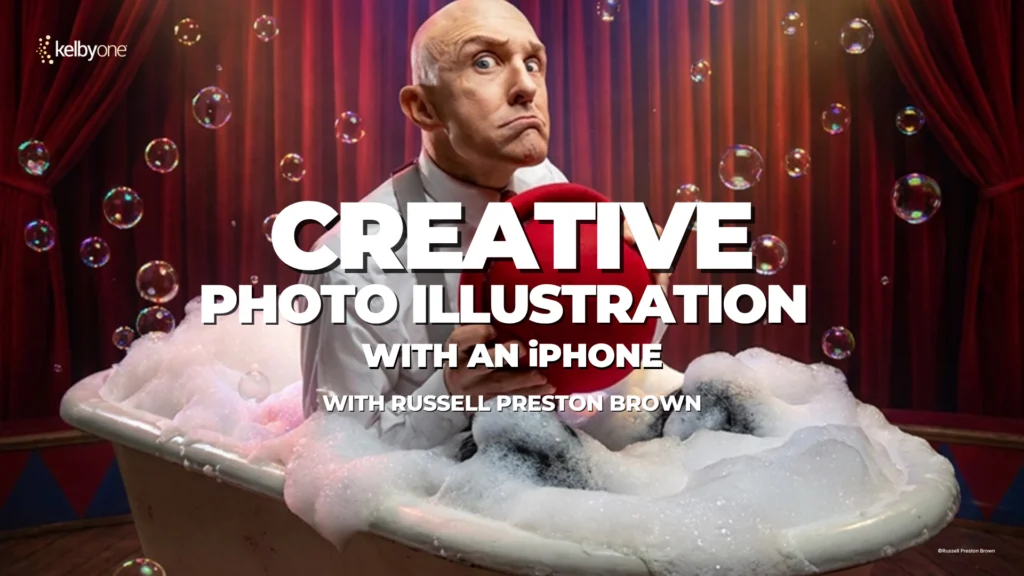
The choice of model for this class is as unconventional as the lighting setup. Kirk Marsh, a professional bubbleologist, serves as the subject for Brown’s photographic experiments. Marsh’s unique profession, involving the creation of elaborate and often mesmerizing bubble art, provides an inherently dynamic and visually captivating element to the shoot. The ephemeral nature of bubbles, their iridescent surfaces, and their interaction with light offer a rich canvas for photographic exploration. This selection underscores another key aspect of creative photography: finding compelling subjects that inherently add interest and challenge to the shooting and post-production process. Marsh’s performance undoubtedly contributes to the "fun" aspect that Brown emphasizes, making the learning experience more engaging and demonstrating how a unique subject can inspire innovative photographic techniques.
Elevating Images with Adobe’s Creative Suite and AI
While the initial capture phase is crucial, the true transformation and "fun" truly begin in the post-production environment, where Brown leverages the full power of Adobe’s industry-standard creative applications, enhanced by cutting-edge artificial intelligence.
Post-Production Prowess: Lightroom and Photoshop
The captured 48-megapixel raw files from the iPhone are first brought into Adobe Lightroom. Lightroom serves as the digital darkroom, where initial adjustments are made. This includes global corrections for exposure, white balance, contrast, and color, as well as local adjustments to refine specific areas of the image. Its non-destructive editing workflow ensures that the original raw data remains untouched, allowing for endless experimentation. Lightroom’s powerful organizational features also ensure that the high volume of raw files can be efficiently managed and cataloged.
Following the foundational adjustments in Lightroom, the images transition to Adobe Photoshop, the undisputed industry standard for image manipulation and compositing. In Photoshop, Brown demonstrates how to take the captured photographs beyond mere enhancement, transforming them into sophisticated illustrations. This involves advanced retouching, precise selections, complex masking, and the integration of various graphical elements. Photoshop’s layered architecture is fundamental to this process, allowing for the creation of intricate compositions where each element can be independently controlled and modified.
The Generative Leap: Adobe Firefly and Generative Fill
The most revolutionary aspect of Brown’s workflow lies in the integration of Adobe’s generative AI tools: Adobe Firefly and Generative Fill. These technologies represent a monumental leap in creative capabilities, enabling artists to expand, modify, and even invent elements within an image with unprecedented ease and realism.
- Adobe Firefly: As a family of creative generative AI models, Firefly is trained on a vast dataset of licensed content, ensuring it is commercially safe and ethically sourced. It powers various generative features across Adobe products, including text-to-image, generative recolor, and text effects. In the context of photo illustration, Firefly’s underlying models provide the intelligence for tools like Generative Fill.
- Generative Fill: This feature, deeply integrated into Photoshop, allows users to select an area of an image and, using a text prompt, generate new content within that selection. Crucially, Generative Fill intelligently understands the context of the surrounding image, matching lighting, perspective, and style to seamlessly integrate the generated elements.
Brown’s class showcases how Generative Fill is used to build upon what was captured in-camera. This is where the "magic" of adding elements that weren’t present during the shoot comes into play. For instance, Brown can extend backgrounds, introduce new objects, or even create entirely new environments around the original subject – Kirk Marsh and his bubbles – without altering the core integrity of the original photograph. Perhaps most strikingly, he demonstrates how to "add lighting that wasn’t there during the shoot." This capability, powered by AI’s understanding of light and shadow, allows for the simulation of complex lighting scenarios, adding depth, drama, or ethereal glows that would be impossible to achieve with a single physical light source. This fusion of real-world photography and AI-driven creation truly blurs the lines between capture and imagination, offering limitless possibilities for creative expression.
Contextualizing the Creative Revolution: Trends in Photography and AI
Brown’s class is not an isolated phenomenon but rather a reflection of broader trends shaping the creative industry.
The Rise of Smartphone Photography:
Over the past decade, smartphones have evolved from simple communication devices into sophisticated portable cameras. Market data consistently shows that the majority of photographs taken globally are captured with mobile phones. According to recent reports, over 1.4 trillion photos were taken in 2023, with the vast majority originating from smartphones. The improvements in sensor technology, lens quality, and computational photography (e.g., HDR, Portrait Mode, Night Mode) have made smartphone cameras capable of producing images of remarkably high quality, challenging the traditional dominance of DSLRs and mirrorless cameras for many applications. This accessibility means that virtually anyone with a smartphone now possesses a powerful photographic tool, making courses like Brown’s immediately relevant to a massive global audience.
AI’s Integration into Creative Workflows:
The advent of generative AI has sent ripples through the creative world. Tools like DALL-E, Midjourney, and Adobe Firefly have demonstrated the ability of AI to create novel images from text prompts, generate variations, and perform complex editing tasks that once required hours of manual work. Adobe, a long-standing leader in creative software, has been at the forefront of integrating AI into its core products, recognizing its potential to augment human creativity rather than replace it. Generative Fill is a prime example of this philosophy, allowing artists to accelerate their workflows, overcome creative blocks, and explore possibilities that were previously unimaginable. This integration marks a new era where AI acts as a creative partner, extending the artist’s capabilities.
A Historical Perspective on Image Manipulation:
Image manipulation is as old as photography itself. From early darkroom techniques like dodging and burning, combination printing, and hand-coloring in the 19th century, photographers have always sought to enhance or alter reality. The digital revolution, ushered in by software like Photoshop in the late 1980s and early 1990s, dramatically expanded these possibilities, moving from chemical processes to pixels. Today, generative AI represents the third major wave of image manipulation, offering an unprecedented level of control and creative freedom, shifting the paradigm from purely manual alterations to AI-assisted generation and transformation.
Implications for the Creative Community
The implications of Russell Preston Brown’s new class and the technologies it employs are profound and far-reaching for the entire creative community.
Bridging the Gap Between Amateurs and Professionals:
By starting with an iPhone and then layering on advanced Adobe tools, the class effectively lowers the barrier to entry for producing professional-level photo illustrations. Amateurs can now aspire to create sophisticated imagery without the initial daunting investment in high-end camera gear. Simultaneously, professionals can integrate these efficient AI-driven workflows to enhance their productivity and explore new creative avenues, allowing them to focus more on conceptualization and less on laborious manual tasks.
Redefining the Creative Process:
The integration of generative AI fundamentally alters the creative process. It introduces a dynamic interplay between intentional capture and AI-assisted expansion. Artists can now approach a shoot with the understanding that environments can be extended, elements can be added, and lighting can be refined in post-production with incredible fluidity. This encourages a more iterative and experimental approach, where the boundaries of what’s possible are constantly being pushed. The class exemplifies how a "strong photograph and a little imagination can become something completely different," highlighting the synergy between human vision and algorithmic intelligence.
Educational Accessibility and Future Skills:
The availability of such a class, especially with free introductory lessons, makes cutting-edge techniques accessible to a global audience. It also signals the evolving skill set required for future visual artists. Proficiency in traditional photographic principles (like lighting and composition) combined with a deep understanding of digital editing software and the ability to effectively prompt and utilize AI tools will become increasingly vital. This class is a testament to Adobe’s commitment to empowering creators with the tools and knowledge necessary to navigate and thrive in this evolving digital landscape.
Course Availability and Learning Opportunities
The new class, "Creative Photo Illustration with an iPhone with Russell Preston Brown," is available through KelbyOne, a leading platform for online creative education. To provide an accessible entry point, the platform offers two lessons from the course for free, allowing prospective learners to experience Brown’s unique teaching style and the innovative techniques demonstrated before committing to the full curriculum. This approach aligns with Adobe’s broader philosophy of fostering a vibrant and knowledgeable creative community.
Adobe’s Commitment to Innovation
This initiative reflects Adobe’s ongoing commitment to innovation and its strategic vision for the future of creativity. By integrating AI capabilities directly into its flagship products, Adobe is not merely keeping pace with technological advancements but actively shaping how artists interact with technology. The focus on an accessible entry point like the iPhone, combined with powerful professional tools and AI, demonstrates a holistic approach to empowering creators across all skill levels. The company continually strives to provide tools that not only meet the current needs of the creative industry but also anticipate future demands, ensuring that its users remain at the forefront of visual storytelling.
In conclusion, Russell Preston Brown’s new class is more than just a tutorial; it is a declaration of a new era in photo illustration. It champions the idea that creativity is unbound by expensive gear, demonstrating how ingenuity, foundational photographic knowledge, and the transformative power of Adobe’s AI-driven tools can converge to produce stunning, imaginative visual art from the palm of one’s hand. It empowers a new generation of visual storytellers to look beyond the lens and into the limitless possibilities of digital creation.