The Economic Reality of Modern Content Demands
The demand for creative content has reached a historical inflection point. According to recent industry reports from the Content Marketing Institute and Gartner, marketing teams are now expected to produce between five and ten times more visual content than they were a decade ago. This surge is driven by the fragmentation of media across social platforms, the rise of personalized advertising, and the necessity of constant performance testing.
In a traditional workflow, creating a single campaign visual from scratch—involving a custom photo shoot, art direction, and post-production—can take weeks and cost thousands of dollars. When that single concept must be adapted into dozens of formats for Instagram, LinkedIn, YouTube, email banners, and localized international markets, the production chain often breaks under its own weight. This "production gap" has forced a reevaluation of how creative value is defined. Industry analysts suggest that up to 70% of creative work in commercial settings consists of repetitive tasks such as resizing, background reconstruction, and minor retouching—tasks that add little strategic value but consume the majority of a department’s budget.
The Evolution of the Creative Starting Point
The use of stock media to solve these challenges is not a new phenomenon, but its role has changed significantly. To understand the current shift, one must look at the chronology of creative production:
- The Analog Era (Pre-1990s): Stock photography existed in physical catalogs. Selection was limited, and integration into designs was a manual, time-consuming process.
- The Digital Proliferation (1990s–2010s): Platforms like Shutterstock and Getty Images democratized access to professional imagery. This allowed teams to bypass the "commissioned shoot" phase for many projects, though the assets were largely static.
- The Generative AI Breakthrough (2022–Present): The integration of Generative AI into stock libraries has turned the static image into a dynamic, modular asset.
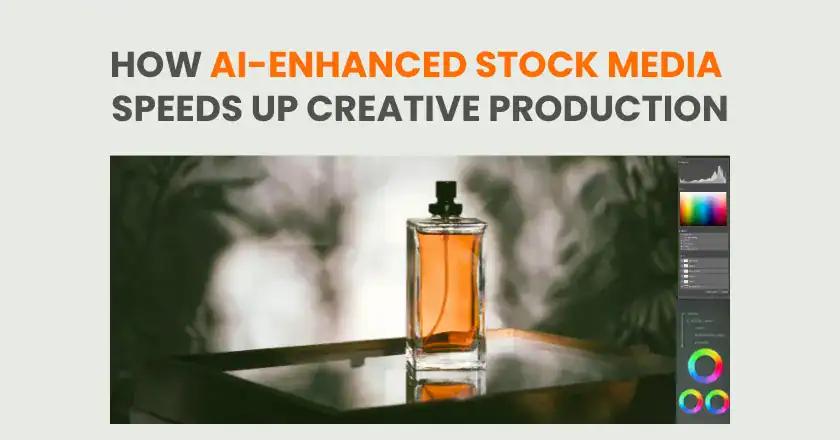
The current era is defined by the realization that a professional stock image is no longer the "final product" but a "high-fidelity foundation." By starting with a photograph that already possesses professional lighting, authentic human emotion, and legal indemnification, creative teams can use AI tools to bridge the remaining distance to their specific campaign needs.
AI-Enhanced Editing as a Force Multiplier
The primary technical driver of this speed is the emergence of AI-assisted editing tools integrated directly into stock libraries. These tools allow designers to perform complex manipulations in seconds that previously required hours of skilled labor.

- Generative Outpainting and Expansion: Designers often find the "perfect" image only to realize it lacks the negative space required for copy or is in a horizontal format when a vertical orientation is needed for mobile social media. AI expansion can analyze the existing pixels and generate a seamless continuation of the background, allowing for instant format adaptation.
- Object Removal and Variation: Modern AI tools allow for the "brushing out" of distracting elements or the replacement of specific objects within a professional frame. This ensures that the core quality of the professional photograph remains intact while the specific details are tailored to the brand’s requirements.
- Style Transfer and Harmonization: AI can now ensure that a stock asset matches a brand’s specific color palette or aesthetic filters automatically, maintaining visual consistency across disparate sources of media.
By automating these "downstream" tasks, the time from asset discovery to campaign deployment is reduced by an estimated 60% to 80%, according to internal data from major stock agencies.
Data-Driven Performance and the Rise of "Performance Creative"
The shift toward AI-enhanced stock media is also being driven by the data-heavy requirements of performance marketing. In digital advertising, the "winning" creative is rarely the result of a single brilliant guess; it is the result of rigorous A/B testing.
Performance teams now require multiple variations of the same concept—different backgrounds, different subjects, or different crops—to see which resonates most with specific demographics. AI-enhanced stock libraries allow for the "mass-customization" of these variants at a negligible cost.

Industry data indicates that campaigns using dynamic creative optimization (DCO), which relies on a high volume of visual variations, see a 20% to 30% increase in conversion rates compared to static, single-asset campaigns. The ability to pull a professional asset from a library and use AI to generate ten different versions for testing provides a competitive advantage that traditional "from scratch" workflows cannot match.
Industry Responses and the Move Toward Legal Safety
As the use of AI in creative production scales, the industry has voiced concerns regarding copyright, ethics, and legal indemnification. Purely generative AI models trained on public web data often carry "legal noise"—uncertainty regarding the ownership of the output.
In response, major industry players like Shutterstock have pioneered a "responsible AI" approach. By training generative models on their own vast libraries of licensed content, these platforms can offer commercial users the same legal protections for AI-modified assets as they do for traditional stock photography.

"The goal is not to replace the artist, but to give the marketer a faster way to deploy professional artistry," noted a senior product strategist at a leading stock agency during a recent industry summit. This sentiment reflects a broader consensus: the market is moving toward "Human-in-the-Loop" systems where the AI handles the mechanical labor and the human professional provides the strategic direction.
Global Scale and the Localization Challenge
For international brands, the production challenge is compounded by the need for cultural relevance. A campaign launched in Tokyo requires different visual cues than one launched in London or Sao Paulo.
The hybrid model of AI and stock media allows global teams to maintain a unified brand voice while localizing imagery. A central creative team can select a "master" stock asset, and regional teams can use AI-assisted tools to adapt elements—such as backgrounds, clothing colors, or localized signage—to fit their specific market. This modular approach eliminates the need for redundant regional photo shoots, saving millions in global marketing budgets.

The Future of the Creative Workforce: From Execution to Direction
The implications for the creative workforce are profound. As AI takes over the "production" aspects of design, the value of the human creative professional is shifting toward "creative direction" and "curation."
- Strategic Judgment: AI can generate a thousand variations, but it cannot determine which one aligns with a brand’s long-term identity or emotional resonance.
- Briefing and Prompting: The ability to communicate complex ideas to AI tools is becoming a core competency for modern designers.
- Quality Control: Human oversight remains essential to ensure that AI-enhanced assets do not contain "hallucinations" or technical errors that could damage brand credibility.
Professional designers are increasingly acting as "editors-in-chief" of visual content, managing a suite of AI tools and stock libraries to maintain a high-velocity output that was previously impossible.
Conclusion: The New Standard of Productivity
The "blank canvas" will always have a place in high-concept art and flagship brand identity projects. However, for the day-to-day requirements of global marketing, the efficiency of AI-enhanced stock media is becoming the new baseline.

By starting with professional source material and using artificial intelligence to handle the friction of adaptation, brands are finding a way to meet the insatiable demand for content without sacrificing quality or legal security. This hybrid model represents a maturation of the creative industry—one where technology does not replace the human spark but provides the infrastructure for it to scale. In an environment where speed is a primary metric of success, the ability to "never start from scratch" is not just a convenience; it is a strategic necessity.