The compelling narrative of Rowan Dear, a renowned underwater photographer, exemplifies a profound journey from a childhood fascination with nature on a Welsh farm to an acclaimed professional capturing the hidden wonders of the marine world. His evolution, marked by a deliberate conquest of personal fears and a relentless pursuit of photographic excellence, offers a fascinating case study in the "From Amateur to Professional" series, showcasing how passion, persistence, and a deep connection to the subject can transform a hobby into a celebrated career.
Born and raised amidst the rolling landscapes of rural Wales, Dear’s early life was steeped in an innate appreciation for the natural environment. His days were often spent exploring fields, observing indigenous British wildlife such as badgers, foxes, hedgehogs, and a diverse array of birdlife. This foundational connection to nature was further nurtured by a steady diet of BBC nature documentaries, particularly those narrated by the legendary David Attenborough. These cinematic windows into distant ecosystems, especially the enigmatic underwater realm, ignited a profound aspiration within the young Dear: to witness and document these extraordinary creatures firsthand.

His initial forays into photography were rudimentary, involving disposable cameras pointed at family pets and fleeting attempts to capture the elusive wild animals inhabiting his farm. At this nascent stage, the notion of becoming a professional wildlife photographer seemed an almost unattainable dream, perceived as a pursuit reserved for individuals with significant financial means and inherent privilege. This early perception highlights a common barrier for many aspiring nature photographers, where the cost of specialized equipment and travel can present a formidable challenge. However, Dear’s journey would ultimately defy this initial apprehension, illustrating a path where dedication can overcome perceived limitations.
A pivotal turning point arrived in 2017 when Dear, confronting a long-standing fear of water, embarked on dive courses in Sydney, Australia. This courageous step not only unlocked a new dimension of personal experience but also laid the groundwork for his future professional trajectory. By 2020, this newfound aquatic proficiency merged with his photographic ambition, leading him to embrace underwater photography. This decisive shift rapidly propelled his career, culminating in multiple competition victories and establishing his reputation as a formidable talent in the specialized field of marine imagery.
The Evolution of a Vision: From Early Attempts to Masterful Captures
Dear’s photographic journey is perhaps best illustrated by comparing his earliest serious underwater image with his current portfolio. His first significant capture, taken with dedicated dive camera equipment (beyond a simple GoPro), depicted a giant cuttlefish at a Sydney dive site. This particular species had long been on his personal wish list, and the excitement of the encounter was palpable. However, the resulting photograph, in his own retrospective analysis, fell short of his mental vision. He describes it as "quite flat, uninteresting, and not very colourful." While initially satisfied enough to share it on social media, he soon recognized its stark contrast to the caliber of work produced by professional and semi-professional underwater photographers. This critical self-assessment marked a crucial developmental stage, highlighting the gap between aspiration and execution, and fueling his drive for improvement.

This early experience underscores a universal truth in photography: the initial excitement of capturing a desired subject often precedes the rigorous self-evaluation required for true artistic growth. Many photographers, especially those venturing into technically demanding fields like underwater imagery, face a steep learning curve involving mastering complex lighting, composition, and equipment in challenging environments. The underwater world, with its inherent light absorption and scattering properties, presents unique hurdles in achieving vibrant, detailed, and dynamic images. Dear’s candid reflection on his early work provides valuable insight into the iterative process of learning and refinement that characterizes any successful artistic endeavor.
Deep Affection for Marine Life: Signature Subjects and Their Stories
Fast forward to today, and Dear’s portfolio showcases a profound mastery, particularly evident in his captures of giant cuttlefish and leafy seadragons – subjects he holds in high regard. The giant cuttlefish (Sepia apama), known for its spectacular color changes and intricate courtship rituals, remains one of his favorite marine animals. He is captivated by their intelligence, vibrant displays, and interactive nature. His goal extends beyond mere documentation; he seeks to convey the emotional impact of these encounters, allowing non-divers to experience the wonder he feels beneath the waves.
One of his favorite images depicts two male giant cuttlefish engaged in a dominance battle for a female. This photograph, rich in color and dynamic behavior, offers multiple layers of visual storytelling. It’s not just an image of an animal; it’s a window into a complex natural drama, showcasing the species’ character and interaction. Such photographs serve a dual purpose: they are artistic achievements and vital tools for public engagement and marine conservation. By presenting these creatures in their natural glory, Dear helps foster a deeper understanding and appreciation for marine biodiversity, implicitly advocating for its protection. The annual aggregation of giant cuttlefish in Whyalla, South Australia, where over 10,000 individuals gather to mate, represents one of the most spectacular natural events globally and is a prime example of the unique phenomena Dear strives to capture. This site, with its shallow depths and shore access, allows for extended dive times, offering unparalleled opportunities to observe and photograph a diverse range of cuttlefish behaviors.

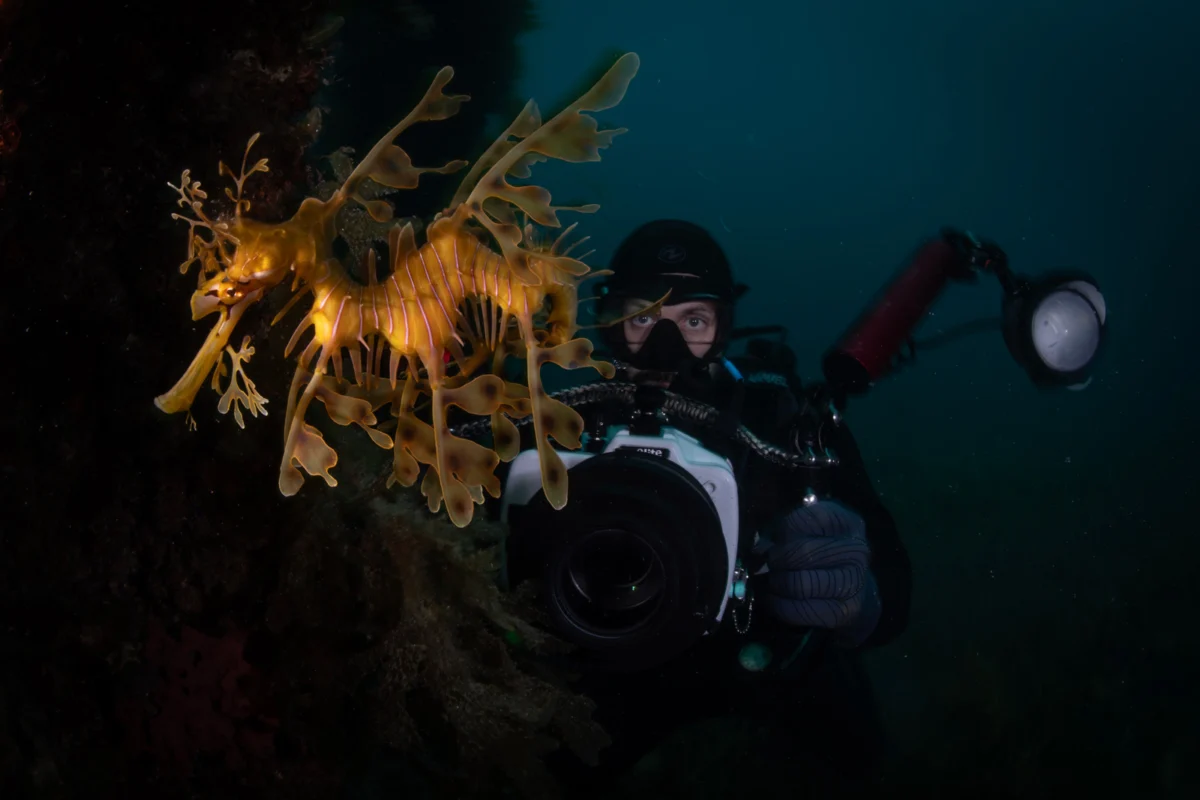
Another cherished image is a portrait of a leafy seadragon (Phycodurus eques). This master of camouflage, endemic to southern Australian waters, is notoriously difficult to spot, let alone photograph. Dear’s photograph, characterized by its striking symmetry and the animal’s perfectly angled head-on gaze, speaks volumes about his patience and technical skill. Achieving this shot involved meticulous planning: diving at night, using a red focus light to minimize disturbance, and waiting for the precise moment the seadragon aligned perfectly with his lens. This dedication highlights the demanding nature of capturing such elusive and delicate subjects, where respect for the animal’s natural behavior is paramount. Leafy seadragons are a protected species under state and federal legislation in Australia, and ethical photography practices are crucial to ensure their well-being.
Revisiting Habitats: Mastering the Craft Through Immersion
Dear’s approach to photography is deeply rooted in understanding his subjects and their environments. He firmly believes that truly capturing an animal’s essence requires extensive knowledge of its species, habitat, and behaviors. This philosophy drives his practice of repeatedly returning to specific, ecologically significant locations.
Whyalla, South Australia, stands out as a critical location for Dear, not only for the giant cuttlefish but also for the opportunity it provides for prolonged underwater immersion. The relatively shallow depth (around 5 meters) and shore access allow for multiple dives daily, extending underwater observation periods. This prolonged engagement enables him to capture the cuttlefish in varying light conditions, from the subtle nuances of early morning light filtering through the water column to the dramatic shifts of midday. Crucially, it allows him to observe the diverse personalities and color transformations of the cuttlefish, providing a comprehensive visual narrative of their world. His technique here involves employing a range of lenses—from wide-angle to fisheye for expansive habitat shots, to macro for intimate portraits of specific features or behaviors—to achieve a full spectrum of photographic perspectives.

Beyond Whyalla, other revisited locations include Byron Bay, where large aggregations of leopard sharks (Stegostoma tigrinum) convene each summer. This site offers dynamic photographic possibilities, allowing for shallow close-ups bathed in sunrays or broader top-down compositions showcasing numerous sharks at different depths. Leopard sharks, typically docile and bottom-dwelling, provide excellent subjects for photographers willing to spend time observing their patterns. Their migratory habits and predictable aggregations make Byron Bay a reliable location for unique shark encounters.
Heron Island, situated on the iconic Great Barrier Reef, is another favored destination. Renowned for its vibrant marine life, it’s particularly exceptional for freediving during the turtle hatching season, which typically runs from February to April. Here, Dear witnesses and photographs the poignant journey of newly hatched turtles making their perilous dash to the sea. The island also boasts year-round residents like lemon sharks (Negaprion brevirostris), countless ray species, and adult sea turtles, offering a continuous bounty of photographic opportunities. Strategic timing around high tide allows for extended periods in the water, maximizing encounters with diverse marine fauna. These repeated visits underscore the dedication required to capture truly impactful wildlife imagery, moving beyond mere snapshots to create a comprehensive visual record.
The Professional Leap: An Organic Ascent
Rowan Dear’s transition to professional photography was less a calculated decision and more an organic evolution fueled by an unyielding passion. He recounts never consciously deciding to "go professional." Instead, his journey was driven by a desire to explore magical underwater experiences, continually refine his craft, and improve his ability to capture these moments. Initially, this improvement was for his personal satisfaction, then for his immediate circle, and eventually for the broader community of animal and ocean enthusiasts. This gradual, passion-driven progression is a common thread among many successful nature photographers, where the intrinsic reward of the work often precedes its commercial viability.

The modern landscape of photography, particularly in niche fields like underwater imaging, often sees a blurred line between amateur enthusiasm and professional practice. The accessibility of high-quality equipment and platforms like social media allows individuals to showcase their work to a global audience, fostering communities and opportunities that were once exclusive. For Dear, his professional path unfolded naturally as his skills matured and his passion translated into compelling visual stories, demonstrating that a career can emerge from a deeply personal pursuit when combined with consistent effort and a growing audience.
Milestones and Motivations: The Impact of Recognition
A significant "eureka moment" in Dear’s career, solidifying his professional trajectory, was the validation received through major competition wins. These accolades provided crucial external affirmation, boosting his confidence and confirming that his work met the high standards of his peers and the broader underwater photography community. In an era where social media metrics like likes and follows can offer a distorted sense of achievement, competitive recognition provides a more objective benchmark of quality and artistry. Winning prestigious awards not only elevates a photographer’s profile but also opens doors to collaborations, commissions, and further opportunities within the competitive field of nature photography.
Wildlife photography, especially at a professional level, demands not only artistic vision and technical prowess but also meticulous planning and strategic execution. Dear emphasizes that success often stems from creating opportunities, which involves extensive research into optimal seasons, specific locations, and prevailing weather conditions. This diligent preparation is paramount to maximize the chances of capturing desired images. For instance, understanding the migratory patterns of whales or the spawning aggregations of fish is crucial for being in the right place at the right time. This blend of artistic intuition and scientific planning is a hallmark of professional wildlife photographers.

Refining the Process: Efficiency and Authenticity in Post-Production
Over time, Dear’s photography process has undergone significant refinement, particularly in his post-production workflow. He now dedicates considerably less time to editing, a testament to his enhanced in-camera skills and deeper understanding of light and composition. His philosophy is straightforward: if an image requires excessive editing, it likely means a better shot could have been achieved in the field. This pragmatic approach underscores the importance of getting it right at the source, minimizing the need for extensive digital manipulation.
Common underwater photography challenges, such as overexposure or excessive backscatter (tiny particles illuminated by strobes), can be difficult to correct convincingly in post-production. Attempts to heavily edit out these imperfections often result in an unnatural or obviously manipulated image. Dear’s style prioritizes natural light and strives for images that appear as authentic as possible, reflecting the scene as he witnessed it. Consequently, most of his editing now takes only a few minutes per image, a stark contrast to the potentially hours-long sessions many photographers might spend. This efficiency not only saves time but also reinforces his commitment to capturing the inherent beauty of the underwater world with minimal intervention.
Navigating the Unpredictable: Challenges of Wildlife Photography
The inherent unpredictability of nature presents the biggest ongoing challenge for wildlife photographers. Despite meticulous planning, success is never guaranteed. Dear recounts frustrating experiences, such as minke whale photography trips hampered by adverse weather and zero sightings. These instances highlight the stark reality that even the most thorough preparation can be undone by environmental factors beyond human control. The behavior of wild animals, the vagaries of weather, and the constantly changing underwater visibility all contribute to an environment where adaptability is key.

For underwater photography, especially wide-angle shots, the ideal conditions—superb visibility and perfect lighting—are often elusive. Photographers must frequently adapt to less-than-ideal circumstances. Dear emphasizes that experience equips a photographer to make the most of challenging situations, still yielding remarkable images despite imperfect conditions. He recalls a recent expedition to Argentina to photograph southern right whales (Eubalaena australis) under a government permit. Despite poor visibility and strong winds, the experience remained magical, and he was confident that the images captured were the best possible given the environmental constraints. This ability to adapt and find beauty even in imperfect conditions is a hallmark of a seasoned professional. The ethical requirement of obtaining government permits for photographing protected species like southern right whales also underscores the responsible practices mandated in professional wildlife photography, ensuring minimal disturbance to vulnerable populations.
Retrospective Wisdom: Advice for Aspiring Photographers
Reflecting on his journey, Dear identifies a past lack of confidence as both a driver for continuous improvement and, at times, a hindrance. While self-doubt can fuel growth, it can also lead to missed opportunities. He admits to having occasionally shied away from work that, in hindsight, he was more than capable of handling. This self-critical perspective, while valuable for honing one’s craft, needs to be balanced with an appreciation for one’s accomplishments. His perfectionist tendencies, which make it difficult to release work he isn’t "1000% happy with," speak to the high standards he sets for himself.
His advice to aspiring photographers is multi-faceted and deeply practical:

- Define your goals: Understand where you aspire to be in your photographic journey, whether it’s artistic expression, conservation, or commercial success.
- Seek inspiration: Follow and learn from those whose work resonates with you, dissecting their techniques and artistic choices.
- Cultivate your style: Develop a unique visual voice that distinguishes your work from others, allowing your personality to shine through.
- Hone your craft: Continuously practice and refine your technical skills, from camera settings to understanding light and composition.
- Embrace continuous improvement: Never become complacent; always strive for betterment, learning from every shot and every experience.
- Be self-critical, but confident: Evaluate your work objectively to identify areas for growth, but also trust your process and abilities, recognizing the value of your unique perspective.
This holistic advice underscores that success in professional photography is a blend of technical skill, artistic vision, persistent effort, and a healthy dose of self-belief. Rowan Dear’s journey serves as an inspiring testament to the fact that with dedication and a genuine love for the subject, the seemingly unattainable dream of becoming a wildlife photographer can indeed become a vibrant reality, enriching both the artist and the world that gets to witness their extraordinary vision. His commitment not only to photography but also to showcasing the beauty and fragility of the marine environment solidifies his position as a significant voice in conservation through visual storytelling.