Each year, as the frigid mists of southwestern Alaska recede from the glacial peaks, revealing rugged coastlines and fertile river valleys, a primal drama unfolds. This is the season of the annual salmon run, an ecological phenomenon of immense proportions that draws some of nature’s most formidable predators: the brown bear. Millions of salmon, driven by an instinct as old as time, surge upstream to their ancestral spawning grounds, initiating a chain of events that is both a testament to nature’s resilience and a stark illustration of survival’s harsh realities. This year’s run, estimated to involve approximately 30 million salmon across various species, promises to be another critical period for the Alaskan ecosystem, particularly for the brown bear population that relies on this bounty to sustain them through the long, lean winter months.
The Calendar of the Run and the Bears’ Appetite
The epic migration of salmon is not a monolithic event but a staggered procession, dictated by species and water temperatures. It begins in late May with the arrival of sockeye salmon, followed by pink salmon, then coho, chum, and finally, the mighty chinook salmon, often referred to as king salmon. This intricate timing ensures a continuous food source for the bears over a period of roughly five months, extending through mid-October. For the brown bears, this period is characterized by a state known as hyperphagia, an intense and insatiable drive to consume vast quantities of calories. During this phase, bears can ingest hundreds of thousands of calories daily, a critical strategy for accumulating the thick layer of fat necessary to survive hibernation. The nutritional density of salmon, rich in protein and essential fatty acids, makes them an unparalleled food source for this crucial fattening period.
A Hierarchy of Feeding Grounds
The salmon-rich rivers and streams of Alaska become a bustling, albeit wild, dining hall, where a distinct social hierarchy governs access to the most coveted feeding spots. Brown bears, particularly the dominant adult males, often referred to as "alpha males," are typically the first to claim prime locations along the riverbanks. These formidable creatures, some weighing up to 1,500 pounds (approximately 680 kilograms), possess the sheer physical power to stand their ground against the strong currents. Their immense size and muscular build allow them to wade into the heart of the rushing water, patiently waiting for salmon to swim within reach. Their feeding strategy is often one of brute force and endurance, capitalizing on their dominance to secure the most abundant catches.
The Nuances of Bear Behavior
Beyond the dominant males, the salmon run also highlights the adaptive strategies of other members of bear society. Younger, more agile bears, including sub-adult males and females, often exhibit a different approach. While they may not possess the same raw power as the alpha males, they employ quickness and cunning. These "subordinate" bears are adept at navigating the terrain, often retreating to the cover of tall grasses and undergrowth to ambush fish or scavenge from the kills of larger bears. Their survival hinges on their ability to avoid direct confrontation with the more aggressive individuals.
The Maternal Imperative: Protection and Provision
Perhaps the most poignant and demanding role during the salmon run is that of the mother bear and her cubs. For a mother bear, this season is a relentless cycle of vigilance and provision. Her primary responsibility is to ensure her cubs, who are still entirely dependent on her for survival, are both fed and protected. Mother bears are known for their exceptional awareness, constantly scanning their surroundings for threats. Bringing young cubs to the river’s edge, a prime feeding ground, presents a particularly perilous situation. While the salmon offer essential nourishment, the same waters attract danger in the form of larger, more aggressive male bears.
The maternal instinct is amplified by the ever-present threat of infanticide, a grim reality in the wild. Male bears, including sometimes even the offspring of the mother bear, have been observed to kill cubs. While the precise evolutionary drivers for this behavior remain a subject of scientific inquiry, theories range from the reduction of competition for scarce resources to sexual selection, or even cubs being viewed as a supplemental food source. Regardless of the underlying reasons, for a mother bear, the imperative to shield her young from such threats is absolute. Her strategies involve a delicate balance of seeking sustenance for her family while maintaining a constant state of defensive readiness. Cubs, especially those just a few months old, are remarkably vulnerable and rely entirely on their mother’s protective prowess.
A Moment of Serene Observation
One particular evening in late August, at the zenith of the salmon run, a seasoned observer found themselves immersed in the tranquil yet potent atmosphere of an Alaskan riverbank. The air was filled with the ambient sounds of the natural world – the distant splashing of salmon, the gentle murmur of the river, and the rustling of leaves. A few large bears were visible upstream, engrossed in their fishing endeavors. It was in this serene setting that an unexpected encounter occurred. A subtle shift in the underbrush, mere feet away, signaled the presence of something significant.
The Emergence of a Mother and Cub
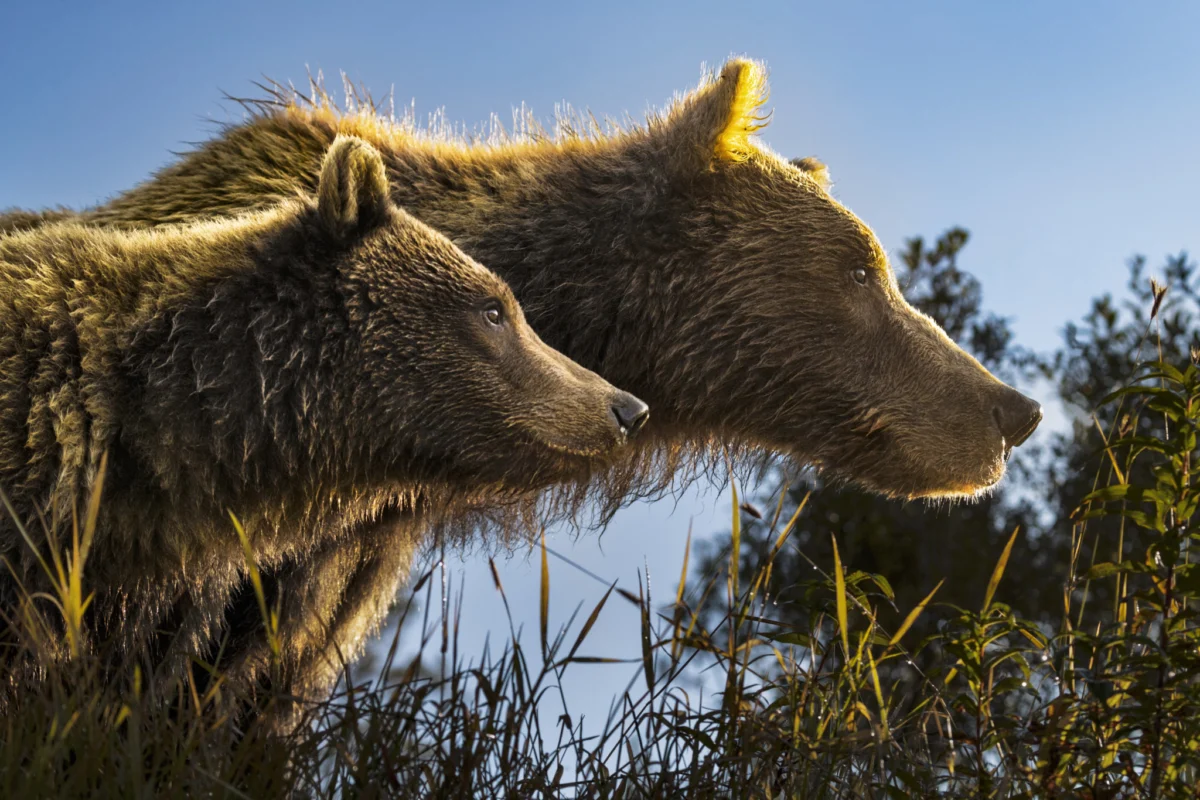
The observer, moving with practiced deliberation, sensed the presence of a mother bear and her cub emerging from the dense foliage. The cub, estimated to be no more than eight months old, was still very much in its formative stages of development. In such close proximity, the observer instinctively adopted a posture of humility and non-aggression, consciously minimizing their perceived threat. The approach involved slowing the breath and avoiding direct, challenging eye contact, a crucial element in de-escalating potential conflict.

A Dance of Awareness and Survival
The mother bear, with ears alert and gaze focused, stepped into the open. Her attention was not on the observer, but rather fixed on a large male bear feeding upstream. This dominant male appeared oblivious to their presence, yet the mother bear remained acutely aware, her senses honed to his movements. Her vigilance served as a powerful lesson in the constant calculus of survival, where understanding the intentions and capabilities of other animals is paramount. The observer, equipped with only a wide-angle lens, recognized the rarity of the moment and the need for an exceptionally gentle approach.
The Art of Wildlife Photography in a High-Stakes Environment
Capturing such intimate moments in the wild demands a profound understanding of animal behavior and an unwavering commitment to ethical practices. The photographer described their actions as akin to practicing Tai Chi – a deliberate, slow, and fluid movement that minimizes disruption. This mindful approach is essential not only for obtaining photographic opportunities but, more importantly, for ensuring the safety of both the photographer and the wildlife. The ability to remain calm and move with deliberate grace in the presence of powerful predators is a skill honed through experience and a deep respect for the natural world.
The Prize of Patience and Respect
With immense care, the camera was raised, the photographer determined not to break the spell of the moment. Two quick captures were made, with no immediate certainty of their success. However, one of these images, the photographer later reflected, became one of the most personally gratifying they had ever taken. This image encapsulated a moment of profound trust, where the animals, sensing no threat, had implicitly accepted the observer’s presence. The bear mother and her cub had acknowledged the observer’s existence but deemed the distant male bear a far greater concern.
The successful capture was a confluence of luck, timing, and a deep respect for the animals’ space. It occurred as the last rays of daylight faded, casting a soft glow over the rugged Alaskan landscape. This encounter underscored the fundamental principle that in the wild, animals dictate the terms of engagement. Their acceptance into a bear’s presence is a privilege, earned through patience, understanding, and a commitment to minimizing human impact.
Broader Implications of the Salmon Run
The annual salmon run is more than just a spectacle of nature; it is a cornerstone of the Alaskan ecosystem. The health of salmon populations directly impacts not only the bears but also a myriad of other species, including eagles, seals, and even marine life that benefit from the nutrient-rich carcasses that wash ashore. Furthermore, the salmon runs are intrinsically linked to the health of the ocean waters, which serve as vital nurseries and feeding grounds for these migratory fish. Conservation efforts aimed at protecting the ocean and its inhabitants are therefore directly beneficial to the terrestrial ecosystems that rely on the salmon’s return.
Data and Scientific Context
Scientific studies have consistently highlighted the critical role of the salmon run in supporting Alaska’s biodiversity. For instance, research conducted by the U.S. Geological Survey has shown that the nutritional input from salmon can significantly influence the growth rates and reproductive success of brown bear populations in coastal areas. The estimated 30 million salmon participating in the annual run represent a significant biomass, translating into millions of pounds of protein and fat available to predators. This abundance is crucial for bears to build up reserves for hibernation, with adult females needing to gain substantial weight to support gestation and lactation.
Economic and Cultural Significance
Beyond its ecological importance, the salmon run holds significant economic and cultural value for Alaska. Commercial fishing, sport fishing, and tourism related to wildlife viewing are substantial industries. Indigenous communities in Alaska have a deep, ancestral connection to salmon, with the fish playing a central role in their traditions, diet, and cultural identity for millennia. The sustainability of these runs is therefore vital for the economic well-being and cultural preservation of the region.
The Future of the Run
While the salmon run has historically been a reliable natural event, climate change poses an evolving threat. Rising ocean temperatures, changes in ocean currents, and altered freshwater flows in spawning streams can impact salmon survival rates and migration patterns. Scientists are actively monitoring these changes, recognizing that the resilience of both the salmon and the predators that depend on them will be tested in the coming years. Ensuring the long-term health of these iconic runs will require continued research, adaptive management strategies, and a global commitment to mitigating climate change. The annual gathering of bears and salmon in Alaska serves as a powerful reminder of the intricate connections within ecosystems and the vital importance of preserving these natural wonders for generations to come.