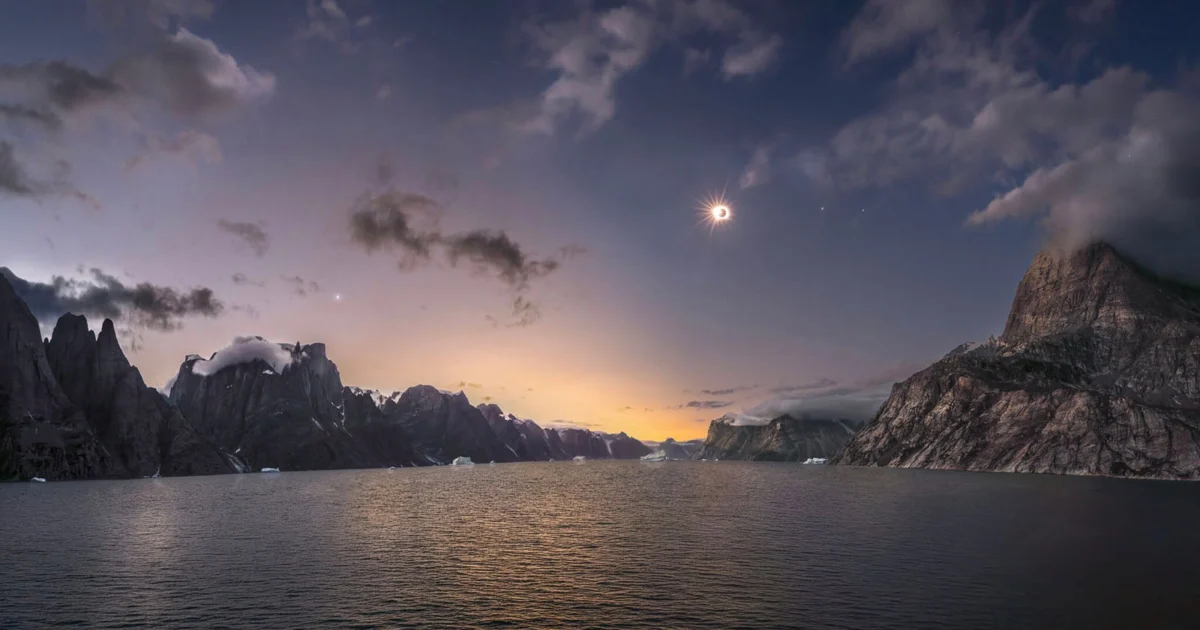
A groundbreaking photographic expedition, led by renowned nature photographers Marc Muench and Wayne Suggs of Muench Workshops, successfully documented a recent total solar eclipse from the remote and majestic Scoresby Sund in East Greenland. The endeavor, a culmination of meticulous planning and logistical fortitude, yielded a series of unprecedented images that integrate the rare celestial event into the dramatic Arctic landscape, challenging conventional approaches to eclipse photography and offering a fresh perspective on one of nature’s most spectacular phenomena.
The Allure of Arctic Eclipses: A Vision Beyond the Corona
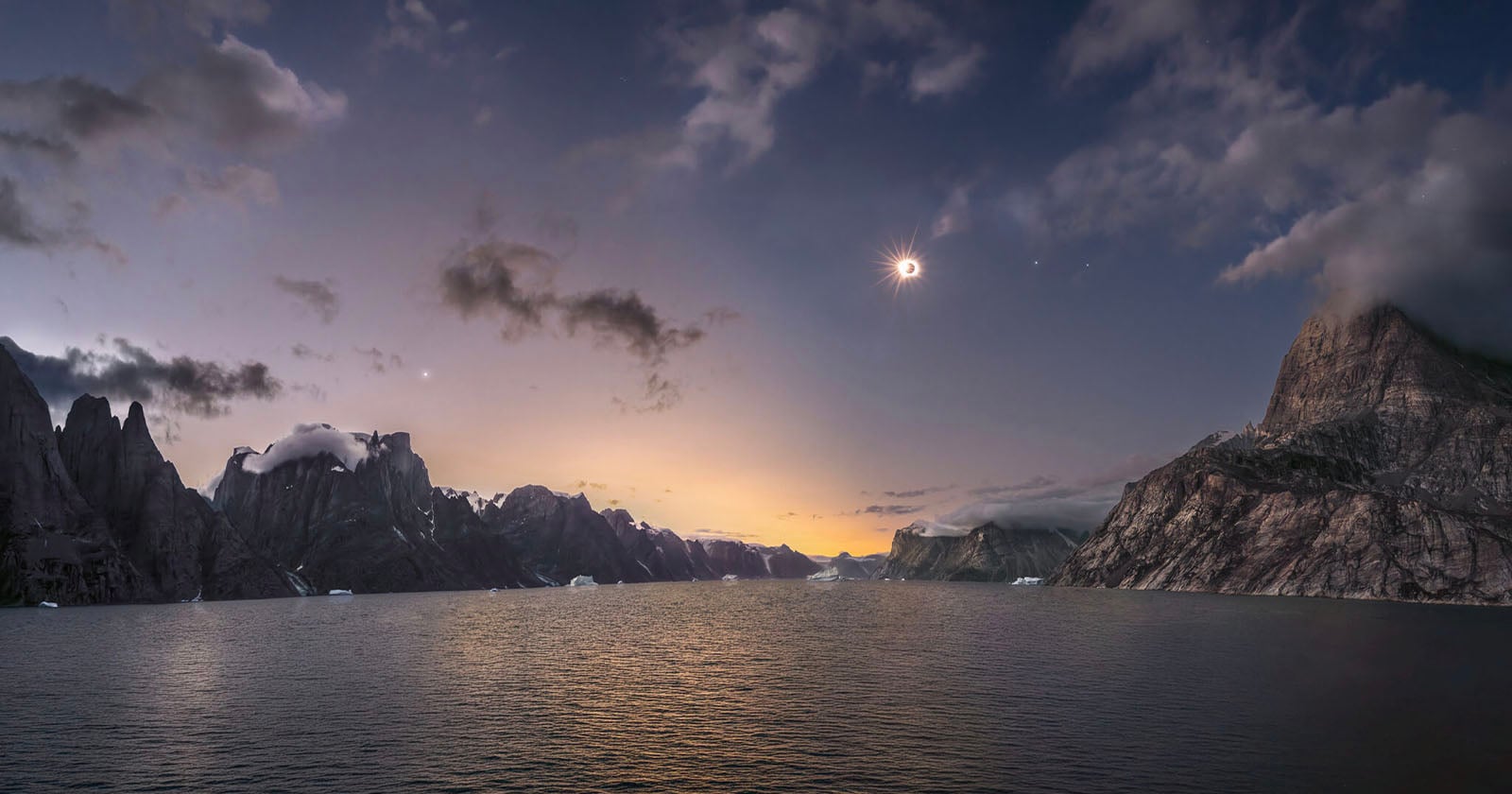
For many years, the primary photographic objective during a total solar eclipse has been the intimate capture of the sun’s corona—the ethereal, wispy outer atmosphere only visible during totality. While technically impressive, Marc Muench observed that such close-up compositions often lack distinctiveness. "Photographically, those types of compositions were never my goal," Muench stated, articulating his desire for a broader narrative. "I knew I could just go to NASA and find a beautiful close-up shot of an eclipse. For me, it was more about the light around the eclipse, and how that affects the wilderness or the landscape wherever you’re standing." This guiding philosophy led him to seek out an "unusual" location where the eclipse could be seamlessly woven into a grander environmental tableau.
Greenland, an island of unparalleled natural grandeur, emerged as the ideal canvas. Having previously led workshops to the region, Muench was intimately familiar with its monumental fjords, towering icebergs, and rugged mountains. The particular August 2026 eclipse offered a unique astronomical alignment: its path of totality traced directly over Scoresby Sund, the world’s largest and deepest fjord system. Crucially, the eclipse would appear at a low angle, approximately 25 degrees above the horizon. This specific elevation was critical for Muench’s vision, as it meant the eclipsed sun would sit just above the mountain peaks, allowing for compositions that positioned the celestial event within the sweeping Arctic vista rather than merely as an overhead occurrence. Wayne Suggs, co-leader of the expedition, recounted the precision of their planning: "Marc knew of this fjord. We looked at the map, and it lined up perfectly, full totality right in the center for over two minutes. We knew we had the perfect spot."
Navigating the Arctic Frontier: A Logistical Masterclass
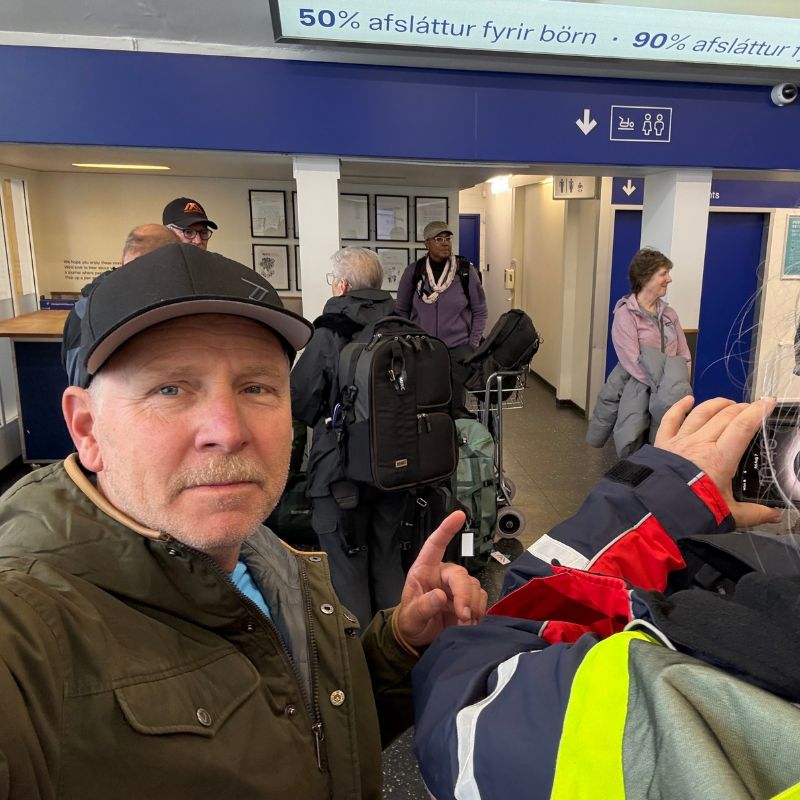
Executing a photographic workshop in Greenland presents inherent challenges, but reaching Scoresby Sund with a group during a precisely timed astronomical event elevated these complexities significantly. Scoresby Sund, a remote outpost, is typically serviced by commercial flights only once or twice a week. These infrequent schedules proved incompatible with the expedition’s tightly orchestrated timeline, which necessitated a specific arrival to meet their chartered expedition vessel. The solution: chartering private aircraft, an undertaking that introduced a new layer of logistical hurdles and financial considerations.
The initial plan for a single, larger chartered plane fell through, forcing Muench to secure two smaller aircraft. This adjustment, while successful, imposed stringent weight restrictions on the passengers and their equipment. "To stay under the plane’s total weight ceiling, every single pound counted, including the photographers themselves," Muench explained, recalling the humorous predicament of accommodating Suggs, a man built "like a wrestler." Each participant was allotted a mere 55 pounds for both camera gear and personal clothing—a formidable constraint for professional photographers accustomed to extensive equipment. To mitigate this, Muench provided a shared laptop for image offloading onto portable hard drives, while the expedition ship, the Polar Front, offered satellite internet (Starlink) and laundry services, ensuring participants could manage their files and personal necessities without compromising on crucial photographic tools. This meticulous attention to detail underscored the expedition’s commitment to overcoming the unique challenges of high-Arctic travel.
Scoresby Sund: A Pristine Stage for a Cosmic Drama
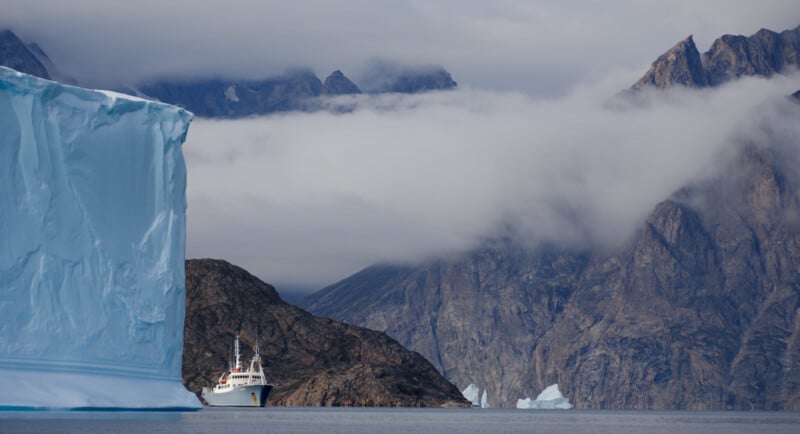
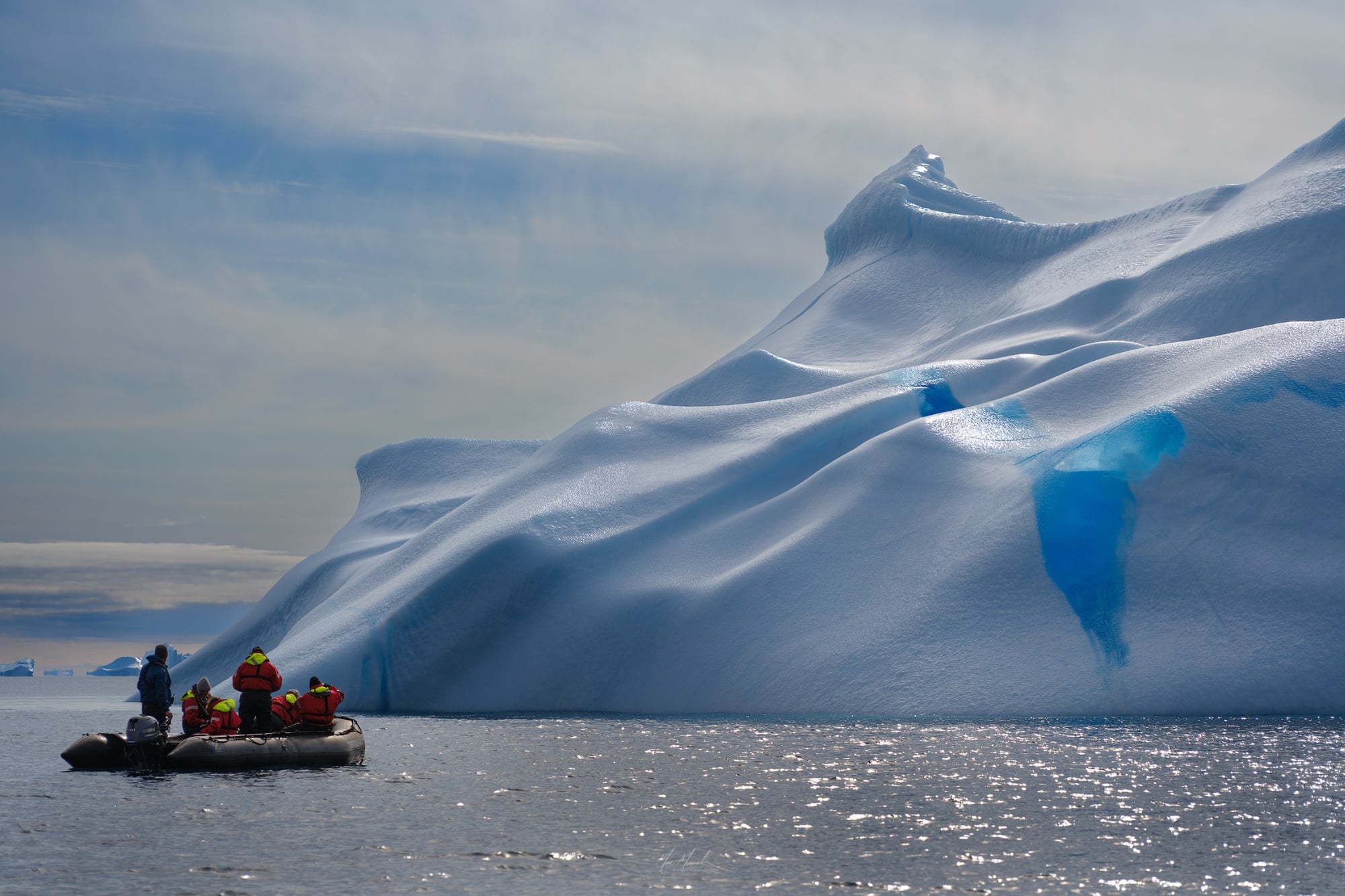
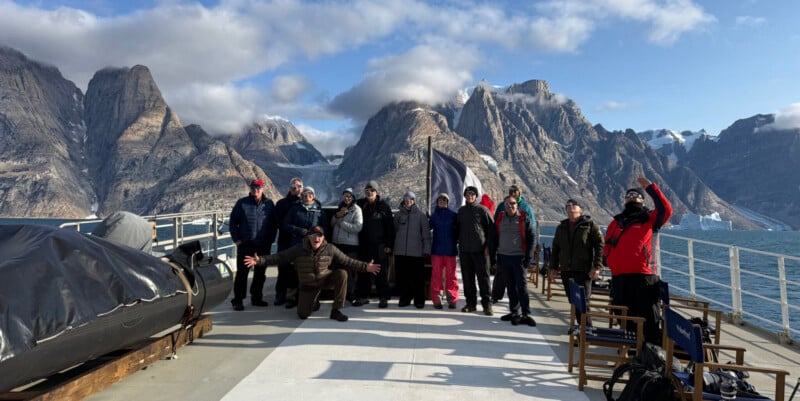
The journey to Scoresby Sund itself served as an integral part of the experience, offering the group several days to acclimate to the Arctic environment and refine their photographic skills amidst breathtaking scenery. The fjord system, characterized by colossal icebergs, calving tidewater glaciers, and mountains soaring thousands of feet directly from the sea, provided an unparalleled natural studio. Participants engaged in zodiac excursions, navigating close to ice sculptures of unimaginable scale and witnessing Arctic wildlife, including muskox, along the shorelines. The expedition also traversed regions recently designated as protected zones to safeguard the resident narwhal population, highlighting the delicate ecological balance of this pristine wilderness.
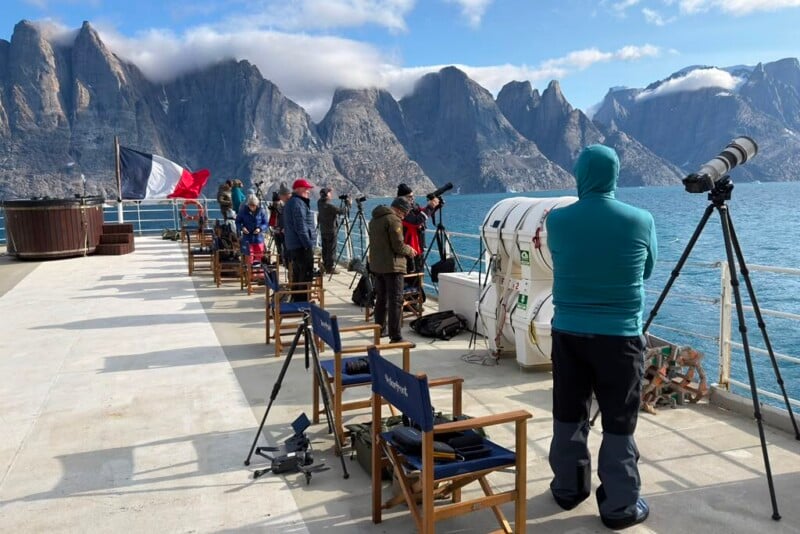
During these pre-eclipse days, Muench and Suggs conducted intensive training sessions, preparing their group for the main event. A critical component of this preparation involved demystifying the proper use of solar filters. While indispensable for viewing and photographing the partial phases of an eclipse, these filters must be removed precisely at the onset of totality. Many first-time eclipse photographers mistakenly leave them on, resulting in severely underexposed or completely black images due to the extreme light reduction. "Everyone thinks you need a solar filter," Marc elucidated. Wayne added, "You’re shooting through a 16 or 18-stop filter and going, ‘It’s black!’ And I’m like, yeah—you’re getting a cookie with a bite out of it. That’s all you’ll see." To prevent such errors, the team conducted multiple practice drills on deck, ensuring every participant was proficient in the rapid removal of filters during the fleeting two minutes of totality.
Strategically, the Polar Front arrived at its chosen viewing location a full 24 hours ahead of the eclipse. This preemptive positioning, as Suggs explained, was to "park on this just in case another ship decides that this is the spot," ensuring an unobstructed view and allowing ample time to monitor the weather patterns.
The Day of Darkness: A Celestial Spectacle Unfolds
On the morning of the eclipse, anxieties ran high as low-lying clouds threatened to obscure the very mountain spires Marc and Wayne had planned to incorporate into their compositions. However, the inherent flexibility of an expedition ship proved invaluable. "That’s the beauty of being on a ship. We just repositioned a little further out in the fjord where there was no cloud, giving us an open sky with nothing obscured," Muench recounted, demonstrating the adaptability crucial for Arctic photography.
While totality itself is brief, the entire eclipse event spans approximately two hours. As the moon began its slow, deliberate transit across the sun, a palpable intensity settled over the ship’s deck. For over an hour, photographers meticulously tracked the changing light, adjusting solar filters, and performing test exposures, building anticipation for the moment the moon’s shadow would finally sweep over their vessel.
"Darkness just—boom!" Wayne Suggs vividly recalled the dramatic onset of totality. "It took about four seconds and everything went from light to dark. It went into twilight, and suddenly you could see Venus to the left, and Jupiter and Mercury to the right of the eclipse." Marc Muench’s memory mirrored this visceral experience, noting how "fast the lights went out, and the beauty of the light around me." The two minutes predicted by astronomical charts seemed to vanish in an instant.
The deep Arctic fjord presented an unexpected challenge: the ambient light during totality was several stops darker than their pre-expedition calculations had anticipated. Adapting instantly, Muench and Suggs began calling out setting adjustments across the deck, instructing the group to bump up their ISOs in real-time. The deck of the Polar Front transformed into a hive of hyper-focused activity, with photographers managing dual-camera setups—some capturing telephoto brackets of the corona, others executing wider handheld panoramas, and a few even deploying drones to capture aerial perspectives of the unfolding cosmic drama.
As the sun began to reappear, signaling the end of totality with the dazzling "diamond ring" effect, the deck erupted in a wave of euphoria. "As soon as the diamond ring came out on the other side, the captain blew the foghorn on the ship, and everybody just erupted," Marc described. "Everyone was cheering, hugging, high-fiving—it was total euphoria." The expedition’s success was further underscored by a narrow escape from adverse weather: "The crazy thing is, 30 minutes after totality ended, the entire sky clouded over completely. If we had been 30 minutes later we would have seen nothing."
Capturing the Unseen: Iconic Imagery Emerges
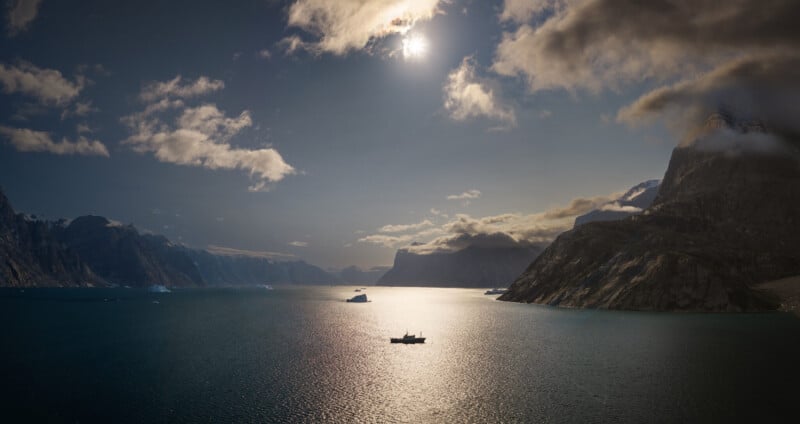
The successful capture of these fleeting moments was a testament not only to the photographers’ skill but also to the remarkable seamanship of the Polar Front’s captain. Operating in a fjord over 500 feet deep, anchoring was impossible. The captain maintained the vessel’s precise position purely by maneuvering the ship sideways against a 16-knot crosswind, timing his adjustments to Muench’s radio instructions, ensuring the entire ship was perfectly aligned the moment totality struck. "It was phenomenal," Wayne praised. "He timed it perfectly."
Amidst the chaos of managing the workshop group and the rapid adjustments, both Muench and Suggs managed to secure defining images of their own. Marc Muench’s centerpiece image, a wide aerial shot, was almost lost to the intensity of the moment. Ten minutes before totality, he launched his drone to hover at 300 feet. Soon, he became engrossed in his on-deck shooting—swapping lenses, firing off close-ups—and nearly forgot the drone. A glance at a participant with a drone controller served as a timely reminder. Instinctively, he captured a single bracketed frame of the ship, the icebergs, and the eclipse. It was only upon reviewing his files back home that he fully comprehended the significance of his shot: a visible line delineating light and shadow, the very edge of the moon’s immense shadow falling across the water. "I looked at it and went, oh, wow—I didn’t expect this," he confessed. "It might even be my favorite shot."
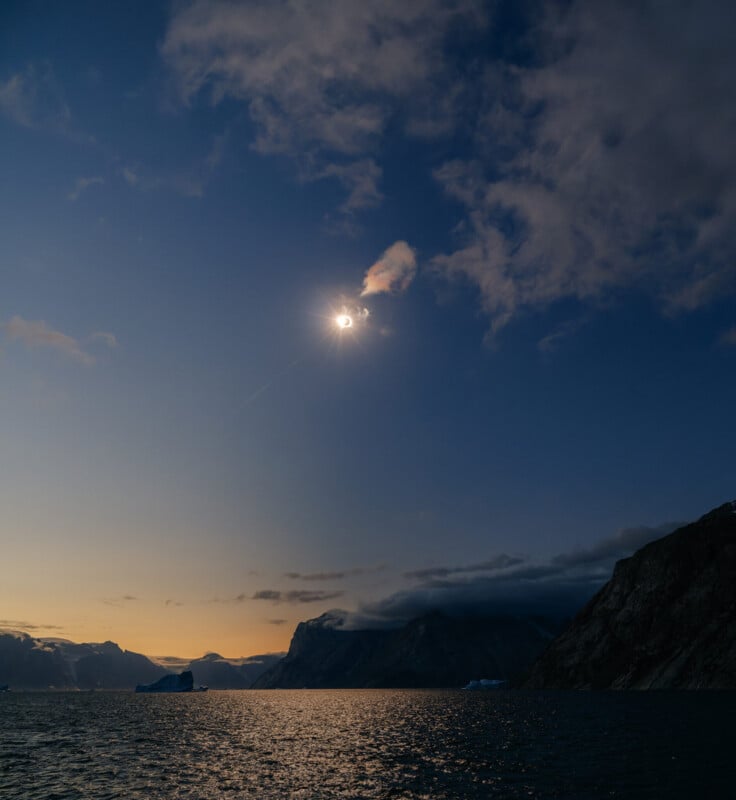
Wayne Suggs’ hero shot was a masterpiece of improvisation. Realizing mid-totality that the eclipse sat higher than he initially composed for, and captivated by the unique light on the water, he decided to attempt something ambitious. Working handheld at a high ISO, while simultaneously answering client questions, Suggs painstakingly pieced together a 12-image, multi-row panorama—sky, mountains, and water captured separately and later stitched. He admitted, "When I got home, I had no idea it would go together. I didn’t think it was possible, to be honest. But it did." His editing process drew parallels to astrophotography, employing noise reduction for high ISO shots and then using distinct masks in Photoshop for the water, mountains, and sky. Crucially, he resisted the common temptation to artificially enlarge the sun in post-processing. "A lot of people overdo the size of the eclipse because they want it to stand out," Suggs explained. "But for Marc and me, the landscape always takes precedence over what’s happening in the sky—no matter how epic it is. We preach that constantly. Everybody on that boat wanted the landscape shot."
Golden Rules for Your Next Eclipse: Lessons from the Arctic Shadow
While few will replicate an Arctic fjord expedition, Muench and Suggs’ insights offer universal guidance for aspiring eclipse photographers:
- Choose the Right Focal Length for Landscape: For integrating the eclipse into a wider scene, Marc Muench advises a 35mm to 50mm lens. "Go wider than 28mm and the eclipse becomes very small," he cautions. A slightly longer wide-angle offers more forgiveness in composition.
- Bracket During Totality: Due to the dramatic and often unpredictable shifts in light during totality, bracketing exposures (shooting multiple frames at different exposures, e.g., two stops under and two stops over) is crucial. "That alone will get you close to the overall feeling of the moment," Muench asserts.
- Stop Down for the Diamond Ring: The dazzling "diamond ring" effect, which occurs just as the sun reappears or disappears, requires specific settings. Marc recommends stopping down to f/13 to f/16 to effectively render the intricate rays of light.
- Don’t Underestimate the Corona’s Size: Many novice photographers fail to account for the true extent of the solar corona. Wayne Suggs emphasizes, "People don’t realise the eclipse is actually much bigger than it looks. When the corona appears, it can be twice the size of the moon or sun itself, sometimes more. You need to leave room for it in the frame."
- Commit to Your Vision: Given the brevity of totality, attempting too many different shots can lead to missed opportunities. Muench advises selecting one primary photographic approach—whether wide landscape or telephoto detail—and committing to it fully. This focused strategy ensures a stronger outcome.
The Afterglow: Celebration and Broader Implications
The expedition concluded with a spirited celebration in the ship’s lounge, where Muench and Suggs presented a six-minute slideshow of the trip’s highlights, including the stunning eclipse images, to the crew and participants. The collective sense of awe and achievement was profound. "We couldn’t believe what we just experienced. We captured it. We were celebrating. It was so memorable," Muench reflected. Suggs added, "I’m the luckiest guy in the world. It was just… it was mind-blowing."
Beyond the immediate triumph of capturing extraordinary images, this expedition carries broader implications. It underscores the evolving landscape of astrophotography, pushing artists to seek not just technical perfection but also environmental context. It highlights the intricate logistics and dedicated expertise required for high-latitude expedition tourism, particularly in fragile environments like the Arctic. The mention of narwhal protection zones subtly integrates the critical theme of conservation, reminding viewers that the breathtaking landscapes photographed are also delicate ecosystems requiring mindful engagement. Such ventures serve to raise global awareness about the unparalleled beauty of the Arctic and the urgent need for its preservation in the face of climate change. The success of this challenging endeavor will undoubtedly inspire future photographic explorations, pushing the boundaries of how humanity observes and documents the wonders of both Earth and sky.