Fujifilm Holdings Corporation has significantly revised its operational cost projections for the current fiscal year, ending March 31, 2027, primarily attributing the changes to a sharp increase in memory prices. While the company’s Imaging business continues to be a formidable profit engine, these updated forecasts, detailed in its latest financial results presentation for the first quarter, signal a potential shift in strategy for Fujifilm and echo concerns across the broader digital camera and electronics industries. The ramifications are expected to extend beyond manufacturers, ultimately impacting consumer prices and product availability.
Fujifilm’s Financial Overview and Revised Projections
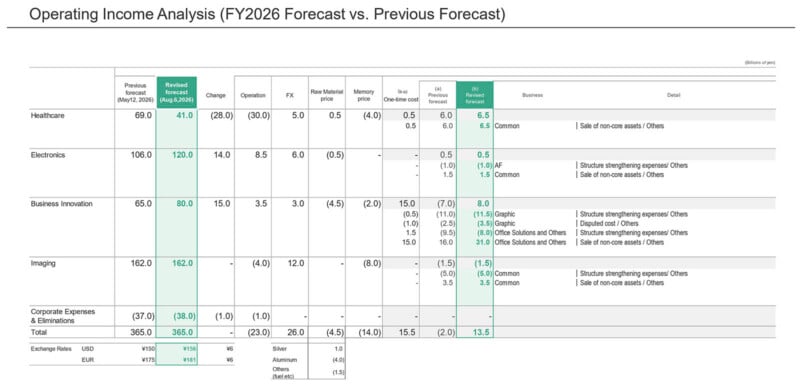
During its first-quarter earnings call, Fujifilm highlighted the pervasive impact of rising raw material costs on its revenue and operating income. A deeper dive into the company’s comprehensive presentation reveals the specific and substantial nature of these revisions. Compared to its initial forecast issued on May 12, 2026, Fujifilm’s cost outlook has undergone a notable adjustment. Despite these upward cost pressures, the company has steadfastly maintained its overall operating income projection for the full fiscal year at 365 billion yen, equivalent to approximately $2.29 billion based on current exchange rates. This unwavering profit target, however, masks a significant re-evaluation of the operational pathways required to achieve it.
The Imaging division, a cornerstone of Fujifilm’s diversified portfolio, is slated to contribute a substantial 162 billion yen to the company’s total operating income, making it the highest contributor among Fujifilm’s four primary business segments. Within this critical division, Fujifilm has adopted a notably cautious stance regarding operational expenditures. The company has escalated its forecasted memory price cost projections by a staggering 14 billion yen (nearly $88 million) for the current fiscal year. A significant portion of this increase, specifically 8 billion yen (just over $50 million), is directly attributable to the Imaging division alone. This substantial financial adjustment underscores the disproportionate impact of memory price inflation on the segment responsible for digital cameras, photographic film, and instant photography products. The revised figures reflect a dynamic and challenging global supply chain environment, forcing companies to re-evaluate their financial models in real-time.
The Global Memory Crisis: A Confluence of Demand and Supply
The surge in memory prices, which has been a topic of extensive discussion across various technology sectors, is now undeniably making its presence felt within the camera industry. For months, the focus of the "memory crisis" has largely centered on its implications for memory cards, solid-state drives (SSDs), and general data storage solutions. However, the underlying drivers of this crisis—principally the insatiable demand from artificial intelligence (AI) data centers—are now creating ripple effects that are reaching the complex internal architectures of digital cameras.
Modern digital cameras, from entry-level compacts to high-end professional mirrorless systems, rely heavily on various types of semiconductor memory. This includes DRAM (Dynamic Random-Access Memory) for buffering images and video, NAND flash memory for internal storage and firmware, and specialized memory embedded within image processors for high-speed data handling. The exponential growth in AI and high-performance computing (HPC) has led to an unprecedented demand for high-bandwidth, high-capacity memory chips. Large language models (LLMs) and other AI applications require massive amounts of data processing, necessitating vast arrays of specialized memory that often share manufacturing lines and components with the memory used in consumer electronics.
The chronology of this crisis can be traced back to late 2024 and early 2025, when analysts first began forecasting a tightening supply and upward price trend for NAND and DRAM. This was exacerbated by a recovery in the broader semiconductor market following a period of oversupply, coupled with strategic production cuts by major memory manufacturers in response to previous market downturns. Geopolitical tensions and lingering supply chain fragilities, remnants of the pandemic era, further complicated the situation, limiting manufacturers’ ability to rapidly scale up production to meet the sudden surge in demand. This created a perfect storm, driving memory prices to levels not seen in several years, profoundly impacting any industry reliant on these crucial components. The competitive bidding for a finite pool of chips has effectively pushed up costs across the board, making it significantly more expensive for camera manufacturers to source the necessary components for their devices.
Fujifilm’s Strategic Response: Pricing Measures and Procurement Diversification
Faced with these escalated production costs, companies typically have two primary avenues: absorb the increased costs, thereby reducing profit margins, or pass some or all of these costs onto the consumer through price adjustments. The latter, while potentially unpopular, is often the more financially sustainable option for maintaining profitability and investment in research and development. This was a strategy widely adopted by many camera companies in the preceding year when grappling with the implications of US tariff policies.
Fujifilm’s financial statements explicitly outline its chosen strategy: "Minimize the impact of rising prices through pricing measures and the procurement of alternative materials and components" in response to "recent increases in semiconductor memory and IT-related component prices." This indicates a two-pronged approach. While actively seeking more affordable memory components and exploring alternative suppliers is a logical and commendable effort to mitigate costs, "pricing measures" offers a more immediate and reliable solution to offsetting increased expenditures.
Evidence of these "pricing measures" has already emerged. Fujifilm Germany, for instance, recently detailed a series of upcoming price increases across its camera lineup. These adjustments range from 5.3% to 11.1%, translating to increases of up to 500 euros on certain models. While the precise percentage and monetary increases may vary by individual market and specific product, it is highly probable that photographers in other regions will face similar price hikes. This proactive stance by Fujifilm suggests a clear intent to protect its robust Imaging division’s profitability, even if it means an increased cost burden for consumers.
It is also pertinent to consider the interplay with previous market adjustments. Last year, US customers experienced price increases on Fujifilm products due to new 15% tariffs imposed by the US government, which were later ruled illegal by the US Supreme Court. While those tariffs are no longer legally enforceable, it is unlikely that the corresponding price increases will be rescinded. Instead, these existing higher price points may now effectively serve to offset the newly incurred increased production costs stemming from the memory shortage, inadvertently providing a buffer against further dramatic price adjustments in that specific market. This complex layering of economic factors highlights the intricate dance between global trade policies, supply chain dynamics, and consumer pricing.
Broader Industry Reactions and Implications for the Camera Market
Fujifilm’s transparent disclosure regarding memory prices offers a unique and granular insight into an industry-wide challenge. While Fujifilm has been the most explicit, other major camera manufacturers have also begun to sound alarm bells, albeit in more generalized terms, in their recent financial reports.
Canon, a dominant player in the imaging sector, recently cited "higher costs resulting from rise in memory prices" in its latest financial results. This acknowledgement underscores the widespread nature of the issue, affecting even companies with massive scale and diversified manufacturing capabilities. Nikon, in its own fiscal update, noted that "higher memory prices" had contributed to its operating profit remaining "flat" despite an increase in sales and the benefit of US tariff refunds. This suggests that even positive revenue growth can be undermined by escalating component costs. Sony, a technology behemoth with a significant presence in image sensors and digital cameras, likewise highlighted the "impact of increase in memory costs" as a factor negatively affecting its Imaging and Displays businesses during the past quarter.
The consensus among these industry leaders is clear: the rising cost of memory is a significant and unavoidable headwind. For photographers, who have already weathered a period of tariff-induced price increases and broader inflationary pressures, this news unfortunately signals yet another round of potential cost escalations. The era of consistently declining or stable camera prices, largely driven by technological advancements and economies of scale, appears to be facing a severe challenge.
Beyond mere price increases, the memory crisis poses a more fundamental threat to the digital camera market: product availability and development timelines. With the supply of high-performance memory chips severely constrained and demand at unprecedented levels from the AI sector, a fierce bidding war is underway. This competitive environment not only drives up prices but also risks diverting critical components away from less-lucrative segments, such as consumer electronics.
It is not inconceivable that some new camera models, particularly those in the entry-level and mid-range segments, could face delays in release or limited availability. These segments are particularly vulnerable to price increases, as their target consumers are highly sensitive to cost. A substantial price hike could render a product uncompetitive or undesirable in the market, forcing manufacturers to either absorb losses or delay launches until more favorable component pricing or supply conditions emerge. High-end professional cameras, while also impacted, might have more pricing flexibility due to their specialized nature and the willingness of professional users to invest in performance. However, even they will not be immune to the underlying cost pressures.
The Path Forward: Uncertainty and Adaptation
The current situation is characterized by many unknowns. The duration and intensity of the global memory shortage remain subjects of ongoing debate among industry analysts. While memory manufacturers are investing in new fabrication plants and technologies, these are long-term solutions that will take years to come online. In the interim, the camera industry, like many others, will have to adapt to a new reality of higher component costs.
Fujifilm’s explicit expectation of spending an additional $50 million to source memory components for its Imaging products this year is a stark indicator of the scale of the challenge. This financial burden, replicated across multiple manufacturers, suggests a period of significant strategic adjustments. Companies will likely explore further optimization of bill-of-materials, greater diversification of suppliers, and continued implementation of "pricing measures."
For consumers, this translates to a need for increased awareness regarding potential price hikes and possibly longer waits for new product releases. The market might see a greater emphasis on software optimizations to make existing hardware more efficient, or a strategic shift towards higher-margin products. The landscape of digital photography, while resilient and innovative, is undeniably entering a period of significant economic flux, driven by forces far beyond the traditional confines of imaging technology. The memory crisis serves as a powerful reminder of the interconnectedness of the global technology ecosystem and the pervasive influence of macro-economic and technological trends on even specialized consumer markets.