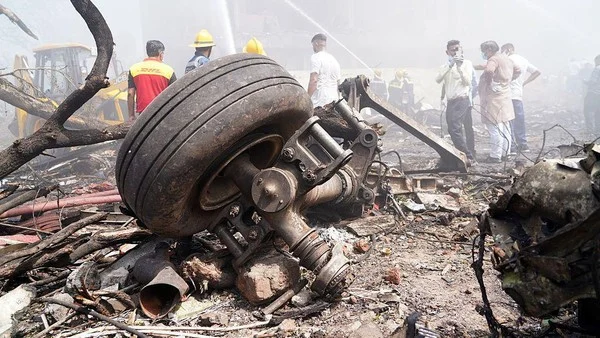
The global aviation community remains in a state of shock following the catastrophic crash of Air India flight AI-171 on June 12, 2025, an event that has claimed the lives of 244 individuals and left a single survivor. The aircraft, a state-of-the-art Boeing 787 Dreamliner, was completing a long-haul journey from London Heathrow to Sardar Vallabhbhai Patel International Airport in Ahmedabad when it went down in the vicinity of the airfield during its final approach. As the wreckage is secured and the initial search and rescue operations transition into a recovery and investigative phase, the focus has shifted entirely to the Flight Data Recorder (FDR) and the Cockpit Voice Recorder (CVR)—collectively known as the black boxes—which have been successfully recovered and transported to a high-security laboratory in New Delhi.
The investigation is being spearheaded by the Aircraft Accident Investigation Bureau (AAIB) of India, with significant technical assistance from the United States National Transportation Safety Board (NTSB) and engineers from Boeing, the aircraft’s manufacturer. This international collaboration is standard procedure for incidents involving American-manufactured aircraft, ensuring that the analysis benefits from the highest level of technical expertise and objective scrutiny. The stakes are exceptionally high, as the Boeing 787 is a cornerstone of modern international fleets, and any systemic failure could necessitate a worldwide grounding of the model.
Chronology of the Final Moments
To understand the gravity of the investigation, one must look at the timeline of Flight AI-171. The aircraft departed London Heathrow on schedule, carrying 230 passengers and 15 crew members. According to preliminary radar data and air traffic control logs, the flight was largely uneventful for the majority of its duration. It was only during the descent into Ahmedabad, approximately 15 minutes before the scheduled landing, that anomalies began to appear.
At 06:42 AM local time, the flight crew acknowledged instructions from Ahmedabad Air Traffic Control (ATC) to descend to 4,000 feet. Meteorological reports from the time indicated clear visibility with moderate crosswinds—conditions that are generally considered routine for experienced pilots. However, minutes later, witnesses on the ground reported seeing the aircraft struggling to maintain a steady glide path. Radar telemetry suggests that the aircraft experienced a sudden and sharp loss of altitude followed by a brief, unsuccessful attempt to climb. Contact was lost at 06:54 AM, and the aircraft impacted the ground shortly thereafter in an open area several kilometers from the runway threshold.
The Critical Role of the Black Boxes
The recovery of both the FDR and CVR is the most significant breakthrough in the investigation thus far. Despite their name, these devices are painted bright international orange to ensure visibility among charred debris. They are designed to withstand extreme impact forces, intense heat, and high deep-sea pressure.
The Flight Data Recorder (FDR) is expected to provide a second-by-second account of the aircraft’s mechanical performance. Modern Dreamliners record thousands of parameters, including airspeed, altitude, vertical acceleration, engine performance, and the exact position of all flight control surfaces. Investigators will be looking for any signs of "asymmetric flap deployment" or "uncommanded inputs" from the flight computer.
Simultaneously, the Cockpit Voice Recorder (CVR) will offer the human context of the tragedy. It captures all sounds in the cockpit, including the conversations between the captain and the first officer, communications with ATC, and any automated cockpit alarms. This will be vital in determining whether the crew was aware of a mechanical failure or if they were dealing with a sudden, localized emergency that left them with no time to issue a distress call.
Technical Scrutiny: The Flap System Hypothesis
Early theories from aviation experts and preliminary observations of the wreckage have pointed toward a potential failure in the aircraft’s flap system. Flaps are movable panels on the trailing edge of the wings that increase lift and drag, allowing an aircraft to fly at the lower speeds required for a safe landing. If the flaps fail to deploy correctly, or if they deploy unevenly (asymmetric flaps), the aircraft can become incredibly difficult to control, potentially leading to a stall or a sudden roll.
In the case of AI-171, if the flaps failed to engage as the pilots slowed the aircraft for landing, the Boeing 787 might have lost the lift necessary to stay airborne at that specific velocity. The investigation team in New Delhi is currently prioritizing the data related to the "Flap Control Unit" and the hydraulic systems that power these surfaces. Boeing has stated that they are providing "full technical support" to the investigators to determine if this was an isolated mechanical failure or a potential design flaw that requires broader attention.

Official Responses and Regulatory Oversight
The Indian Ministry of Civil Aviation has called for a transparent and swift investigation. The Union Minister of Civil Aviation addressed the media, stating, "Our primary objective is to provide the families of the victims with the truth. We are leaving no stone unturned, and the involvement of the NTSB and Boeing ensures that this investigation meets the highest global standards of rigor."
Air India, which was recently privatized and acquired by the Tata Group, has also faced intense scrutiny. The airline has undergone a massive modernization program over the last few years, including rigorous pilot training and fleet upgrades. A spokesperson for the airline emphasized that the aircraft involved in the crash was relatively new and had passed all scheduled maintenance checks, including a comprehensive "A-Check" just weeks prior to the accident.
In the United States, the Federal Aviation Administration (FAA) is monitoring the situation closely. While no immediate grounding order has been issued for the Boeing 787 fleet, the agency has noted that it will take "appropriate action" based on the preliminary findings of the black box analysis.
Broader Impact on Global Aviation Safety
The crash of AI-171 has sent ripples through the global aviation industry, particularly regarding the reliability of composite-heavy aircraft like the Dreamliner. The 787 was a revolutionary design, utilizing carbon-fiber-reinforced polymers to reduce weight and increase fuel efficiency. While the aircraft has had a strong safety record since its introduction, this tragedy raises questions that only the investigation can answer.
Airlines worldwide that operate the 787, including United Airlines, All Nippon Airways (ANA), and British Airways, are reportedly reviewing their own maintenance logs for flap-related issues as a precautionary measure. The outcome of the New Delhi analysis could lead to a global "Airworthiness Directive" (AD), requiring mandatory inspections or software updates for hundreds of aircraft currently in service.
Furthermore, the human element of this tragedy cannot be overlooked. The lone survivor, currently in critical but stable condition at a specialized trauma center in Ahmedabad, may eventually provide a firsthand account of the cabin environment during the final moments. For the families of the 244 deceased, the investigation represents the only path toward closure.
The Investigative Process Ahead
The analysis of the black boxes is not a process that happens overnight. The data must be carefully extracted, decoded, and then synchronized with radar data and weather reports to create a comprehensive "flight recreation."
- Extraction: The memory modules are removed from their protective casings. If there is heat damage, the chips must be cleaned and repaired using specialized microscopic techniques.
- Decoding: The raw binary data is converted into human-readable engineering units (e.g., knots, feet, degrees of pitch).
- Synchronization: The CVR audio is overlaid onto the FDR data to match pilot actions with aircraft reactions.
- Validation: The findings are checked against physical evidence from the crash site, such as the position of the engines and the condition of the wing components.
A preliminary report is expected to be released within 30 days, as per International Civil Aviation Organization (ICAO) Annex 13 standards. However, a final, comprehensive report detailing the "probable cause" and safety recommendations could take a year or longer to complete.
As the world waits for these answers, the tragedy of Air India AI-171 serves as a somber reminder of the complexities of modern flight. While aviation remains the safest mode of transport, the margin for error at 30,000 feet—or during the final approach—remains razor-thin. The tiny orange boxes currently under a microscope in New Delhi hold the key to ensuring that the lessons learned from this disaster prevent another one from ever occurring.