By Michiel van Mens
The pursuit of what constitutes a "good" street photograph has long been a subject of fascination and rigorous investigation. For many practitioners and observers, the question of discerning excellence in this dynamic genre remains a persistent enigma. My own extensive research into this very topic has yielded compelling insights, with one of the most significant conclusions being the crucial role of visual contrast. However, as is often the case with artistic endeavors, the reality proves to be more nuanced. While visual contrast can serve as a powerful catalyst for photographic impact, numerous street photographs devoid of obvious visual discord are nevertheless profoundly appreciated by audiences, suggesting that other, less tangible elements contribute to their success. This article delves into the multifaceted nature of impactful street photography, exploring the interplay of visual contrast and a more subtle, yet equally potent, force: suggestion.
The Foundational Role of Visual Contrast in Photography
Visual contrast, in its myriad forms, acts as a fundamental principle in photography, drawing the viewer’s eye and creating visual interest. My previous research, detailed in "The Photographic Signature of the Street Photographer," identified several key manifestations of this principle. These include thematic contrasts, such as the juxtaposition of social classes or opposing ideologies; chromatic contrasts, achieved through the interplay of color palettes; temporal contrasts, highlighting differences in time or historical periods; kinetic contrasts, emphasizing action versus stillness; and the often striking contrast between the mundane and the extraordinary.
A significant empirical study further illuminated the importance of visual contrast. An analysis of visitor responses to the "American Photography" exhibition held at the Rijksmuseum in Amsterdam in 2025 revealed a striking correlation between visual contrast and memorability. Of the ten most frequently recalled photographs from the exhibition, a remarkable eight featured a clear and discernible visual contrast. This observation led to the cautious, yet statistically supported, conclusion that visual contrast is not merely a stylistic choice but a significant criterion by which photographs are judged as "good" or impactful, as further explored in my subsequent article, "The ‘Good’ Photographs of American Photography."
Distinguishing Photographic Genres: Purpose and Perception
While visual contrast can be a valuable tool across various photographic genres, including journalistic news photography, documentary photography, and street photography, the criteria for evaluating success differ significantly due to their distinct purposes. Understanding these differences is crucial to appreciating the unique demands and artistic intentions of each genre.
Journalistic News Photography: The primary objective of news photography is to convey information factually and immediately. These images are intended to clarify the news story, ensuring the viewer grasps the essence of the event at a glance. Often accompanying written articles, iconic news photographs can transcend their original context to become powerful symbols of pivotal historical moments. Examples such as Robert Capa’s "The Falling Soldier" from the Spanish Civil War or Eddie Adams’ "Saigon Execution" from the Vietnam War exemplify this, serving as potent visual metaphors for significant events. In this genre, aesthetic considerations like beauty or ugliness are secondary to the photograph’s ability to accurately and effectively represent reality.
Documentary Photography: Documentary photography operates on a different paradigm, typically presented in series. The photographer’s commitment lies in crafting a narrative that unfolds across multiple images. The meaning of an individual photograph is intrinsically linked to the context provided by its companions within the series. Consequently, the overall impact and success of the documentary project are evaluated, rather than the individual merit of each photograph in isolation. The aesthetic qualities of a single image are thus less critical than its contribution to the overarching story.
Street Photography: Street photography, by contrast, generally functions as a self-contained art form. While images may be presented in series, each individual street photograph is expected to possess sufficient inherent qualities to generate meaning for the viewer without external support. The goal is to imbue everyday urban life with a distinctive artistic vision. Lacking the explanatory framework of a news article or the narrative cohesion of a documentary series, a compelling street photograph must stand on its own, offering a complete, albeit often suggestive, experience.
The Power of Unanswered Questions: Suggestion as a Driving Force
While visual contrast has proven to be a significant factor in photographic memorability, certain exceptions in my research highlight the importance of another critical element: suggestion. Two photographs from the "American Photography" exhibition analysis, "Paul" by Bryan Schutmaat from the series "Grays the Mountain Sends," and "Homegirls" by Amanda Lopez, despite lacking overt visual contrast, left a profound impression on visitors.
What these images share is a common thread of ambiguity. They do not offer definitive answers; instead, they skillfully pose questions, inviting the viewer to actively participate in constructing meaning. It is as if the photographer has initiated a narrative, pausing at a crucial juncture to prompt the viewer to complete the story. This power of suggestion is not a new phenomenon but has been recognized as a cornerstone of compelling visual storytelling.
The French philosopher Gilles A. Tiberghien eloquently articulated this concept in his text for an exhibition of anonymous photographs: "Each image could be the beginning of a story, a poem, a film, the starting point of a series of other images which, by crossing and re-crossing one another, would form a gigantic interchange of dreams and fictions." This perspective underscores how a single image can act as a springboard for imagination, a gateway to a universe of potential narratives and interpretations.
In the realm of cinema, this principle is embodied in the technique of suspense. Alfred Hitchcock, a master of the craft, demonstrated this in "Psycho," where the audience experiences terror not through explicit depiction of violence but through suggestive cues: the glint of a knife, a shower curtain, darkening water. The viewer’s imagination fills in the horrific details, proving more potent than a literal portrayal. Similarly, Stanley Kubrick’s "The Shining" utilizes suggestion when Jack Torrance breaches the bathroom door with an axe; the power lies in the implied action, not its graphic depiction.
Street photography can harness this same power. Even without strong visual contrast, a photograph can captivate if it triggers the viewer’s imagination, prompting them to engage with the scene on a deeper, more personal level. Photographer Robert Doisneau captured this essence, stating, "The photographs that interest me, that I consider successful, are those that do not close the story, that do not tell it completely, but remain open—photographs that form a stepping stone toward a dream."
Fred Herzog’s "Man with Bandage": A Masterclass in Suggestion
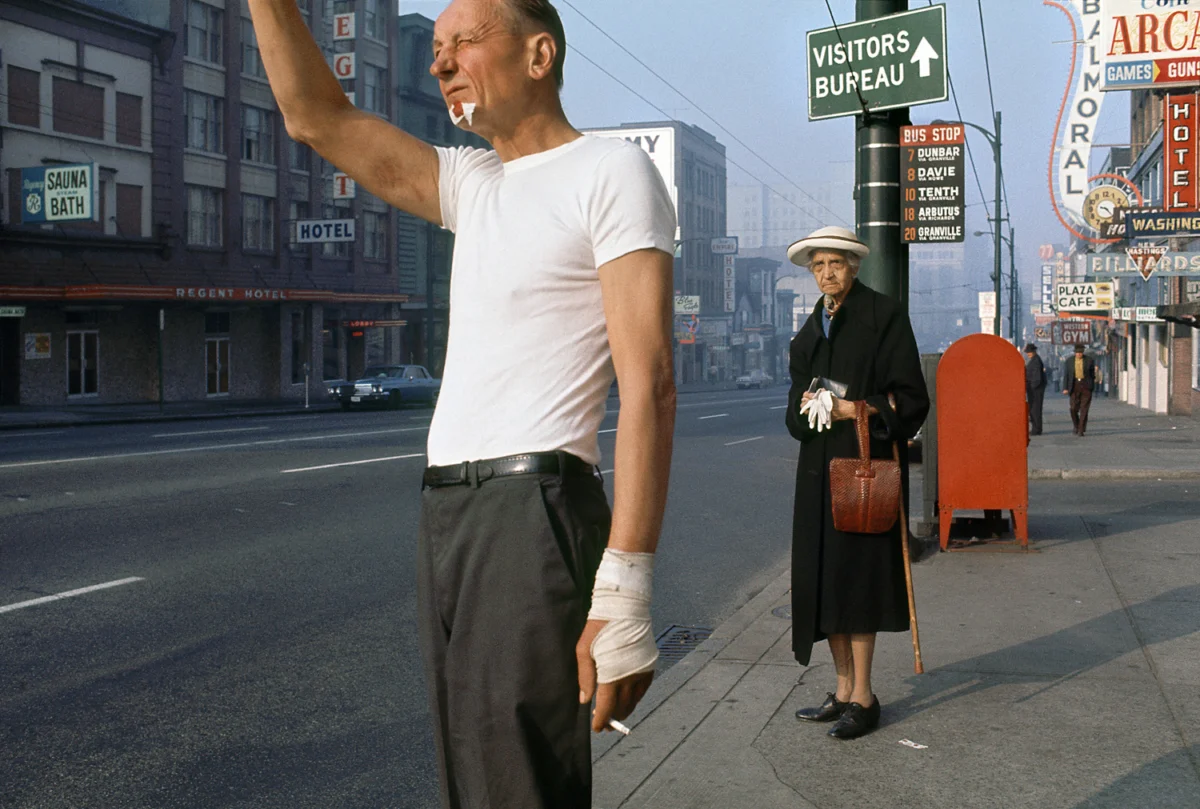
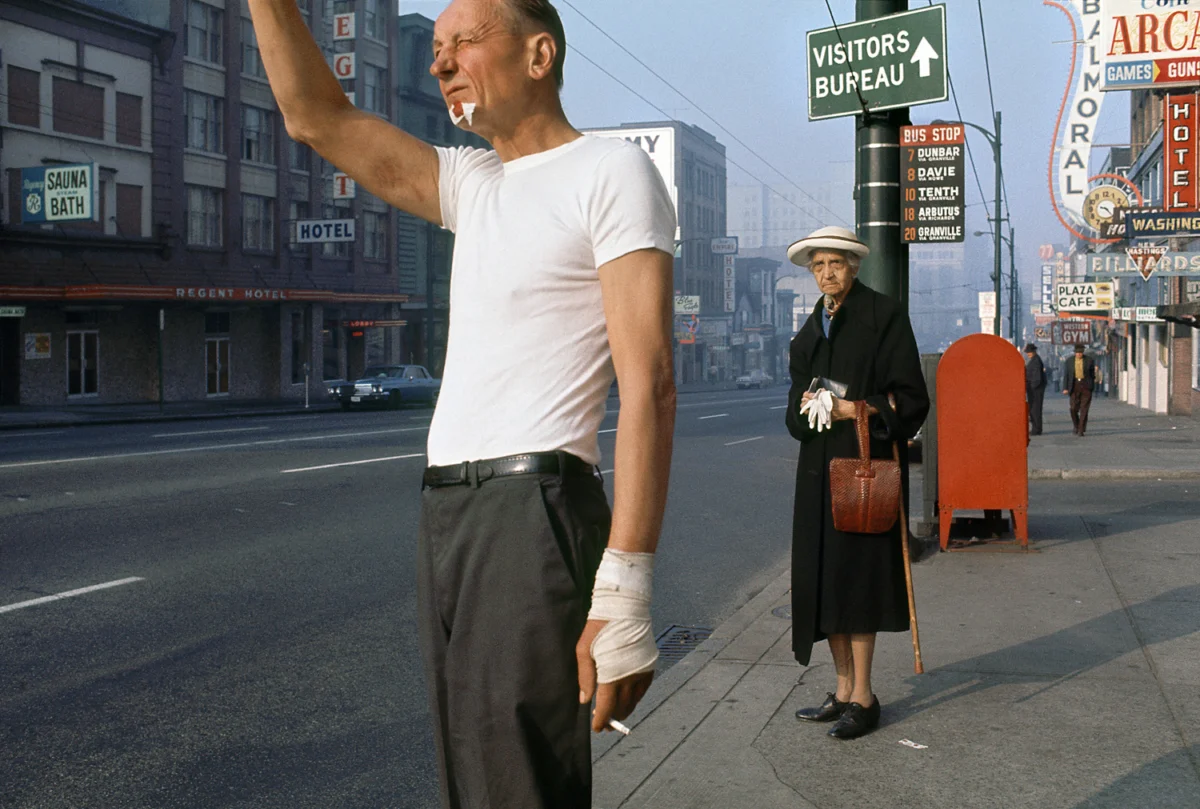
A prime example of a photograph that excels through suggestion, despite a lack of overt visual contrast, is Fred Herzog’s iconic "Man with Bandage." This image masterfully poses a series of unanswered questions, compelling the viewer to construct their own narrative. The photograph invites contemplation: What is the woman in the background observing? What is the man’s activity? Why the bandage on his chin? Is this a Sunday morning scene? The "Visitors Bureau" sign further adds to the enigma, offering no clear direction or explanation.
Instead of providing answers, "Man with Bandage" grants the viewer the freedom to explore their own interpretations. It is an invitation to look closely, to ponder possibilities, and to engage in a personal dialogue with the image. The ambiguity inherent in the scene allows for a deeply immersive and individual viewing experience, demonstrating that compelling street photography can transcend the need for explicit visual cues.
Fred Herzog, Man with Bandage 1968, Courtesy The Estate of Fred Herzog and Equinox Gallery, Vancouver, © The Estate of Fred Herzog, 2026
Another of Herzog’s works, "Elysium Cleaners" (1958), also exemplifies this subtle power. While the composition may not rely on dramatic contrasts, the juxtaposition of elements and the implied narrative of daily life create an intriguing visual texture that encourages prolonged engagement and personal reflection.

Fred Herzog, Elysium Cleaners 1958 Courtesy The Estate of Fred Herzog and Equinox Gallery, Vancouver © The Estate of Fred Herzog, 2026
From Theory to Practice: Cultivating Suggestion in Street Photography
The principles of visual contrast and suggestion are not merely theoretical constructs; they offer practical guidance for street photographers seeking to elevate their craft. By understanding and actively employing these elements, photographers can move beyond serendipitous captures to intentionally create more impactful and resonant images.
My research has identified eight recurring forms of suggestion that can be deliberately integrated into street photography:
-
Omission: The deliberate act of not showing everything is a foundational technique. Similar to Steven Spielberg’s use of the unseen shark in "Jaws" to evoke terror, street photographers can imply narratives by leaving certain elements out of the frame. This selective focus compels the viewer’s imagination to fill the void.
-
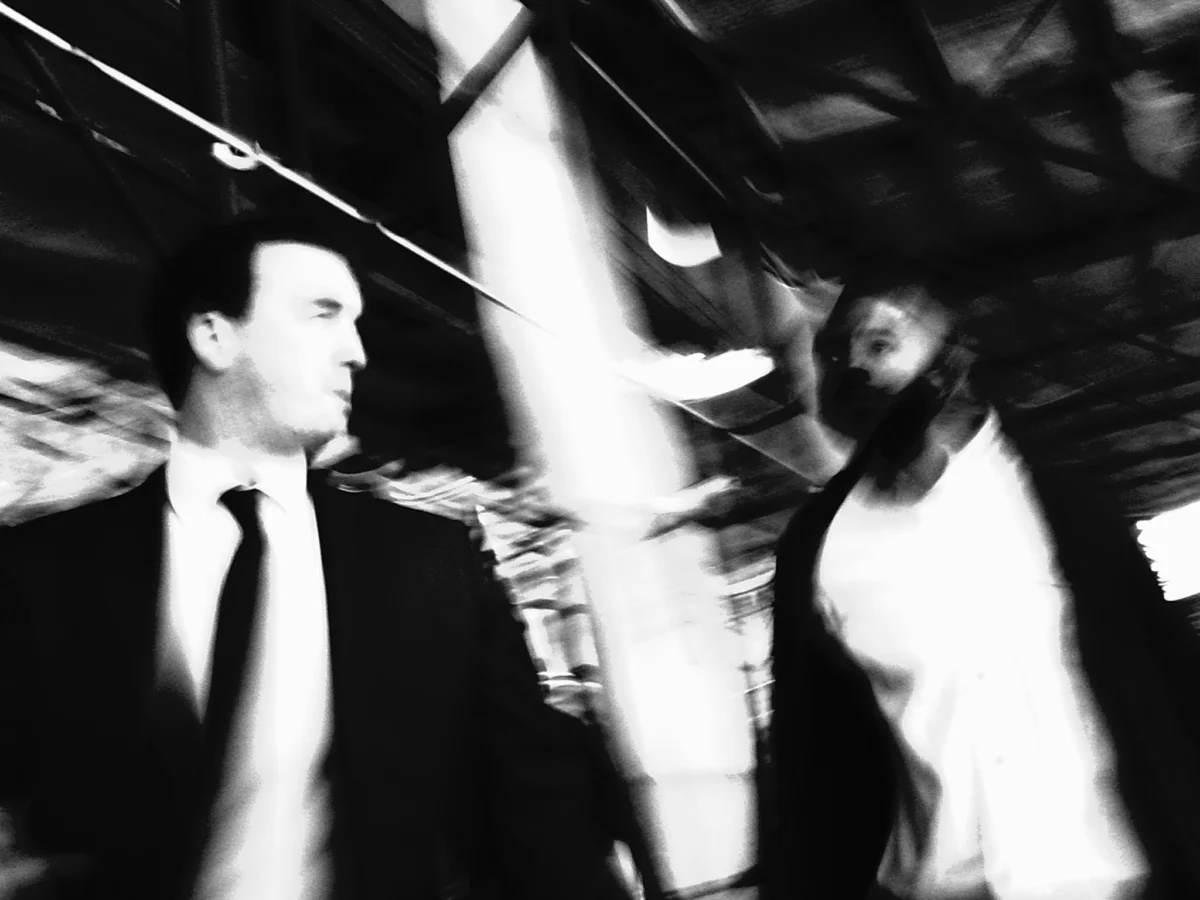
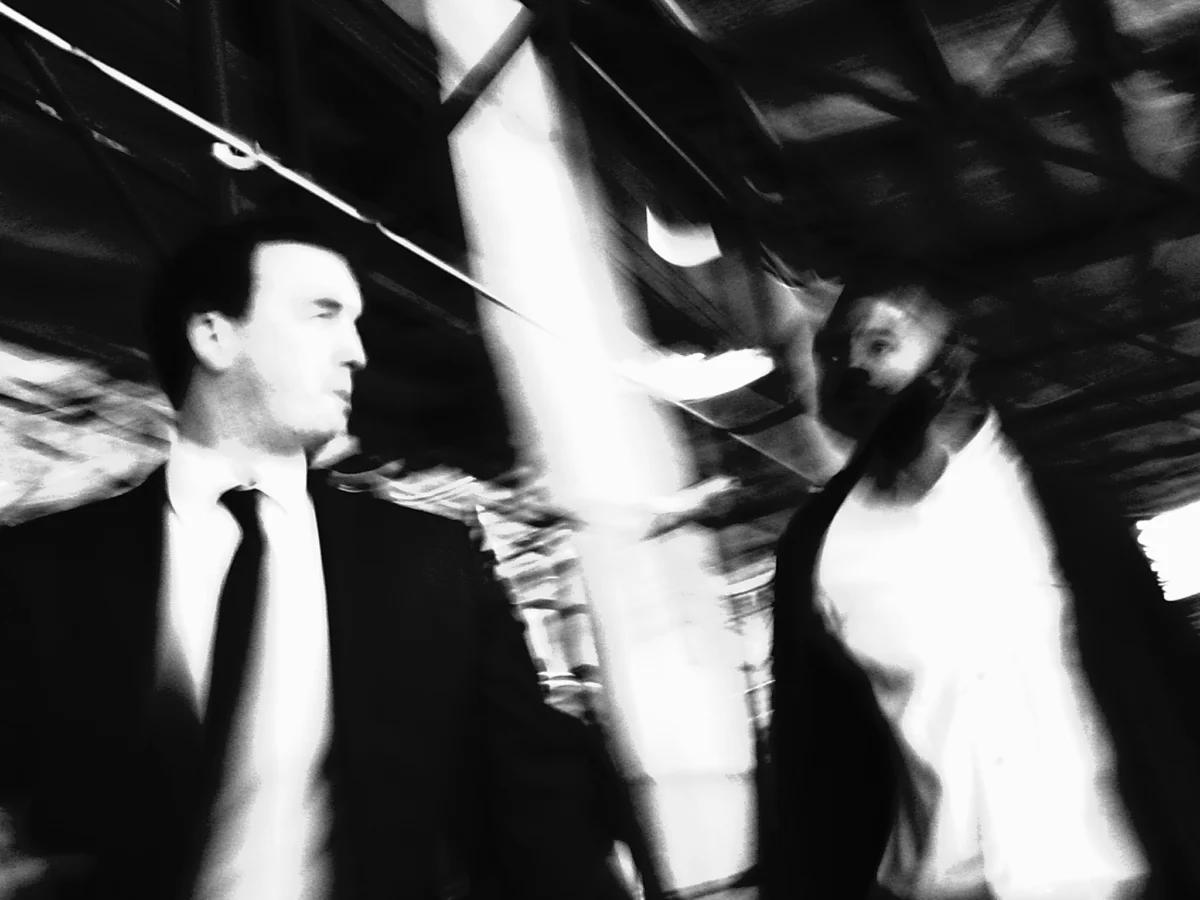
Blur: The strategic use of blur, whether through out-of-focus backgrounds or motion blur, can conceal information and add an element of mystery. It can suggest movement, transience, or a fleeting moment that defies clear articulation.
-
Juxtaposition of Spaces (Inside and Outside): Photographs that capture both interior and exterior scenes simultaneously, often through windows or storefronts, create a sense of layered reality. This technique can hint at hidden narratives or contrasting environments existing in close proximity.
-
Anomalous Elements: The inclusion of an element that appears out of place or incongruous within a scene can immediately raise questions and pique the viewer’s curiosity. This unexpected detail disrupts the ordinary and invites deeper scrutiny.
-
Distance: Depicting an event or subject from a distance, where details are not entirely clear, can imbue the image with mystery and intrigue. The spatial separation creates a sense of detachment, allowing the viewer to speculate about the unfolding situation.
-
Disproportionate Scale: The interplay of large and small elements within a single frame can generate visual tension and create a sense of unease or wonder. These contrasting proportions can subtly alter the viewer’s perception of the scene.
-
Estrangement or Surrealism: When reality appears slightly illogical or dreamlike, it can engage the viewer on a subconscious level. This subtle departure from the ordinary can evoke a sense of the uncanny or the surreal.
-
Facial Expressions: The nuanced use of facial expressions can be a powerful tool for suggestion. A particular look can convey a wealth of unspoken emotion or hint at an internal narrative that the viewer is invited to decipher.
Conclusion: The Art of Intentional Storytelling
The creation of a "good" street photograph is not a matter of chance but a deliberate artistic pursuit. By understanding the principles that contribute to photographic impact, photographers can actively cultivate their ability to capture compelling images. Visual contrast serves as a potent tool for drawing attention and creating immediate visual interest. However, the equally vital principle of suggestion, the art of raising questions rather than providing answers, can imbue a photograph with lasting resonance and encourage deeper viewer engagement.
When these two powerful elements—visual contrast and suggestion—are skillfully combined, the potential for creating an iconic street photograph is significantly amplified. The street photographer, in essence, becomes a "dramatist," capable of orchestrating visual narratives that captivate and linger in the viewer’s mind. This approach, exemplified by the staged yet profoundly evocative work of photographers like Gregory Crewdson in his series "Eveningside," demonstrates that the street can be transformed into a stage for intentional storytelling, where every frame offers a doorway to imagination.
About The Author: Michiel van Mens’s photographic journey began during his military service, where he trained as a photographer and corporate journalist. This formative period provided invaluable experience, including collaborations with professional photographers, extensive travel across Europe, the creation of photo essays, and hands-on darkroom work. Post-service, his passion for photography led him on significant photographic expeditions to Poland, the Baltic States, and Ukraine, including immersive explorations of Crimea and Odessa, and the historically resonant KGB prison in Vilnius. Inspired by the work of Ed van der Elsken, van Mens embarked on a long-term project in 1993, documenting Amsterdam Oud-West, which culminated in multiple exhibitions. His academic pursuits included attendance at the Photo Academy in Amsterdam.
Van Mens has been a dedicated researcher in the field of street photography. His earlier article, "The Photographic Signature of the Street Photographer in Six Stylistic Characteristics," served as a condensed preview of his forthcoming book, slated for release in the fall of 2025. This book is the product of his in-depth research into the distinctive visual styles of renowned street photographers.
A central finding of his research is the identification of six common stylistic traits that collectively define a photographer’s signature in street photography. This concept was further explored in "The Photographic Signature of the Street Photographer," and his subsequent article, "The ‘Good’ Photographs of American Photography," builds upon this foundation, revealing that one of these identified traits is also a key element in photographs that tend to be most memorable to audiences.
With Thanks & Gratitude To Michiel Van Mens. To see and learn More, visit his Street Photography portfolio and follow him on Instagram.
Images Courtesy of The Estate of Fred Herzog at Equinox Gallery.