The path from an aspiring enthusiast to an accomplished professional in nature photography is often paved with dedication, perseverance, and a profound connection to the natural world. This is precisely the journey of Rowan Dear, an acclaimed underwater photographer whose captivating work now graces global platforms. From a childhood immersed in the pastoral landscapes of a Welsh farm to conquering a deep-seated fear of water, Dear’s trajectory into the professional realm of marine photography offers a compelling narrative of passion transforming into purpose. His evolution, marked by technical mastery and an unwavering commitment to showcasing the ocean’s hidden wonders, exemplifies the spirit of the "From Amateur to Professional" series, chronicling how practice, vision, and technique coalesce over time.
Dear’s story begins far from the ocean’s depths, rooted in the rolling hills and vibrant ecosystems of a Welsh farm. Here, his formative years were spent in intimate communion with nature. He describes days "running around the fields and finding all the amazing creatures we have in the UK, like badgers, foxes, hedgehogs, and all the beautiful birdlife." This early exposure cultivated a deep-seated appreciation for wildlife, an intrinsic curiosity that would later define his career. Like countless others of his generation, the mesmerizing narratives of Sir David Attenborough’s BBC nature documentaries fueled his imagination, igniting a fervent desire to witness the spectacular animals depicted, particularly those inhabiting the elusive underwater world.

His initial forays into photography were humble, involving disposable cameras pointed at family pets – dogs and cats – and unsuccessful attempts to capture the more elusive wild inhabitants of the Welsh countryside. At this juncture, the dream of becoming a wildlife photographer seemed distant, an aspiration reserved for those with "money and privilege," a sentiment reflecting the perceived barriers to entry in specialized fields of photography during that era. The high cost of professional equipment, specialized training, and travel often made such careers appear unattainable for many.
Conquering the Deep: A Pivotal Transformation
A significant turning point in Dear’s life, and arguably the genesis of his professional career, arrived in 2017. Despite his inherent love for the natural world, he harbored a profound fear of water. This personal hurdle became a challenge he determined to overcome. Embarking on dive courses in Sydney, Australia, was not merely a recreational pursuit but a courageous step towards confronting this fear head-on. Sydney, with its vibrant marine life and numerous dive sites, provided an ideal, if initially daunting, environment for this transformative experience. This decision proved to be a pivotal moment, unlocking a new dimension of nature for him.

By 2020, Dear fully embraced underwater photography. This marked the beginning of his deliberate journey into the highly specialized field, a move that quickly yielded remarkable results. His dedication, combined with an innate artistic sensibility, led to several prestigious competition wins, swiftly catapulting him from an amateur with a passion to an emerging talent and, eventually, an established underwater photographer. This rapid ascent underscores the power of focused effort and natural talent when directed towards a deeply cherished pursuit.
The Evolution of a Photographer’s Eye: Early Attempts vs. Masterful Captures
Reflecting on his early photographic endeavors, Dear offers a candid assessment of his inaugural "proper" underwater image, taken with a dedicated dive camera rather than a basic GoPro. The subject was a giant cuttlefish, a creature he had long yearned to photograph, encountered at a dive site near Sydney. The resulting image, he admits, was "quite flat, uninteresting, and not very colourful." While he found it satisfactory enough to share on social media at the time, believing it would "wow" his audience, he quickly recognized its qualitative disparity when compared to the work of professional and semi-professional photographers. This early experience highlights a common initial hurdle for aspiring photographers: the gap between personal satisfaction and objective, professional-grade quality. It was a crucial lesson in understanding the technical nuances required to translate the majesty of the underwater world into a compelling photograph.

Today, his portfolio stands in stark contrast. One of his current favorite images, also featuring giant cuttlefish, vividly illustrates his artistic and technical maturation. This particular shot captures two male giant cuttlefish engaged in a fierce battle for dominance, vying for the attention of a female. Dear explains its significance: "The image has so much colour, shows off the cuttlefish’s character, behaviour, and has so many layers to it when you look closer." This photograph is a testament to his ability to not only capture a visually striking moment but also to convey the complex behaviors and inherent drama of marine life. Giant cuttlefish (Sepia apama), known for their remarkable camouflage, intelligence, and elaborate mating displays, are challenging subjects. Capturing their dynamic interactions, vibrant chromatophores, and intricate patterns requires not just advanced equipment but also an intimate understanding of their ethology and the elusive art of being in the right place at the right time.
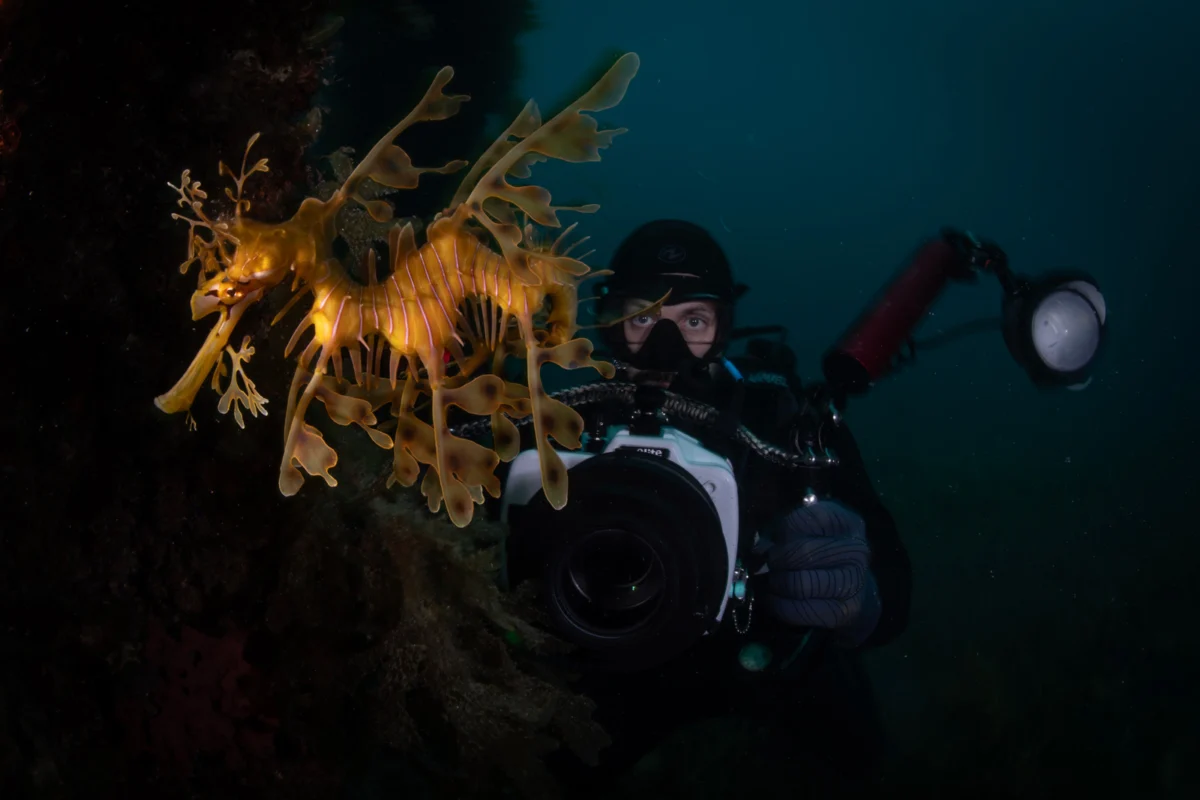
Another cherished image in his collection is a portrait of a leafy seadragon (Phycodurus eques). This image, prized for its symmetry and the sheer difficulty of its execution, required immense patience and specialized techniques. Leafy seadragons, masters of disguise, are notoriously shy and blend seamlessly with their seaweed habitats. Photographing them demands a delicate touch and minimal disturbance. Dear recalls the meticulous process: "Shooting at night, with a red focus light so as not to disturb the seadragon too much, I waited patiently for it to turn and face the camera, with its head tilted at the right angle, to get a full front-on headshot." This illustrates a photographer’s dedication to his craft, prioritizing the animal’s welfare while striving for an image that reveals its unique beauty and character. The successful capture of such an elusive and fragile creature highlights both his technical skill and deep respect for marine biodiversity.
Revisiting Depths: A Deeper Understanding of Species and Sites

For Dear, successful wildlife photography extends beyond mere technical proficiency; it necessitates a profound understanding of the species, their habitats, and behaviors. This philosophy underpins his practice of revisiting specific locations and subjects, allowing him to deepen his connection and refine his approach. This iterative process is crucial for capturing the nuances of animal life and conveying them authentically to an audience.
Whyalla, South Australia, stands out as a recurring pilgrimage site for Dear. Each year, this coastal town becomes the stage for one of nature’s most spectacular marine events: the aggregation of over 10,000 giant cuttlefish for their annual mating ritual. The site’s unique accessibility – a shallow, 5-meter deep area reachable directly from the shore – allows for extended underwater sessions, enabling Dear to dive multiple times a day and spend countless hours immersed in the cuttlefish world. This unparalleled access provides diverse photographic opportunities, from capturing the interplay of natural light filtering through the water column to documenting the individual personalities and vibrant color changes of the cuttlefish. He employs a range of lenses, including wide-angle, fisheye, and macro, to achieve a comprehensive visual narrative, showcasing everything from broad environmental shots to intricate details of individual creatures. This multi-lens approach demonstrates his evolving technique, moving beyond single-shot captures to tell a richer, more complete story.
Beyond Whyalla, other locations have become integral to his cyclical photographic journeys. Byron Bay, for instance, attracts large aggregations of leopard sharks (Stegostoma tigrinum, often called zebra sharks due to their juvenile striped pattern) each summer. This site offers dynamic shooting conditions, allowing for close-up shallow shots bathed in sunrays or broader top-down perspectives that capture multiple sharks at varying depths. Heron Island, a jewel in the Great Barrier Reef, is another favored destination, particularly for freediving during the turtle hatching season, which typically runs from February to April. Here, Dear witnesses the poignant spectacle of newly hatched turtles making their perilous journey to the sea, alongside resident lemon sharks, diverse ray species, and adult turtles. The ability to time dives with optimal tides allows for extended periods underwater, providing abundant opportunities to photograph a thriving ecosystem. These repeated visits underscore a key aspect of professional nature photography: building a comprehensive understanding of specific ecosystems and their inhabitants through sustained engagement.

The Organic Ascent to Professionalism and the Validation of Peers
Dear recounts his transition to professional photography not as a conscious decision but as an organic progression, a natural outcome of his deep-seated passion. "It was more about being out there, trying to find these magical underwater experiences, getting better at capturing them and improving my photography – firstly for myself, then for people I knew, and then for the wider community of animal and ocean lovers!" This highlights a common trajectory for many successful creatives, where intrinsic motivation and a love for the craft naturally lead to professional opportunities. His ability to "combine the two" – his love for the ocean and for photography – laid the foundation for his career.
A significant "eureka moment" or turning point for Dear came with the validation of his work through major competition wins. While social media can offer fleeting affirmation through "likes and follows," which he acknowledges can sometimes provide a "warped perspective" of one’s standing, competition wins offer an objective, peer-reviewed standard of excellence. These accolades instilled confidence, reinforcing the belief that his images met the rigorous standards of his contemporaries and those he admired in the underwater photography community. Such recognition not only boosts morale but also significantly enhances a photographer’s credibility, opening doors to commissions, publications, and collaborations.

Wildlife photography, especially at a professional level, demands meticulous planning and strategic execution. Dear emphasizes that success isn’t merely about luck but about creating opportunities. "Plenty of research goes into making sure the time of year, the locations, the weather and so on are all correctly lined up to give you the best possible chance of getting the shots you want." This proactive approach, combining biological knowledge, logistical planning, and meteorological understanding, is a hallmark of professional wildlife photography, maximizing the potential for compelling imagery.
Refined Workflow and Artistic Philosophy: The Power of ‘In-Camera’ Excellence
Over time, Dear’s photography process has undergone a significant transformation, particularly in his approach to post-processing. He now dedicates "far less time editing photos than I used to," attributing this efficiency to improved "in-camera" skills and knowledge. This shift reflects a mature understanding of photography, where the emphasis moves from fixing errors in post-production to mastering the capture process itself. His current philosophy is pragmatic: "if a photo takes too long to edit, you just need to go back out and take a better one." This principle underscores the importance of fundamental photographic techniques – exposure, composition, and lighting – in achieving high-quality results directly in the field.

He advises against excessive editing to correct fundamental flaws like overexposure or significant backscatter (particles in the water illuminated by flash), noting that "the more you try to edit out these mistakes, the more obvious it becomes." Dear’s artistic style is characterized by a preference for natural aesthetics, working with "plenty of light" to create images that appear as authentic as possible. His minimalist editing approach, often taking "a couple of minutes per image," ensures that the integrity of the original scene and the inherent beauty of the marine subjects are preserved, presenting them in their most natural and compelling form.
Navigating Challenges: The Unpredictability of Nature and the Inner Critic
The biggest challenge in wildlife photography, Dear asserts, remains the inherent unpredictability of nature. Despite meticulous planning – selecting the right season, location, and weather conditions – success is never guaranteed. He recounts trips planned to photograph minke whales that were thwarted by "bad weather and zero sightings," a stark reminder that "nature has other ideas." This unpredictability is amplified in underwater photography, where conditions like visibility and currents are critical. While professional photographers "pray for those days with great visibility and perfect lighting, where everything comes together perfectly," the reality is often less ideal.

Experience, however, equips a photographer to adapt. Dear explains that with increased experience, one can "still make the most of the opportunity and still come away with some amazing shots despite the less-than-ideal conditions." He cites a recent expedition to Argentina to photograph Southern Right Whales (under government permit), where "the visibility was far from ideal, with lots of wind whipping around." Despite these challenges, the experience remained "magical," and he was confident that "the images I took were the best that were able to be taken under the circumstances." This ability to produce high-quality work even in suboptimal conditions is a hallmark of a seasoned professional.
Beyond external challenges, Dear also reflects on internal struggles, particularly a past "lack of confidence in my ability." While this self-critical stance paradoxically fueled his growth and continuous learning, he acknowledges that it might have "held me back from taking on work that, in hindsight, I was more than capable of doing." This introspection reveals the delicate balance between striving for perfection and trusting one’s developed skills. As a self-proclaimed "perfectionist," releasing work that isn’t "1000% happy with is really hard for me to do." This relentless pursuit of excellence is a powerful driver but also presents a constant internal hurdle, requiring a photographer to learn when to trust their process and when to push for further refinement.
A Legacy of Wisdom: Advice for the Aspiring

Drawing from his transformative journey, Rowan Dear offers invaluable advice to aspiring photographers: "work out where you want to get to, follow the people who inspire you and follow your instincts, create your own style, hone your craft, and always try to improve." This comprehensive counsel emphasizes the importance of vision, mentorship, originality, continuous learning, and persistent practice. He stresses the need to "never be content with where you are at; be self-critical, but also appreciate the value of the work you have done and trust in your process and your ability." This dual approach – a drive for improvement coupled with self-belief – is fundamental for sustainable growth in any creative field.
Rowan Dear’s journey from a curious child on a Welsh farm to an internationally recognized underwater photographer is a compelling testament to the power of passion, resilience, and continuous self-improvement. His work not only captures the breathtaking beauty of the ocean’s inhabitants but also serves as a powerful medium for conservation, fostering a deeper appreciation and understanding of marine ecosystems. Through his lens, the unseen wonders of the deep become visible, inspiring a wider audience to connect with and protect the fragile underwater world. His story is a vibrant illustration of how a profound personal connection to nature, combined with the disciplined pursuit of photographic excellence, can transform an amateur’s dream into a professional’s impactful reality.