By Michiel van Mens
The question of what constitutes a "good" street photograph has long been a subject of intense contemplation for photographers and critics alike. This exploration delves into the multifaceted nature of compelling street photography, moving beyond the readily apparent and into the realm of suggestion and the evocation of curiosity. While visual contrast has been identified as a significant factor, extensive observation and analysis suggest that its absence does not preclude a photograph from achieving impactful resonance. This article aims to dissect the core elements that elevate a street photograph from a mere snapshot to a work of enduring visual interest, drawing upon extensive research and illustrative examples.
The Enduring Appeal of Visual Contrast
For years, the pursuit of understanding the aesthetic underpinnings of exceptional street photography has been a driving force behind my research. My previous investigations into the stylistic characteristics of renowned street photographers, detailed in "The Photographic Signature of the Street Photographer," pinpointed visual contrast as a crucial, though not exclusive, condition for creating impactful images. This contrast can manifest in various forms, extending beyond mere tonal or chromatic differences. It can be thematic, highlighting societal dichotomies; it can lie in the juxtaposition of vibrant colors against muted backgrounds; it can play with temporal elements, capturing fleeting moments against a static backdrop; it can be found in dynamic action versus serene stillness; and it can be the striking contrast between the mundane and the extraordinary.
Further substantiation for the significance of visual contrast emerged from a comparative study conducted in 2025 at the Rijksmuseum in Amsterdam during the "American Photography" exhibition. Among the ten most frequently recalled photographs by exhibition visitors, a clear presence of visual contrast was observed in eight instances. This empirical data led to a cautious conclusion, presented in my earlier article "The ‘Good’ Photographs of American Photography," that visual contrast serves not only as a distinctive stylistic feature but also as a critical criterion in how viewers perceive and judge the quality of a photograph. The ability of a photograph to immediately draw the eye through a discernible interplay of elements, whether in light, color, form, or concept, appears to be a fundamental aspect of its initial impact.
Differentiating Photographic Intent: Genre and Audience Expectation
While visual contrast is a potent tool applicable across various photographic genres, including journalistic news photography, documentary photography, and street photography, the criteria for evaluating success differ significantly due to their distinct purposes and intended audiences. A "good" news photograph, for instance, operates under a different set of imperatives than a "good" street photograph.
Journalistic news photography is fundamentally driven by the need for clarity, accuracy, and immediate comprehension. Its primary function is to inform, to explain events, and to make subjects instantly understandable, often serving as a visual complement to written reports. Iconic news photographs, such as Robert Capa’s "The Falling Soldier" from the Spanish Civil War or Eddie Adams’ "Saigon Execution" from 1968, achieve their power by visualizing pivotal moments, becoming potent symbols of historical events. The aesthetic appeal or perceived beauty of these images often takes a secondary role to their informational and symbolic weight. They tell a story through their direct depiction of an event, leaving little room for ambiguity.
Documentary photography, conversely, is typically conceived and presented as a series. The photographer’s commitment lies in constructing a narrative that unfolds across multiple images. The meaning of an individual photograph is intrinsically linked to the other images within its series, and the overall body of work is subjected to critical evaluation. In this context, the isolated merit of a single photograph, whether deemed "good," "beautiful," or "ugly," becomes less critical than its contribution to the overarching narrative. The strength lies in the cumulative effect.
Street photography, however, operates under a distinct paradigm. Each street photograph, even when presented as part of a series, generally aims to possess an independent communicative power. The overarching objective is to capture the essence of everyday life on the street in a way that is distinctive and thought-provoking. Unlike news photographs, street photographs rarely come with an accompanying article to provide context, nor do they typically rely on a fixed narrative provided by other images. Consequently, a successful street photograph must possess sufficient intrinsic qualities to generate meaning and engagement for the viewer on its own terms. This self-sufficiency demands a different approach to composition, subject matter, and the evocation of feeling or thought.
The Power of Unanswered Questions: Suggestion as a Creative Force
The research into memorable photographs from the "American Photography" exhibition revealed a fascinating dichotomy. Alongside images exhibiting strong visual contrast, two photographs stood out for their compelling impact despite the apparent absence of clear visual contrast. These were Bryan Schutmaat’s "Paul" from the series "Grays the Mountain Sends" and Amanda Lopez’s "Homegirls." "Paul" depicts a man in a light blue shirt, seated at a bar with a glass of beer, a seemingly straightforward portrait. "Homegirls" offers a similarly understated yet evocative portrayal.
What these photographs share is a profound ability to pose questions rather than offer definitive answers. They function as narrative invitations, presenting a scene that feels like the beginning of a story, abruptly paused, encouraging the viewer to become an active participant in its completion. This quality of suggestion, of leaving elements open to interpretation, has been a recurring theme in my research into the stylistic signatures of prominent street photographers. The potency of a street photograph often resides in what remains unsaid, unshown, and unexplained, employing suggestion over literal or overtly realistic depiction.
The French philosopher Gilles A. Tiberghien eloquently articulated this concept in his writings for an exhibition of anonymous photographs. He posited that "Each image could be the beginning of a story, a poem, a film, the starting point of a series of other images which, by crossing and re-crossing one another, would form a gigantic interchange of dreams and fictions." This perspective highlights how a single image can act as a catalyst for imagination, sparking a network of personal narratives, poetic associations, and cinematic visions.
This principle of suggestion is deeply ingrained in the art of filmmaking, particularly in the masterful technique of suspense. Directors like Alfred Hitchcock employed this to profound effect. In "Psycho" (1960), for instance, explicit violence is largely absent. Instead, the viewer witnesses the glint of a knife, the swirl of a shower curtain, and darkened water – cues that, through suggestion alone, convey the horror of the event. Similarly, Stanley Kubrick’s "The Shining" utilizes suggestion to create visceral impact. The iconic scene of Jack Torrance breaking through a bathroom door with an axe is not depicted literally. The implied violence, the unseen force, generates a far more potent and suspenseful experience than a direct portrayal.
In street photography, the absence of explicit visual contrast can be overcome by the photograph’s capacity to activate the viewer’s imagination. When a photograph effectively prompts introspection and invites the viewer to project their own narratives and interpretations, it transcends mere observation and becomes an interactive experience. Renowned street photographer Robert Doisneau perfectly encapsulated this idea: "The photographs that interest me, that I consider successful, are those that do not close the story, that do not tell it completely, but remain open—photographs that form a stepping stone toward a dream."
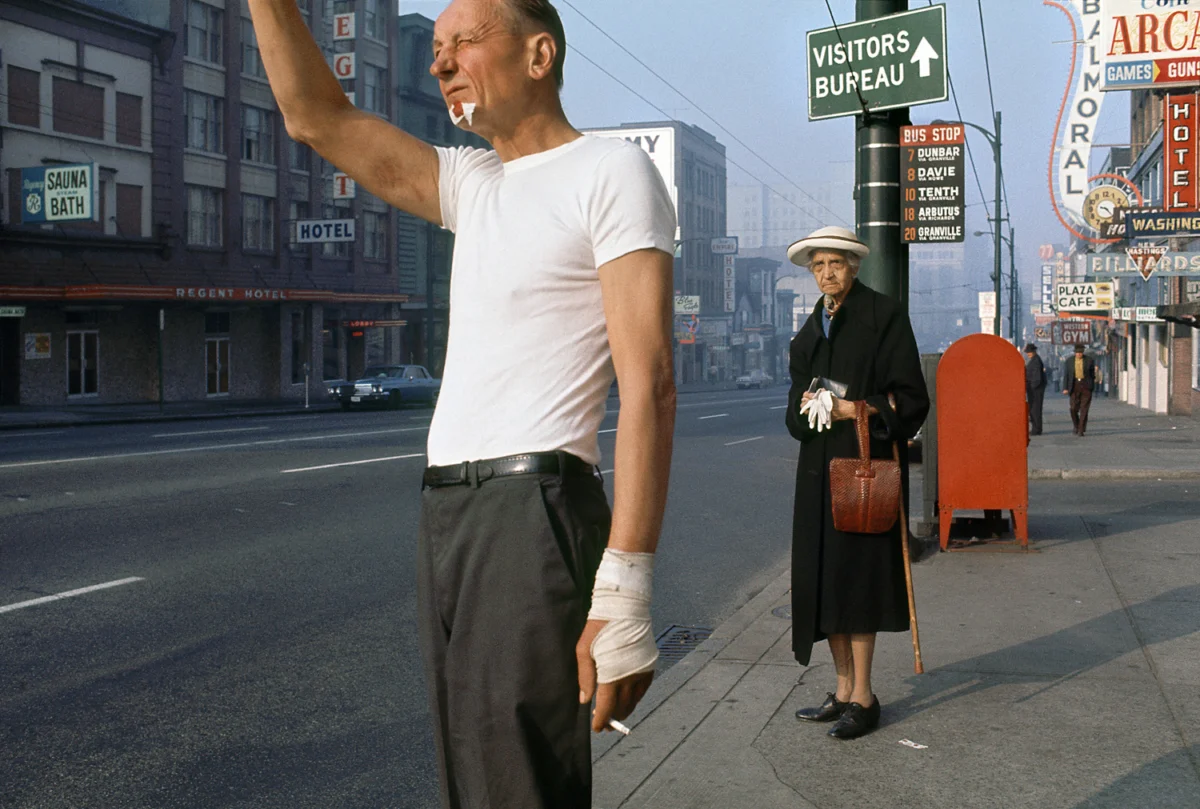
A prime example of a street photograph that excels through its suggestive power, even without overt visual contrast, is Fred Herzog’s "Man with Bandage." This image masterfully poses a multitude of questions without providing a single answer. The viewer is drawn into a scene that evokes a sense of mystery and prompts contemplation: What is the woman in the background looking at? What is the man’s purpose at this location? Why the bandage on his chin? Is this a specific moment, perhaps a Sunday morning? The sign pointing towards the "Visitors Bureau" adds another layer of intrigue, its destination and relevance left entirely to the viewer’s speculation.
Herzog’s "Man with Bandage" exemplifies how a photograph can be compelling precisely because it refrains from offering resolutions. Instead, it creates a vacuum that the viewer’s imagination rushes to fill. This encourages a more profound engagement with the image, fostering careful observation and the construction of personal narratives. The photograph becomes a portal, inviting the viewer to become a co-creator of its meaning.
From Theory to Practice: Cultivating Suggestion in Street Photography
The principles of visual contrast and suggestion are not merely theoretical constructs; they are practical tools that street photographers can actively employ to enhance the impact and quality of their work. While visual contrast can help in identifying inherently interesting scenes, the deliberate cultivation of suggestion can elevate a photograph from good to memorable.
My analysis of numerous street photography books and portfolios has identified eight recurring techniques that contribute to a photograph’s suggestive power:
-
Strategic Omission: Suggestion begins with what is intentionally left out of the frame. Much like the unseen shark in Steven Spielberg’s "Jaws," whose presence is amplified by frightened reactions and ominous music, the power of suggestion lies in what is not explicitly shown. In street photography, this translates to framing scenes that hint at broader narratives or unseen elements, allowing the viewer’s mind to fill in the gaps.

-
The Art of Blur: Blur can serve as a powerful tool for concealing information and creating ambiguity. This can manifest as an out-of-focus background that hints at activity beyond the primary subject’s immediate context, or as motion blur that suggests movement and transience, leaving the viewer to infer the dynamics of the scene.
-
Juxtaposition of Interior and Exterior: Photographs that simultaneously depict the inside and outside of a space, often achieved through windows or shopfronts, can create a sense of voyeurism and invite contemplation about the relationship between public and private realms. This layering of perspectives adds complexity and encourages the viewer to consider different viewpoints.
-
The Unsettling Element: An image can generate intrigue and provoke questions when it contains an element that seems out of place or incongruous with the rest of the scene. This disruption of the expected can lead the viewer to question the context and the underlying narrative.
-
The Mystery of Distance: When an event or subject is positioned at a distance, just beyond clear visibility, it can imbue the photograph with an aura of mystery. This spatial separation compels the viewer to lean in, to try and decipher what is happening, thereby increasing their engagement.
-
Play with Proportions: The interplay between large and small elements within a single frame can create visual tension and subtly alter the viewer’s perception of scale and significance. This manipulation of proportions can suggest power dynamics or highlight unexpected relationships between subjects.
-
Estrangement and Surrealism: Reality, when presented with a subtle twist that renders it slightly illogical or dreamlike, can create a powerful sense of estrangement. This approach can draw the viewer into a more contemplative and subjective interpretation of the scene.
-
The Evocative Facial Expression: Human faces are rich with narrative potential. A compelling facial expression, whether conveying a specific emotion or an inscrutable gaze, can act as a potent trigger for questions and personal interpretation, inviting the viewer to speculate about the subject’s inner world.
Conclusion: The Synthesis of Contrast and Suggestion
The pursuit of a "good" street photograph is not a matter of serendipity; it is a deliberate endeavor that can be cultivated through an understanding of visual principles and a keen eye for narrative potential. By actively seeking out subjects that exhibit clear visual contrast, photographers lay a strong foundation for an impactful image. However, the true mastery lies in the ability to evoke meaning through suggestion, posing questions that resonate with the viewer and invite them to become active participants in the photographic experience.
The combination of visual contrast and suggestion represents a powerful synergy. When a photograph possesses both the immediate visual appeal of contrast and the enduring intrigue of unanswered questions, it approaches the realm of iconic status. This synthesis allows for an image that is both striking at first glance and deeply engaging upon prolonged contemplation.
Furthermore, street photographers can adopt a more proactive role, moving beyond simply capturing spontaneous moments to subtly orchestrating "street theater." In this capacity, the street photographer becomes a dramaturge, carefully composing scenes that balance visual elements with narrative suggestion. The work of American photographer Gregory Crewdson, particularly his series "Eveningside," exemplifies this approach, demonstrating the profound impact of staged yet evocative street-based narratives. By understanding and applying these principles, photographers can consistently elevate their work, creating images that not only capture a moment but also resonate with viewers long after the initial viewing.
About The Author: Michiel van Mens
Michiel van Mens is a photographer and corporate journalist whose career began during his military service, where he received extensive training in photography and journalistic practices. He had the unique opportunity to collaborate with a professional photographer, traveling extensively across Europe, producing photo essays, writing reports, and dedicating countless hours to darkroom work. This period culminated in the monthly production of a high-quality magazine. Following his service, van Mens embarked on further photographic expeditions to Poland, the Baltic States, and Ukraine, documenting regions such as Crimea and Odessa, and exploring historical sites like the former KGB prison in Vilnius.
Inspired by the seminal street photographer Ed van der Elsken, van Mens initiated a long-term photographic project in 1993 focused on Amsterdam Oud-West, which led to several exhibitions. During this period, he also pursued formal education at the Photo Academy in Amsterdam.
Van Mens has been deeply involved in research concerning street photography. His prior publication, "The Photographic Signature of the Street Photographer in Six Stylistic Characteristics," served as a condensed preview of his forthcoming book, slated for release in the fall of 2025. This book is the product of his in-depth personal research into the visual styles of prominent street photographers.
A central finding of his research is that a photographer’s unique style can be deconstructed into six commonly observed stylistic traits within street photography. This concept was explored in the aforementioned article, and his subsequent piece, "The ‘Good’ Photographs of American Photography," further investigates this, revealing that one of these six traits is a key element in photographs that viewers tend to remember most vividly.
With Thanks & Gratitude To Michiel Van Mens. To see and learn More, visit his Street Photography & follow him on Instagram.
Images Courtesy of The Estate of Fred Herzog at Equinox Gallery.