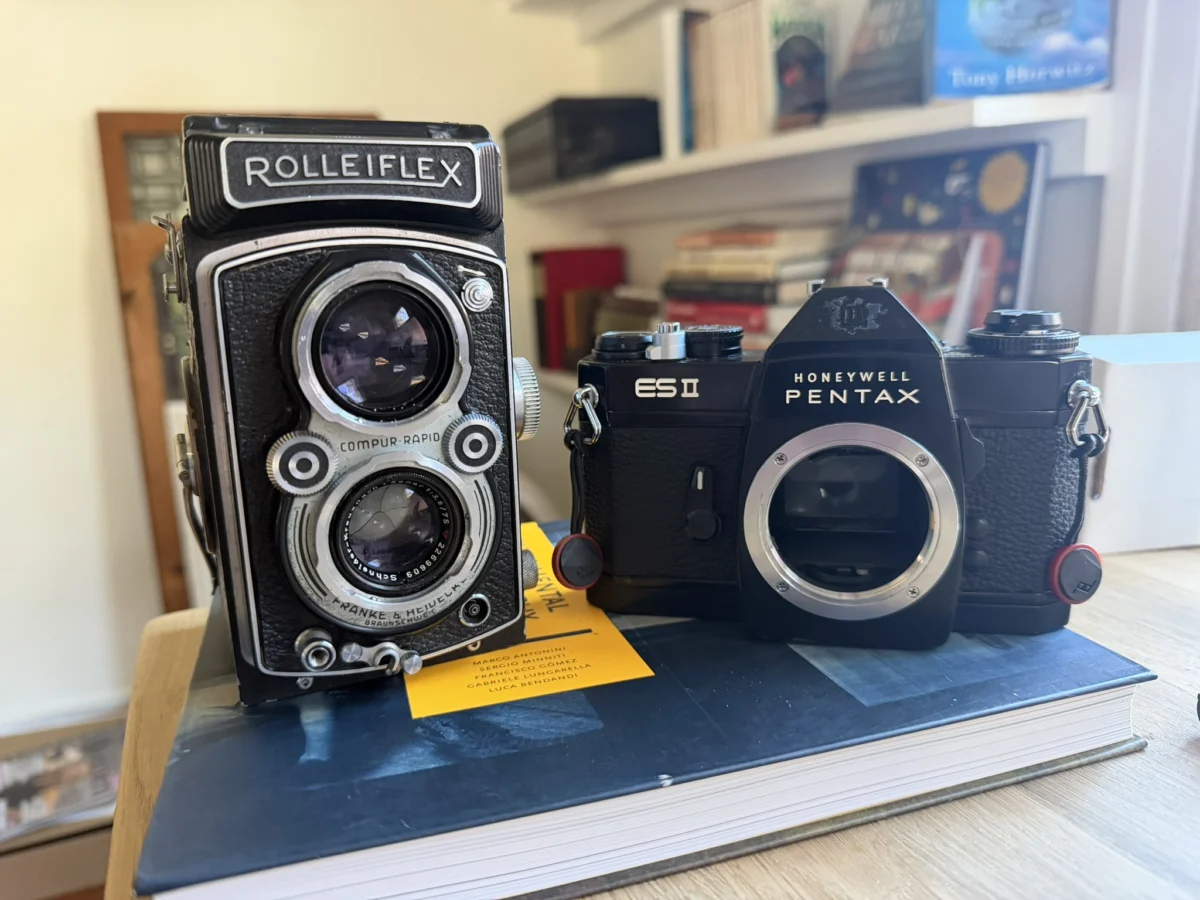
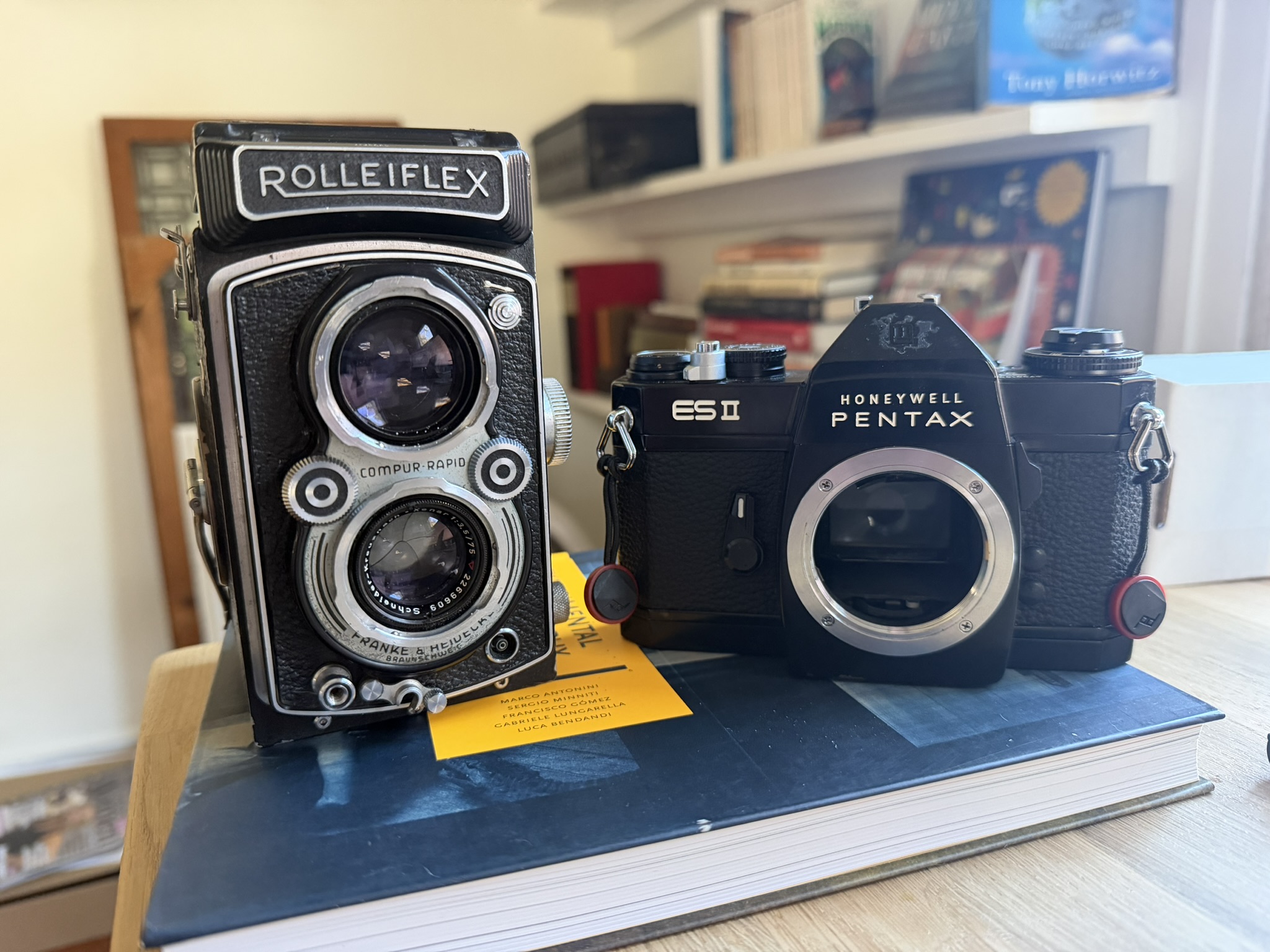
The mechanical integrity of vintage photographic equipment has become a focal point of concern for the growing community of analog film enthusiasts, as the natural effects of entropy begin to compromise the precision of mid-20th-century hardware. As the global market for film photography experiences a resurgence, the reliance on decades-old mechanical shutters has necessitated a more rigorous approach to technical validation. Recent testing conducted on iconic models, such as the Honeywell Pentax Spotmatic and the Rolleiflex 3.5, reveals significant discrepancies between advertised shutter speeds and actual performance, underscoring the necessity for modern calibration tools in the preservation of the analog medium.
The Evolution of Shutter Speed Verification
Historically, verifying the accuracy of a camera’s shutter required specialized equipment found only in professional repair shops. Traditional methods for hobbyists often involved crude approximations, such as recording the shutter actuation in slow motion using high-frame-rate digital cameras and manually counting frames. While this method provides a baseline, it is widely considered inefficient for generating the high-volume data sets required for statistical reliability.
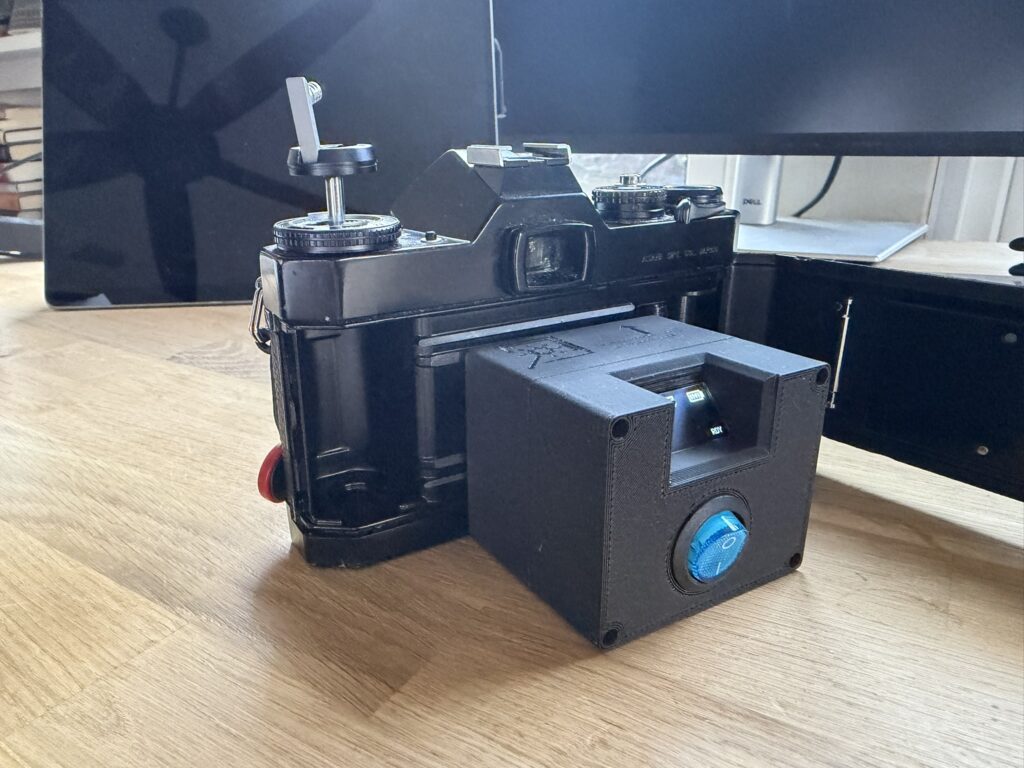
The emergence of dedicated, affordable shutter speed testers, such as the FAST Box One manufactured in Poland, has democratized the ability to audit vintage gear. These devices utilize high-speed light sensors and microprocessors to measure the exact duration a shutter remains open, providing data in milliseconds or fractions of a second. This technological shift allows photographers to move away from guesswork and toward data-driven exposure management.
Mechanical Entropy and the Physics of Decay
The degradation of vintage cameras is an inevitability governed by the laws of physics. Mechanical shutters rely on a complex interplay of springs, gears, and lubricants. Over a span of 50 to 70 years, several factors contribute to "shutter drag" or timing inaccuracies:
- Lubricant Viscosity: The organic greases used in the mid-20th century tend to congeal or "gum up" over time, increasing friction within the gear train.
- Spring Fatigue: Tension springs responsible for firing shutter curtains or leaves can lose their elasticity, leading to slower travel times.
- Environmental Corrosion: Microscopic oxidation on brass or steel components can impede the smooth transition of mechanical parts.
These factors generally result in shutters running slower than their designated settings. In the context of film photography, a slow shutter results in overexposure, which, while often manageable, can compromise the intended aesthetic of a photograph, particularly when using slide film with narrow exposure latitudes.
Case Study I: The Honeywell Pentax Spotmatic
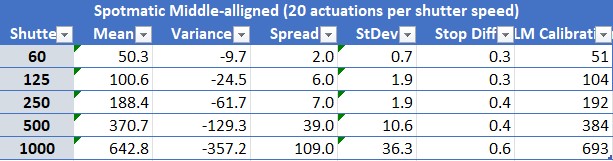
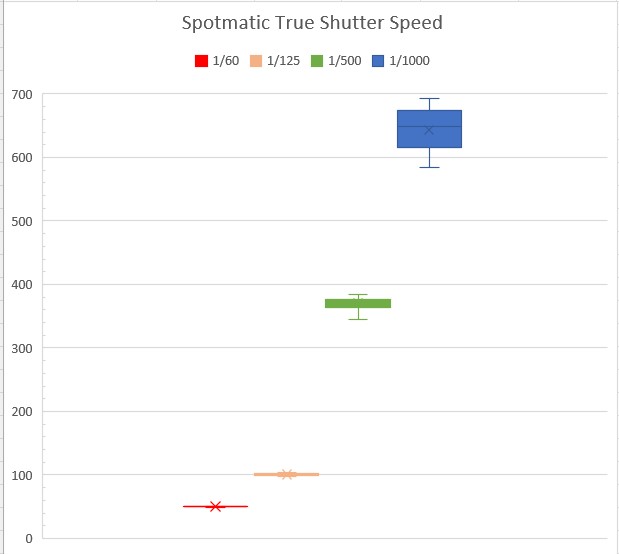
The Honeywell Pentax Spotmatic, a staple of the 1960s SLR market, serves as a primary example of how time affects focal-plane shutters. In recent diagnostic tests, a Spotmatic unit—deprived of its electronic light meter due to age-related failure—was subjected to a series of 20 actuations per shutter speed to determine consistency and accuracy.
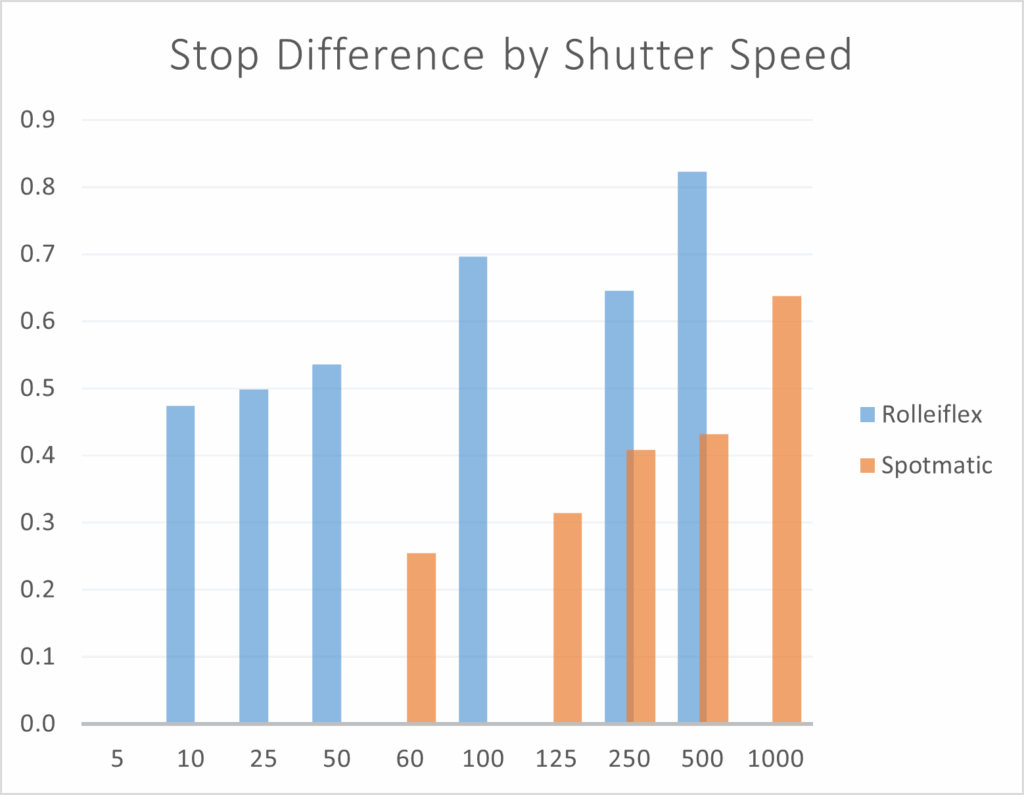
The data indicated a direct correlation between higher shutter speeds and increased variance. At a designated speed of 1/1000 of a second, the camera recorded a mean actual speed of approximately 1/693. This represents a significant deviation, though in practical photographic terms, it results in roughly 1/2 to 2/3 of a stop of overexposure.
Statistically, the "Spread"—the difference between the fastest and slowest recorded times at a single setting—also widened at higher speeds. This suggests that as the mechanical demands on the springs increase, the mechanism’s ability to repeat the same performance precisely diminishes. For a photographer, this means that even if they compensate for a slow shutter, the inherent inconsistency of the device introduces a margin of error that cannot be fully mitigated without professional servicing.
Case Study II: The Rolleiflex 3.5 (1949–1951)
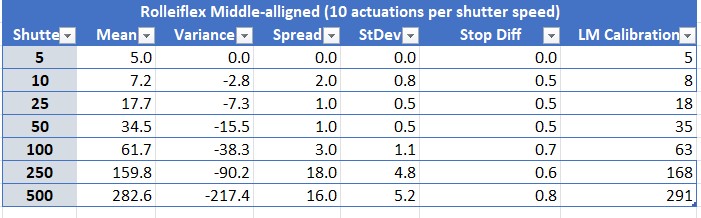
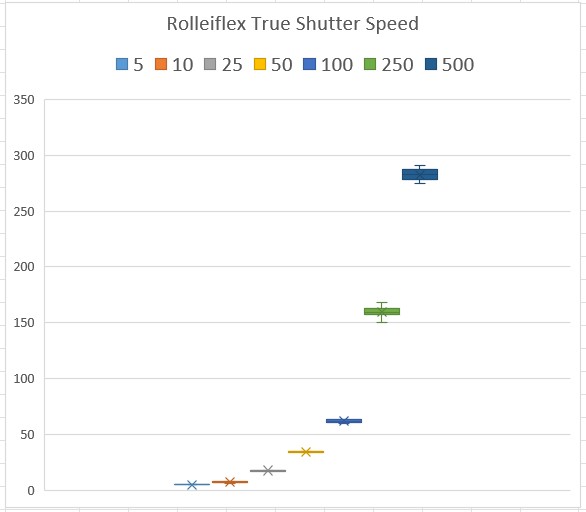
In contrast to the focal-plane shutter of the Pentax, the Rolleiflex 3.5 utilizes a leaf shutter mechanism integrated into the lens. Despite being manufactured between 1949 and 1951—making it nearly two decades older than the Spotmatic—the Rolleiflex exhibited superior consistency in testing, albeit with more pronounced timing delays.
Testing 10 actuations per speed revealed that the Rolleiflex’s 1/100 setting actually functioned at a mean speed of 1/61. While this is nearly a full stop slower than the factory specification, the "Standard Deviation" (StDev) remained remarkably low. The consistency of the leaf shutter suggests that while the springs have weakened or the lubricants have thickened, the mechanical cycle remains stable.
This stability is a testament to the high-precision engineering of the Compur or Synchro-Compur shutters used in Rolleiflex cameras. From a journalistic and technical perspective, a consistent but slow shutter is preferable to an inconsistent one, as the former can be easily accounted for through exposure compensation.
Comparative Data and Statistical Definitions
To analyze these findings, technicians utilize several key metrics that define the health of a camera’s timing:
- Mean: The average of all recorded shutter speeds for a specific setting.
- Variance: The numerical difference between the speed selected on the camera dial and the actual mean recorded by the tester.
- Spread: The range between the absolute maximum and minimum values recorded in a test set, indicating the reliability of the mechanism.
- Stop Difference: The conversion of time variance into photographic "stops." This is the most practical metric for photographers, as it dictates how they should adjust their aperture or ISO.
The data suggests that for most mechanical cameras over 40 years old, a variance of 1/3 to 1 stop is the industry norm. Professionals in the camera restoration field suggest that any camera exhibiting more than a 1.5-stop variance or a high standard deviation should be considered for a "Clean, Lubricate, and Adjust" (CLA) service.
Market Impact and the Economics of Maintenance
The financial implications of shutter inaccuracies are significant for the second-hand camera market. As prices for vintage Leica, Rolleiflex, and Hasselblad systems continue to rise, the ability to provide a "shutter certificate" or proof of accuracy is becoming a value-add for sellers.
Conversely, for the average consumer, a shutter tester can serve as a cost-saving tool. By identifying that a camera is consistently 2/3 of a stop slow, a photographer can adjust their light meter accordingly rather than spending $200 to $400 on a professional overhaul. This "software-side" fix—adjusting the user’s behavior rather than the hardware—extends the usable life of vintage equipment without the immediate need for rare parts or specialized labor.
Industry Reactions and Expert Analysis
Industry analysts note that the rise of mobile light metering apps has changed how photographers interact with these data sets. Many modern apps allow users to input "Custom Shutter Speeds." By entering the actual measured speed (e.g., 1/693 instead of 1/1000), the app provides an exposure calculation that is perfectly calibrated to that specific camera body.
"We are seeing a shift from ‘restoration’ to ‘calibration,’" says one vintage equipment specialist. "Not every camera needs to be factory-perfect to take great photos. They just need to be predictable. If you know your 1/500 is actually 1/300, you have all the information you need to create a perfect negative."
Furthermore, the data highlights the resilience of analog film. Because negative film (color and black-and-white) possesses significant "exposure latitude," it can absorb the 1/2 to 1-stop overexposure caused by a slow shutter without losing detail in the highlights. This characteristic of the medium has likely masked mechanical failures for decades, allowing photographers to continue using aging gear without realizing the extent of the mechanical decay.
Broader Implications for the Analog Community
The move toward rigorous shutter testing reflects a broader trend in the analog community: the professionalization of the hobbyist. As film stocks become more expensive—with prices for certain professional rolls doubling over the last five years—the cost of a "failed" exposure has increased. In this economic climate, the $100 investment in a shutter tester or the time spent on calibration is seen as an insurance policy against wasted film and chemistry.
The study of these two cameras—the Spotmatic and the Rolleiflex—ultimately proves that while "entropy" is a constant, it is not a death sentence for vintage hardware. Instead, it defines a new era of "informed photography," where the limitations of the tool are integrated into the creative process.
Chronology of Camera Reliability
- 1940s–1950s: Era of high-precision mechanical leaf shutters (e.g., Rolleiflex). These units remain highly consistent today but are prone to uniform slowing due to aged lubricants.
- 1960s–1970s: Mass production of SLRs with focal-plane shutters (e.g., Pentax Spotmatic). These introduced higher speeds (1/1000) but show more significant variance and inconsistency as they age.
- 1980s–1990s: Transition to electronically controlled shutters. While more accurate, these face "catastrophic failure" modes where electronic component degradation renders the camera unrepairable.
- 2020s: The "Data Era" of analog photography, characterized by the use of digital sensors to audit and calibrate mechanical legacy systems.
In conclusion, the testing of vintage shutters is less about achieving perfection and more about understanding the "personality" of a specific machine. By bridging the gap between mid-century mechanics and modern data analysis, photographers can ensure that the art of film photography remains viable for decades to come. Consistency, rather than absolute speed, remains the gold standard for mechanical reliability in the field.