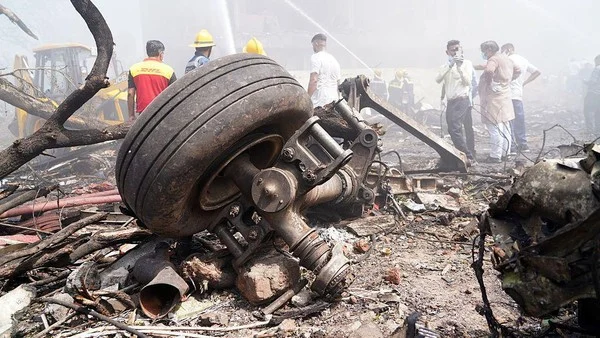
The aviation world remains in a state of profound shock and mourning following the catastrophic loss of Air India Flight AI-171, which went down on June 12, 2025, during its final approach to Sardar Vallabhbhai Patel International Airport in Ahmedabad. The Boeing 787 Dreamliner, a cornerstone of Air India’s long-haul fleet, was completing a routine scheduled service from London Heathrow when the tragedy occurred. With 245 souls on board, including crew members, the incident has been confirmed as one of the deadliest in Indian aviation history. As the smoke clears from the crash site, the focus has shifted from a frantic search-and-rescue operation to a meticulous, high-stakes forensic investigation. At the heart of this inquiry are the aircraft’s "black boxes," which have now been recovered and transported to a high-security laboratory in New Delhi for exhaustive analysis.
The recovery of the Flight Data Recorder (FDR) and the Cockpit Voice Recorder (CVR) marks the most critical milestone in the investigation since the crash occurred. These devices, though referred to as black boxes, are coated in heat-resistant, bright orange paint to facilitate their discovery amidst charred wreckage. For the families of the victims and the global aviation community, the data contained within these hardened steel and titanium containers represents the only definitive way to reconstruct the final, terrifying moments of AI-171.
Chronology of Flight AI-171
To understand the gravity of the investigation, one must look at the timeline of the flight’s final hours. Air India Flight AI-171 departed London Heathrow (LHR) at approximately 10:30 AM GMT on June 11, 2025. The journey across Europe and the Middle East was reported as uneventful, with the aircraft maintaining a steady cruise altitude and the crew checking in periodically with various regional Air Traffic Control (ATC) centers.
The situation began to change as the aircraft entered Indian airspace in the early hours of June 12. According to preliminary radar data, the Boeing 787 began its planned descent toward Ahmedabad at approximately 3:45 AM local time. Weather conditions at the time were reported as "fair," with moderate visibility and light winds, suggesting that external environmental factors may not have played a primary role in the disaster.
At 4:12 AM, the aircraft was cleared for its final approach to Runway 23. However, just three minutes later, at 4:15 AM, radar contact was abruptly lost. Witnesses on the ground near the airport periphery reported seeing the aircraft flying at an unusually low altitude and appearing to struggle with its pitch before it disappeared behind a line of trees, followed by a massive explosion and fireball. Emergency services reached the site within minutes, but the devastation was near-total. Amidst the debris, rescuers located the sole survivor—a passenger seated in the rear section of the aircraft—who was rushed to a local hospital in critical condition.
The Technical Heart of the Investigation: The Black Boxes
The Indian Ministry of Civil Aviation, in coordination with the Directorate General of Civil Aviation (DGCA), has prioritized the extraction of data from the FDR and CVR. Because the Boeing 787 is an American-manufactured aircraft, the United States National Transportation Safety Board (NTSB) and technical advisors from Boeing have joined the Indian Aircraft Accident Investigation Bureau (AAIB) to ensure the integrity of the process.
The Flight Data Recorder (FDR) is designed to track more than 1,000 different parameters, including airspeed, altitude, vertical acceleration, engine performance, and the movement of various flight control surfaces. This data will allow investigators to create a digital recreation of the flight path. Meanwhile, the Cockpit Voice Recorder (CVR) captures the sounds of the flight deck, including the pilots’ conversations, radio transmissions, and any ambient noises such as engine changes or mechanical alarms.
The analysis process is grueling and follows a strict international protocol:
- Condition Assessment: Experts first evaluate the physical integrity of the memory modules. If the boxes have suffered extreme thermal damage, specialized chemical cleaning is required.
- Data Extraction: Using proprietary software provided by the manufacturer, investigators "read out" the binary data stored on the solid-state memory chips.
- Synchronization: The audio from the CVR is synchronized with the technical data from the FDR to provide a second-by-second account of what the pilots were doing and what the plane was experiencing.
- Transcription: A group of experts, including "listening groups" from the airline and the regulator, create a verbatim transcript of the cockpit audio, noting even the smallest clicks or background hums.
Early Theories: The Flap System Anomaly
While the official report is months away, early indications from ground-based telemetry and preliminary wreckage inspection have pointed toward a potential failure in the aircraft’s flap system. Flaps are movable panels on the trailing edge of the wings that increase lift and drag, allowing an aircraft to fly safely at the slower speeds required for landing.

Initial reports suggest that AI-171 may have experienced a "flap asymmetry" or a total failure of the flap actuation system as it configured for landing. If the flaps on one wing deploy while the other side fails, it can create a violent rolling motion that is difficult for pilots to counteract, especially at low altitudes. Furthermore, if the flaps fail to deploy entirely, the aircraft may have been forced to land at a much higher speed than the runway could accommodate, or it could have suffered an aerodynamic stall if the pilots tried to maintain a standard approach speed without the necessary lift.
Investigators are currently examining the hydraulic and electrical actuators recovered from the wing sections to see if there is evidence of mechanical fatigue or a software glitch that could have bypassed the redundant safety systems inherent in the Dreamliner’s design.
Official Responses and Global Repercussions
The crash of AI-171 has sent ripples through the political and corporate landscape. India’s Minister of Civil Aviation issued a formal statement expressing deep condolences and promising a "transparent and uncompromising" investigation. "The loss of life is a national tragedy," the Minister stated. "We owe it to the families to find the truth. No stone will be left unturned, and no technical detail will be overlooked."
Boeing, which has faced significant scrutiny over the past decade regarding its safety culture and manufacturing processes, is under intense pressure to provide answers. A spokesperson for the company stated, "Boeing is deeply saddened by the loss of Air India Flight 171. We are providing full technical assistance to the investigating authorities and are committed to understanding the cause of this accident to ensure the continued safety of the global fleet."
The impact on the airline industry has been immediate. Several international carriers that operate the Boeing 787-8 and 787-9 variants have announced "precautionary inspections" of their wing flap systems. While no formal grounding order has been issued by the Federal Aviation Administration (FAA) or the European Union Aviation Safety Agency (EASA), the insurance industry is already bracing for record-breaking claims, and Air India’s stock—and the broader reputation of the Tata Group-owned carrier—faces a challenging period of recovery.
Broader Implications for Aviation Safety
Every major aviation accident results in a "safety dividend"—a set of new regulations or technical modifications designed to prevent a recurrence. The AI-171 investigation is expected to look closely at the "fly-by-wire" logic of the Dreamliner. As a highly computerized aircraft, the 787 relies on complex software to translate pilot inputs into mechanical action. Investigators will be looking to see if there was a "mode confusion" or a software conflict that prevented the crew from recovering from a mechanical failure.
Furthermore, the role of pilot training will be scrutinized. In modern aviation, "Upset Prevention and Recovery Training" (UPRT) is mandatory. The CVR will reveal whether the crew followed standard operating procedures (SOPs) for a flap failure and whether the stress of the emergency led to a breakdown in Crew Resource Management (CRM).
The Path Forward
As the analysis in New Delhi continues, the site of the crash remains a somber reminder of the fragility of human flight. Recovery teams have completed the difficult task of identifying the victims through DNA testing and dental records, and the process of returning remains to their families is underway.
The final report from the AAIB is not expected for at least 12 to 18 months, as is standard for an investigation of this magnitude. However, preliminary findings—often called "Interim Reports"—are likely to be released within the next 30 to 60 days. These reports will contain factual data from the black boxes and may include urgent safety recommendations if a systemic flaw is discovered in the Boeing 787 fleet.
For now, the world waits for the black boxes to "speak." In those digital records lies the truth of AI-171’s final moments. Whether the cause was mechanical failure, human error, or a combination of unforeseen factors, the lessons learned from this tragedy will undoubtedly shape the future of aviation safety for decades to come. The goal is clear: to ensure that the 244 lives lost on June 12, 2025, were not lost in vain, but instead serve as a catalyst for a safer sky.