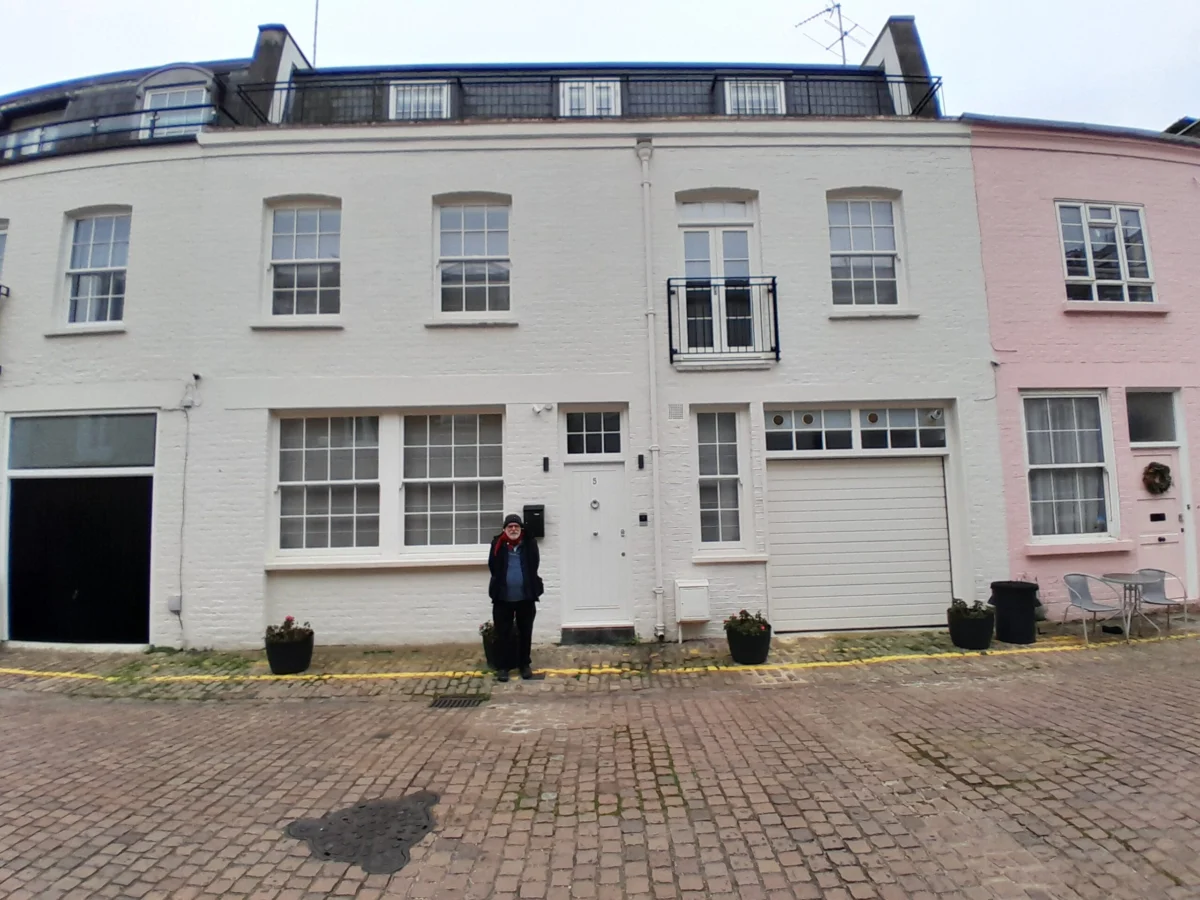
The architectural and socio-economic history of London is perhaps nowhere more visible than in the evolution of the "mews," a term originally describing rows of stables and coach houses with living quarters above, built to serve the grandest mansions of the 18th and 19th centuries. Once considered the humble domain of grooms, coachmen, and later chauffeurs, these properties have transitioned from utilitarian service buildings into some of the most sought-after luxury real estate in the world. A primary example of this transformation is found at 5 Princes Gate Mews, located in the Royal Borough of Kensington and Chelsea. This specific address, once the modest residence of a professional chauffeur and his family during the mid-20th century, now commands a market valuation approaching £6 million, illustrating the staggering trajectory of the London property market over the last eight decades.
The Architectural Heritage of the London Mews
The term "mews" is derived from the Royal Mews at Charing Cross, where the king’s hawks were kept during their "mew" or molting season. By the 17th century, the term had shifted to describe stable buildings. In areas such as South Kensington, Mayfair, and Belgravia, mews were designed as service roads behind the primary residential squares and terraces. While the aristocratic families resided in the "grand houses" with expansive facades and high ceilings, the staff responsible for transportation lived in the mews.
Architecturally, a mews house typically featured a ground floor dedicated to stalls for horses and space for carriages. The upper floor, accessed by a narrow internal staircase, contained small, often cramped rooms for the staff. By the early 20th century, as the internal combustion engine replaced horse-drawn transport, these ground-floor stables were converted into garages for motor cars. The residents shifted from being grooms and ostlers to chauffeurs and mechanics. Despite the prestigious location—often just meters away from museums, parks, and embassies—the living conditions within these mews houses remained rudimentary well into the mid-20th century.
Case Study: 5 Princes Gate Mews in the 1930s and 1940s
During the 1930s and 1940s, 5 Princes Gate Mews served as the residence and workplace for Charlie Wright, a professional chauffeur. Situated off Exhibition Road, the property was positioned in the heart of London’s cultural district, adjacent to the Victoria and Albert Museum and opposite the Science and Natural History Museums. At the time, the property functioned as a functional annex to a larger estate, housing high-end vehicles, including multiple Rolls-Royces, on the ground floor.
The domestic arrangements of the period reflect the stark contrast between the external wealth of the area and the internal lives of the service class. Records and family accounts indicate that the Wright family lived in the quarters above the garage. The layout consisted of a landing that functioned as a basic kitchen, where the sink served as the primary washing facility. A small cupboard housed a toilet, which, while basic, was considered a relative luxury for the era compared to the communal or outdoor facilities common in working-class districts. The living quarters included a fireplace and three small bedrooms for Wright, his wife Alice—who worked as a "char-lady" or domestic cleaner—and their children.
The resilience of the residents during this era is highlighted by the family’s experiences during the Second World War. While the neighboring Victoria and Albert Museum sustained significant damage during the Blitz—scars of which are still visible on the building’s exterior today—the mews residents continued their service. One of Wright’s daughters, Eve, worked as a shop assistant at the nearby Harrods department store in Knightsbridge and served as an ambulance driver during the air raids, despite having no formal driving certification at the onset of her service.
The Churchill Connection and Military History
The history of the residents at 5 Princes Gate Mews intersects with significant figures in British political and military history. Charlie Wright’s career as a chauffeur reportedly included a tenure in the service of Winston Churchill during the early stages of the First World War. At the time, Churchill served as the First Sea Lord and was a pivotal member of the War Cabinet.
Following the failure of the Gallipoli campaign in 1915, for which Churchill bore significant political responsibility, he resigned from the government and sought a military commission. In early 1916, Churchill served as a Lieutenant-Colonel commanding the 6th Battalion of the Royal Scots Fusiliers on the Western Front. Historical accounts suggest that Wright was invited to serve as Churchill’s batman (an officer’s personal servant) during this period in Flanders.
When Churchill eventually returned to London to resume his parliamentary career, Wright remained on the front lines. His military service ended after he was wounded in a gas attack during the Battle of the Somme. Despite the severity of such injuries during that era, Wright survived and eventually returned to his profession as a chauffeur, a role he maintained until his retirement in the late 1940s.
The £125 Valuation and the Post-War Real Estate Pivot
The most significant turning point in the financial history of 5 Princes Gate Mews occurred in the late 1940s. Upon the conclusion of Charlie Wright’s employment, he was reportedly offered the opportunity to purchase the mews house for approximately £125. In the economic context of 1948, this was a substantial but not insurmountable sum for a working professional; however, the family ultimately declined the offer, viewing the price as excessive for what was then considered "servant’s quarters."
This decision highlights a broader historical trend where the long-term value of urban land was not yet fully realized by those living within it. At the time, London was recovering from the exhaustion of the war, and the "mews" were not yet viewed as fashionable or desirable residential properties for the middle or upper classes. They remained functional buildings tied to the service industry.
Modern Market Analysis and Property Valuation
The subsequent decades saw a radical shift in the valuation of London real estate, particularly in the Royal Borough of Kensington and Chelsea. The mews houses, once dismissed as lowly outbuildings, became highly prized for their privacy, central location, and historical character.
By December 2015, 5 Princes Gate Mews was recorded as having sold for £3,025,000. At that stage, the property had undergone significant modernization, including the conversion of the attic space into an additional floor, bringing the total to four bedrooms and three bathrooms. As of 2024, the property is once again on the market with an asking price of approximately £5,950,000.
The current configuration of the home reflects the contemporary demands of the ultra-high-net-worth market:
- Accommodations: Three bedrooms, including a master suite.
- Amenities: Four bathrooms and a dedicated home gym (converted from a fourth bedroom).
- Features: An integrated garage, a rare and highly valuable commodity in central London.
- Taxation: A purchase at this price point carries significant Stamp Duty Land Tax (SDLT) implications. For a primary residence, the tax would amount to nearly £700,000, while a buyer purchasing the property as an additional home could face a tax bill approaching £1 million.
The leap from a £125 valuation in 1948 to a £5.95 million valuation today represents a price increase of over 4,700,000%. This far outpaces standard inflation and reflects the extreme "gentrification" of the mews as an architectural category.
Broader Implications and Urban Transformation
The story of 5 Princes Gate Mews is emblematic of the wider "hollowing out" of central London’s working-class history. In the early 20th century, the mews were vibrant, albeit cramped, communities of laborers, drivers, and domestic staff who were essential to the functioning of the city’s elite households. Today, these same streets are some of the most exclusive enclaves in the world, often populated by international investors and high-ranking professionals.
The transformation of these properties also reflects a change in urban living priorities. The proximity to cultural institutions like the Victoria and Albert Museum, which was once a workplace for the neighbors, is now a primary "lifestyle" selling point. The historical damage from the Blitz, preserved on the museum’s walls, serves as a silent witness to the era when the mews were still humble dwellings.
Furthermore, the evolution of 5 Princes Gate Mews illustrates the transition of the "garage" from a workspace to a luxury asset. In a city where parking is at a premium, a mews house with its own ground-floor garage is a significant outlier in the real estate market. While Charlie Wright once used that space to maintain his employer’s Rolls-Royces, the modern owner likely views the garage as a vital component of the property’s multi-million pound valuation.
Conclusion
The history of 5 Princes Gate Mews provides a unique lens through which to view the social and economic shifts of 20th and 21st-century London. From the trenches of the Somme and the service of Winston Churchill to the contemporary world of multi-million pound property portfolios, the address has moved from the periphery of the "grand life" to its very center. The missed opportunity to purchase the property for £125 stands as a stark reminder of how dramatically the perception of value, architecture, and social class has shifted in the heart of the British capital. Today, 5 Princes Gate Mews is no longer a place where the staff lives; it is a trophy asset in one of the world’s most expensive real estate markets.