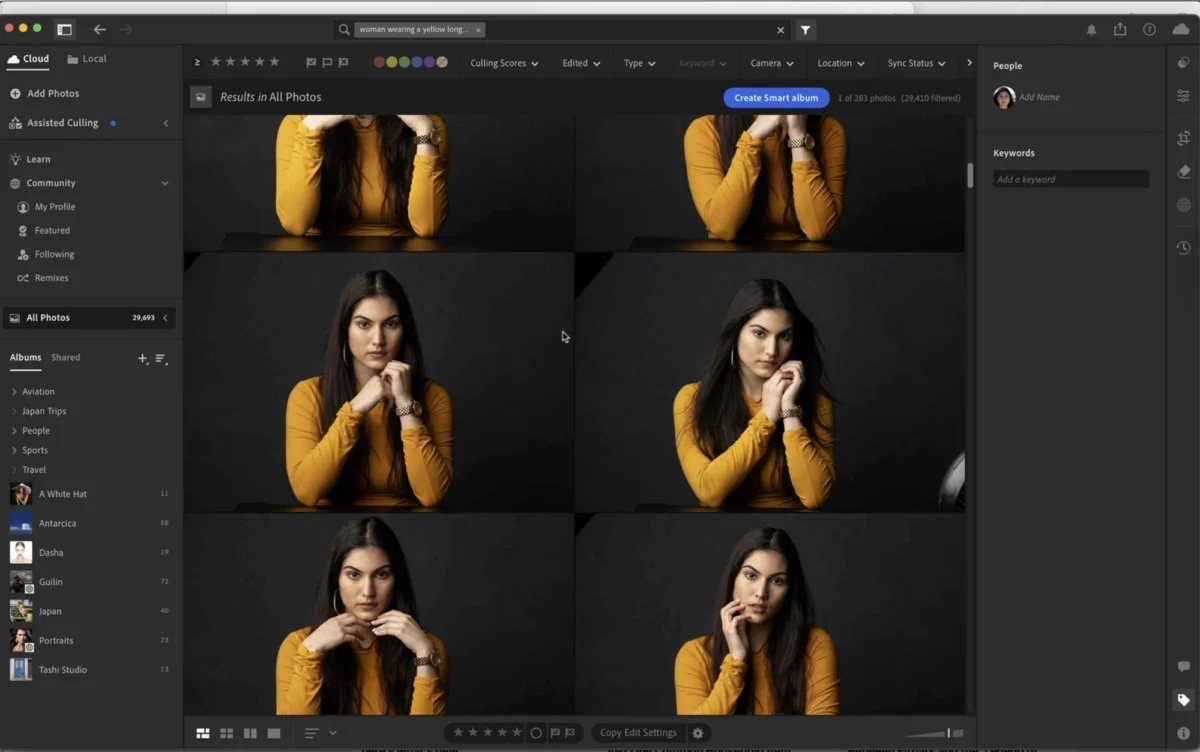
The latest suite of enhancements to Adobe Lightroom, detailed by industry expert Terry White, marks a significant leap forward in photographic post-production, integrating advanced artificial intelligence and machine learning capabilities designed to streamline workflows and unlock new creative possibilities for photographers. These updates, prominently featuring an enhanced Assisted Culling feature, groundbreaking Firefly Generative AI integrations, and superior Generative Upscale technology, are poised to redefine efficiency and quality standards across Lightroom Classic, Desktop, and Mobile platforms. Released in February 2026, these innovations underscore Adobe’s continued commitment to embedding cutting-edge AI into its Creative Cloud ecosystem, offering solutions that address long-standing pain points for professionals and enthusiasts alike.
Streamlining Selection: The Enhanced Assisted Culling Feature
One of the most anticipated features in the February 2026 update is the significantly enhanced Assisted Culling, currently available in early access for Lightroom Classic and Desktop users. This intelligent tool leverages sophisticated algorithms to dramatically accelerate the often-tedious process of reviewing and selecting images from large shoots. Historically, photographers would spend hours manually sifting through hundreds or thousands of photographs, a task that, while critical, consumed valuable time that could otherwise be dedicated to creative editing or client work.
The updated Assisted Culling feature introduces two key functionalities that directly tackle this inefficiency. Firstly, it intelligently helps photographers "quickly spot sharp images." Utilizing advanced image analysis, the system identifies and flags photographs that exhibit optimal focus and minimal motion blur, presenting them for prioritized review. This precision is invaluable, especially in dynamic shooting environments such as sports, events, or wildlife photography, where capturing a perfectly sharp image can be challenging. By reducing the manual effort of zooming in on each image to check for sharpness, photographers can significantly reduce their initial selection time.
Secondly, and perhaps even more remarkably, the feature is designed to "check group shots to see if your subject’s eyes are all open." This addresses a common and frustrating challenge in portrait and group photography, where even a single blink can render an otherwise perfect shot unusable. The AI analyzes facial expressions within group compositions, flagging instances where subjects’ eyes may be closed or partially obscured. This proactive identification allows photographers to quickly identify and set aside problematic images, ensuring that only the most viable options proceed through the editing pipeline. The early access availability indicates Adobe’s iterative development approach, allowing real-world feedback to refine the feature before its full release, a strategy that has proven successful in previous Adobe product rollouts.
Revolutionizing Correction and Creation with Firefly Generative AI
The February 2026 Lightroom updates demonstrate Adobe’s deep integration of its proprietary Firefly Generative AI, pushing the boundaries of what is possible in image manipulation. Terry White’s demonstration highlighted two transformative applications: generating video from a still image and advanced group shot corrections.
The ability to "generate video from a still" is a groundbreaking development. This feature enables photographers to transform a static photograph into a dynamic, short video clip directly within the Lightroom environment, by sending images to Firefly. While the specifics of the video generation (e.g., duration, types of motion, resolution) require further detailed exploration, the mere existence of this capability signifies a paradigm shift. It opens up new avenues for content creators, particularly those operating in social media, marketing, or multimedia storytelling, where dynamic visuals are increasingly paramount. Imagine a landscape photographer being able to instantly animate clouds or water from a single still image, or a product photographer creating a subtle pan and zoom effect to highlight product details without needing dedicated video editing software. This integration blurs the lines between photography and videography, offering a seamless transition for creators looking to diversify their output.
Even more immediately impactful for many photographers is the enhanced capability to "fix group shots—like opening closed eyes—by sending images directly to Firefly." This builds upon the Assisted Culling’s identification capability by offering a powerful, AI-driven solution for correction. If the Assisted Culling identifies closed eyes in a group shot, photographers can now send that image to Firefly, which can then intelligently regenerate the problematic area, seamlessly "opening" closed eyes based on other subjects’ expressions or general facial anatomy. This eliminates the need for complex manual retouching, tedious head swaps from other frames, or even reshoots, saving immense time and effort. The ethical implications of such powerful generative AI in altering reality are an ongoing discussion within the photographic community, prompting calls for transparency and responsible use. However, its practical benefits for salvageable images are undeniable, offering a powerful tool for delivering perfect client assets. This direct integration of Firefly within Lightroom signifies a move towards a more holistic and interconnected creative ecosystem within Adobe’s offerings, leveraging the power of its generative AI across multiple applications.
Elevating Quality and Performance: Generative Upscale and Platform Optimizations
Beyond the generative AI advancements, the February 2026 updates also focus on improving image quality and overall user experience. The introduction of "Generative Upscale using Topaz Gigapixel" represents a significant enhancement for photographers needing to enlarge images without sacrificing detail or introducing artifacts. Upscaling, the process of increasing an image’s resolution, has historically been a challenging task, often resulting in pixelation or a loss of sharpness. Topaz Gigapixel AI is renowned in the industry for its state-of-the-art AI-powered upscaling technology, capable of generating astonishingly high-quality enlarged images by intelligently inferring missing pixel data.
The integration of this technology directly into Lightroom means photographers can now produce larger prints, crop more aggressively, or repurpose images for different high-resolution applications with unprecedented quality. This is particularly beneficial for photographers working with older or lower-resolution cameras, or those who frequently need to make significant crops in post-production. The "generative" aspect implies that the upscaling is not merely interpolative but intelligently "creates" detail, resulting in a more natural and sharper final output. This partnership with a leading third-party AI solution demonstrates Adobe’s pragmatic approach to delivering the best tools to its users, whether developed in-house or through strategic collaborations.
Furthermore, the updates include critical "performance improvements for Mobile and Classic users." For Lightroom Classic, a desktop-centric application favored by many professional photographers for its robust local file management, performance enhancements are always welcome. These improvements likely translate to faster import/export times, smoother brush operations, quicker module switching, and more responsive rendering of adjustments, directly impacting daily productivity. Given the increasing complexity of editing tasks and the growing size of image libraries, these optimizations are crucial for maintaining a fluid and frustration-free workflow.
Similarly, performance improvements for Lightroom Mobile address the evolving landscape of photography. With the proliferation of advanced smartphone cameras and the increasing trend of on-the-go editing, a highly responsive mobile application is essential. These enhancements could include faster loading times, smoother synchronization with the cloud, more responsive editing sliders, and improved stability, enabling photographers to make quick edits and share content efficiently from anywhere. This dual focus on both desktop and mobile performance ensures that Lightroom remains a versatile and powerful tool across the entire spectrum of photographic workflows.
The Broader Context: Adobe’s AI Strategy and Industry Impact
These February 2026 Lightroom updates are not isolated features but integral components of Adobe’s overarching strategy to infuse artificial intelligence across its entire Creative Cloud suite. Adobe Sensei, the company’s AI and machine learning framework, has been powering intelligent features for years, but the advent of generative AI, particularly with Firefly, marks a new era. By integrating Firefly directly into core applications like Lightroom, Adobe is democratizing access to highly sophisticated AI capabilities that were previously complex or time-consuming to achieve.
The move also reinforces Adobe’s position as a leader in creative software. In a competitive landscape featuring powerful alternatives, continuous innovation, especially in AI, is critical for retaining market share and attracting new users. These updates serve to strengthen the value proposition of the Creative Cloud subscription model by consistently delivering cutting-edge tools that significantly enhance user productivity and creative output.
From an industry perspective, these developments have profound implications. The enhanced Assisted Culling, for instance, reflects a growing industry trend towards automation in initial workflow stages, allowing creatives to focus on higher-value tasks. The generative AI capabilities, particularly for image correction and video generation from stills, signal a future where the distinction between "capturing" and "creating" imagery becomes increasingly fluid. This shift presents both opportunities and challenges, prompting discussions on authenticity, copyright, and the evolving role of the photographer.
The integration of Topaz Gigapixel AI also highlights a broader trend of collaboration and specialization in the tech industry. Rather than attempting to build every component in-house, companies like Adobe are increasingly partnering with specialists to deliver best-in-class features, ultimately benefiting the end-user.
In conclusion, the February 2026 Lightroom updates, expertly showcased by Terry White, represent a significant evolution in photo editing technology. By combining intelligent culling, powerful generative AI for creative and corrective tasks, advanced upscaling, and crucial performance optimizations, Adobe is not just offering new tools; it is reshaping the very fabric of the photographic workflow. These innovations promise to save countless hours, unlock new creative potential, and ensure that Lightroom remains at the forefront of digital imaging for years to come, affirming Adobe’s vision for an AI-powered future of creativity.