Fireworks are no longer confined to the Fourth of July, finding their way into the celebratory tapestry of theme parks, sporting events, and, perhaps most surprisingly, weddings. For couples and photographers alike, fireworks offer a spectacular, dynamic backdrop for creating truly unforgettable portraits. This guide delves into the intricacies of capturing these ephemeral moments, transforming a potentially challenging lighting scenario into an opportunity for breathtaking artistry. Drawing upon the expertise of seasoned wedding photographers, we explore the essential techniques, equipment considerations, and creative strategies needed to freeze the flash and excitement of a grand finale in your couples’ portraits.

The fleeting nature of fireworks, typically lasting between five to eight minutes, demands precision and efficiency. Photographers must be meticulously prepared, with a clear understanding of their location, equipment, and desired shots before the first fuse is lit. This guide, featuring insights and images from photographers associated with Wedding Maps, aims to equip professionals with the knowledge to produce stunning, action-packed images that embody the celebratory spirit of a wedding.
Strategic Location Scouting: The Foundation of a Stellar Shot
The journey to capturing iconic fireworks portraits begins long before the first sparkler ignites. Identifying the optimal vantage point is paramount, a process that requires proactive communication and thorough reconnaissance. Wedding photographers are advised to engage with the couple and their wedding planner early in the planning stages to ascertain the exact location and timing of any planned fireworks displays. Venue staff can also provide invaluable information regarding the launch site and potential viewing angles.

The definition of the "best" angle is subjective and depends on the desired photographic outcome. An expansive view, showcasing fireworks bursting across the entire sky with the couple as silhouetted figures gazing upwards, requires an open area. Conversely, incorporating foreground elements like trees or architectural features can add depth and context, framing the couple and the pyrotechnics within a richer visual narrative. Meticulous scouting allows photographers to pre-visualize compositions, ensuring they are positioned to maximize the visual impact of both the couple and the fireworks. This compositional foresight is critical for achieving a balanced and compelling image.
Mastering Dynamic Range: RAW Files and Exposure Settings
Photographing fireworks presents a formidable challenge due to the extreme contrast between the dark ambient light and the intensely bright explosions. To effectively manage this dynamic range and preserve crucial details in both the shadowy foreground and the luminous sky, capturing images in RAW format is non-negotiable. RAW files offer significantly more flexibility in post-production for recovering details in highlights and shadows compared to the compressed nature of JPEG files.

RAW Files vs. JPEG: The inherent advantage of RAW lies in its uncompressed data, providing a wider latitude for editing. This is particularly vital when dealing with the stark differences in illumination characteristic of fireworks displays. JPEG compression, while convenient for immediate use, discards image data, making it difficult to recover subtle nuances in either the darkest or brightest areas of a photograph. For fireworks portraits, where balancing the couple’s illumination with the pyrotechnic spectacle is key, RAW is the undisputed choice.
Exposure Settings: A recommended starting point for exposure settings during fireworks photography involves a carefully balanced approach.

- Aperture: An aperture of f/8 to f/11 is generally advisable. This range offers a good balance between depth of field, ensuring the couple remains sharp, and allowing sufficient light to enter the lens without causing excessive diffraction.
- Shutter Speed: Long exposures are essential. A shutter speed of 5 to 10 seconds is a common starting point. This allows the camera to capture the trails of light as fireworks ascend and explode, creating a sense of motion and filling the frame with color. Shorter exposures, around 2 to 5 seconds, will capture less of the firework’s light trails but may offer more defined bursts.
- ISO: Keeping the ISO as low as possible, typically between 100 and 400, is crucial to minimize digital noise, especially in the darker areas of the image.
Crucially, photographers must utilize their camera’s histogram. This visual representation of tonal distribution helps prevent blown-out highlights (data pushed too far to the right) or completely black shadows (data pushed too far to the left). The goal is to achieve a balanced histogram that represents the full spectrum of light present in the scene without clipping either extreme.
Harmonizing White Balance for Consistent Color
The color cast of fireworks can vary dramatically, and achieving a consistent and aesthetically pleasing white balance is key. A common starting point for white balance when photographing fireworks is the "Tungsten" preset, which often approximates the color temperature of artificial lights and can help counteract the cooler tones of the night sky.

If artificial lighting is being used to illuminate the couple, such as flashes or continuous lights, the application of a CTO (Color Temperature Orange) gel to the light source is recommended. This gel will warm the light, and the camera’s white balance can then be set to approximately 3200 Kelvin. Fine-tuning this setting in real-time, based on the visual feedback from the camera’s LCD screen and the desired artistic outcome, is essential for achieving harmonious colors between the fireworks and the subjects.
Selecting the Right Lens: From Wide-Angle Grandeur to Telephoto Compression
The choice of lens significantly influences the composition and overall feel of fireworks portraits. The desired field of view is a primary determinant. For wide, expansive shots that capture the couple within a grand spectacle, a wide-angle lens is often preferred. These lenses allow for the inclusion of a broad panorama, encompassing both the couple and a significant portion of the pyrotechnic display. However, photographers must be mindful that using a wide-angle lens can sometimes make communication with the couple challenging if they are positioned at a distance.

Alternatively, a zoom lens can offer versatility, particularly for tighter shots. When used to compress the scene, a zoom lens can make the fireworks appear larger and more dominant in the frame relative to the couple. This technique can create a sense of intimacy and focus attention on the explosive beauty above. It is also a practical consideration if the shooting space is limited. Photographers should remember that even if a wide shot is captured, judicious cropping in post-production can often refine the composition without compromising image quality.
Embracing Long Exposures: Capturing the Dance of Light
The essence of photographing fireworks lies in the deliberate use of long exposures. This technique allows the camera’s sensor to collect light over an extended period, resulting in brighter images and, crucially, capturing the mesmerizing trails of light left by the fireworks as they streak across the night sky. Exposures ranging from five to ten seconds are typically employed to render the full glory of the pyrotechnics.

To execute long exposures effectively, a stable platform is indispensable. A sturdy tripod is paramount to prevent camera shake, which would otherwise result in blurred and unappealing images. Furthermore, minimizing direct physical contact with the camera during the exposure is vital. This can be achieved through the use of a cable release, a remote control button, or the camera’s built-in self-timer, usually set to a two-second delay. These measures ensure that the act of pressing the shutter button does not introduce unwanted vibrations, leading to sharp and pristine long-exposure photographs.
Illuminating Your Subjects: The Art of Balancing Light
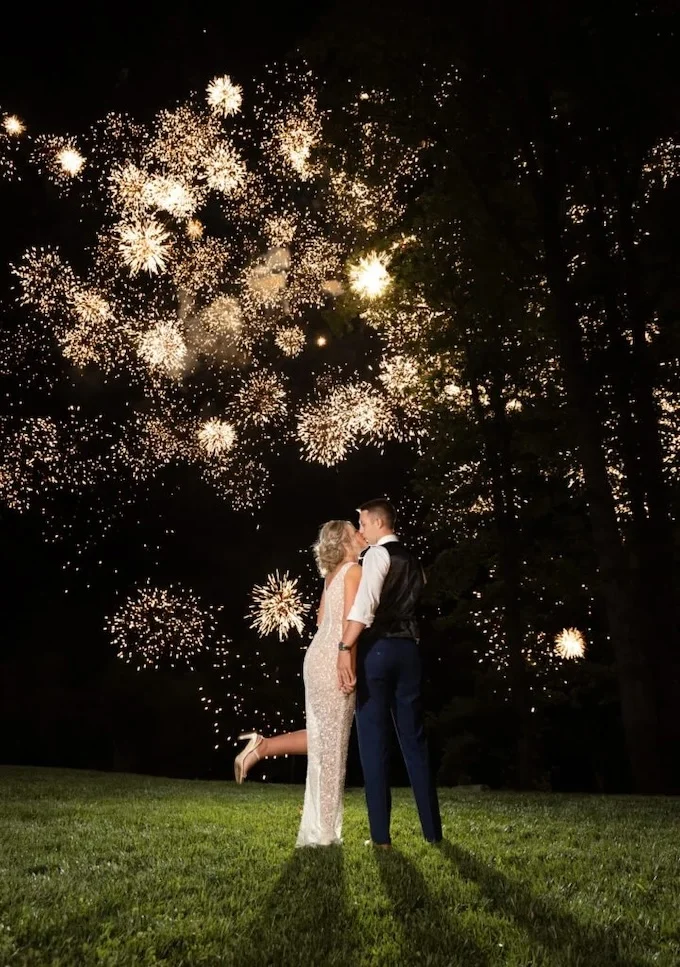
While traditional fireworks photography often focuses solely on the pyrotechnics, couples portraits necessitate careful illumination of the subjects. This requires a deliberate and well-executed lighting strategy to ensure the couple is visible and well-defined against the dramatic sky. The advantage here is that, with sufficient planning time, photographers can dial in flash power and exposure settings before the fireworks commence.

The fundamental approach involves lighting the couple as if fireworks were not present, establishing a baseline exposure that balances the flash output with the ambient light. A common lighting setup involves positioning the light source at approximately a 45-degree angle to the couple and camera, often with a slightly top-down orientation. This creates natural-looking shadows and highlights on their faces and attire.
To further enhance the subjects’ separation from the background and add dimension, a backlight can be employed. Alternatively, modifiers such as snoots or grids can be used to precisely control light spill, concentrating the illumination directly onto the couple and preventing light from washing out the fireworks or creating distracting ambient illumination. The specific lighting configuration will ultimately be guided by the photographer’s creative vision and the desired aesthetic.

The Precision of Manual Focus
Autofocus systems can struggle in low-light conditions and when faced with rapidly moving, brightly colored subjects like fireworks. This can lead to missed shots or unfocused portraits. To circumvent these issues, switching the lens to manual focus is a critical step.
If the camera features live view functionality, it can be invaluable for achieving precise focus. The photographer can use autofocus to lock onto the couple initially (before the fireworks begin) or manually zoom in on their faces within the live view display to achieve critical sharpness. Once focus is established, it is imperative to confirm that the lens is set to manual focus and to leave it in that mode throughout the fireworks display. This ensures that the focus remains locked on the couple, even as the dynamic and unpredictable nature of the fireworks unfolds.

Crafting a Composite: The Power of Layered Storytelling
For photographers seeking ultimate control over the final image, creating a composite is a powerful technique. This involves combining separate exposures of the couple and the fireworks into a single, cohesive image. This method is particularly effective for ensuring the couple is perfectly lit and posed, while also allowing for the capture of multiple, stunning fireworks sequences.
Lightroom Workflow: The compositing process typically begins in photo editing software like Adobe Lightroom. It is essential to edit the batch of images intended for the composite consistently. A streamlined approach involves editing the primary portrait of the couple first, meticulously adjusting exposure, color balance, and other parameters to achieve the desired look. Once this master edit is complete, it can be applied to all other selected images through a batch editing process, ensuring visual harmony across the composite elements.

Photoshop Integration: The edited images are then imported into Adobe Photoshop and stacked into a single document. The blend mode for the layers containing the fireworks is set to "Lighten." This mode selectively reveals the brightest pixels, effectively layering the vibrant bursts of fireworks over the couple’s portrait. Layer masks are then employed to meticulously mask out any unwanted elements from each layer, such as distracting foreground objects or less aesthetically pleasing fireworks, allowing the best parts of each exposure to shine through and create a seamless, dramatic final image.
Illuminating Love: The Art of Sparkler Photography
While distinct from large-scale pyrotechnics, sparklers frequently feature in wedding celebrations, particularly during grand exits. Their inclusion in a couples’ portrait session adds a unique charm and festive atmosphere. Photographers can leverage similar principles to those used for fireworks, with some specific considerations for these handheld light sources.

Embrace Larger Sparklers: When recommending sparklers to couples for photographic purposes, advise them to opt for larger varieties, such as 36-inch sparklers, over smaller 10-inch versions. The extended burn time of larger sparklers provides a more generous window for posing the couple and capturing multiple shots, allowing for greater creative flexibility and ensuring that everyone involved has ample time to participate.
Optimizing Exposure for Sparklers: Sparklers, as a light source, are relatively weak. Therefore, photographers must be prepared to either supplement with external lighting or adjust camera settings to compensate for the dim conditions. The approach will vary depending on whether the subjects are moving or remaining static.

- Moving Subjects: For dynamic shots where subjects are moving, such as during a sparkler exit, a higher ISO and a wider aperture are generally recommended. This allows for faster shutter speeds to freeze motion while still gathering sufficient light. A starting point might involve an ISO of 800-1600, an aperture of f/2.8-f/4, and a shutter speed of 1/125s or faster.
- Static Subjects: For posed portraits with sparklers, lower shutter speeds can be employed, allowing the sparkler’s light to create trails and illuminate the subjects more effectively. This might involve an ISO of 100-400, an aperture of f/8-f/11, and shutter speeds of 1 second or longer, used in conjunction with a tripod.
Safety First: The Essential Safety Bucket
Working with open flames, even small ones like sparklers, necessitates a strong emphasis on safety. A readily accessible safety bucket filled with water is an indispensable piece of equipment. After the sparklers have served their photographic purpose, they must be immediately and safely extinguished. Having a designated bucket of water nearby ensures that used sparklers can be promptly and securely disposed of, mitigating any fire hazards.

Conclusion: A Sky Full of Memories
Photographing fireworks and sparklers at weddings elevates couples’ portraits from traditional to extraordinary. By meticulously planning locations, mastering exposure and white balance settings, selecting appropriate lenses, and utilizing techniques like long exposures and creative compositing, photographers can transform a fleeting spectacle into enduring visual art. The inclusion of these dazzling displays adds an undeniable layer of magic and excitement to wedding photography, creating cherished memories that sparkle for a lifetime. The accompanying images serve as a testament to the creative possibilities and provide a rich source of inspiration for future endeavors in capturing love under a sky ablaze.