
Artificial intelligence has fundamentally altered the velocity of visual content production, enabling marketers to transform abstract concepts into high-fidelity imagery within seconds. This technological leap has shifted the creative bottleneck from the labor-intensive process of production to the complex challenges of governance, legal compliance, and brand consistency. While generative AI tools like Midjourney, DALL-E, and Adobe Firefly have democratized the ability to create "attractive" visuals, the industry is now confronting a critical distinction between an image that looks impressive and one that is "commercial-ready." As marketing departments move beyond the experimental phase of AI adoption, the demand for professionally vetted, licensed, and technically superior assets is reaching a historic peak, necessitating a hybrid approach that combines synthetic speed with traditional creative rigors.
The Evolution of Visual Production: From Film to Generative AI
To understand the current state of the market, one must look at the chronology of commercial imagery. For decades, the primary constraint was physical production. A standard campaign required a multi-stage pipeline involving location scouting, talent casting, professional photography, and weeks of post-production. The rise of digital stock photography in the early 2000s, pioneered by platforms such as Shutterstock and Getty Images, provided the first major efficiency boost, allowing brands to bypass the "shoot-for-everything" model.
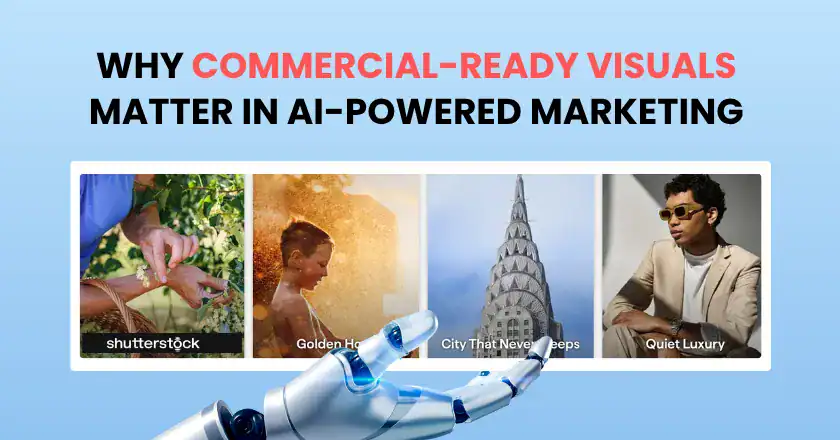
The current era, defined by the 2022-2023 explosion of generative AI, represents the third major shift in this timeline. According to industry reports, the volume of digital content is expected to grow exponentially, with some estimates suggesting a 600% increase in the need for visual assets by 2026. However, this abundance has created a "signal-to-noise" problem. While a designer can now generate fifty variations of a background in the time it once took to crop a single photo, the time spent vetting those assets for commercial safety has increased proportionately.
Defining the "Commercial-Ready" Standard
The term "commercial-ready" refers to a specific set of technical and legal criteria that an image must meet before it can be used in paid advertising or global campaigns. In the context of AI-powered marketing, this involves four primary pillars:
1. Legal Indemnification and Provenance
One of the most significant risks of "raw" AI-generated content is the lack of clear copyright ownership. In the United States, the U.S. Copyright Office has consistently ruled that images created solely by AI without significant human creative input cannot be copyrighted. Furthermore, many open-source AI models were trained on datasets that included copyrighted material without the creators’ consent. For a global brand, using an asset with "muddy" provenance is a liability risk that could lead to multi-million dollar lawsuits. Commercial-ready visuals, conversely, come with ironclad licensing agreements and indemnification, ensuring the brand has the legal right to use the image across all jurisdictions.

2. Model and Property Releases
A visually perfect AI image might inadvertently include a face that resembles a real person or a building that is protected by trademark laws (such as the Eiffel Tower’s nighttime lighting or the Burj Al Arab). Professional stock libraries solve this through rigorous metadata and release management. Every recognizable person or private property in a commercial-ready asset has a signed release on file—a safeguard that most generative AI tools cannot yet guarantee with 100% certainty.
3. Technical Scalability
Generative AI often produces images at a standard web resolution (72 DPI), which may look excellent on a smartphone screen but fails when scaled for a 48-sheet billboard or a high-definition 4K display. Commercial-ready assets are typically provided in high-resolution, uncompressed formats with professional color grading. This technical foundation allows for "lossless" editing, enabling a single asset to be adapted for a social media post, a print brochure, and a television commercial without a drop in quality.
4. Brand Coherence and "The Uncanny Valley"
AI-generated images frequently suffer from "hallucinations"—anatomical errors, inconsistent lighting, or a generic aesthetic that can make a brand feel "cheap" or untrustworthy. Maintaining a consistent visual identity is the hallmark of luxury and enterprise brands. When every image in a campaign has a slightly different lighting temperature or artistic style, brand recognition suffers.

The Economic Reality: Efficiency vs. Risk
From a budgetary perspective, the shift toward AI has been framed as a cost-saving measure. However, a brief analysis of the "total cost of ownership" for a visual asset reveals a different story. While the "cost per prompt" is near zero, the cost of a legal department reviewing a campaign or the cost of a public relations crisis stemming from a trademark violation is astronomical.
Industry data suggests that marketing agencies are increasingly adopting a "70/30" hybrid model. In this framework, 70% of a campaign’s visual foundation is built using "known-good," professionally produced stock or custom photography, while 30%—the adaptations, background variations, and platform-specific crops—is handled by AI-assisted tools. This approach maximizes the speed of AI while anchoring the campaign in the safety and quality of commercial-ready material.
Industry Reactions: The Shift Toward Partnership
The response from major industry players reflects this need for stability. Shutterstock, for example, has moved to integrate AI not as a replacement for its library, but as a layer on top of it. By partnering with organizations like OpenAI and LG, they have developed "ethically sourced" AI models trained on their own vast libraries of licensed content. This ensures that when a marketer uses an AI tool within their platform, the resulting image is backed by the same commercial protections as a traditional photograph.

Statements from Chief Marketing Officers (CMOs) at Fortune 500 companies indicate a growing "AI fatigue" regarding the lack of control. "Speed is a commodity; trust is the new currency," noted one executive in a recent industry roundtable. "We don’t need a thousand images; we need ten images that we know won’t get us sued and that perfectly match our brand’s color palette."
Global Marketing and the Challenge of Localization
For international brands, commercial readiness also encompasses cultural sensitivity and local relevance. A generative AI tool might produce a "generic" office setting, but it often defaults to Western-centric aesthetics. A global campaign requires localized versions that reflect the specific demographics, architecture, and cultural nuances of markets like Tokyo, São Paulo, or Dubai.
Professional stock libraries have spent decades building diverse, global contributor networks. By using these assets as the "source material," AI tools can then be used to make minor adjustments—such as changing the time of day or the weather in a scene—without losing the authentic cultural representation of the original photograph. This modular approach is becoming the standard for global "always-on" marketing.

The Future: Provenance and Content Authenticity
As the digital landscape becomes increasingly saturated with synthetic media, the concept of "provenance" will move from a legal necessity to a consumer demand. Initiatives like the Content Authenticity Initiative (CAI) and the C2PA standard are working to create a "nutrition label" for digital content, showing exactly how an image was made and where it came from.
In this future, commercial-ready visuals will be those that carry a verified digital history. Brands that can prove their imagery is ethically sourced and professionally vetted will likely see higher levels of consumer trust. This suggests that rather than making professional photography obsolete, AI is actually increasing the value of "human-in-the-loop" content. The original photograph becomes the "truth anchor" in a sea of generated variations.
Conclusion: The Strategic Integration of AI and Stock
The narrative that AI will "kill" the stock photography industry is being replaced by a more nuanced reality: AI is transforming stock content into "creative raw material." A high-quality, commercially-ready image is no longer a static end-product; it is a versatile foundation that can be extended, morphed, and scaled through AI-assisted editing.

The most successful marketing departments in the coming decade will be those that do not treat AI and professional imagery as competing forces. Instead, they will utilize large, professionally curated libraries to provide the structure, legality, and quality that commercial communication requires, while using AI to provide the agility and volume that the modern digital ecosystem demands. In an era where anyone can generate an image, the true competitive advantage lies in knowing which images are actually fit for the world stage. The "commercial-ready" standard is not a hurdle to innovation; it is the safety net that allows true innovation to happen at scale.