The landscape of modern conflict has been irrevocably altered by the rapid industrialization and deployment of First-Person View (FPV) drones, a phenomenon most prominently visible in the ongoing defense of Ukraine. Since the onset of the full-scale Russian invasion in early 2022, the Ukrainian military-industrial complex has undergone a radical transformation, evolving from a reliance on traditional Soviet-era hardware to becoming a global leader in low-cost, high-precision aerial technology. This shift is not merely a tactical adjustment but a comprehensive strategic pivot that has seen the domestic production of FPV drones surge to unprecedented levels. As of early 2025, the Ukrainian government has committed more than $2.6 billion toward the procurement of unmanned aerial vehicles (UAVs), with an ambitious production target exceeding 4.5 million FPV units for the current year alone. This massive mobilization of resources underscores a new reality in 21st-century warfare: the democratization of precision strikes through decentralized, high-volume manufacturing.
The Industrial Mobilization of 2025: Scaling for Survival
The decision to scale FPV drone production to the millions is rooted in the harsh mathematical reality of the front lines. Unlike traditional artillery shells, which require massive industrial plants and complex supply chains to produce, FPV drones can be assembled in smaller, decentralized workshops, making the production network resilient against long-range missile strikes. The 2025 target of 4.5 million units represents a nearly fourfold increase over previous annual objectives, reflecting a maturing ecosystem of over 200 domestic companies currently engaged in UAV development.
This industrial surge is supported by the "Army of Drones" initiative, a joint project between the Ministry of Digital Transformation, the Ministry of Defense, and the General Staff of the Armed Forces. By streamlining the bureaucratic process for military certification—reducing it from months to mere weeks—the Ukrainian government has allowed startups and established defense firms to iterate their designs at a pace previously unseen in military procurement. The result is a diverse fleet of drones tailored for specific roles, including anti-personnel "kamikaze" strikes, anti-armor operations, and night-time reconnaissance using thermal imaging.
A Chronology of Tactical Evolution: From 2022 to the Present
To understand the current scale of production, one must examine the timeline of Ukraine’s drone integration. In the early months of 2022, the Ukrainian defense relied heavily on commercial off-the-shelf (COTS) drones, primarily used for reconnaissance and artillery spotting. However, as the conflict transitioned into a war of attrition, the need for an inexpensive alternative to precision-guided munitions became apparent.
By mid-2023, the first mass-produced FPV drones began appearing on the battlefield in significant numbers. These devices, operated by pilots wearing virtual reality-style goggles, allowed for manual steering into high-value targets such as tank hatches or ammunition depots. The success of these early units led to the establishment of dedicated "Strike UAV" companies within every brigade of the Ukrainian Armed Forces.
In 2024, the focus shifted from quantity to technological sophistication. Producers began integrating artificial intelligence (AI) for terminal guidance, allowing drones to lock onto targets even if the pilot’s radio link was severed by electronic warfare (EW). Entering 2025, the focus has expanded to include "drone swarms" and the development of specialized carriers that can transport multiple FPV drones closer to the target zone, extending their operational range and lethality.
Technical Specifications and the Advantage of FPV Systems
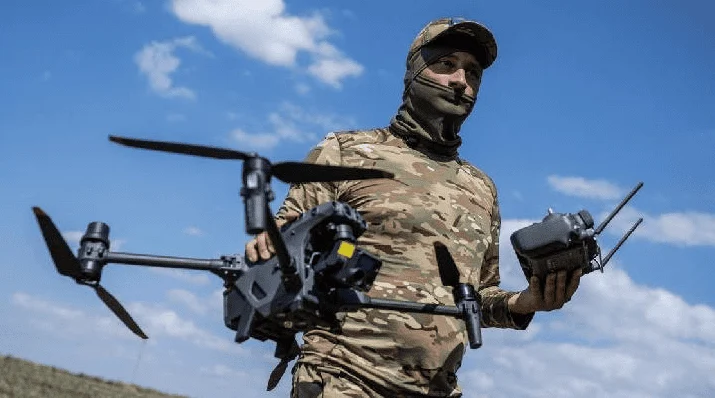
The FPV drone’s primary advantage lies in its maneuverability and the immersive perspective it provides the pilot. Unlike standard GPS-guided drones, an FPV pilot sees exactly what the drone sees in real-time with minimal latency. This allows for surgical strikes in complex environments, such as flying into a bunker door or navigating through dense forest canopies where traditional weapons would fail.
From a technical standpoint, the current generation of Ukrainian-produced FPV drones features several key innovations:
- Frequency Agility: To counter Russian electronic countermeasures, manufacturers are producing drones that can operate across a wide spectrum of radio frequencies, often switching automatically to avoid jamming.
- Payload Versatility: Standardized mounting systems allow operators to attach various munitions, from PG-7V anti-tank grenades to custom-made thermobaric explosives.
- Enhanced Battery Life: Advances in lithium-ion and solid-state battery technology have pushed the flight time of these small quadcopters from 10 minutes to nearly 25 minutes, significantly increasing the "kill zone" around the launch point.
The Economic Logic of Asymmetric Warfare
One of the most compelling aspects of the Ukrainian FPV program is its cost-effectiveness. A standard FPV drone costs between $400 and $600 to produce. In contrast, a modern main battle tank, such as a T-90, costs upwards of $4.5 million. This disparity creates a favorable economic ratio for the defender; a single successful strike can result in a return on investment of nearly 10,000 to 1.
The economic impact extends beyond the battlefield. The surge in production has fostered a burgeoning tech sector within Ukraine. Thousands of engineers, software developers, and assembly technicians have found employment in the drone industry, creating a "war-tech" hub that is likely to become a major exporter of defense technology once the conflict concludes. The 22% increase in FPV strikes recorded in February 2025 alone serves as a statistical testament to the increasing efficiency of this domestic industrial base.
Overcoming Logistical and Electronic Barriers
Despite the rapid growth, the industry faces significant hurdles. The most pressing challenge is the reliance on imported components. While the airframes, software, and assembly are Ukrainian, critical parts such as brushless motors, electronic speed controllers (ESCs), and microchips are largely sourced from global markets, particularly China. Supply chain disruptions or export restrictions pose a constant threat to production targets.
Furthermore, the "radio-electronic struggle" remains a cat-and-mouse game. As Ukrainian drones become more effective, Russian forces deploy more sophisticated jamming stations. This has necessitated a shift toward fiber-optic controlled drones—which are immune to radio jamming—and the aforementioned AI-driven autonomous terminal homing. Security is another concern; because production is decentralized across hundreds of small sites, ensuring the physical and cybersecurity of these facilities against espionage and sabotage is a monumental task for Ukrainian intelligence services.
Institutional Support and Global Implications
The Ukrainian government has taken an active role in fostering this ecosystem through the "Brave1" defense-tech cluster. This platform acts as a bridge between private developers and the military, providing grants, testing grounds, and direct feedback from frontline operators. Mykhailo Fedorov, the Minister of Digital Transformation, has frequently stated that Ukraine’s goal is to become the "most technologically advanced military in the world" regarding unmanned systems.
The global military community is watching these developments with intense interest. NATO member states have begun incorporating lessons from the Ukrainian FPV experience into their own doctrinal updates. The realization that expensive, high-end platforms are vulnerable to swarms of cheap, expendable drones is forcing a re-evaluation of armored vehicle design and infantry tactics worldwide. Many analysts suggest that the "Ukrainian model" of decentralized, high-speed defense innovation will become the standard for medium-sized nations looking to deter larger aggressors.
Future Outlook: The Path to 2026 and Beyond
Looking toward the future, the evolution of FPV drones in Ukraine is moving toward total autonomy and integration. The next phase involves the "Internet of Drones," where UAVs, ground robots, and satellite intelligence are linked in a single, seamless data network. This would allow for automated target prioritization and the deployment of autonomous swarms that can overwhelm enemy defenses without direct human intervention for every unit.
Additionally, the development of "Deepstrike" FPV drones—larger versions designed to travel hundreds of kilometers to hit strategic infrastructure—is already underway. These systems aim to bridge the gap between tactical battlefield tools and strategic long-range missiles.
Conclusion
The production of FPV drones in Ukraine has transcended its initial role as a stopgap measure for artillery shortages to become the cornerstone of the nation’s defense strategy. Through a combination of government investment, private-sector innovation, and battlefield necessity, Ukraine has built a world-class UAV industry under the most difficult conditions imaginable. With a target of 4.5 million drones for 2025 and a proven track record of increasing strike effectiveness, the Ukrainian FPV program stands as a definitive example of how technology can level the playing field in modern warfare. While challenges in the supply chain and electronic warfare persist, the momentum of this "drone revolution" shows no signs of slowing, promising to reshape military strategy for decades to come.