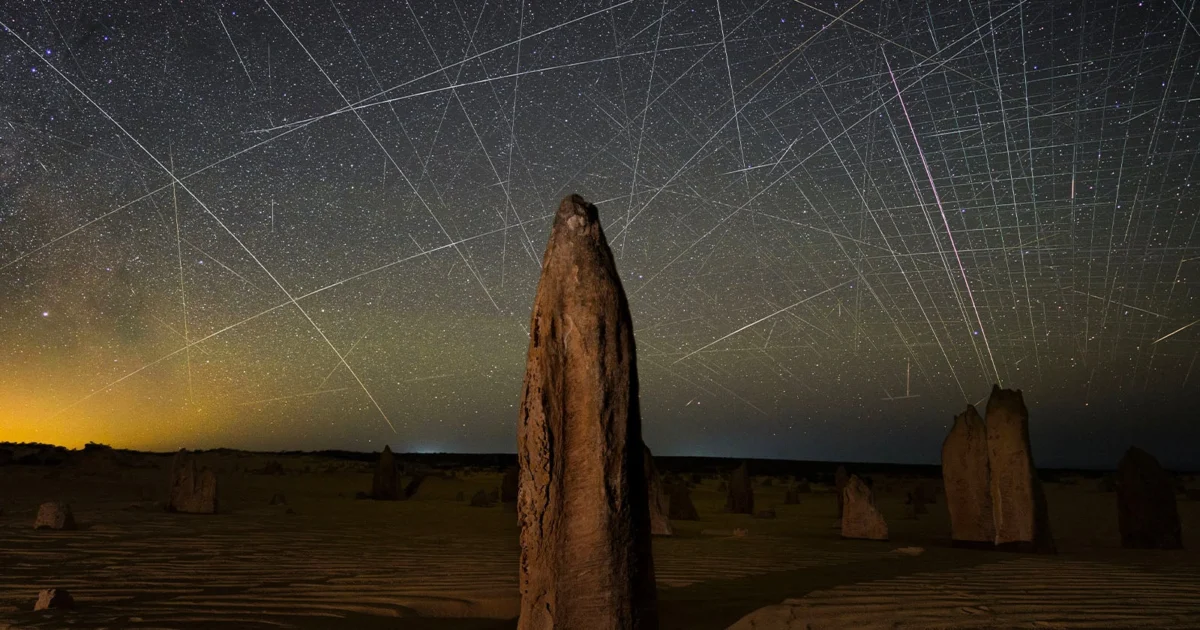
The vast, intricate tapestry of the night sky, long a source of wonder and scientific inquiry, is undergoing an unprecedented transformation. This week, SpaceX marked a monumental achievement, launching its 10,000th active Starlink satellite into low-Earth orbit (LEO). This astonishing milestone underscores a burgeoning challenge to both professional astronomy and the public’s ability to experience an unblemished celestial panorama: the pervasive and rapidly increasing phenomenon of satellite light pollution. While the sheer scale of these orbiting devices is difficult for the human mind to grasp, photographer Joshua Rozells has provided a stark visual testament with his composite image, "Swamped Skies," offering a compelling glimpse into a future where our night sky is increasingly crisscrossed by the trails of human innovation.
The Genesis of "Swamped Skies": An Unintended Revelation
Joshua Rozells, an Australian astrophotographer, embarked on a routine photographic expedition in January 2021 to the dramatic limestone formations of the Pinnacles in Western Australia. His initial objective was to capture the serene beauty of star trails, a long-exposure technique that renders the apparent motion of stars as elegant arcs across the night sky. However, the night delivered an unexpected and profound revelation. Rozells quickly noticed an unusually high number of satellite streaks marring his exposures, a phenomenon far exceeding anything he had encountered previously.
"I was surprised," Rozells recounted to PetaPixel, expressing his initial astonishment. "I had previously seen satellite streaks in my photos but never this many. Previously I might have seen a few over the course of the night, but this night had streaks in almost every photo, particularly those taken in the 90 minutes or so after sunset." This observation marked a pivotal moment, shifting his photographic intent from capturing natural celestial beauty to documenting an emerging environmental concern.
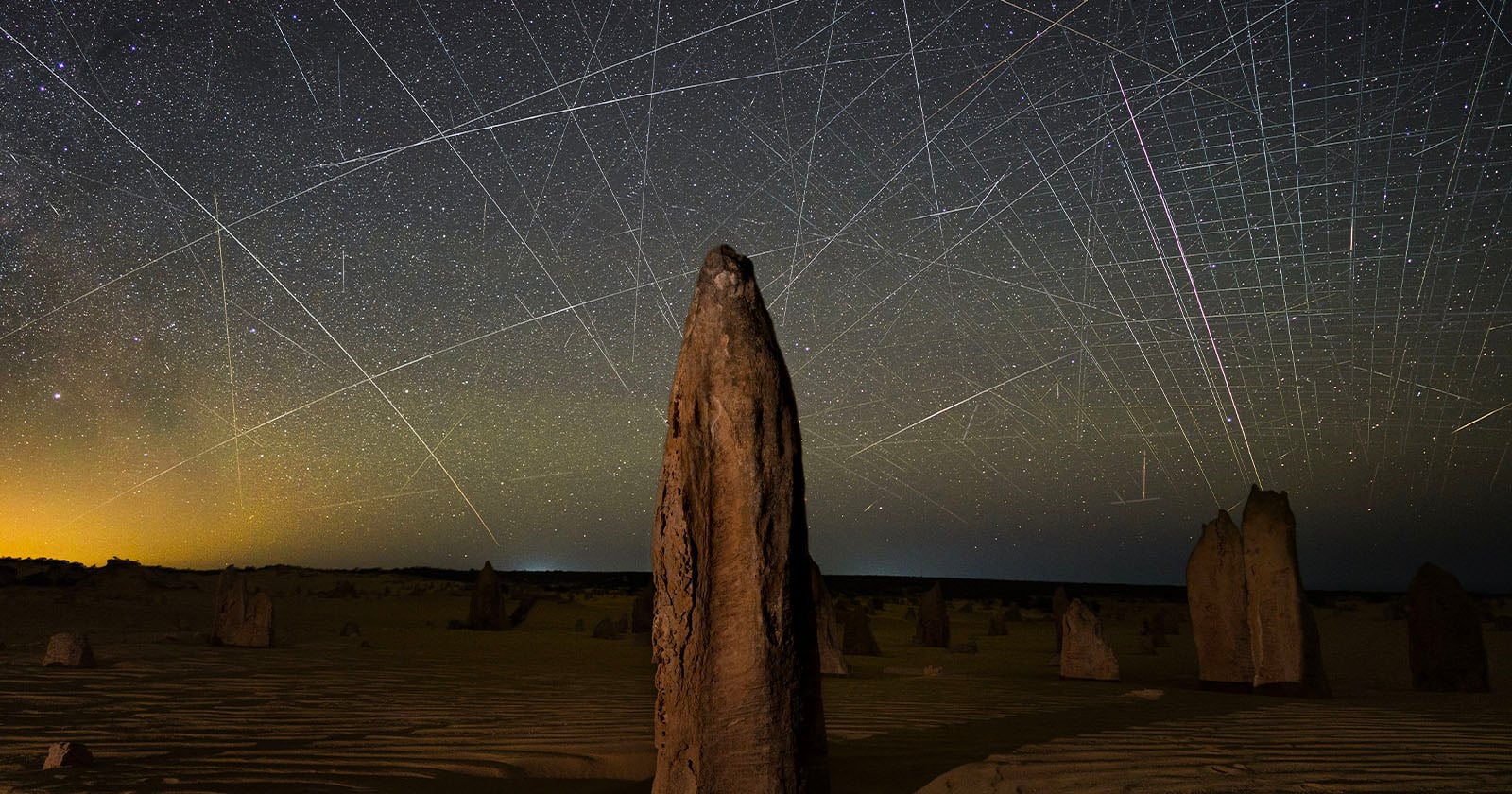
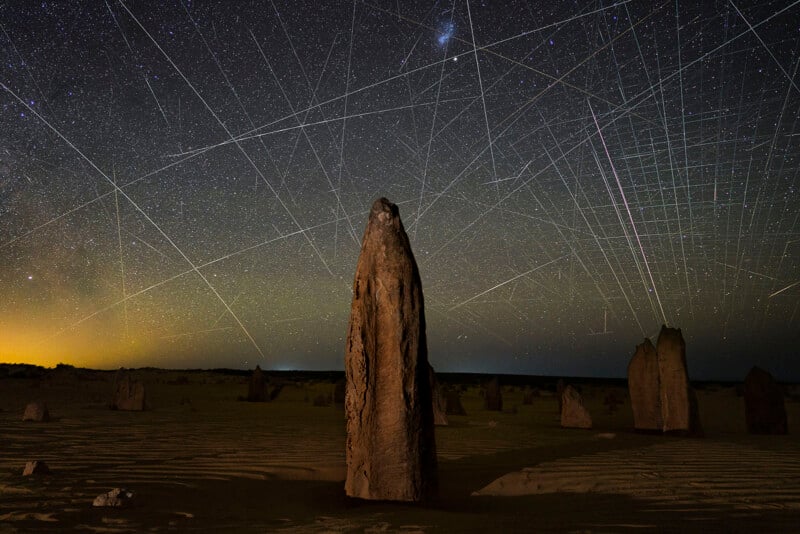
The resulting artwork, "Swamped Skies," is a meticulous composite of 343 individual photographs, each containing at least one discernible satellite streak. Spanning an impressive 85 minutes of continuous capture, the image overlays these numerous streaks onto a single low-light foreground shot of the unique limestone spires. The post-production process was labor-intensive, involving the careful blending of each satellite trail using Photoshop. Rozells amplified the sky’s contrast, highlights, and whites to emphasize the bright lines left by the satellites. He noted the challenge of maintaining sky color consistency due to atmospheric airglow later in the night, requiring precise layer masking around each streak. The final image serves not just as a piece of art but as a powerful, data-rich visualization of the sheer volume of objects now traversing our immediate cosmic neighborhood.
The Rapid Proliferation of Low-Earth Orbit Satellites
While Rozells captured "Swamped Skies" in early 2021, its relevance has only intensified. Since then, thousands more satellites have joined the orbital fray, predominantly driven by the ambition of mega-constellations designed to provide global internet access. SpaceX’s Starlink, a pioneering project in this domain, has been at the forefront of this expansion. The recent milestone of 10,000 active Starlink satellites in low-Earth orbit is a stark indicator of the rapid industrialization of space.
Starlink’s vision is to provide high-speed, low-latency internet connectivity to underserved and remote areas worldwide. To achieve this, the company plans to deploy tens of thousands of satellites, initially targeting a constellation of 12,000, with regulatory approval to potentially expand to 42,000. Each satellite weighs approximately 260 kilograms (573 pounds) and orbits at altitudes typically between 540 and 570 kilometers (335 to 354 miles). This relatively low orbit is crucial for minimizing signal latency, but it also places them squarely in the field of view of ground-based telescopes and makes them highly visible to the naked eye, particularly during twilight hours when they reflect sunlight.
Other companies are pursuing similar ambitious projects. OneWeb, a competitor, aims for a constellation of 648 satellites, with a significant portion already deployed. Amazon’s Project Kuiper has received approval to launch over 3,200 satellites. China’s Guowang constellation plans for thousands more. This collective push promises a future where tens, if not hundreds, of thousands of artificial objects will routinely traverse the night sky, fundamentally altering humanity’s relationship with the cosmos.
Astronomical Alarm: The Impact on Scientific Observation and Discovery
The astronomical community has voiced increasingly urgent concerns about the escalating number of bright satellites. For millennia, the night sky has been a pristine laboratory for observing distant galaxies, tracking asteroids, and searching for exoplanets. Now, this laboratory is becoming cluttered.
-
Interference with Ground-Based Telescopes: Professional observatories, particularly those engaged in wide-field surveys, are significantly affected. The Vera C. Rubin Observatory in Chile, designed to conduct a decade-long Legacy Survey of Space and Time (LSST), is especially vulnerable. Its wide field of view and long exposure times mean that satellite streaks are almost guaranteed to appear in a significant percentage of its images. These streaks can saturate detectors, obscure faint objects, and introduce artifacts that complicate data analysis, effectively reducing the observatory’s scientific output and requiring extensive, time-consuming post-processing to mitigate the damage. A 2022 study by the LSST Dark Energy Science Collaboration estimated that without mitigation, up to 30% of Rubin Observatory’s twilight observations could be impacted by Starlink trails alone.
-
Radio Astronomy: While optical astronomy faces challenges from reflected sunlight, radio astronomy is also at risk. Satellites emit radio waves for communication, which can interfere with sensitive radio telescopes listening for faint signals from the early universe or distant cosmic phenomena. While Starlink operates in frequency bands designed to minimize interference, the sheer number of transmitters creates a persistent low-level noise floor that can degrade scientific data.
-
Astrophotography and Public Engagement: Beyond professional science, astrophotographers like Rozells find their craft directly impacted. Capturing pristine images of nebulae, galaxies, or star trails becomes increasingly difficult as satellite streaks photobomb exposures. More broadly, the ability of the general public to experience the grandeur of an unpolluted night sky – a fundamental human right, according to some dark sky advocates – is being eroded. The beauty of a meteor shower or the subtle glow of the Milky Way can be overshadowed by artificial light trails.
Organizations like the International Astronomical Union (IAU) and the American Astronomical Society (AAS) have issued numerous statements and hosted workshops to address the issue. They emphasize that while the benefits of global internet connectivity are recognized, the unchecked deployment of mega-constellations poses a severe threat to fundamental astronomical research and cultural heritage. The IAU, for instance, established the Centre for the Protection of the Dark and Quiet Sky from Satellite Constellation Interference (CPS) to coordinate efforts and engage with satellite operators and policymakers.
Beyond Light Pollution: Broader Implications and Orbital Sustainability
The impact of mega-constellations extends beyond mere light pollution. The sheer volume of objects in LEO raises critical concerns about orbital congestion and space debris. The "Kessler Syndrome" – a theoretical scenario where the density of objects in LEO reaches a point where collisions generate more debris, leading to a cascade of further collisions – looms as a potential long-term threat.
Every satellite launch contributes to the growing population of objects in orbit. While operators design satellites with deorbiting capabilities (either passive decay or active propulsion), malfunctions can occur, leaving defunct spacecraft to become uncontrolled debris. A single collision could generate thousands of new, untrackable fragments, endangering operational satellites, future space missions, and even human spaceflight. The long-term sustainability of LEO, a valuable and finite resource, is at stake.
The increase in orbital traffic also complicates space traffic management. Tracking tens of thousands of active satellites and millions of pieces of debris requires sophisticated systems and international cooperation to prevent collisions. As Rozells points out, the lack of robust international regulation governing satellite deployment is a significant vulnerability. While national agencies like the FCC in the U.S. grant licenses, a global framework for managing the LEO environment, including provisions for light pollution and debris mitigation, is largely absent.
Mitigation Efforts and the Regulatory Labyrinth
Satellite operators are not entirely oblivious to these concerns. SpaceX, in particular, has engaged with the astronomical community and implemented some mitigation strategies:
- Darkening Satellites: Early Starlink satellites were highly reflective. Subsequent iterations, starting with "DarkSat" and later "VisorSat," incorporated design changes like dark coatings and deployable sun visors to reduce reflectivity. These efforts have shown some success in reducing brightness, particularly for the main body of the satellites.
- Orbital Adjustments: Efforts are made to orient satellites to present a less reflective profile during critical astronomical observation windows.
- Data Sharing: Some operators are exploring sharing precise orbital data with observatories to help them plan observations and avoid satellite transits.
However, these measures are often described as partial solutions. Even darkened satellites remain visible, especially to sensitive telescopes, and the sheer number of objects means that even individually fainter satellites collectively contribute to skyglow and streak frequency. Furthermore, mitigation efforts primarily address optical visibility, while concerns about radio frequency interference and orbital debris persist.
The regulatory landscape is fragmented. Most countries have very few restrictions on satellite launches, provided a legitimate purpose can be demonstrated. This laissez-faire approach has facilitated rapid innovation but has also allowed the problem of satellite light pollution and orbital congestion to escalate without comprehensive oversight. International bodies like the UN Committee on the Peaceful Uses of Outer Space (COPUOS) provide guidelines, but these are often non-binding. A global consensus on the sustainable use of LEO, balancing economic benefits with scientific and environmental protection, remains an elusive goal.
The Dual-Edged Sword: Connectivity Versus Conservation
Rozells’ "Swamped Skies" serves as a powerful visual metaphor for this complex dilemma. As he states, the image is "a warning of the effects of satellite light pollution," an issue "getting exponentially worse." Yet, he also acknowledges the remarkable human achievement: "it also shows the means in which humans have been able to connect people in the most remote areas of the world to the internet — something that is truly remarkable."
The ability to provide internet access to remote communities, disaster zones, and maritime vessels offers undeniable societal benefits, fostering education, economic development, and communication where traditional infrastructure is unfeasible. This promise of global connectivity is a powerful driver for mega-constellation deployment.
However, this technological advancement comes at a cost, not just to astronomical research but to our shared heritage of a dark, star-filled night sky. It forces humanity to confront difficult questions about priorities: How do we balance technological progress and universal connectivity with the preservation of scientific discovery and the natural beauty of the night? How do we ensure that our pursuit of progress in one domain does not inadvertently diminish another, equally vital, aspect of human endeavor and experience?
The conversation initiated by images like "Swamped Skies" is crucial. It brings an abstract problem into vivid focus, making it tangible for those who might otherwise be unaware. As the number of satellites continues to climb, the pressure for robust international regulation, innovative mitigation technologies, and a shared commitment to responsible space stewardship will only intensify. The future of our night sky, both as a scientific resource and a source of inspiration, hinges on these urgent deliberations and actions.
Joshua Rozells’ work, along with his other captivating photographic endeavors, can be explored further on his Instagram page. The images serve as a vital reminder of what is at stake and the critical decisions that lie ahead in our ongoing exploration and utilization of space.