The contemporary live music landscape is increasingly defined by a tension between the immediate sensory experience of the performance and the digital preservation of the moment through photography and videography. This duality was recently highlighted during a high-profile concert in Rome featuring Daniele Bonaviri, one of Italy’s preeminent flamenco guitarists and composers. The event, which followed a performance by an accordion and violin duo, served as a case study for the technical and philosophical challenges facing both professional and amateur photographers in a concert setting. As the "smartphone jungle" continues to grow within concert halls, the traditional boundaries of audience engagement are being redefined, raising questions about the cost of digital documentation in the pursuit of cultural consumption.
The Profile of a Virtuoso: Daniele Bonaviri and the Italian Flamenco Tradition
Daniele Bonaviri stands as a central figure in the evolution of flamenco within the Italian musical landscape. While flamenco is traditionally rooted in the Andalusian region of Spain, its influence has permeated Mediterranean cultures, finding a sophisticated home in Italy through performers like Bonaviri. A Roman native, Bonaviri has garnered international acclaim not only for his technical proficiency but also for his contributions as a composer, blending traditional flamenco structures with contemporary sensibilities.
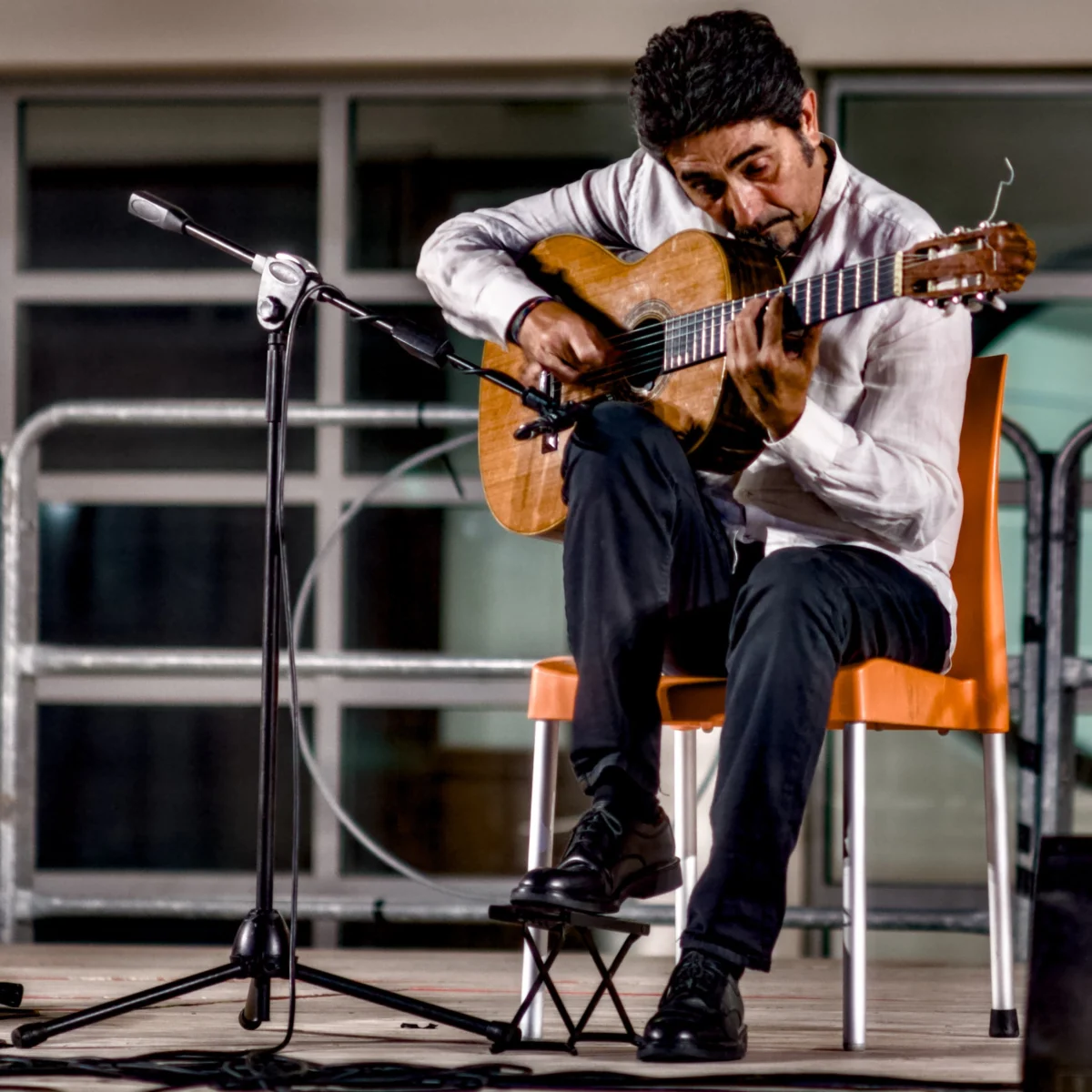
His performances are characterized by a profound physical stillness, a trait common among classical and flamenco guitarists, which places the focus entirely on the dexterity of the hands and the internal emotional state of the musician. In the context of the Rome recital, Bonaviri’s set followed a dynamic opening act—an accordion and violin duo—providing a stark contrast in visual energy. Whereas the opening act offered more kinetic movement for photographers to capture, Bonaviri’s performance required a more nuanced approach to documentation, focusing on the "internal expressiveness" that surfaces during moments of intense musical resolution.
Technical Constraints and Photographic Methodology
Capturing the essence of a flamenco performance presents a unique set of obstacles for photographers. Unlike rock or pop performances, where lighting is often flamboyant and movement is constant, a solo flamenco recital is an exercise in minimalism. The subject is typically seated, maintaining a static posture that minimizes the "external" action available for the lens.
Technical reports from the event indicate that the primary challenge was the identification of the "decisive moment"—a concept popularized by Henri Cartier-Bresson—wherein the photographer must anticipate the peak of emotional or technical intensity. For a guitarist of Bonaviri’s caliber, these moments are often subtle: a slight furrowing of the brow, the tension in the neck muscles, or the specific positioning of the fingers during a complex rasgueado or picado passage.
Furthermore, environmental factors played a significant role in the photographic outcome. The stage at the Rome venue was described as "cluttered," a common issue in smaller or multi-act venues where equipment from previous sets often remains visible. Photographers operating from fixed seating arrangements—without the liberty to move for better vantage points—were forced to utilize compositional workarounds. One such solution observed in the documentation of the event was the use of a square crop. This technique allowed the photographer to eliminate extraneous stage elements and distracting background clutter, effectively "reframing" the musician to maintain the focus on the performance’s intimacy.
Chronology of the Recital: From Duo to Soloist
The event followed a structured progression that transitioned from high-energy instrumental dialogue to the focused intensity of the solo guitar.
- Opening Act (The Battle of the Accordion and the Violin): The evening commenced with a performance that emphasized the interplay between the accordion and the violin. This segment was characterized by visual dynamism and a "battle-like" rapport between the two musicians, providing ample opportunities for wide-angle shots and action-oriented photography.
- The Transition: Following the duo, the stage was reset for the solo performance. It was during this interlude that the logistical challenges of stage clutter became most apparent, as the intimacy of the solo set required a cleaner visual field than the previous act.
- The Bonaviri Set: Daniele Bonaviri took the stage, delivering a program that showcased both his original compositions and traditional flamenco standards. The atmosphere shifted from the playful tension of the duo to a more somber, focused "duende"—the heightened state of emotion, expression, and authenticity inherent in flamenco.
- The Conclusion: The recital concluded late in the evening, leaving the audience with a sense of the profound technical mastery required for such a performance. However, for those engaged in photographing the event, the conclusion also brought a realization of the "experiential cost" of documentation.
Supporting Data: The Impact of Digital Documentation on Live Experiences
The phenomenon of the "smartphone jungle" noted during the Bonaviri recital is backed by significant data regarding audience behavior in the 2020s. According to a 2025 study on digital engagement at cultural events, approximately 74% of concertgoers report using their mobile devices to record or photograph at least one portion of a live performance.
Furthermore, psychological research into the "photo-taking impairment effect" suggests that individuals who focus on documenting an event often have a poorer memory of the experience itself compared to those who simply observe. In the context of the Rome recital, this was reflected in the photographer’s admission that the act of capturing the "perfect shot" resulted in "missing the music."
| Metric | Percentage/Detail |
|---|---|
| Audience Smartphone Usage | 74% of attendees record at least 30 seconds of video. |
| Memory Retention Impact | 15-20% decrease in auditory recall for those filming. |
| Professional vs. Amateur | 90% of "smartphone shots" are never viewed more than once. |
| Venue Policies | 35% increase in "phone-free" zones in European jazz/classical venues (2024-2026). |
Analysis of Implications: The Future of Concert Photography
The reflections following the Bonaviri concert point toward a growing sentiment among both amateur and professional photographers: the necessity of "assignment-based" documentation. The realization that one might "never take this kind of photo again if not on assignment" highlights a shift in the value proposition of concert photography.
For the professional, the goal remains the production of a high-quality visual record for archival or promotional use. For the enthusiast, however, the trade-off between a "decent shot" and the lived experience of the music is increasingly viewed as an unfavorable bargain. This shift is likely to lead to several key developments in the industry:
- Stricter Venue Regulations: As audiences become more vocal about the "jungle of smartphones" obstructing views, more venues may adopt "Yondr" pouches or strict no-photo policies to preserve the sanctity of the performance.
- The Rise of Professional Archival Services: To satisfy the audience’s desire for a memento without requiring them to film it themselves, venues may increasingly provide high-quality digital downloads of the performance to ticket holders.
- Technological Evolution: Camera manufacturers may continue to focus on "silent shutter" technology and low-light capabilities to minimize the intrusiveness of photography in quiet, intimate settings like a flamenco recital.
Official Responses and Artist Perspectives
While Daniele Bonaviri has not issued a direct statement regarding the specific photography at this event, his previous interviews suggest a focus on the "purity of the sound." Flamenco artists generally emphasize the connection between the performer and the listener—a connection that can be thinned by the presence of a lens.
Industry analysts suggest that for an artist like Bonaviri, whose work relies on subtle emotional cues, the distraction of a glowing screen or a clicking shutter can disrupt the "duende." Cultural commentators in Rome have noted that the "compromises made to achieve something viable" in photography often mirror the compromises made in the audience’s attention span.
Conclusion: The Final Frame
The recital of Daniele Bonaviri in Rome serves as a poignant reminder of the complexities inherent in modern cultural consumption. While the resulting photographs may capture a moment of "internal expressiveness" that would otherwise be lost to time, they do so at the expense of the photographer’s immediate connection to the art. As the industry moves forward, the balance between documentation and participation will remain a central theme in the discourse surrounding live music. For now, the "square crop" of a flamenco master remains a testament to both the technical skill of the performer and the persistent, if sometimes intrusive, human desire to hold onto the ephemeral.