The captivating journey of Rowan Dear, an acclaimed nature photographer, from his formative years on a Welsh farm to his current standing as a celebrated underwater photographer, is the latest feature in our ongoing interview series, "From Amateur to Professional." This series delves into the evolution of established nature photographers, examining how their practices, perspectives, and photographic prowess have developed, changed, and improved over time. For those keen to follow more inspiring stories, a subscription to our free newsletter is available.
Rowan Dear’s profound connection with nature was forged during his childhood amidst the rolling landscapes of a Welsh farm. This early immersion fostered a deep appreciation for the natural world, a bond that would later guide his professional trajectory. However, his path to becoming a distinguished underwater photographer involved confronting a significant personal challenge: a deep-seated fear of water. In 2017, a pivotal decision saw him embark on dive courses in Sydney, a courageous step that would ultimately unlock an entirely new realm of photographic exploration. By 2020, Dear had fully embraced underwater photography, a field where his unique vision quickly garnered recognition, leading to several prestigious competition wins and establishing a flourishing career.
The Genesis of a Passion: From Welsh Fields to Documentary Dreams

Dear’s initial fascination with nature photography was not an abrupt revelation but a gradual unfolding rooted in his upbringing. "Growing up on a farm in Wales, I always had a love for nature and the outdoors," Dear recounts. His days were spent exploring the fields, encountering the diverse wildlife of the UK, from elusive badgers and cunning foxes to charming hedgehogs and a myriad of birdlife. This early exposure to biodiversity laid the groundwork for his future endeavors.
Like many of his generation, Dear’s imagination was ignited by the iconic BBC nature documentaries narrated by Sir David Attenborough. These cinematic windows into the planet’s most extraordinary ecosystems fueled a childhood dream: to witness and document the fascinating animals depicted, especially those inhabiting the mysterious underwater world. His early photographic attempts, using a simple disposable camera, involved capturing images of his pets and, with limited success, trying to approach wild animals. At that juncture, the ambition of becoming a wildlife photographer seemed largely unattainable, perceived as a pursuit reserved for those with significant financial means and privilege. This perception highlights a common barrier for aspiring artists from less affluent backgrounds, underscoring the determination required to break into such specialized fields.
Conquering the Deep: A Pivotal Shift in Sydney
The transformation from a land-based enthusiast to an underwater specialist began with Dear’s decision to confront his aquaphobia. In 2017, while in Sydney, Australia, he committed to dive courses. This was more than just acquiring a new skill; it was a psychological breakthrough that opened up the 71% of the planet previously inaccessible to his lens. Australia, with its rich marine biodiversity and numerous diving opportunities, provided the perfect crucible for this transformation. The Great Barrier Reef, the world’s largest coral reef system, and the diverse temperate waters off its coast offer unparalleled opportunities for marine photographers, attracting enthusiasts and professionals globally.

This brave step ultimately set the stage for his professional journey. By 2020, with newfound confidence and expertise in diving, Dear dedicated himself to underwater photography. The transition was swift and impactful, marked by a series of competition successes that quickly propelled him into the professional arena.
Evolution Through the Lens: From Flat Images to Dynamic Narratives
A clear illustration of Dear’s photographic evolution can be seen by comparing his early attempts with his current masterpieces. His first significant underwater image, captured with a dedicated dive camera rather than a GoPro, depicted a giant cuttlefish near Sydney. "I had long wanted to see a giant cuttlefish, and was desperate to capture an image with my new, expensive dive camera," he recalls.
The initial outcome, however, was far from his envisioned masterpiece. "Unfortunately, it didn’t quite work out how I had pictured it, and I was left with a quite flat, uninteresting, and not very colourful image." Despite his initial satisfaction, sharing it on social media, Dear soon recognized the disparity between his work and that of professional or semi-professional photographers. This early experience, while a learning curve, provided crucial insights into the technical complexities of underwater photography, such as managing light, color, and composition in a dynamic, challenging environment. Underwater photography often requires specialized strobes and lighting techniques to restore the colors lost at depth, a lesson Dear undoubtedly absorbed.

Key Subjects and Artistic Vision: The Soul of the Ocean
Today, Dear’s portfolio showcases a profound artistic and technical leap. His affection for giant cuttlefish remains a cornerstone of his work, driven by their intelligence, vibrant coloration, and interactive nature. "Giant cuttlefish have long been on my list to photograph and are one of my favourite animals underwater for many reasons; they are incredibly interactive, colourful, intelligent, and stunning creatures," he explains. These cephalopods, known for their remarkable camouflage and elaborate mating rituals, offer endless photographic opportunities.
One of his favorite images captures two male giant cuttlefish engaged in a fierce dominance display for a female. This photograph, bursting with color and intricate detail, goes beyond mere documentation. "The image has so much colour, shows off the cuttlefish’s character, behaviour, and has so many layers to it when you look closer," Dear elaborates, aiming to evoke the same emotion in viewers as he experienced firsthand. This pursuit of emotional resonance and narrative depth distinguishes his professional work.
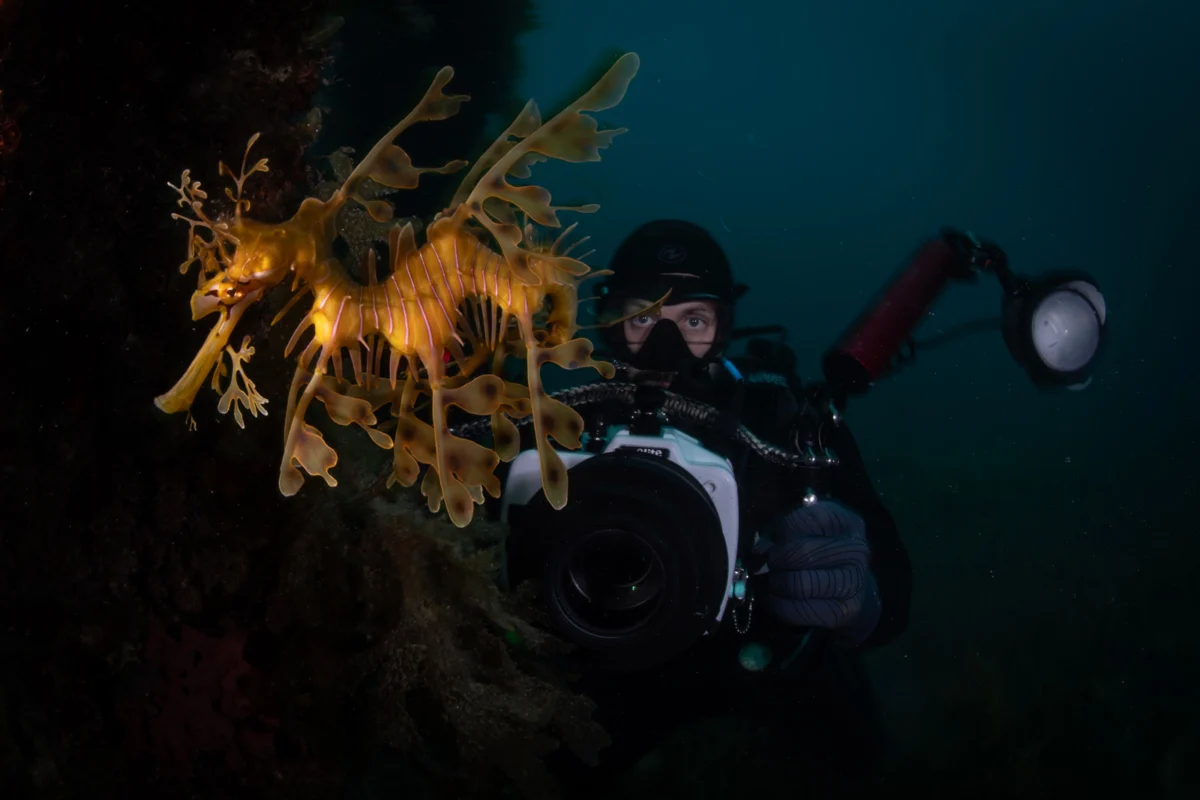
Another cherished image is a portrait of a leafy seadragon. This shot is significant not only for its striking symmetry but also for the considerable effort required to achieve it. Leafy seadragons, masters of camouflage, are notoriously difficult to spot and photograph. "Shooting at night, with a red focus light so as not to disturb the seadragon too much, I waited patiently for it to turn and face the camera, with its head tilted at the right angle, to get a full front-on headshot." This dedication to capturing specific behaviors and compositions, often under challenging conditions, exemplifies his meticulous approach. The use of a red focus light, which is less disruptive to nocturnal marine life, highlights his ethical considerations in wildlife photography.

The Art of Re-visiting: Deepening Understanding and Technique
Dear emphasizes the importance of understanding a species’ biology, habitat, and behaviors to capture its essence effectively. This philosophy underpins his practice of revisiting specific locations and subjects. "I think when photographing an animal, you need to get to understand the species, their habitat, behaviours, and so on to capture them properly, which will then help the viewer see the full beauty of the animal."
One such recurring destination is Whyalla in South Australia, a critical aggregation site where over 10,000 giant cuttlefish gather annually to mate. The site’s shallow depth (around 5 meters) and shore access allow for multiple, extended dives daily, offering unparalleled opportunities for immersion. "You get to capture different light coming through the water column and are surrounded by so many different characters and colours, totally immersing yourself into the world of the giant cuttlefish," he notes. His approach here is comprehensive, utilizing a range of lenses—from wide-angle to fisheye and macro—to capture the full spectrum of cuttlefish life, from grand environmental shots to intricate portraits. This strategic use of varied focal lengths allows for diverse storytelling within a single location.
Other favored return sites include Byron Bay, Australia, known for its summer aggregations of leopard sharks. This location provides opportunities for diverse compositions, from shallow close-ups bathed in sun rays to top-down views capturing multiple sharks at varying depths. Leopard sharks (or zebra sharks, Stegostoma tigrinum, as they are globally known, with "leopard shark" often referring to Triakis semifasciata in California) are generally docile and approachable, making them excellent subjects for underwater photography.

Heron Island on the Great Barrier Reef is another key location, particularly during the turtle hatching season from February to April. It’s a prime spot for freediving, allowing him to witness newly hatched turtles making their perilous journey to the sea, alongside resident lemon sharks, numerous ray species, and adult turtles. Timing dives around peak high tide maximizes interactions, offering hours of photographic opportunities. This focus on seasonal events and specific behaviors underscores his dedication to capturing unique and impactful moments in the marine ecosystem.
The Professional Leap: An Organic Transition
Dear’s transition to professional photography was less a conscious decision and more an organic progression driven by an unyielding passion. "I don’t ever really remember deciding I wanted to go professional," he states. His primary motivation was simply to be immersed in the underwater world, constantly refining his skills to better capture these "magical experiences." Initially, his aim was personal satisfaction, then sharing with friends, and eventually reaching the broader community of ocean and animal enthusiasts.
The business aspect of his career evolved naturally from this dedication. "The rest was more organic and just happened as a result of my love and passion for the ocean and photography, and my ability to combine the two." This narrative resonates with many creative professionals who find their passion naturally leading to professional opportunities, often fueled by intrinsic motivation rather than explicit career planning.

Milestones and Validation: The Impact of Competition Wins
A significant turning point in Dear’s journey was the validation he received from major photography competitions. "I think it helped a lot when I started winning some major competitions, as that gave me confidence in my work and reinforced the idea that my images were up to the standard of my peers, who I looked up to in the underwater photography space." In an era dominated by social media metrics, where likes and followers can distort one’s perception of quality, external validation from established photographic bodies provides a much-needed objective benchmark.
Wildlife photography, especially at a professional level, demands meticulous planning and foresight. Dear emphasizes the importance of making opportunities rather than simply waiting for them. "Wildlife photography is also about making those opportunities happen and planning ahead to make sure you are best prepared to take the images that you want." This involves extensive research into seasonal patterns, optimal locations, weather forecasts, and animal behaviors to maximize the chances of capturing desired shots. This proactive approach underscores the blend of artistic vision and strategic execution required in his field.
Refining the Craft: Workflow and Editing Philosophy

Over time, Dear’s photography process has also evolved, particularly in his post-production workflow. He now dedicates significantly less time to editing, a testament to his improved in-camera skills and knowledge. "I now believe that if a photo takes too long to edit, you just need to go back out and take a better one," he asserts. This philosophy reflects a commitment to achieving excellence at the point of capture, minimizing the need for extensive digital manipulation.
He candidly acknowledges past mistakes, such as overexposure or excessive backscatter (particles in the water illuminated by flash), which he would attempt to correct in editing. However, he realized that "the more you try to edit out these mistakes, the more obvious it becomes." His current style prioritizes natural light and minimal intervention, aiming for images that appear as authentic as possible. "My style works with plenty of light, creating images that look as natural as they can. I don’t like to change too much, so most of my editing takes me a couple of minutes per image these days." This streamlined approach allows him to focus more on fieldwork and less on the digital darkroom.
Navigating Challenges: Nature’s Unpredictability and Market Realities
Wildlife photography presents inherent challenges, primarily the unpredictability of nature. "With wildlife photography, the biggest challenge is being in the right place at the right time to get the images you want," Dear explains. Despite meticulous planning, success is never guaranteed. He recounts a trip to photograph minke whales, where adverse weather conditions resulted in zero sightings. "Sometimes, it doesn’t matter how well you have planned, as nature has other ideas."

For underwater wide-angle photography, specific conditions are crucial. Photographers often "pray for those days with great visibility and perfect lighting, where everything comes together for you perfectly." The reality, however, is often less ideal, requiring adaptability and resilience. Dear notes that with experience, one learns to "make do with the hand you are dealt" and still produce compelling images even in suboptimal conditions. He cites a recent experience in Argentina, photographing southern right whales under a government permit, where strong winds and poor visibility hampered conditions. Yet, the experience remained magical, and he was confident that the images captured were the best possible given the circumstances. This adaptability is a hallmark of a seasoned professional.
Reflections and Future Forward: Advice for Aspiring Photographers
Looking back, Dear reflects on the role of confidence in his early career. "I think sometimes I lacked confidence in my ability, which I believe has helped me to keep growing and learning as a photographer, but also maybe held me back from taking on work that, in hindsight, I was more than capable of doing." This self-awareness, coupled with a perfectionist streak, made it difficult for him to release work that didn’t meet his exceptionally high standards.
His advice to aspiring photographers is comprehensive and deeply insightful. It begins with clarity of purpose: "work out where you want to get to." He encourages learning from inspiring figures while simultaneously developing a unique style and honing one’s craft. The pursuit of continuous improvement is paramount: "Never be content with where you are at; be self-critical, but also appreciate the value of the work you have done and trust in your process and your ability." This balance between critical self-assessment and self-belief is crucial for long-term growth and success in any creative field.

The Broader Impact: Photography for Conservation
Beyond personal achievement, Rowan Dear’s work as an underwater photographer serves a vital role in marine conservation. By showcasing the beauty, complexity, and vulnerability of underwater ecosystems and their inhabitants, his images transcend mere aesthetics to become powerful tools for advocacy and public awareness. In an era where ocean health is increasingly threatened by climate change, pollution, and overfishing, photographers like Dear bridge the gap between scientific understanding and public engagement. His ability to capture the "character" and "behaviour" of marine life fosters empathy and a sense of connection, inspiring viewers who may never have the opportunity to dive themselves.
The locations he frequents, such as Whyalla, Byron Bay, and Heron Island, are not just photographic playgrounds but critical habitats. His repeated visits and in-depth study of species like the giant cuttlefish and leafy seadragon contribute to a visual archive that can inform conservation efforts. By bringing the hidden wonders of the deep to the surface, Rowan Dear not only fulfills a personal passion but also champions the urgent need to protect the fragile marine world for future generations. His journey exemplifies how dedication, resilience, and a profound love for nature can transform personal challenges into a career that enriches both the artist and the world.