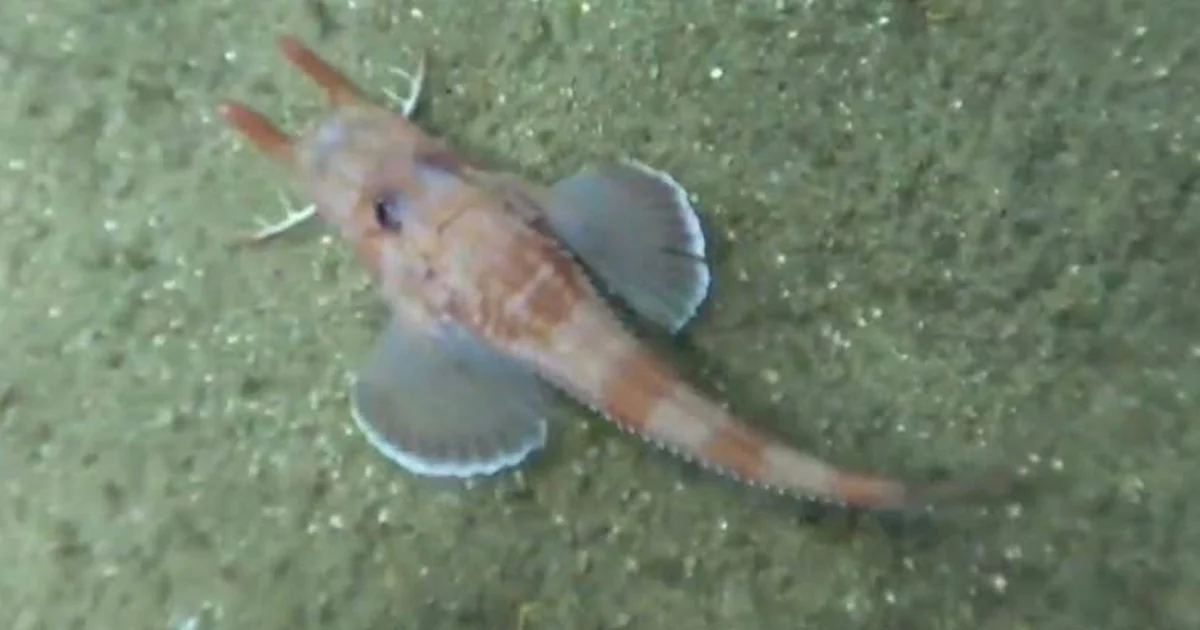
In a significant advancement for marine biology, a collaborative team of scientists has captured unprecedented footage of a shrimp-like fish, identified as Scalicus engyceros, moving across the seafloor not only in its characteristic walking manner but also remarkably sideways, akin to a crab, and even backward, a motion eerily reminiscent of the "moonwalk." This groundbreaking observation, believed to be the first recorded instance of such versatile locomotion in any fish species, challenges conventional understanding of fish movement and highlights the rich, unexplored complexities of deep-sea life. The findings were detailed in a recent paper titled "Walking Fish," published in the esteemed journal Ocean-Land-Atmosphere Research.
The Revelation of Unconventional Locomotion
The extraordinary behavior of Scalicus engyceros, an armored searobin belonging to the family Triglidae, was documented across three distinct areas of the South China Sea. Researchers from Sun Yat-sen University and the Southern Marine Science and Engineering Guangdong Laboratory employed advanced deep-sea submersibles – both remotely operated vehicles (ROVs) and human-occupied vehicles (HOVs) – to capture the elusive movements of this deep-dwelling creature in its natural habitat. The footage explicitly shows the fish utilizing its free pectoral-fin rays, which are distinct from the main fin membrane, to scuttle along the benthic environment. While the ability of searobins to "walk" on these specialized rays has been known, the newly observed sideways and backward movements represent a paradigm shift in understanding their motor capabilities.
Han Tian, the primary author of the study and a doctoral researcher in the School of Marine Sciences at Sun Yat-sen University, emphasized the profound implications of this discovery. "These walking fish harbor far more novel behavioral and evolutionary adaptations than previously assumed," Tian stated in a press release. The observation of Scalicus engyceros performing these complex maneuvers confirms long-held predictions by researchers who theorized such movements might be possible, despite never having been witnessed until now. The ability to move in multiple directions offers significant adaptive advantages, particularly in the challenging and often predator-rich environment of the deep sea.
A Deep Dive into Scalicus engyceros and its Adaptations
Scalicus engyceros, an armored searobin primarily found in the western Pacific Ocean, was first scientifically described by the eminent ichthyologist Albert Günther in 1872. For over a century, its unique mode of locomotion – using its modified pectoral fin rays to "walk" on the seafloor – has fascinated scientists. Unlike most fish that rely solely on swimming with their main caudal fin and body undulations, searobins have evolved a distinct mechanism. Their pectoral fins are not just for propulsion through water but have specialized, stiffened lower rays that function much like limbs, allowing them to "crawl" or "walk" along the substrate.
The new footage, however, reveals an even more sophisticated level of motor control. The shrimp-like movement described by researchers highlights the dexterity of these fin rays, enabling the fish to navigate complex seafloor topographies. Tian elaborated on these remarkable anatomical features: "The creature retains the pectoral fins, which have evolved into flat, round plates, improving balance during walking and swimming, while its shrimp-like fin rays and tail enable explosive, jerky shrimp-style leaps when threatened." This combination of adaptations allows for both steady, deliberate movement and rapid escape responses, crucial for survival in an environment where visibility is limited and threats can emerge swiftly.
Beyond its unique locomotion, the study also drew attention to another striking feature of the searobin: its unusually large eyes. While the researchers noted the fish did not appear to register the approaching submersible directly, its eyes visibly reacted to the vehicle’s powerful beam of light. This suggests that despite living in perpetually dim or dark conditions, the searobin’s visual system retains a degree of light sensitivity. This adaptation might be crucial for detecting bioluminescent prey or predators, or perhaps for navigating during brief periods of ambient light from surface activity or other deep-sea organisms. The adaptability of its visual system reflects a complex evolutionary trajectory tailored to its specific deep-sea niche.
Technological Frontiers in Deep-Sea Exploration
The breakthrough discovery was made possible by significant advancements in deep-sea exploration technology. The research team utilized state-of-the-art human-occupied vehicles (HOVs) and remotely operated vehicles (ROVs), which have revolutionized scientists’ ability to observe marine life in situ. Specifically, the Shenhaiyongshi (meaning "deep-sea warrior"), a Chinese-developed HOV, and the ROV Haiqin were instrumental in capturing the footage. These vehicles allowed researchers to film Scalicus engyceros at impressive depths, ranging from 1,148 feet (350 meters) to 1,640 feet (500 meters) below the surface.
Prior to such technological capabilities, the study of deep-sea species was largely confined to morphological analysis of preserved specimens retrieved through trawling or dredging. While these methods provided valuable anatomical information, they offered little insight into the live behaviors, ecological interactions, or adaptive strategies of these creatures. As Han Tian remarked, "Deep sea life remains mysterious today with so many unknowns. Modern deep-sea diving vehicles allow not only discovery of new species but also add a new in situ, functional dimension to the study of species based solely on the morphology of preserved specimens." The ability to observe animals alive in their natural environment provides an unparalleled window into their adaptation and evolution, offering context that museum specimens simply cannot.
The South China Sea, where these observations were made, is a vast and ecologically complex region, known for its significant biodiversity and unique deep-sea ecosystems. It is an area of ongoing scientific interest, with numerous research expeditions continually unveiling new species and behaviors. The deployment of advanced submersibles in this particular region underscores its importance as a frontier for marine biological discovery.
Broader Implications for Science and Beyond
The revelation of a fish capable of sideways and backward "walking" carries profound implications across several scientific disciplines.
- Evolutionary Biology: This discovery forces a re-evaluation of the evolutionary pathways of fish locomotion. It suggests a much greater plasticity in fin function and motor control than previously understood. The development of specialized fin rays for such versatile terrestrial-like movement in a fully aquatic environment is a testament to the power of natural selection in shaping novel adaptations. It provides a living example of convergent evolution with crustaceans like crabs and shrimp, which navigate the seafloor using lateral movements.
- Biomechanics and Robotics: Understanding the precise biomechanics of how Scalicus engyceros achieves these complex movements could inspire new designs for underwater robotics. Engineers and roboticists are constantly seeking to emulate biological systems to create more efficient and adaptable machines. The nuanced control of multiple fin rays to execute forward, sideways, and backward motion, coupled with sudden leaps, offers a rich blueprint for developing highly maneuverable submersibles or biomimetic robots capable of navigating challenging underwater terrains.
- Neuroscience: The neural mechanisms underlying such sophisticated motor coordination in a fish brain present an intriguing area for future research. How does the fish integrate sensory information and command its specialized fin rays to perform these distinct and complex movements? Unraveling these neurological pathways could provide insights into motor control systems in a broader biological context.
- Deep-Sea Ecology and Conservation: Each new discovery in the deep sea adds another piece to the puzzle of these vast, often overlooked ecosystems. Understanding the unique adaptations of species like Scalicus engyceros contributes to a more comprehensive picture of deep-sea biodiversity and the intricate web of life that thrives under extreme pressure and perpetual darkness. This knowledge is critical for developing informed conservation strategies as human activities, including deep-sea mining and fishing, increasingly encroach upon these fragile environments.
The discovery serves as a powerful reminder of the vast unknown that still exists within our oceans. While humanity has explored the surface of the Moon and sent probes to distant planets, the deep sea, Earth’s largest habitat, remains largely unexplored. Less than 20% of the global seafloor has been mapped to modern standards, and an even smaller fraction has been directly observed. This new footage of Scalicus engyceros underscores the immense potential for further groundbreaking discoveries as deep-sea exploration technology continues to advance. Each new observation not only adds to our scientific knowledge but also ignites curiosity and fosters a deeper appreciation for the planet’s incredible biological diversity. The "moonwalking" fish is not merely a scientific curiosity but a vivid symbol of the mysteries that still lie beneath the waves, waiting to be uncovered.