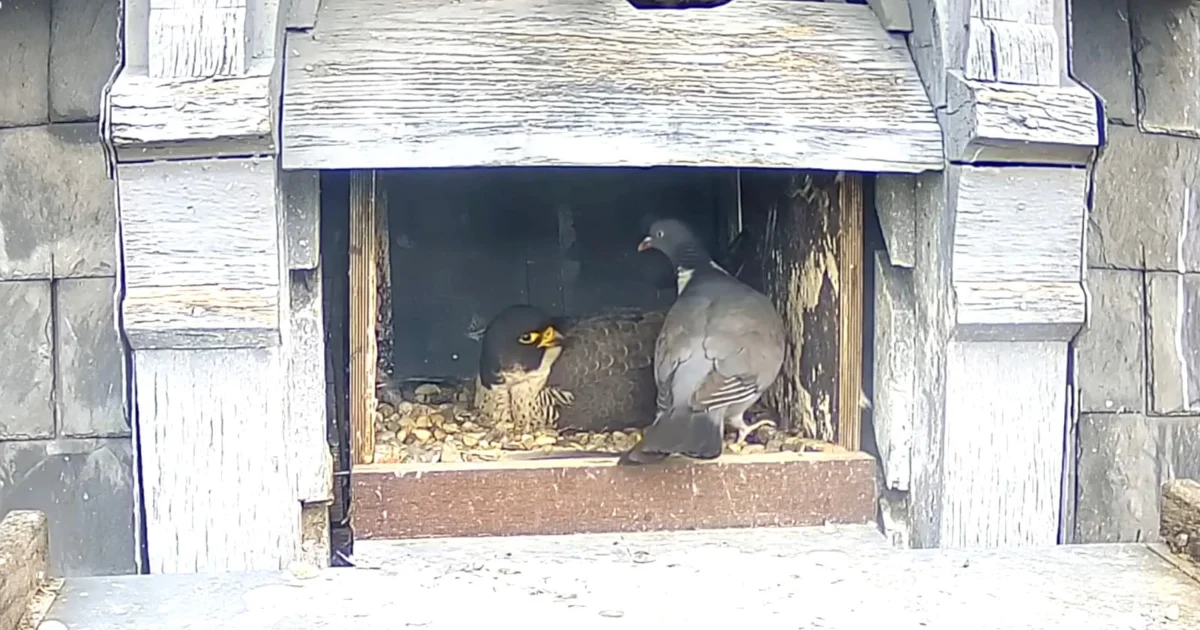
A remarkable and perilous encounter unfolded within the confines of a Peregrine Falcon’s nesting box atop the historic Church of Illerich-Graffenstaden near Strasbourg, France, captivating a global audience and igniting widespread discussion about the intricate, often brutal, dynamics of urban wildlife. In an incident that has since gone viral across social media platforms, particularly Reddit, a wood pigeon, exhibiting an almost unbelievable lack of caution, casually strolled into the nest of its primary avian predator, narrowly escaping with its life, albeit significantly lighter on feathers. This extraordinary footage, captured in 2023 by a series of strategically placed cameras, provides an unfiltered glimpse into the high-stakes survival game playing out in our shared urban landscapes.
The incident, initially documented by the "Peregrine Falcons Illkirch" (Faucons Pèlerins Illkirch) YouTube channel, showcases the sheer audacity, or perhaps naivety, of the wood pigeon. The video, titled "Extensive preening of a wood pigeon’s feathers" (translated from French), depicts the pigeon making an unhurried entrance into the falcon’s abode. The resident Peregrine Falcon, a formidable apex predator, was initially observed in a state of apparent disbelief at the intruder’s brazenness. This momentary hesitation, however, quickly gave way to a territorial and predatory response, resulting in a swift, though not fatal, assault on the unsuspecting pigeon. The dramatic footage shows the pigeon enduring a severe beating, losing a significant number of feathers, before miraculously extricating itself from the precarious situation and flying to safety.
Unpacking Predator-Prey Dynamics in Urban Environments
The core of this viral event lies in the fundamental predator-prey relationship between Peregrine Falcons (Falco peregrinus) and pigeons. Peregrine Falcons are renowned for their incredible speed, reaching over 200 miles per hour during their hunting dives, making them the fastest animals on the planet. Their diet in urban environments consists almost exclusively of other birds, with pigeons, particularly feral pigeons (Columba livia domestica) and wood pigeons (Columba palumbus), forming the vast majority—often upwards of 80-90%—of their prey base. These powerful raptors utilize their keen eyesight to spot prey from great heights, executing breathtaking stoops to incapacitate birds mid-flight with a strike from their powerful talons or a precise bite to the neck.
Pigeons, on the other hand, despite their ubiquitous presence and often-underestimated intelligence, are perpetually on high alert for these aerial threats. Their primary defense mechanisms include flocking behavior, which offers safety in numbers, and rapid, erratic flight patterns designed to evade pursuit. The wood pigeon involved in this incident, however, appeared to abandon these innate survival instincts, venturing alone and directly into the most dangerous possible location: the predator’s nest. This unusual behavior has prompted much speculation among wildlife enthusiasts and ornithologists alike, raising questions about individual animal decision-making, territorial miscalculation, or even a momentary lapse in judgment that defied millennia of evolutionary programming.
The Lens of Observation: The Illkirch Nest Cam Project
The extraordinary footage is a testament to the invaluable role of wildlife monitoring projects like the Peregrine Falcons Illkirch initiative. The cameras installed at the Church of Illerich-Graffenstaden have been operational for several years, providing a continuous live feed of the falcon’s nesting activities. These projects serve multiple critical functions: they offer scientists unprecedented opportunities to study avian behavior, breeding success, dietary habits, and population dynamics in real-time without disturbing the animals. For the public, they act as powerful educational tools, fostering a deeper appreciation for nature and conservation efforts by bringing the wild directly into homes and classrooms.
The Church of Illerich-Graffenstaden, with its towering steeple and commanding views, provides an ideal nesting site for Peregrine Falcons, mimicking the high cliffs they naturally prefer. The "Faucons Pèlerins Illkirch" team, composed of dedicated ornithologists, volunteers, and local enthusiasts, meticulously maintains the camera equipment and curates the captured footage. Their mission extends beyond mere observation; they actively engage in conservation awareness, educating the community about the importance of protecting these magnificent birds and their habitats. Over the years, this particular nest has indeed yielded a treasure trove of "incredible footage," as the original article notes, documenting the trials and triumphs of successive falcon broods, from the hatching of fragile chicks to their first daring flights. The recent pigeon incident merely adds another dramatic chapter to this ongoing wildlife saga.
A Chronology of Viral Fame
The timeline of this specific incident traces back to its capture in 2023. While the exact date within that year is not specified, the footage was evidently archived by the Peregrine Falcons Illkirch team. It gained significant public traction when it was uploaded to their YouTube channel and subsequently shared on Reddit in early 2024, rapidly ascending to viral status. The Reddit thread titled "Pigeon walks into falcons nest" quickly amassed thousands of upvotes and hundreds of comments, drawing in a diverse audience from wildlife enthusiasts to casual internet browsers.
The immediate reaction on Reddit was a mix of awe, amusement, and disbelief. Users frequently expressed surprise at the pigeon’s apparent lack of self-preservation and the falcon’s initial "stunned" reaction. Comments ranged from humorous observations about the pigeon "asking for trouble" to more analytical discussions on the rarity of such a close-range, non-fatal interaction between predator and prey. This viral spread underscores the power of compelling wildlife content to transcend niche interests and capture mainstream attention, serving as an unexpected conduit for public engagement with natural history.
Expert Commentary and Public Fascination
While no official statements from ornithological bodies or wildlife experts were provided in the original context, one can infer their likely commentary. Experts would undoubtedly highlight the extreme rarity of such an event, emphasizing that pigeons typically exhibit strong innate avoidance behaviors toward falcons. They might posit several theories for the pigeon’s unusual foray:
- Navigational Error/Disorientation: The pigeon might have been disoriented or simply unaware of the nest’s occupancy, perhaps mistaking it for a safe roosting spot.
- Territorial Misjudgment: Though less likely for a prey species, a momentary lapse in judgment regarding territorial boundaries could be considered.
- Individual Aberration: Animal behavior, like human behavior, can sometimes deviate from the norm. This particular pigeon might have possessed an unusually high level of curiosity or a compromised sense of danger.
- Young or Inexperienced Bird: Younger birds are often more prone to making mistakes as they learn to navigate their environment and recognize threats.
The falcon’s initial "stunned" reaction is also noteworthy. While Peregrines are efficient hunters, encountering a prey animal inside their nest, rather than in the open air, might have momentarily disrupted its typical predatory sequence. The subsequent "beating" was likely a combination of territorial defense and an instinctive predatory response, though perhaps not a full-fledged hunt given the enclosed space and the immediate proximity. The pigeon’s escape, while losing feathers, speaks to a remarkable stroke of luck and perhaps the falcon’s momentary hesitation or a less-than-optimal strike angle within the confined space.
The public’s fascination stems from several factors: the inherent drama of life-and-death stakes, the relatable "dopy" behavior attributed to the pigeon, and the sheer unpredictability of wildlife. It taps into a primal curiosity about the natural world, amplified by the high-quality, intimate view provided by the nest camera.
The Broader Significance of Wildlife Monitoring
The incident at Illerich-Graffenstaden serves as a vivid illustration of the broader significance of remote wildlife cameras and live feeds. These technological tools are revolutionizing our understanding of animal behavior, ecology, and conservation. Beyond capturing dramatic predator-prey interactions, they provide invaluable data for research that would be impossible or highly intrusive to collect through traditional field methods.
For instance, the article itself cites another compelling example from Honduras, where camera traps played a crucial role in exonerating the endangered Baird’s tapir (Tapirus bairdii). Local Indigenous Miskitu communities had long blamed these large land mammals for significant crop damage. However, data collected from remote cameras definitively showed that other animals, not the tapirs, were responsible for the agricultural losses. This scientific validation not only saved an endangered species from potential retaliatory killings but also helped foster better coexistence between humans and wildlife by accurately identifying the true culprits. Such insights are paramount for developing effective conservation strategies and resolving human-wildlife conflicts.
Wildlife cameras also contribute to public awareness and education on a massive scale. By bringing the hidden lives of animals into public view, these projects cultivate empathy, inspire environmental stewardship, and highlight the importance of biodiversity. They democratize scientific observation, allowing citizen scientists worldwide to engage with and contribute to wildlife understanding.
Lessons Learned (or Not): The Ongoing Saga
As for the pigeons in Strasbourg, it appears that the lessons of this dramatic encounter may not be universally applied, or perhaps the allure of the falcon’s platform remains too strong for some. The article concludes by noting a subsequent, recent video on the Peregrine Falcons Illkirch YouTube page featuring another pigeon perched precariously on the predator’s platform. This suggests an ongoing, high-risk dynamic where individual pigeons continue to test the boundaries of safety, perhaps drawn by curiosity, a lack of alternative perching spots, or simply a failure to learn from the misfortunes of their predecessors.
This repeated behavior underscores the continuous evolutionary arms race between predator and prey. While falcons are highly adapted hunters, pigeons are equally adapted survivors, with large populations that allow for some individuals to take risks, even fatal ones, ensuring that the species as a whole continues to thrive. The platforms on urban structures, while ideal for falcons, are also often frequented by pigeons, creating inevitable points of contact and potential conflict.
The Peregrine Falcons Illkirch project, through its continuous monitoring, will undoubtedly continue to provide such fascinating, sometimes startling, glimpses into this eternal struggle. These documented interactions not only entertain but also offer invaluable data points for ornithologists studying urban ecology and the behavioral plasticity of both predator and prey. As urban environments continue to expand, understanding these dynamics becomes increasingly critical for ensuring the health and balance of our shared ecosystems. The audacious wood pigeon’s brush with death is more than just a viral video; it’s a testament to the raw, untamed beauty and peril that persists even in the heart of human civilization.