
The intersection of classic street photography aesthetics and modern mobile technology has ushered in a new era of urban documentation, characterized by the accessibility and sophisticated computational power of the iPhone. While street photography was once the exclusive domain of film-based Leica users and professional photojournalists, the proliferation of high-end smartphone cameras has democratized the genre. Black and white street photography, in particular, remains a pinnacle of the medium, relying on light, shadow, and composition rather than the distractions of color. By mastering specific technical approaches and leveraging the inherent portability of the iPhone, photographers are now able to capture high-contrast, emotive images that rival traditional silver halide prints.
The Evolution of Mobile Street Photography: A Chronological Context
The journey of the smartphone as a serious tool for street photography began in earnest with the release of the iPhone 4 in 2010, which featured a 5-megapixel sensor and heralded the "Instagram era." However, the true shift toward professional-grade mobile imaging occurred between 2017 and 2023. During this period, Apple introduced multi-lens systems, Night Mode, and the ProRAW format, significantly expanding the dynamic range available to mobile users.
Historically, street photography was defined by the "decisive moment," a concept popularized by Henri Cartier-Bresson. This required a camera that was fast, silent, and unobtrusive. The iPhone fulfills these requirements more effectively than almost any DSLR or mirrorless system. In the current landscape, mobile street photography is no longer viewed as a secondary hobby but as a primary medium for contemporary artists like Maksim Kyshtymov, who transitioned from heavy professional gear to the iPhone to regain the freedom of movement essential for urban exploration.
Technical Foundation: The Benefits of Monochrome Visualization
One of the most significant advantages of modern iOS architecture is the ability to apply non-destructive filters in real-time. Industry experts suggest that the most effective way to master black and white photography is to "see" in monochrome during the act of capture. By selecting the "Noir" filter within the native Camera app, the photographer removes the emotional bias of color, allowing for a more clinical focus on structural elements.
When the color data is suppressed in the viewfinder, the photographer’s brain begins to prioritize luminosity over hue. This shift in perception makes it easier to identify high-contrast scenes where the interplay of light and shadow creates a compelling narrative. Because these filters are non-destructive, the underlying color data remains available in the Photos app, providing a safety net for post-processing while ensuring the initial composition is optimized for black and white.
Pillar 1: Minimalism and the Strategic Use of Negative Space
In the dense environment of a modern metropolis, visual clutter is the primary enemy of a successful photograph. The most impactful black and white images often adhere to minimalist principles, utilizing "negative space" to isolate a single human subject. Negative space—the empty area surrounding the focal point—serves to direct the viewer’s eye and imbues the image with a sense of scale and solitude.
Data from visual psychology studies indicate that the human eye gravitates toward areas of high contrast. In a minimalist monochrome shot, a dark silhouette against a vast, light-colored concrete square creates an immediate focal point. Photographers are encouraged to seek out expansive urban locations such as public plazas, parks, and modern cultural sites. Utilizing tools like Google Maps Street View allows photographers to scout these open spaces before arriving, ensuring they find environments where subjects can be framed without overlapping background distractions.
Pillar 2: Linear Perspective and Leading Lines in Urban Architecture
The urban landscape is a grid of geometric opportunities. Leading lines—parallel or converging lines that lead from the foreground toward the background—are essential for creating depth in a two-dimensional image. In the absence of color, these lines become the "skeleton" of the photograph.
Common architectural elements such as bridges, road markings, tunnels, and fences act as natural conduits for the viewer’s gaze. For maximum visual impact, photographers often position themselves so these lines originate from the corners of the frame. This technique, known as "dynamic tension," creates a sense of movement. Furthermore, curved leading lines, such as those found in spiral staircases, offer a more organic, fluid alternative to the rigid geometry of city streets. Capturing a subject at the vanishing point where these lines converge provides a sense of resolution to the composition.
Pillar 3: Pattern Recognition and Rhythmic Facades
Modern architecture frequently employs repetitive elements—windows, pillars, arches, and balconies—that create visual rhythms. In black and white, these patterns become abstract textures. When a photographer introduces a human element into a repetitive architectural pattern, it creates a "break" in the rhythm, which serves as a powerful focal point.
Symmetrical compositions are particularly effective when photographing building facades. By centering the frame on a repeating pattern, the photographer creates a sense of order and stability. Professional mobile photographers often utilize the "Grid" feature in the iPhone settings to ensure perfect alignment, as even a slight tilt can disrupt the effectiveness of a patterned shot.
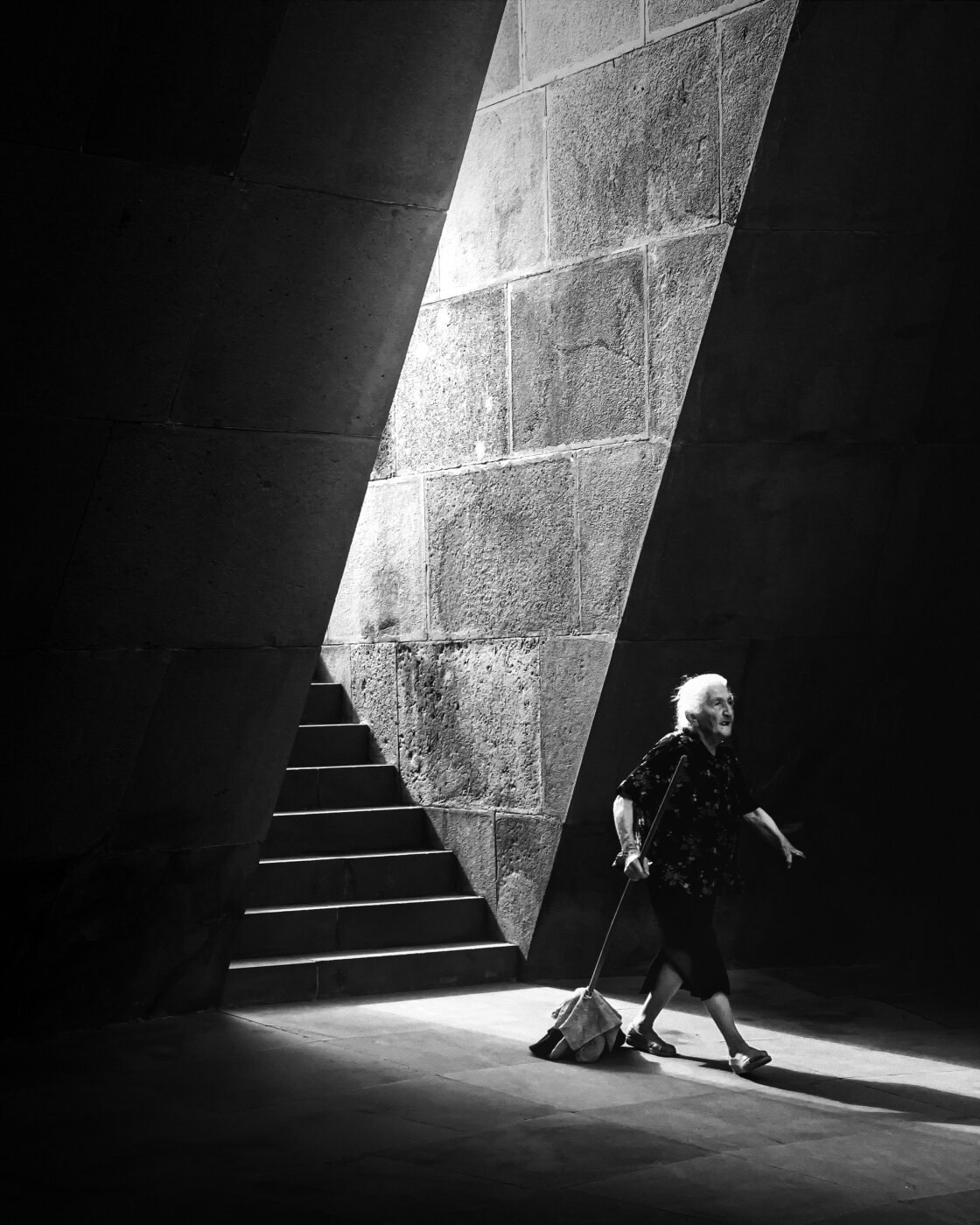
Pillar 4: Architectural Framing and Burst Mode Execution
Framing is a compositional technique where the photographer uses elements within the scene to create a "window" around the subject. Archways, doorways, and tunnels are ideal for this purpose. This "sub-frame" adds a layer of depth and context, making the viewer feel as though they are looking through a portal into the subject’s world.
To capture the perfect moment within these frames, the use of "Burst Mode" is critical. Since street photography involves moving subjects, the difference between a mediocre shot and a masterpiece is often a fraction of a second. By dragging the shutter button to the left (on newer models) or holding the volume button, the iPhone captures a rapid sequence of images. This allows the photographer to select the frame where the subject’s stride and posture are most aesthetically pleasing.
Pillar 5: High-Contrast Silhouettes and Exposure Manipulation
The silhouette is a hallmark of the black and white genre. It transforms a specific individual into an anonymous, universal figure, adding a layer of mystery. Executing a silhouette requires backlighting—positioning the subject between the camera and a bright light source.
The "Golden Hour"—the hour after sunrise and the hour before sunset—provides the ideal low-angle light for silhouettes. However, urban environments offer artificial alternatives, such as illuminated shop windows or bright street lamps. The technical key to a successful silhouette on an iPhone is the manual reduction of exposure. By tapping the screen to set focus and then swiping down on the sun icon, the photographer can intentionally underexpose the subject until they become a solid dark shape against the light.
Pillar 6: Shadow Play and the Drama of Low-Angle Light
While many photographers avoid harsh sunlight, street photographers embrace it for the shadows it produces. During the Golden Hour, shadows stretch across the pavement, creating elongated shapes that can be more interesting than the subjects themselves. In some cases, the shadow becomes the primary subject, while the actual person remains outside the frame.
This technique requires a shift in perspective. Instead of looking at eye level, the photographer must look at the ground. Reducing the exposure value (EV) in these scenarios ensures that the shadows are deep and "crushed," a look that is highly sought after in noir-style photography. This high-contrast approach emphasizes the abstract nature of the city.
Pillar 7: Advanced Post-Processing and Digital Cleanup
The final stage of creating a professional black and white image occurs in the editing suite. While the native Photos app offers robust tools for brightness, contrast, and highlights, professional-grade apps like Adobe Lightroom Mobile provide more granular control.
A key aspect of modern editing is the removal of distractions. Even with careful composition, unwanted elements like trash cans, signs, or stray pedestrians can enter the frame. Tools like "TouchRetouch" or the "Healing Brush" in Lightroom allow photographers to clean up the image, maintaining the minimalist aesthetic. Furthermore, increasing the "Clarity" and "Dehaze" sliders in post-processing can enhance the grit and texture of urban stone and metal, giving the image a more tactile, cinematic quality.
Broader Impact and Industry Implications
The rise of iPhone street photography has significant implications for both the art world and historical preservation. According to data from photo-sharing platforms like Flickr, the iPhone is consistently the most used camera in the world. This means that more of the "human experience" is being documented now than at any other point in history.
Professional reactions to this trend are increasingly positive. Many galleries now host exhibitions dedicated exclusively to mobile photography, recognizing that the artist’s eye is more important than the sensor size. Moreover, the "invisibility" of the iPhone allows photographers to capture more authentic, candid moments without the defensive reaction people often have toward large professional cameras.
Conclusion: The Future of the Monochrome Medium
As Apple and other manufacturers continue to integrate AI and machine learning into their camera systems, the barriers to technical perfection are falling. Features like "Deep Fusion" and "Smart HDR" allow the iPhone to handle complex lighting situations that would have been impossible a decade ago. However, the soul of black and white street photography remains rooted in the photographer’s ability to see light, geometry, and human emotion. By combining these eight pillars of composition with the advanced hardware in their pockets, iPhone users are not just taking snapshots; they are contributing to a long and storied tradition of visual storytelling that continues to define our understanding of the urban world.