The stark, unforgiving beauty of Norway’s Arctic waters served as the backdrop for an extraordinary encounter, a testament to the raw power and captivating grace of the orca, often referred to as the killer whale. For weeks, a dedicated team, including acclaimed wildlife photographer Paul Nicklen, navigated the challenging conditions of the Norwegian winter, a period characterized by prolonged darkness and frigid temperatures. Their pursuit was singular: to document the elusive orcas that frequent these northern fjords, a quest that demanded patience and resilience against a backdrop where daylight was a fleeting, ethereal glow. This article delves into the intricate details of a specific, breathtaking moment when that perseverance was rewarded, offering a deeper understanding of the orcas’ behavior, the photographic challenges, and the broader ecological context of this remarkable wildlife spectacle.
The Arctic Challenge: Weeks of Elusive Giants
The expedition’s objective was to observe and photograph orcas in their natural habitat during the Norwegian winter. This period, typically from late autumn through early spring, sees large pods of orcas migrating to these nutrient-rich waters, drawn by the abundant herring populations that spawn there. The environment, however, presents significant hurdles. The sun’s arc is minimal, often not rising above the horizon, plunging the landscape into a perpetual twilight, or "polar night." This low-light condition, coupled with frequent rough seas and biting winds, transforms the act of wildlife observation and photography into an arduous undertaking.
For weeks, the team experienced limited success. Days were characterized by long stretches of darkness, with only a faint pink or orange hue illuminating the sky during what would be considered midday. The visual landscape was often somber, dominated by dark skies and choppy waters. Spotting the iconic black dorsal fins of orcas against this muted palette was a rare and fleeting occurrence, often made more challenging by the turbulent conditions. The frustration of repeated near-misses and the sheer difficulty of the environment tested the resolve of the observers.
The Dawn Patrol: A Sudden Burst of Life
The turning point arrived on a particular morning, as the team was tracking a distant pod of orcas. Initially, the group appeared subdued, spread out in the water. The presence of large males was noted, but there was an overarching sense of quietude. This observation is significant, as Norwegian orcas, while powerful predators, are not typically known for the acrobatic displays seen in their counterparts in the waters of British Columbia, Canada. Orcas in BC are renowned for their frequent breaching and aerial maneuvers, a behavior less commonly exhibited by their Norwegian cousins, who are more often observed spyhopping – raising their heads vertically out of the water to survey their surroundings.
Suddenly, an inexplicable trigger galvanized the pod. Although still at a distance, it became evident that something profound was occurring. The energy shift was palpable, signaling an imminent feeding frenzy. This sudden awakening of intense activity instantly heightened the senses of the observers. The boat, previously cruising at a more measured pace, accelerated to approximately 20 knots, a speed carefully calibrated to maintain a respectful distance from the orcas while keeping pace with their dynamic movements. The conditions, for once, were remarkably calm, and the water’s surface was cooperative, offering a rare window of opportunity for observation and photography.

The Spectacle Unfolds: A Male Orca’s Explosive Display
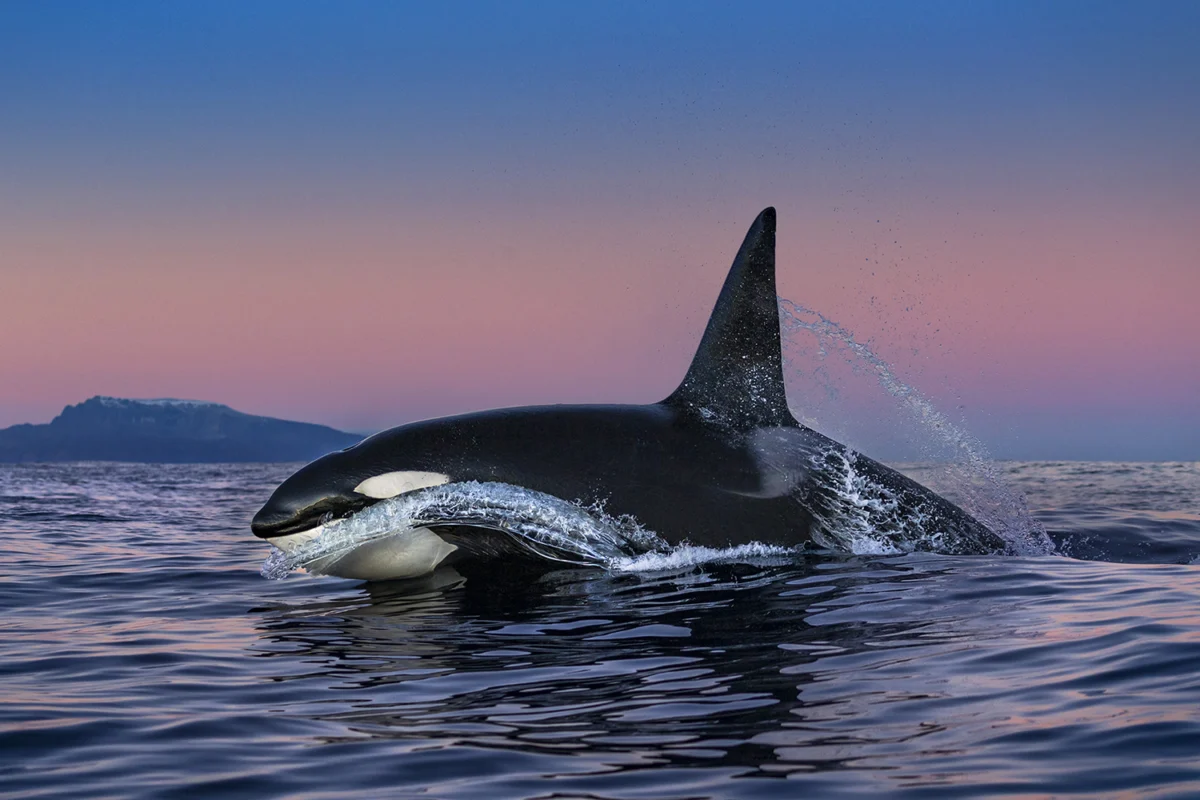
As the team maintained their position, a colossal male orca began to engage in a behavior rarely witnessed in these waters: porpoising. This powerful, rapid series of leaps and dives, characterized by immense speed and force, sent plumes of water exploding outwards with each surge. The sheer magnitude of the animal, estimated to weigh 12,000 pounds and measure 25 feet in length, was underscored by its impressive physical attributes: a dorsal fin reaching six feet in height and pectoral fins comparable in size to a car hood.
The photographer, Paul Nicklen, described the scene as a "12,000-pound dolphin explode out of the water," a visceral depiction of the orca’s power. The low light conditions presented a significant photographic challenge. Capturing such rapid motion required a delicate balance between achieving a fast enough shutter speed to freeze the action and allowing sufficient light to enter the camera to properly expose the image. The sky, at this moment, offered a brief reprieve from the darkness, transitioning to a painterly canvas of pink and orange hues, with the majestic, snow-capped mountains of Norway providing a dramatic natural backdrop.
The Art of the Shot: Navigating Low Light and High Speed
The technical demands of photographing a fast-moving subject in such dim light were immense. Nicklen’s account highlights the inherent difficulties of using single-lens reflex (SLR) cameras, particularly in high-speed action sequences. The act of taking ten frames per second, a standard feature of many professional cameras, temporarily blinds the photographer as the mirror mechanism lifts and the shutter operates. This meant that for a fraction of a second with each shot, there was no visual confirmation of whether the image was being captured successfully.
The decision-making process was rapid and critical. A shutter speed fast enough to freeze the violent motion was paramount, otherwise, the resulting images would be blurred, rendering the moment lost. Fortunately, the ambient light, though low, was just sufficient. The photographer’s friend, Goran, who was piloting the boat, demonstrated exceptional skill in maneuvering the vessel, maintaining the perfect pace to keep the orcas in frame without disturbing their behavior. This synergy between man and machine, coupled with the orcas’ unexpected exhibition, created a confluence of ideal circumstances.
The Revelation: A Perfectly Captured Moment
In the aftermath of the orcas’ dynamic display, a sense of quiet reflection settled over the team. Nicklen, back in the boat, reviewed the images on his camera’s LCD screen. The anxiety of whether the shot had been successfully captured, a common concern given the challenging conditions, began to dissipate. He described an almost disbelieving sense of certainty that "the whole package was there." The detail captured was extraordinary: water droplets streaking from the orca’s eye, cascading down its powerful body, all rendered with exquisite detail under the moody, yet perfectly balanced, light.
The photographer’s initial apprehension was that the resolution and sharpness might be compromised, particularly when attempting to zoom in on the orca’s eye. However, upon closer examination, the clarity was astounding. Every element of the image was sharp, defying the initial expectations born from the difficult shooting environment. He scrolled through the images, almost expecting to find a flaw, a sign of failure, but none appeared. This perfect capture was, in his words, a "gift of nature," an instance where the ephemeral beauty of the natural world was successfully translated into a lasting photographic record.

Broader Implications: Understanding Orca Behavior and Conservation
This remarkable encounter offers valuable insights into orca behavior, particularly the differences observed between populations in Norway and British Columbia. While the former are less prone to aerial displays, their powerful feeding behaviors, as witnessed, are equally awe-inspiring. The successful documentation of this event underscores the importance of continued research and observation in understanding the complex lives of these apex predators.
The presence of large orca pods in Norwegian fjords is intrinsically linked to the health of the marine ecosystem, specifically the abundance of herring. These seasonal migrations are a vital indicator of the ecological balance within these waters. The challenges faced by wildlife photographers like Nicklen also highlight the increasing need for advanced technology and skilled execution to document these often-fleeting moments.
From a conservation perspective, such powerful imagery plays a crucial role in raising public awareness and fostering appreciation for marine wildlife. The ability to capture and share these extraordinary events can inspire greater support for initiatives aimed at protecting marine environments and the species that inhabit them. The data gathered, both visually and through observation, contributes to a growing body of knowledge that informs conservation strategies and policy decisions.
The Enduring Power of a Frozen Moment
The experience of witnessing such raw, untamed power is profoundly transformative. The captured image, a "perfect little bottle of light and time," transcends its visual representation, embodying the thrill of discovery, the resilience of nature, and the dedication of those who strive to document it. It serves as a potent reminder of the wild wonders that exist in the world and the critical importance of preserving these natural spectacles for future generations. The story of the "Dawn Patrol" is not merely an anecdote of a successful wildlife photography expedition; it is a narrative of perseverance, technical mastery, and the profound connection between humanity and the untamed beauty of the natural world.