Each year, as the icy mists recede from the glacial peaks that crown southwestern Alaska’s rugged coastline and verdant river valleys, a primal drama unfolds. This is the season of the annual salmon run, an event of immense ecological significance and breathtaking visual spectacle. For brown bears, emerging from their winter dormancy, this migration represents a critical period of sustenance, a feasting that fuels their survival through the harsh Arctic months. The annual return of an estimated 30 million salmon, battling their way upstream to their ancestral spawning grounds, provides a vital larder for these magnificent predators, creating one of nature’s most awe-inspiring wildlife spectacles.
The Rhythms of the Run and Bear Hyperphagia
The salmon run is not a monolithic event but a sequential ballet of species, each with its own timing. The sockeye salmon are the vanguard, followed by pink and coho salmon, with chum and finally the majestic chinook salmon rounding out the procession. This intricate biological clock dictates a migration that spans nearly five months, typically commencing in late May and extending through mid-October. For the brown bears of Alaska, this extended period is synonymous with prime feeding opportunities. It is a crucial window for accumulating the fat reserves and nutritional stores necessary to endure the prolonged, frigid winter. This physiological imperative drives a phenomenon known as hyperphagia, where bears engage in near-continuous feeding, consuming hundreds of thousands of calories daily to prepare for their long hibernation.
Social Dynamics and Feeding Strategies
Within this grand ecological theatre, individual bears exhibit distinct feeding territories and behavioral adaptations. The dominant alpha males, often tipping the scales at a formidable 1,500 pounds (approximately 680 kilograms), assert their prerogative over the most advantageous fishing spots along the rivers. Their sheer mass and strength allow them to stand their ground against powerful currents, wading into the heart of the rushing water to intercept the relentless flow of salmon. Their strategy is one of brute force and opportunistic feeding, capitalizing on their size to secure the best opportunities.
In contrast, younger and more agile bears, including subadult males and females, known as subordinates, often employ different tactics. While not always possessing the seasoned wisdom of their elders, they demonstrate a keen understanding of the social hierarchy. They tend to avoid direct confrontation with larger, more aggressive males, often retreating to the cover of tall grasses or seeking out less contested fishing areas. Their agility allows them to snatch fish with quick, precise movements, adapting to the available resources without challenging the established order.
The most vulnerable participants in this annual gathering are the mother bears and their cubs. For these females, the salmon run is a period of heightened vigilance and unwavering dedication. They must not only secure sustenance for themselves but also provide for and protect their young offspring. Mother bears are characterized by their acute awareness and constant focus, their every action dictated by the dual imperatives of feeding and safeguarding their cubs.
Cubs, especially those just a few months old, are almost entirely defenseless and rely on their mothers for survival. Bringing them to the river’s edge, a prime feeding location, represents one of the most perilous environments for a mother and her progeny. The proximity to abundant food sources also brings significant dangers.
The Stark Reality of Infanticide in the Wild
Mother bears navigate a landscape fraught with challenges, perhaps none as profoundly disturbing as the threat of infanticide. The natural world, while often awe-inspiring, can also be brutally pragmatic. Infanticide, the act of male bears killing cubs—sometimes even their own offspring—is a stark reality in the wild. While the precise motivations remain a subject of ongoing scientific inquiry, various theories have emerged from years of research and observation. These range from the reduction of competition for scarce food resources to sexual selection, and even the consumption of cubs as a supplementary food source.
Regardless of the underlying biological drivers, the immediate concern for a mother bear is the undeniable threat posed by male bears, particularly the large, dominant alpha males. Her maternal instinct compels her to employ every strategy at her disposal to shield her young from this peril. The cycle of life and death is an ever-present narrative in these wild ecosystems.

A Personal Encounter: Witnessing a Mother’s Vigilance
One late August evening, at the zenith of the salmon run, the author found himself on a tranquil stretch of riverbank in southwestern Alaska. The air was still, punctuated only by the distant, rhythmic splashing of salmon fighting their way upstream. The scene exuded a profound sense of peace, a stark contrast to the intense predatory activity unfolding around. Several large bears were visible upstream, engrossed in their pursuit of an easy meal.
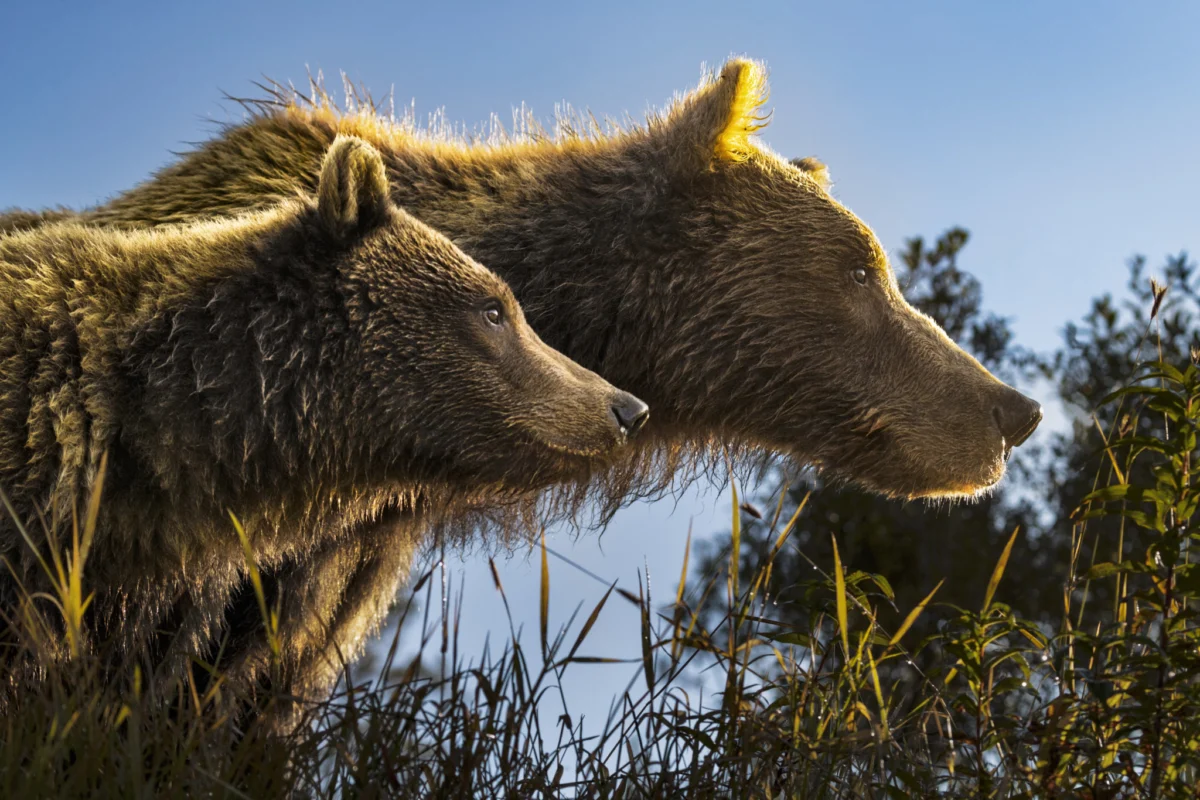
A subtle disturbance in the underbrush nearby, a faint rustling, drew the author’s attention. Approximately eight feet away, a mother brown bear and her cub emerged cautiously from the dense foliage. The cub, estimated to be no more than eight months old, peered out, its small form a poignant symbol of innocence amidst the rugged wilderness. The author instinctively slowed his breathing, avoided direct eye contact, and adopted a posture of deference, a silent acknowledgment of the bears’ dominion over their environment.
Armed only with a wide-angle lens, the photographer was not equipped for long-distance shots but was determined to capture the essence of the moment. The mother bear, her ears alert and eyes keenly scanning her surroundings, stepped fully into the open. Her focus was not on the human observer, but on a large male bear fishing upstream. This dominant male appeared oblivious to her presence, and indeed, to the author’s as well. Yet, the mother bear remained hyper-aware, her senses honed, observing, listening, and learning from the unfolding scene.
The Art of Slow Photography in the Wild
Moments like these demand an almost meditative presence. The photographer described a profound sense of calm descending, a necessity for steady hands and deliberate movements. Field assistants are often trained in a method akin to Tai Chi, emphasizing smooth, slow, and considered motions, even when urgency dictates a change of position or lens. This deliberate approach minimizes disturbance and maximizes the chances of coexisting peacefully with wildlife.
With immense care, the camera was raised to the eye, a silent prayer that the spell would not be broken. Two rapid captures were made, with no immediate certainty of their success. However, one of these images would later be recognized as one of the most satisfying the photographer had ever taken, a testament to the serendipity and skill involved in wildlife photography.
The profound experience underscored the implicit understanding that can develop between humans and animals when respect and caution are paramount. The mother bear and her cub were aware of the observer’s presence, yet they perceived no threat. The true danger, the looming presence of the large male bear, dictated the mother’s vigilance. The author was merely an accidental witness, a fortunate observer at a nexus of luck, timing, and happenstance, capturing a fleeting moment as the day’s last light faded behind the mountains.
Ecological Significance and Conservation Imperatives
The annual salmon run is more than just a dramatic wildlife event; it is a cornerstone of the Alaskan ecosystem. The ocean waters, which the author actively works to protect, serve as the vital genesis for this incredible migration. The health of these marine environments directly influences the abundance and vitality of the salmon populations, which in turn sustain a complex web of terrestrial and aquatic life.
The implications of disruptions to this delicate balance are far-reaching. Factors such as climate change, habitat degradation, and unsustainable fishing practices can significantly impact salmon populations, with cascading effects throughout the food chain. The brown bears, relying so heavily on this annual bounty, are particularly susceptible to such environmental shifts. Understanding and protecting the intricate relationships within this ecosystem is therefore crucial for the long-term survival of both the salmon and the iconic predators that depend on them.
The spectacle witnessed in Alaska serves as a powerful reminder of the intricate beauty and profound importance of wild places. It highlights the need for continued conservation efforts to ensure that these vital natural processes, like the annual salmon run, can persist for generations to come, allowing future observers to marvel at the enduring power and resilience of nature. The very simplicity of this natural cycle, the unwavering drive of salmon to return home and the bears’ primal need to feed, embodies a profound and enduring beauty that resonates deeply within the human spirit.