The Evolution of the Content Marketplace: A Chronological Overview
To understand the current pricing strategy of Depositphotos, it is necessary to examine its trajectory within the stock media industry. Founded in 2009 by Dmitry Sergeev in Kyiv, Ukraine, the company entered a market already dominated by established giants. However, by focusing on a "microstock" model—offering high-quality images at lower price points through high-volume sales—Depositphotos quickly gained traction among small-to-medium enterprises (SMEs) and independent creators.
The following timeline highlights the strategic milestones that have shaped its current market position:
- 2009: Depositphotos is launched, initially focusing on a rapidly growing library of royalty-free images.
- 2012: The company surpasses 10 million files, establishing itself as one of the fastest-growing stock agencies in the world.
- 2013-2015: Expansion into video and music tracks begins, transforming the platform into a multi-media resource.
- 2017: The launch of Crello (now VistaCreate) provides a design tool integrated with the Depositphotos library, further cementing its appeal to non-designers.
- 2021: VistaPrint’s parent company, Cimpress, acquires Depositphotos and Crello for a reported $85 million, integrating the library into a massive global ecosystem of marketing services.
- 2023-2024: The platform integrates AI-powered search and generative AI tools, adjusting its value proposition to include machine-learning-enhanced creativity.
Today, Depositphotos hosts over 304 million files, supported by a network of more than 100,000 contributors. With a client base exceeding 43 million users, the platform’s pricing must accommodate a vast spectrum of budgets and usage frequencies.
Detailed Analysis of Subscription Models and Data
Depositphotos utilizes a tiered subscription model designed to incentivize long-term commitment while maintaining entry points for low-volume users. The pricing is divided primarily between monthly and annual billing, with the latter offering substantial discounts for organizations with predictable content needs.

Small-Scale and Freelancer Tiers
The entry-level plans target freelancers and bloggers who require a consistent but limited number of assets.
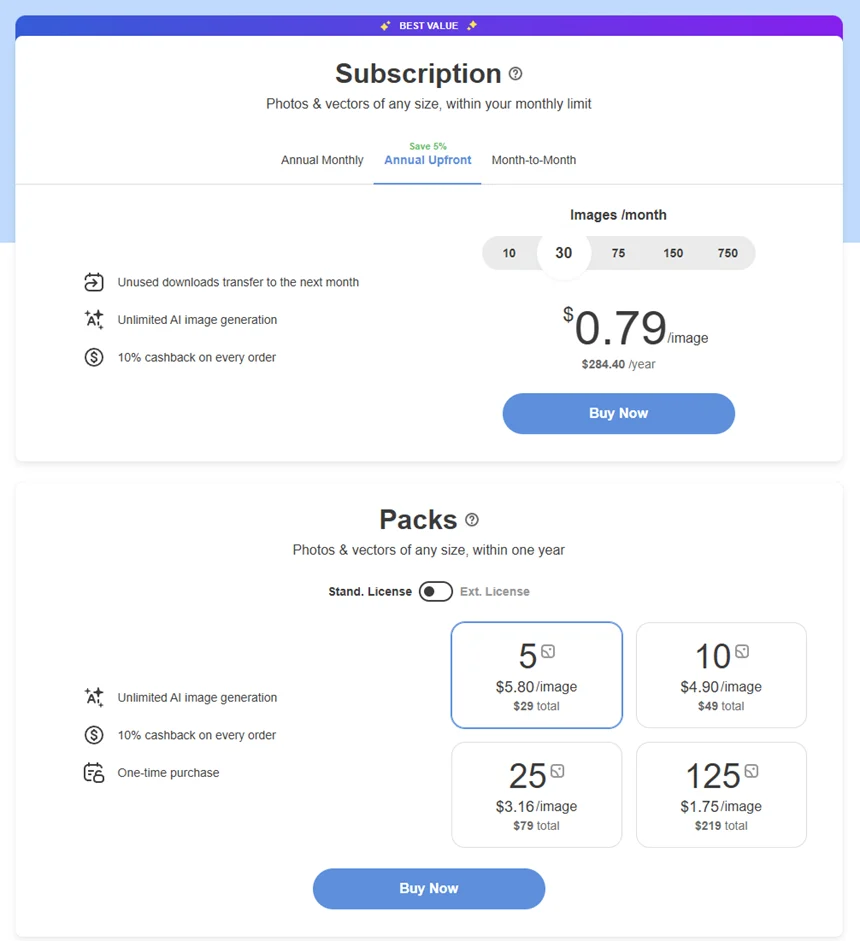
- The 10 Images Plan: Priced at $9.90 per month under an annual contract ($106.80 upfront), this plan brings the cost per image to approximately $0.89 to $1.09. This is significantly lower than the "pay-as-you-go" rates of many competitors.
- The 30 Images Plan: This tier acts as a bridge for growing brands, costing roughly $26.70 per month on an annual basis.
High-Volume Professional Tiers
For agencies and marketing departments, the cost-per-image drops dramatically as the volume increases.
- The 75 to 150 Images Plans: These plans range from $59.25 to $88.50 per month (annual billing).
- The 750 Images Plan: This represents the flagship "power user" tier. At $172.50 per month (billed annually at $1,699), the cost per image plummets to approximately $0.23. This pricing is specifically engineered to compete with Adobe Stock and Shutterstock’s high-volume offerings, often undercutting them on a pure price-per-download basis.
On-Demand Credits: The Flexibility Factor
Recognizing that not all projects follow a monthly cycle, Depositphotos maintains an "On-Demand" credit system. These credits are valid for one year from the date of purchase, providing a safety net for users with sporadic needs. While the price per image is higher in this category, it eliminates the "use it or lose it" pressure of monthly subscriptions.
Technical Features and Licensing Standards
The value of a Depositphotos subscription extends beyond the quantity of downloads. The platform’s utility is bolstered by several technical and legal features that are standard across all paid tiers.
Royalty-Free (RF) Licensing
All plans include a standard Royalty-Free license. In the context of intellectual property law, this allows the purchaser to use the image multiple times across various projects without paying additional royalties for each use. This is a critical distinction for businesses operating across multiple social media platforms, websites, and print materials.

High-Resolution Outputs
Unlike "free" stock sites that often limit resolution or quality, Depositphotos provides full-resolution access to its entire library. This includes vector files (EPS/AI) which are essential for large-scale printing, such as billboards or vehicle wraps, where image clarity is paramount.
Multi-User and Enterprise Solutions
For larger organizations, the "Team" and "Enterprise" accounts allow for centralized billing and collaborative folders. This reduces the administrative burden of managing individual logins and ensures that all downloaded assets are legally attributed to the corporation rather than an individual employee.
Comparative Market Analysis
In the competitive landscape of 2025, Depositphotos positions itself as a "mid-market" leader. While Getty Images remains the premium choice for editorial and high-end exclusive content, and sites like Unsplash cater to the zero-budget amateur market, Depositphotos competes directly with Shutterstock and Adobe Stock.
Data Comparison: Price Per Image (Standard High-Volume Plans)
- Depositphotos: ~$0.23 per image (at 750/month tier).
- Shutterstock: Historically ranges between $0.22 and $0.40 depending on promotional cycles and regional pricing.
- Adobe Stock: Generally maintains a higher price point but offers deeper integration with the Creative Cloud suite.
Industry analysts note that Depositphotos’ primary advantage is its aggressive promotional strategy and its "unused downloads" rollover feature for certain plans, which addresses a common pain point in the subscription economy.

Statements and Industry Implications
While Depositphotos does not publicly disclose every internal strategic shift, the acquisition by Cimpress signaled a move toward becoming a "full-stack" marketing resource. Industry experts suggest that the integration of stock libraries with design and printing services is the future of the industry.
"The democratization of high-quality imagery has leveled the playing field for small businesses," notes one independent marketing consultant. "The ability for a startup to access the same caliber of photography as a Fortune 500 company for less than $30 a month is a fundamental shift in how brands are built."
However, the rise of AI-generated content presents a new challenge. Depositphotos has responded by launching its own AI Image Generator, which allows users to create custom visuals from text prompts. This tool is currently being integrated into the existing credit and subscription systems, suggesting that the platform is transitioning from a "repository of existing art" to a "generative creative partner."
Broader Impact on the Creative Economy
The pricing models adopted by Depositphotos have broader implications for the global creative economy. On one hand, the low cost per image facilitates rapid content production, enabling the "always-on" marketing required by modern algorithms. On the other hand, the microstock model has put downward pressure on the earnings of individual photographers.
To maintain its 100,000+ contributor base, Depositphotos utilizes a tiered commission structure where contributors earn more as they reach higher sales milestones. This creates a volume-driven incentive for photographers to upload high-quality, commercially viable content that meets current aesthetic trends.

Furthermore, the platform’s commitment to 24/7 support in 26 languages highlights the global nature of the visual content market. As emerging markets in Asia and Latin America digitize, the demand for localized, culturally relevant stock media is expected to grow. Depositphotos’ ability to offer regional pricing and localized search results will be a key factor in its long-term sustainability.
Conclusion: Strategic Considerations for Buyers
Choosing the right Depositphotos plan requires a data-driven assessment of an organization’s monthly content output. For small businesses and individual creators, the 10 or 30-image monthly plans offer the most balanced risk-to-reward ratio. Large agencies and high-growth e-commerce platforms, conversely, will find the greatest ROI in the 750-image annual subscription, which offers the lowest overhead per asset.
As the industry moves toward a hybrid model of traditional photography and AI-generated visuals, Depositphotos’ current pricing structure appears designed to offer stability while allowing for technological evolution. For the professional buyer, the platform remains a robust, legally compliant, and cost-effective pillar of the modern creative toolkit.