Each year, the pristine wilderness of southwestern Alaska becomes the stage for one of the planet’s most profound and vital ecological dramas: the annual salmon run. As mists recede from glacial peaks and riverine valleys, brown bears emerge, drawn by an instinct as ancient as the land itself. This congregation of Ursus arctos is not merely a breathtaking wildlife spectacle; it is a critical, months-long feeding frenzy that underpins the survival of these magnificent predators through the harsh Alaskan winter. The return of approximately 30 million salmon to their natal streams is a testament to nature’s resilience and a cornerstone of the region’s intricate food web.
The Salmon’s Epic Journey: A Biological Imperative
The salmon run is a complex, multi-species event, with different runs arriving in succession. The sockeye salmon are typically the vanguard, their vibrant red bodies a stark contrast against the churning waters. They are followed by pink salmon, then coho, chum, and finally, the colossal chinook, the largest of the Pacific salmon species. This migration spans an impressive five months, beginning in late May and continuing through mid-October, transforming the rivers into arteries of life. For the brown bears, this period represents a critical window for accumulating essential fat reserves and nutritional value necessary to endure the long, unforgiving winter months.
Hyperphagia: A Bear’s Quest for Survival
As autumn approaches, brown bears enter a phase known as hyperphagia, a biological imperative that drives them to consume prodigious amounts of food. During this period, their caloric intake can skyrocket into the hundreds of thousands daily. This intense feeding behavior is crucial for survival, allowing them to build the blubber that will sustain them through hibernation. The abundance of protein-rich salmon provides the ideal fuel for this demanding biological process.
Navigating the Hierarchy: Bear Feeding Strategies
The salmon-rich rivers become a complex social arena for the bears, with established hierarchies dictating access to prime feeding grounds. Alpha males, often weighing as much as 1,500 pounds (680 kg), are the first to claim the most advantageous positions along the riverbanks. Their sheer size and strength enable them to stand their ground against powerful currents, patiently waiting to intercept the surging salmon. Their immense bulk and muscular physique are formidable advantages in this high-stakes environment.
Subordinate bears, including younger males and females, often employ different tactics. They are typically quicker and more agile, frequently retreating to the cover of tall grasses along the riverbanks. This strategy allows them to forage for fish while minimizing direct confrontation with the larger, more dominant males. While not always as bold, these bears exhibit a keen understanding of the social dynamics, recognizing the necessity of avoiding conflict with their more aggressive counterparts.
The Maternal Instinct: Protecting the Future Generation
Perhaps the most poignant aspect of the salmon run is the role of mother bears with their cubs. These maternal figures face a dual challenge: ensuring their own nutritional needs are met while simultaneously safeguarding their vulnerable offspring. The riverbanks, while a source of sustenance, also present inherent dangers.
Young cubs, often only five to six months old and still reliant on their mother’s milk, are particularly defenseless. They are introduced to the river’s edge, a place of immense opportunity but also significant peril. These mothers must remain hyper-vigilant, their attention constantly divided between foraging and protecting their young. The risks are amplified by the presence of large, dominant male bears.
The Shadow of Infanticide: A Harsh Reality of the Wild
Nature, while beautiful, is also starkly unforgiving. A significant threat to mother bears and their cubs is infanticide, the act of male bears killing young cubs, sometimes even their own offspring. While the precise reasons remain a subject of ongoing scientific research and observation, prevailing theories suggest a complex interplay of factors. These include reducing competition for limited food resources, promoting sexual selection by eliminating rival males’ progeny, and in some instances, cubs may even serve as a supplementary food source for males.
For a mother bear, these complex biological and evolutionary drivers are secondary to the immediate threat. Her primary responsibility is the protection of her young. She must employ all her instincts and strength to deter or evade male bears, particularly the dominant alphas, who pose the greatest risk. The presence of such threats underscores the immense pressure on these mothers to find safe havens and secure food for their families.

A Moment of Serene Encounter: Observation in the Alaskan Wilderness
One late August evening, amidst the peak of the salmon run, a photographer found himself in a uniquely tranquil setting along a pristine stretch of Alaskan riverbank. The air was filled with the distant sounds of salmon splashing, yet an overarching quietude prevailed. Upstream, several large bears were engaged in their methodical hunt, seemingly absorbed in the pursuit of an easy meal.
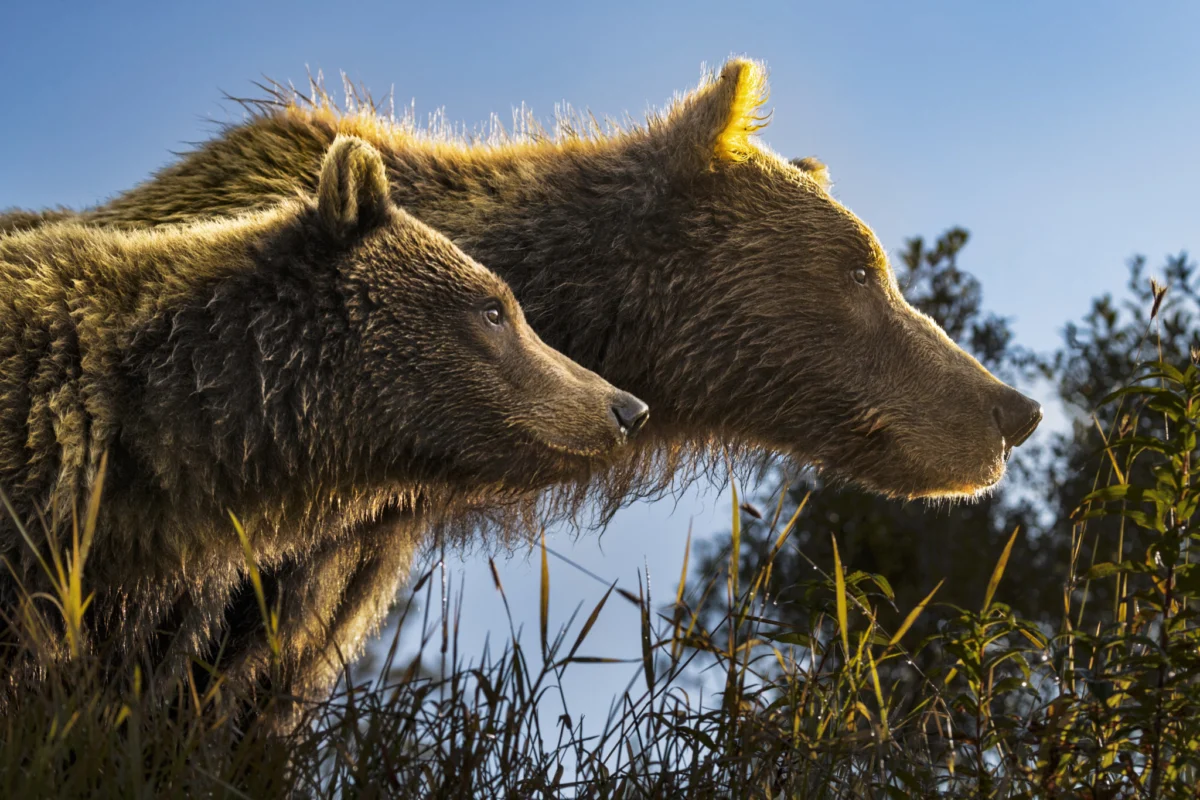
It was in this serene atmosphere that an unexpected presence was detected. A subtle rustling in the underbrush, mere feet away, signaled the approach of something significant. Slowing his breathing and adopting a posture of humility, the photographer became aware of a mother bear and her cub emerging from the dense foliage. The cub, estimated to be no more than eight months old, was still largely dependent on its mother.
The mother bear, with ears alert and eyes keenly focused, stepped into the open. Her attention, however, was not on the photographer but fixed intently on a large male bear fishing further upstream. This male appeared oblivious to their presence, but the mother’s vigilance was unwavering. She was observing, listening, and learning, constantly assessing the potential threats in her environment.
The Photographer’s Delicate Approach: Capturing the Unseen
The photographer, lacking a telephoto lens and equipped only with a wide-angle zoom, understood the extreme sensitivity of the situation. He recognized that any sudden movement or direct eye contact could shatter the fragile peace. Drawing on principles of wildlife photography ethics, he adopted a slow, deliberate approach, akin to the fluid movements of Tai Chi. This methodology emphasizes grace, control, and a profound respect for the animal’s space and autonomy.
With immense care, the camera was raised to the eye. The aim was not to intrude but to document, to capture a fleeting moment of raw, untamed nature without disrupting its course. Two quick frames were taken, the photographer unsure if he had successfully preserved the essence of the encounter. Yet, one of these images would go on to become a deeply cherished capture, a testament to the power of patience and respectful observation.
The experience highlighted a profound truth: in such moments, the rules are dictated by the animal. The mother bear and her cub acknowledged the photographer’s presence, recognizing him not as a threat, but as a passive observer. The true danger lay upstream, in the form of the dominant male. This encounter was a serendipitous intersection of luck, timing, and an understanding of the wild’s intricate dynamics.
The Broader Context: Conservation and the Vital Role of Salmon
The salmon run is not merely a local phenomenon; it is a linchpin in the broader ecosystem of the Pacific Northwest and beyond. The health of these salmon populations is inextricably linked to the vitality of marine environments and the terrestrial ecosystems they support. The Alaskan coastline, with its vast ocean waters, provides a crucial habitat for salmon throughout their lives.
The conservation of these salmon runs is therefore paramount. Declines in salmon populations, whether due to habitat degradation, overfishing, climate change, or other factors, have cascading negative impacts. These impacts extend to the bears, the eagles, the marine mammals, and ultimately, to human communities that rely on these resources.
Data and Implications: Understanding the Ecosystem
- Salmon Population Estimates: The figure of 30 million salmon migrating annually represents a significant biomass that fuels predator populations. Disruptions to this number can have immediate and noticeable effects on bear populations.
- Bear Population Dynamics: Southwestern Alaska is home to a substantial population of brown bears, with some areas supporting densities of up to one bear per square mile. The salmon run is essential for maintaining these populations, particularly for successful reproduction.
- Caloric Needs: A mature brown bear can consume up to 60 pounds (27 kg) of salmon per day during the peak of the run. This translates to tens of thousands of calories, crucial for accumulating the estimated 200-400 pounds (90-180 kg) of fat needed for hibernation.
- Infanticide Rates: While precise figures vary by region and year, infanticide is a documented behavior that significantly impacts cub survival rates, often cited as a primary cause of mortality for young bears.
Expert Perspectives (Inferred):
While direct quotes from experts are not available in the original text, the narrative strongly implies the underlying scientific understanding of bear behavior and salmon ecology. Conservation biologists and wildlife managers in Alaska would likely emphasize:
- The critical importance of intact river systems: Healthy spawning grounds and unobstructed migration routes are vital for sustaining salmon populations.
- The interconnectedness of the food web: The salmon run’s impact extends far beyond bears, supporting a diverse array of wildlife.
- The need for continued monitoring and research: Understanding the complexities of bear social structures, feeding habits, and the factors influencing infanticide is crucial for effective conservation strategies.
- The role of human activity: Balancing human interests, such as fishing and resource development, with the ecological needs of salmon and their predators is an ongoing challenge.
Broader Impact and Future Outlook
The annual salmon run in Alaska is more than just a natural phenomenon; it is a vital indicator of ecosystem health. The survival of the brown bear, a symbol of the wild, is intrinsically linked to the abundance of these fish. As climate change continues to exert pressure on marine and freshwater environments, understanding and protecting these ancient migrations becomes increasingly urgent. The serene encounters, the desperate struggles for survival, and the delicate balance of predator and prey all underscore the profound beauty and inherent fragility of the natural world. The image captured by the photographer serves as a powerful reminder of the respect and careful observation required to coexist with these magnificent creatures and the vital ecosystems they inhabit. The ongoing cycle of life, death, and renewal played out along Alaskan rivers is a story that demands our attention and our commitment to conservation.