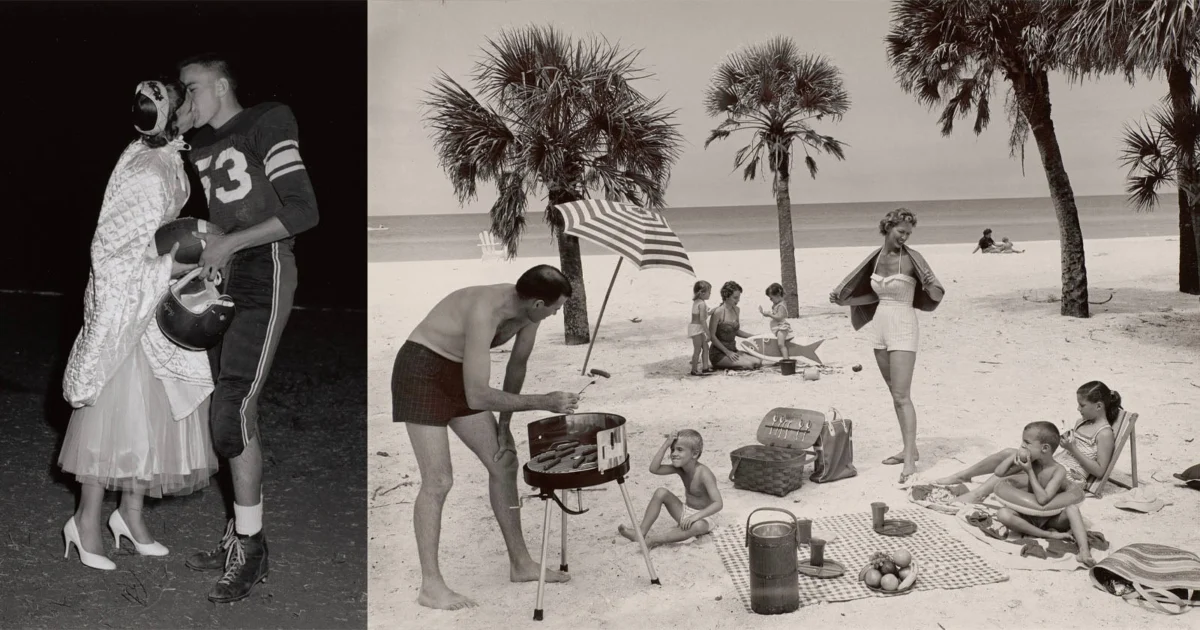
The Harvard Art Museums have unveiled a powerful and timely exhibition, "The Way We Never Were: The American Professional Photographers Collection," inviting viewers to critically re-examine the pervasive, often romanticized narrative of postwar life in the United States. Through a curated selection from its vast photographic archives, the exhibition challenges the long-held perception of a uniformly idyllic era, revealing instead a carefully constructed visual fantasy that masked deep-seated societal divisions and anxieties. Located in the University Research Gallery in Cambridge, Massachusetts, this thought-provoking display is on view until May 9, 2027.
The Fictional Facade: Deconstructing the Postwar American Dream
For decades, the period immediately following World War II in the United States has been etched into collective memory as a golden age of unparalleled prosperity, social harmony, and boundless optimism. Popular culture, historical accounts, and especially commercial photography, painted a vivid picture of American life characterized by bustling sock hops, charming malt shops, impeccably manicured suburban lawns, and a pervasive sense of national unity. This curated imagery showcased a world where families gathered for wholesome picnics, teenagers enjoyed carefree dances, and domestic life unfolded in a picture-perfect setting of consumer abundance and suburban comfort.
This powerful visual narrative was not accidental; it was meticulously crafted and disseminated by a legion of commercial photographers working on commission for a diverse array of clients. Private individuals sought polished family portraits, corporations commissioned promotional material to fuel a burgeoning consumer market, and government agencies aimed to project an image of national strength and stability. These photographers, adept at employing sophisticated visual conventions, staging techniques, and framing devices, became instrumental in defining and perpetuating the era’s most familiar and idealized scenes. They captured moments designed to reflect a burgeoning middle class, a booming economy, and a seemingly cohesive society recovering from the ravages of war and looking confidently towards the future. Images of families enjoying new appliances, children playing in safe suburban streets, and community events celebrating traditional values became emblematic of what was presented as the universal American experience. This visual lexicon, reinforced through advertising, magazines, and public relations campaigns, effectively sold not just products, but an entire lifestyle—the quintessential "American Dream."
Beneath the Surface: The Unseen Realities of a Divided Nation
Yet, as "The Way We Never Were" poignantly illustrates, this polished surface obscured a far more complex and often troubling reality. The exhibition compels visitors to look beyond the superficial charm of these images and confront the underlying cultural divisions and social policing that defined mid-century America. The photographs, predominantly taken between the end of the Korean War (1953) and the significant rise of the Civil Rights Movement (mid-1960s), offer only a partial and often misleading representation of lived experience.
This was a period marked by profound tensions that were systematically excluded from the idealized visual record. Racial segregation, enforced by Jim Crow laws in the South and de facto discrimination across the nation, dictated every aspect of life for African Americans and other minority groups, denying them equal access to housing, education, employment, and public spaces. The burgeoning Civil Rights Movement was a direct response to this systemic injustice, but its struggles and the realities of segregation rarely found their way into the commercial photographs promoting a unified America.
Simultaneously, the chilling shadow of the Cold War cast a pall over American society. Anxiety over nuclear annihilation, the constant threat of communism, and the pervasive fear of internal subversion fueled McCarthyism and a culture of conformity. Loyalty oaths, blacklists, and a climate of suspicion suppressed dissent and stifled individuality. While the government and corporations promoted an image of unwavering patriotism and national strength, the psychological toll of this era was immense. These anxieties, however, were conspicuously absent from the cheerful depictions of American life.
Furthermore, strict gender roles rigidly defined expectations for men and women, particularly within the burgeoning middle class. Women were largely confined to the domestic sphere, celebrated as homemakers and mothers, with limited opportunities for professional advancement or personal autonomy outside the home. While men were expected to be breadwinners, providing for their families in a rapidly expanding economy, the pressures of this role were often immense. The idealized images of happy homemakers and devoted fathers often failed to capture the frustrations, limitations, and unfulfilled aspirations inherent in these rigid societal structures.
Beyond these major divisions, the exhibition implicitly highlights other significant exclusions. Economic inequality, despite the overall growth, persisted for many. Rural poverty, the experiences of non-white immigrant communities, and the nascent LGBTQ+ movements were largely invisible in the mainstream visual narrative. These photographs, therefore, did not merely record American life; they actively constructed an idealized vision of postwar prosperity and belonging that, by its very nature, masked the underlying tensions, exclusions, and diverse experiences that truly characterized the era. They presented a specific, narrow vision of "Americanness," predominantly white and middle-class, as the universal standard.
A Curatorial Journey: Assembling and Reinterpreting a Unique Archive
The genesis of "The Way We Never Were" lies in a monumental effort undertaken in the 1970s by Barbara P. Norfleet, a distinguished Harvard sociologist and curator. Recognizing the impending loss of valuable historical documentation, Norfleet embarked on a cross-country odyssey, visiting dozens of professional photography studios across the United States. Her mission was to salvage and preserve the photographic negatives and prints that chronicled the everyday lives and significant milestones of American communities.
This ambitious initiative resulted in the creation of the American Professional Photographers Collection, an extraordinary archive comprising over 20,000 negatives and prints. Norfleet initially conceived of this collection as a "unique and valuable record of American life," a direct window into the customs, rituals, and celebrations of ordinary people. The collection captured a vast spectrum of subjects, from the joyous solemnity of weddings and the coming-of-age celebrations of bar mitzvahs, to the exuberant energy of school dances, the triumphs of sports victories, and the structured camaraderie of corporate retreats. It was, in her initial assessment, an unvarnished testament to the nation’s collective memory.
However, the passage of time and the evolution of critical historical and sociological perspectives have led to a profound reinterpretation of this very collection. What was once seen as a straightforward record has, under contemporary scrutiny, transformed into a "mediated and carefully composed fantasy of the ‘good old days.’" The exhibition at Harvard Art Museums marks a pivotal moment in this evolving understanding. It foregrounds the realization that these photographs were not merely passive reflections of an existing reality but active participants in the construction of a national identity, meticulously crafted to uphold a particular, often exclusionary, view of American belonging. The 1970s, a decade marked by disillusionment from the Vietnam War, the Watergate scandal, and the ongoing Civil Rights and feminist movements, likely provided a fertile ground for questioning established narratives, making Norfleet’s collection effort prescient, even if its ultimate interpretation would shift decades later.
Featured Works: A Glimpse into the Curated Past
The exhibition showcases approximately 70 photographs, each a testament to the era’s visual conventions and the stories they told—and omitted. These works span a wide range of subjects, illustrating the pervasive nature of commercial photography in shaping public perception.
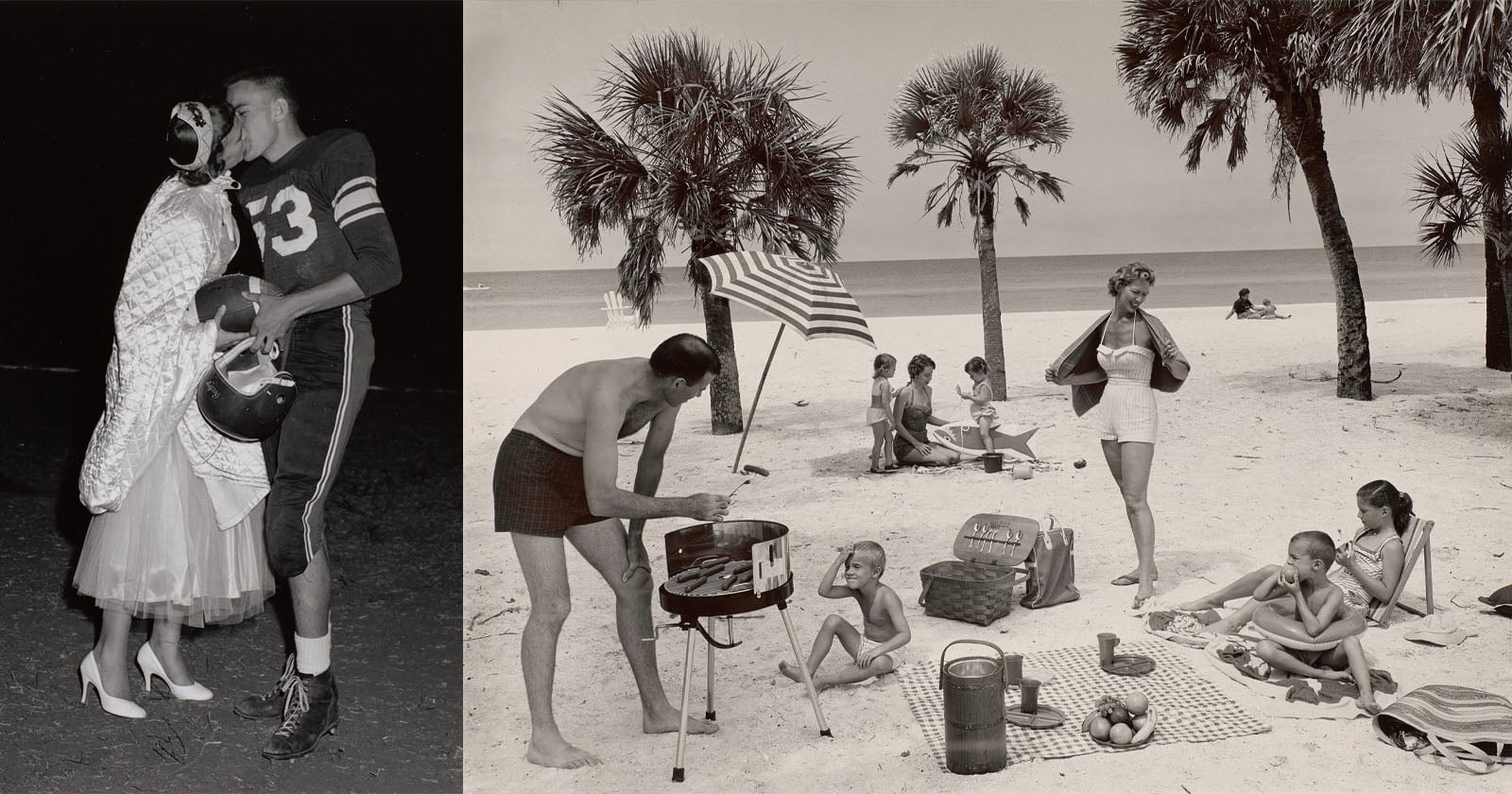
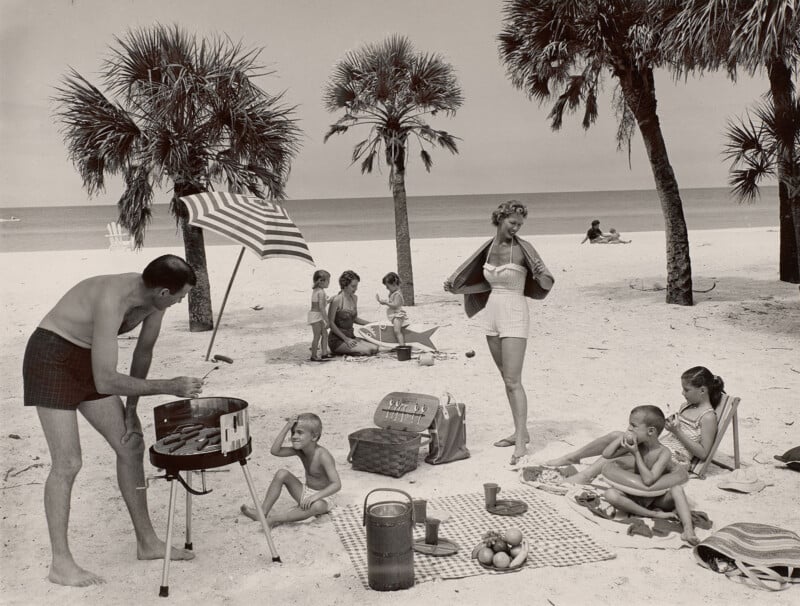
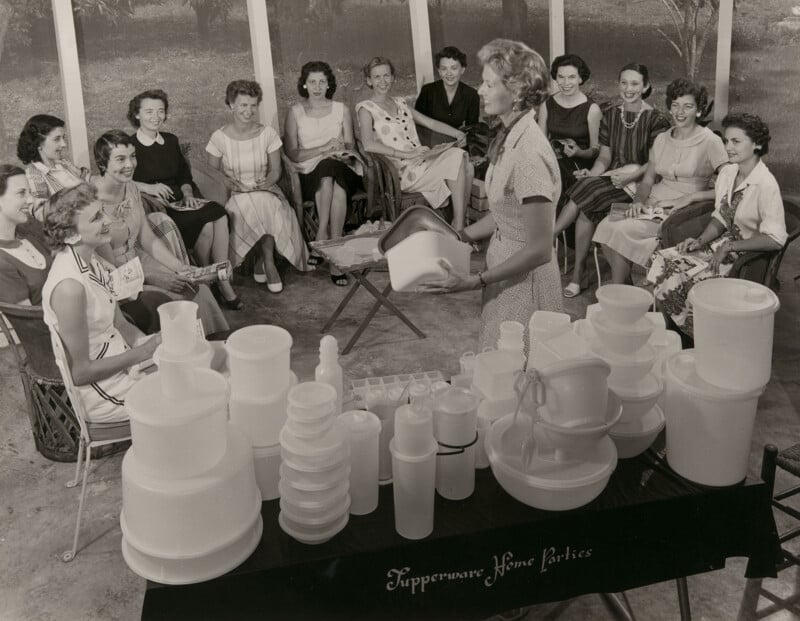
Among the featured artists is Joseph Janney Steinmetz (1905–1985), whose works frequently depicted idyllic scenes of leisure and domesticity. His "Untitled (Family picnic on beach)" from Longboat Key, Florida, 1958, perfectly embodies the carefree image of American leisure, with a family enjoying the sun and grilling hot dogs. Similarly, his "Untitled (Tupperware party)" from Sarasota, Florida, 1958, captures the essence of burgeoning consumer culture and female domesticity, as women gather to marvel at new household products. Another piece by Steinmetz, "Untitled (Woman at mailbox)" from Bayshore Gardens, Florida, 1959, subtly reinforces the suburban ideal, depicting a woman in a dress checking her mail while a neighbor mows his lawn—a scene of quiet, ordered neighborhood life. These images, while charming, represent the carefully curated facade of a homogenous, affluent suburban experience.
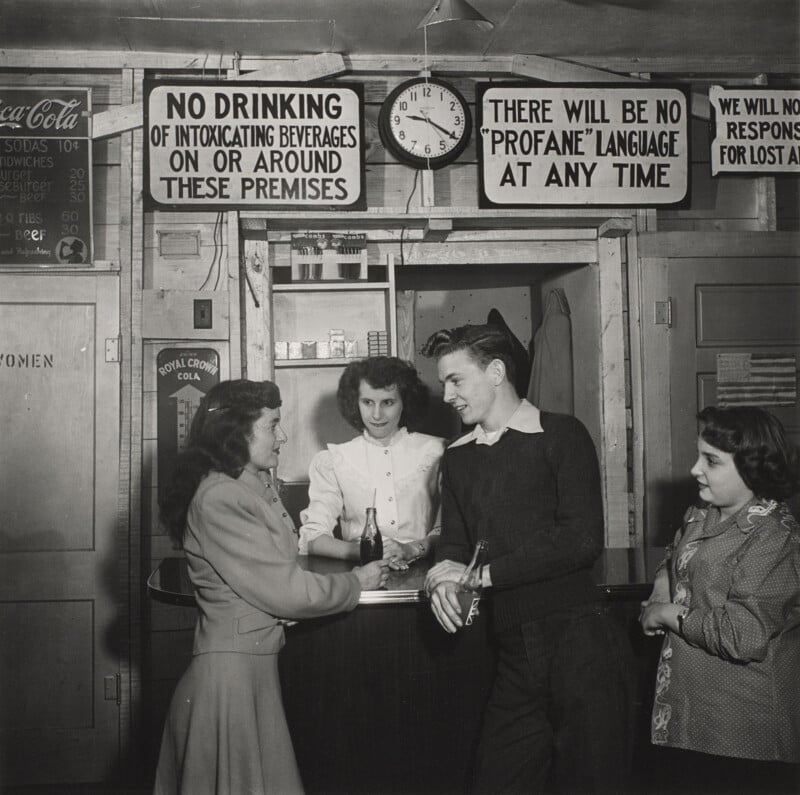
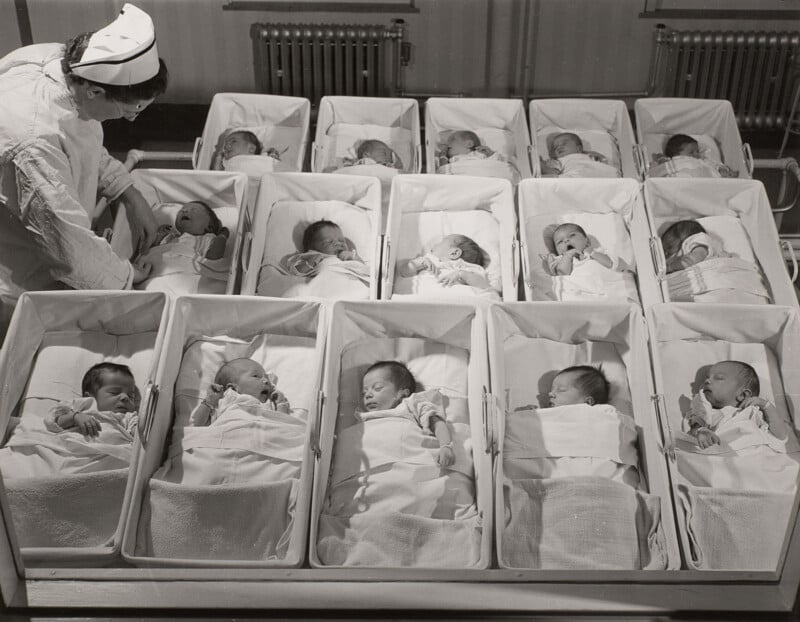
Jack Gould (1905–1963) contributes to the exhibition with images that capture youth culture and societal institutions. His "Untitled (Teenagers at dance hall)" from around 1950, with its signs prohibiting alcohol and profanity, offers a glimpse into the controlled social spaces for adolescents. "Untitled (Nurse with newborn babies at hospital)" from Saint Louis, Missouri, 1946, portrays the sanitized and hopeful image of new life and modern healthcare, while "Untitled (Television Night School)," 1948, shows a group gathered around a television, highlighting the early adoption of new technology in educational or communal settings.
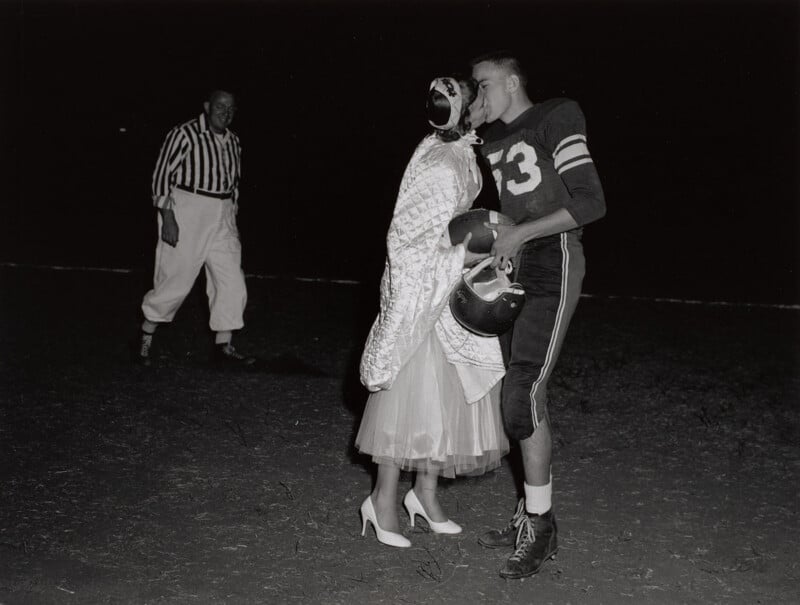
The milestones of youth are further captured by Gene Claseman (1915–2004), whose "Untitled (Homecoming queen and football player kissing)" from South Dakota, 1955, epitomizes the idealized high school romance and celebratory rituals of small-town America. The image, set against a nighttime football field with a referee in the background, is a classic depiction of teenage triumph and budding affection.
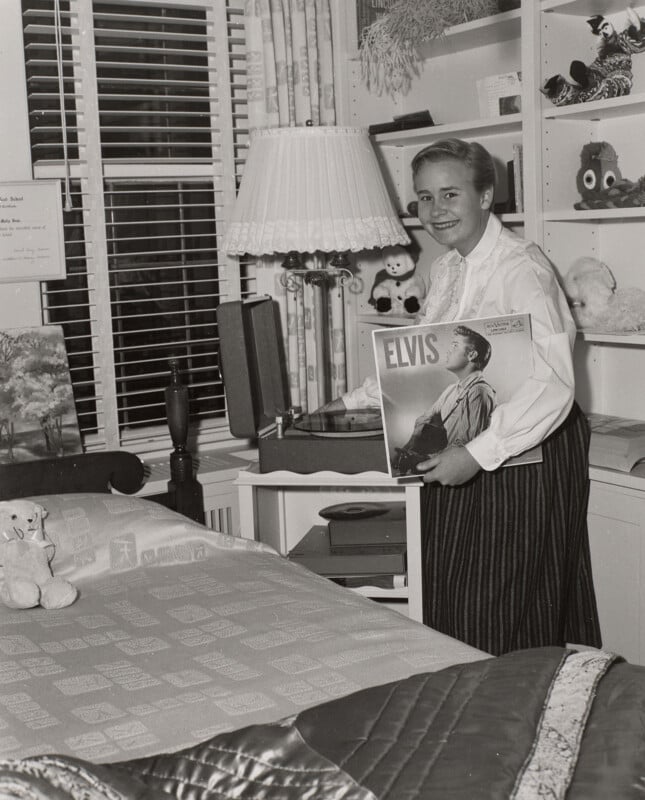
The cultural impact of emerging pop figures is seen in Lucian Brown (1915–2007) and Mary Brown (1916–2009)’s "Untitled (Girl with Elvis record)" from Minnesota, circa 1956. This intimate portrayal of a young woman smiling with an Elvis Presley vinyl record in her bedroom, surrounded by stuffed animals and a record player, encapsulates the rise of youth idolization and the nascent rock-and-roll revolution, yet still within a seemingly wholesome, middle-class setting.
Crucially, the exhibition also includes images that subtly—or not so subtly—challenge the dominant narrative. Clement McLarty (active 1950s–60s)’s "Untitled (Bride in living room)" from Boston, Massachusetts, 1965, depicts a Black bride in a beautiful white wedding dress. This photograph is particularly significant. Taken in the midst of the Civil Rights Movement and against the backdrop of a largely segregated society, it serves as a powerful reminder that "American life" was never solely white or monolithic. The presence of a framed portrait of John and Jackie Kennedy on a nearby side table adds another layer of historical context, hinting at the aspirations and political consciousness within this particular household, and standing in stark contrast to the often exclusively white suburban imagery. Such inclusions are vital in demonstrating "what’s left out of the frame" in the broader collection and in the historical narrative.
Curatorial Voices: Challenging Perception and Promoting Critical Engagement
The curators of "The Way We Never Were" articulate the exhibition’s mission with clarity and insight. Audrey Sands, one of the exhibition’s curators, reflects on the dual nature of encountering these historical photographs. "It has been a revelation to dig into this archive," Sands states, acknowledging the immediate appeal and richness of the images. "On one hand, we get to delight in these pictures – a Tupperware party, teen canteens, hula-hoop competitions, Christmas morning in a family living room bursting with gifts, a kiss between a homecoming king and queen – in their humor, intimacy, and visual richness." This sentiment speaks to the nostalgic pull and genuine artistry often present in these works.
However, Sands quickly pivots to the deeper critical engagement the exhibition demands: "On the other, we must reckon with the fact that photography is constructed. These images weren’t simply recording an existing reality; they were helping create, circulate, and sell a particular vision of America." This statement is central to the exhibition’s thesis, urging viewers to move beyond passive consumption of images and to understand photography as an active agent in shaping cultural perceptions and historical narratives.
Madison Brown, another curator, further elaborates on this critical imperative. "We want to encourage viewers to look critically at how professional photography crafted and promoted an idealized vision of American life, in which sunny, white, middle-class experiences came to stand in for a far more diverse national story," she explains. This highlights the exhibition’s role in advocating for a more inclusive and truthful understanding of American history. Brown emphasizes the local origins of many of these photographs: "Each of these photographers served a particular town or region, documenting everything from weddings to parades for the communities they knew best." Yet, she concludes, "Taken together, their distinctly local work reveals a shared American culture of remembrance – not only in what people chose to preserve, but also in what’s left out of the frame." This powerful observation underscores the exhibition’s dedication to uncovering the silences and omissions that are as revealing as the visible content within the archive.
Lasting Legacy: Implications for Understanding History and Media Today
"The Way We Never Were" is more than a historical photography exhibition; it is a profound lesson in media literacy and historical revisionism. By meticulously deconstructing the visual mythology of postwar America, the Harvard Art Museums are contributing to a more nuanced and accurate understanding of the nation’s past. The exhibition demonstrates that history is not merely a collection of facts, but an ongoing process of interpretation, particularly when influenced by powerful visual media.
The implications of this exhibition extend far beyond the mid-20th century. In an age saturated with digital imagery, social media, and carefully curated online personas, the lessons learned from examining these historical photographs resonate profoundly with contemporary experiences. The exhibition serves as a vital reminder of the power of visual media to shape perceptions, influence desires, and, intentionally or unintentionally, distort reality. It encourages audiences to apply the same critical lens to the images they encounter daily, questioning their origins, their purpose, and what might be deliberately left out of the frame.
Ultimately, "The Way We Never Were" champions the importance of questioning dominant narratives and seeking out diverse perspectives. Institutions like the Harvard Art Museums play a crucial role in fostering this critical discourse, ensuring that cultural memory is not a static, idealized tableau, but a dynamic, ever-evolving landscape that acknowledges the complexities, struggles, and multifaceted identities that truly constitute a nation’s history. The exhibition stands as a testament to the enduring power of photography, not just to document, but to shape, challenge, and ultimately enrich our understanding of who we are and who we aspire to be.
"The Way We Never Were: The American Professional Photographers Collection" is currently on view at the University Research Gallery at Harvard Art Museums in Cambridge, Massachusetts, and will run until May 9, 2027.