Japan’s Ministry of Economy, Trade, and Industry (METI) has released an insightful analysis indicating a significant recovery in the global digital camera market, a crucial industry where Japan holds unparalleled dominance. This assessment comes as a welcome development for an sector that has grappled with profound challenges posed by the meteoric rise of smartphones over the past two decades. The Ministry’s findings, initially highlighted by Digicame-Info and detailed in a METI article, underscore a pivotal turnaround, particularly in the compact camera segment and the burgeoning mirrorless interchangeable lens camera category, attributing this resurgence partly to the evolving demands of younger generations engaged in social media and video sharing.
Japan’s Unrivalled Position in Global Photography
The landscape of professional and consumer photography is overwhelmingly shaped by Japanese innovation and manufacturing prowess. With the notable exceptions of European stalwarts like Leica (Germany) and Hasselblad (Sweden), virtually all major global players in camera bodies, lenses, and associated imaging technologies hail from Japan. Giants such as Canon, Nikon, Sony, Fujifilm, Panasonic, Olympus, Ricoh, and specialist lens manufacturers like Sigma and Tamron, collectively command a vast majority of the market share. This enduring supremacy is not merely a testament to their engineering excellence but also a deeply embedded component of Japan’s industrial identity and economic strength. Consequently, the health of the digital camera market is of direct strategic interest to governmental bodies like METI, which plays a vital role in monitoring and fostering the competitiveness of key national industries. The Camera & Imaging Products Association (CIPA), a global trade organization based in Japan, further solidifies this centrality by aggregating and reporting industry-wide shipment data, providing a comprehensive pulse check on the sector’s performance worldwide.
The Smartphone Tsunami: A Decade of Disruption and Decline
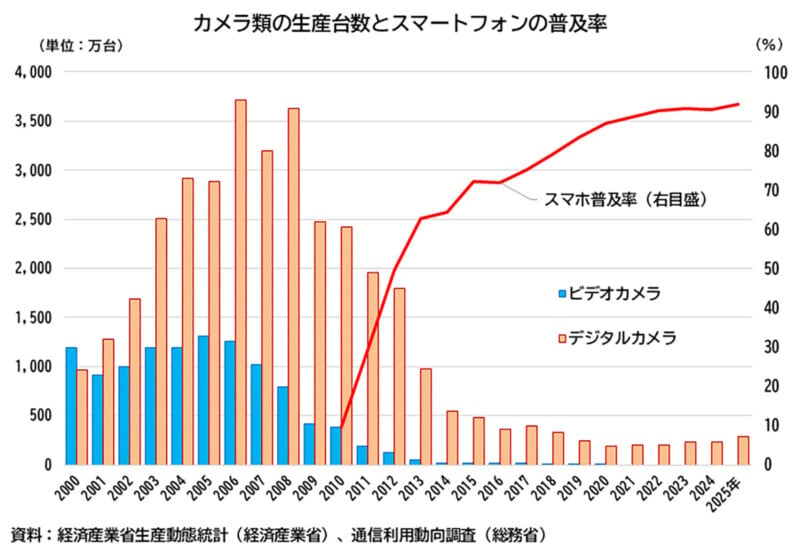
The period from the mid-2000s to the early 2010s marked a golden age for digital cameras, characterized by rapid technological advancements, increasing affordability, and widespread adoption by the general public. Manufacturers churned out millions of units annually, from basic point-and-shoot models to sophisticated DSLRs. However, this boom was abruptly curtailed by the introduction and rapid proliferation of smartphones. As METI’s historical production dynamics statistics vividly illustrate, the advent of smartphones around 2007-2008 coincided almost perfectly with a precipitous decline in digital camera sales.
The METI report includes compelling visual data, featuring a bar and line chart that meticulously tracks domestic production figures for digital still cameras and video cameras alongside the smartphone penetration rate in Japan from 2000 to 2025. This chart serves as a stark visual narrative of the industry’s dramatic fortunes. Video camera production, which peaked around 2005, began its descent shortly thereafter. Digital camera production followed suit, initiating a sharp decline around 2008—the precise period when smartphones began their exponential ascent into mainstream consumer culture. The inverse correlation shown in the chart is undeniable: as smartphone penetration eclipsed the 50 percent mark, the demand for dedicated digital cameras plummeted, effectively pushing the industry off a cliff. For years, the convenience, connectivity, and increasingly competent imaging capabilities of smartphones made standalone compact cameras seem redundant to the average consumer, who no longer saw the need to carry an additional device solely for photography.
Signs of Resilience: A Market Rebound
Despite the initial catastrophic impact, recent data suggests a remarkable and encouraging shift. METI’s analysis highlights that "digital camera production has recently been picking up," signaling that the industry, after years of struggle, is finally demonstrating "meaningful signs of recovery." This positive trend is underscored by the fact that 2025 saw digital camera shipments among Japanese companies increase for the second consecutive year. This marks a truly significant milestone, as it is the first time in nearly two decades that the industry has experienced back-to-back years of shipment growth, a clear indicator of stabilization and renewed vitality.
The recovery, however, is not uniform across all segments. The METI report points to particular strength in two key areas: compact cameras and mirrorless interchangeable lens cameras. The accompanying line graph, charting domestic shipments of digital cameras in Japan from 2020 to 2025, provides further granular detail. While the blue line representing DSLRs shows a continued, albeit slower, decline, the red line for integrated lens cameras (compacts) and the black line for mirrorless cameras both exhibit an upward trajectory. This segmentation reveals a strategic pivot and adaptation within the industry.
The resurgence of compact cameras is particularly noteworthy. While the basic, low-cost point-and-shoots that once dominated the market largely disappeared, a new wave of advanced, premium compacts, often featuring larger sensors, fast lenses, and robust video capabilities, has found favor. Furthermore, there’s been an unexpected resurgence in demand for older, more basic compact digital cameras, often dubbed "digicams," driven by a nostalgic aesthetic and a desire for a distinct, less polished look for social media content, particularly among younger demographics.
Mirrorless cameras, on the other hand, represent the future of advanced photography. These cameras, which forgo the mirror box of traditional DSLRs, offer significant advantages in terms of size, weight, speed, and video capabilities. Manufacturers have heavily invested in developing sophisticated mirrorless systems, offering everything from entry-level models to professional-grade bodies that rival, and often surpass, DSLRs in performance. The consistent growth in mirrorless shipments reflects this technological superiority and strategic focus.
Driving Factors: The Rise of the "Creator Economy" and Technological Advancements
METI speculates that this recovery is "likely due in part to the capture of demand from younger generations for use in social media and video sharing." This insight is crucial. The pervasive influence of platforms like TikTok, YouTube, Instagram Reels, and Twitch has fostered a massive "creator economy." Millions of individuals are now actively producing high-quality photo and video content, pushing the boundaries of what’s achievable with a smartphone. While smartphones remain indispensable tools for casual content creation, many aspiring and established creators quickly realize the limitations of mobile devices when seeking superior image quality, better low-light performance, greater creative control, versatile optical zoom, and professional-grade audio input.

This segment of users, often starting their creative journey with a smartphone, represents a compelling target audience for camera manufacturers. The industry’s strategic shift has been to make dedicated cameras more appealing and accessible to these "first-time buyers" or "smartphone upgraders" who are looking for a noticeable leap in photo and video quality. This involves focusing on user-friendly interfaces, robust video features (such as 4K/8K recording, advanced stabilization, and fast autofocus for tracking subjects), and seamless connectivity options to facilitate quick transfer and sharing of content. The rise of "vlogging cameras" – compact, mirrorless models specifically designed with features like flip-out screens, external microphone inputs, and easy streaming capabilities – is a direct response to this burgeoning market.
Beyond the youth-driven content creation boom, technological advancements have played a critical role. Modern mirrorless cameras boast sophisticated autofocus systems that can track eyes and faces with uncanny accuracy, powerful in-body image stabilization (IBIS) that allows for sharper handheld shots, and advanced sensor technologies that deliver exceptional dynamic range and low-noise performance even in challenging lighting conditions. The continuous evolution of lens lineups also provides unparalleled creative flexibility that no smartphone, regardless of its computational photography prowess, can replicate. The ability to swap lenses, choose specific focal lengths, and achieve true shallow depth of field remains a significant differentiator for dedicated cameras.
Official Responses and Industry Adaptation
METI’s positive assessment serves as an official endorsement of the Japanese camera industry’s resilience and its successful adaptation strategies. For a government ministry focused on industrial health, acknowledging this recovery is a significant statement, indicating confidence in the sector’s future trajectory.
From the industry’s perspective, the path to recovery has been marked by strategic pivots and aggressive innovation. Canon and Nikon, traditionally dominant in the DSLR market, initially struggled to adapt to the mirrorless shift but have since made substantial investments in their respective mirrorless R and Z systems, rapidly expanding their lens ecosystems and introducing highly competitive camera bodies. Sony, an early pioneer in the full-frame mirrorless segment, continues to push boundaries with its Alpha series, catering to both amateur enthusiasts and professional photographers and videographers. Fujifilm has carved out a unique niche with its retro-inspired designs, exceptional image quality, and film simulation modes, appealing to a segment that values aesthetics and a tactile shooting experience. Panasonic, while maintaining a strong presence in micro four-thirds, has also entered the full-frame mirrorless market, focusing heavily on video capabilities.
These companies have learned critical lessons from the smartphone disruption. They are now acutely aware of the need to differentiate their products not just on raw technical specifications but also on user experience, creative potential, and seamless integration into modern digital workflows. This includes developing robust mobile applications for remote camera control and quick image transfer, enhancing in-camera connectivity (Wi-Fi, Bluetooth), and actively engaging with the creator community to understand evolving needs.
Broader Impact and Future Outlook
While the digital camera market may never again reach the dizzying heights of its pre-smartphone peak in terms of sheer volume, the current stabilization and signs of growth suggest a more specialized, robust, and sustainable future. The industry has effectively shed its mass-market, casual-user segment to smartphones and has instead focused on cultivating a passionate core of enthusiasts, semi-professionals, and professional content creators.
The economic implications for Japan are substantial. A healthy camera industry contributes to national GDP through manufacturing, research and development, and exports. It sustains a highly skilled workforce and fosters continuous innovation in optics, sensor technology, and image processing. The recovery ensures that Japan retains its global leadership in a technologically advanced and culturally significant sector.
Looking ahead, the market will likely remain segmented. Smartphones will continue to dominate casual photography for the vast majority of consumers. However, for those who prioritize superior image quality, creative control, specialized functionalities (like advanced video, extreme telephoto, or macro photography), and the tactile experience of a dedicated photographic tool, interchangeable lens cameras and premium compacts will remain indispensable. The ongoing competition between computational photography in smartphones and the optical and sensor advantages of dedicated cameras will continue to drive innovation in both spheres. The role of artificial intelligence in image processing, autofocus, and content creation workflows will also increasingly blur the lines and create new opportunities.
In conclusion, the METI report provides a clear and optimistic outlook for the Japanese digital camera industry. After a challenging period of adaptation, the market has not only stabilized but is showing tangible signs of recovery, fueled by technological innovation and a renewed appeal to a generation hungry for high-quality visual content. This resurgence confirms the enduring relevance of dedicated cameras in a world increasingly dominated by mobile devices, solidifying their place as essential tools for serious photographers and the burgeoning creative economy.