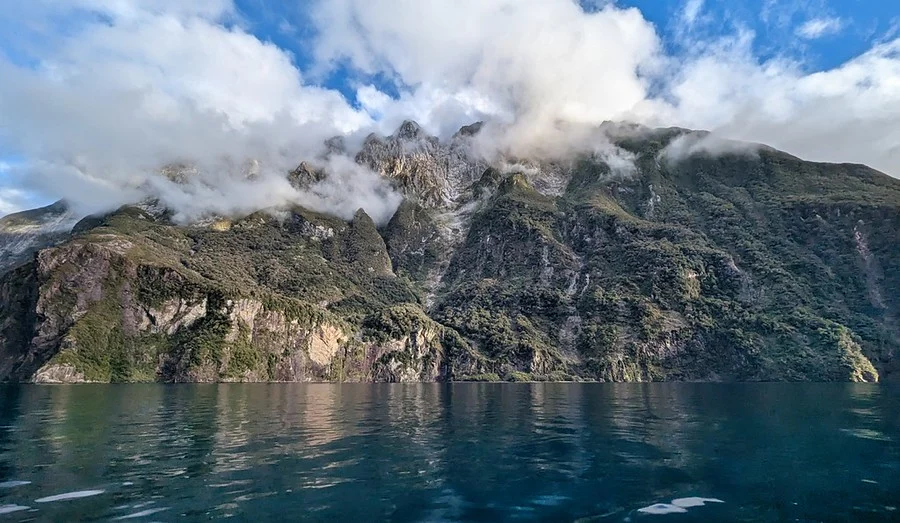
The dramatic entrance to Milford Sound, also known by its Māori name Piopiotahi, is a breathtaking gateway that captivates visitors and locals alike, offering a first glimpse into one of New Zealand’s most iconic natural wonders. This initial vista, as captured in recent photographic documentation, serves as a powerful visual introduction to a landscape sculpted by ancient glaciers and defined by towering granite cliffs, cascading waterfalls, and the deep, dark waters of the fjord. The image, shared from the perspective of approaching from the ocean, presents a scene of immense scale and raw beauty, a testament to the geological forces that have shaped this UNESCO World Heritage site.
Milford Sound, situated on the southwest coast of New Zealand’s South Island, is renowned for its dramatic topography. The fjord, carved by glaciers during the last ice age, stretches approximately 15 kilometers inland from the Tasman Sea. Its sheer sides rise almost vertically from the water, often reaching heights of over 1,000 meters. The most prominent peaks visible from the entrance include Mitre Peak, a distinctive, pyramid-shaped mountain that has become synonymous with the Sound’s image, and The Pinnacles. The geological history of the region is a story of relentless glacial erosion, with ice sheets thousands of meters thick grinding through the bedrock over millennia, leaving behind the U-shaped valleys characteristic of fjords. The depth of Milford Sound itself is considerable, reaching up to 530 meters in its deepest point, a testament to the immense power of the glaciers that formed it.
The journey into Milford Sound from the Tasman Sea is an experience that many describe as transformative. As vessels navigate the narrow entrance, the scale of the surrounding cliffs becomes overwhelmingly apparent. The water within the fjord is often a deep, inky blue, reflecting the dark, forested slopes that descend to its edge. Rainfall is exceptionally high in this region, with an average of around 6,400 millimeters per year, making it one of the wettest inhabited places on Earth. This abundant precipitation is the source of the numerous waterfalls that adorn the fjord’s walls, many of which are permanent features, while others are ephemeral, appearing only after significant rainfall. Stirling Falls and Bowen Falls are among the most famous, plunging hundreds of meters in spectacular fashion.
The ecological significance of Milford Sound is also a crucial aspect of its allure. The fjord supports a unique marine ecosystem, influenced by the freshwater runoff from the mountains, which creates a distinct layer on the surface. This stratification affects light penetration and salinity, fostering specialized conditions. The waters are home to a variety of marine life, including seals, dolphins, and the rare Fiordland crested penguin. Larger marine mammals, such as whales, are also occasional visitors to the area, drawn by the rich feeding grounds. The surrounding rainforests, characterized by ancient beech trees and a dense undergrowth of ferns and mosses, are home to native bird species, including the kiwi, though sightings are rare due to their nocturnal and elusive nature.
The human history of Milford Sound is equally compelling. The Māori people have a deep connection to this land, with oral traditions dating back centuries. The name Piopiotahi refers to a legend of a bird, the piopio, that was caught in the fjord by the demigod Maui. The area was a source of food and shelter for early Māori explorers and settlers, who navigated the treacherous waters in waka (canoes). European exploration of the fjord began in the early 19th century, with Captain John Grono and later Robert Rhys charting its course. However, it was Captain James Cook’s 1773 encounter that marked the first recorded European sighting of the Sound. Despite its immense natural beauty, Milford Sound remained relatively inaccessible for a long time, with access primarily by sea.
The development of infrastructure has gradually opened up Milford Sound to a wider audience. The construction of the Milford Road, a project that involved overcoming significant engineering challenges due to the rugged terrain, has been pivotal. The road, which winds through Fiordland National Park, offers stunning vistas and a dramatic approach to the fjord. The completion of the Homer Tunnel in 1953 was a landmark achievement, connecting Milford Sound to the rest of the South Island and significantly reducing travel times. Today, Milford Sound is a major tourist destination, attracting hundreds of thousands of visitors annually, eager to experience its unparalleled natural grandeur.
The photographic documentation of the fjord’s entrance serves as a reminder of the ongoing appreciation for this natural wonder. Such images, when shared, contribute to a broader awareness of the importance of conservation efforts. Fiordland National Park, established in 1952, is a protected area managed by the Department of Conservation (DOC), tasked with preserving its unique biodiversity and geological heritage for future generations. The park’s designation as a UNESCO World Heritage site in 1986 underscores its global significance and the need for careful stewardship.
The economic impact of tourism in Milford Sound is substantial, supporting local communities and the national economy. However, this influx of visitors also presents challenges, particularly concerning the environmental footprint of tourism activities. Sustainable tourism practices are increasingly emphasized, with efforts to minimize waste, manage visitor numbers, and educate tourists about the fragility of the ecosystem. Cruise operations, a dominant form of visitor experience in the Sound, are subject to environmental regulations designed to protect marine life and water quality.
The broader implications of Milford Sound’s accessibility and popularity extend beyond its immediate region. It stands as a symbol of New Zealand’s commitment to preserving its natural heritage and showcasing it to the world. The ongoing study of its geology, ecology, and climate continues to provide valuable scientific insights. For instance, research into the fjord’s unique marine environment has contributed to a better understanding of how freshwater and saltwater interactions influence aquatic ecosystems. Furthermore, the geological formations offer clues about the planet’s glacial past and the processes of mountain building and erosion.
The visual appeal of Milford Sound, as exemplified by the photograph of its entrance, plays a crucial role in promoting national identity and attracting international visitors. It is a landscape that evokes awe and inspires a sense of connection to the natural world. The ongoing documentation and sharing of these scenes are vital for fostering public engagement with conservation issues and for reminding us of the irreplaceable value of such natural treasures. The continuous flow of visitors, drawn by the promise of witnessing such magnificent scenery, underscores the enduring power of nature to captivate and inspire humanity.
The infrastructure supporting tourism, while essential for access, also requires constant maintenance and adaptation to environmental conditions. Landslides and seismic activity are natural phenomena in this geologically active region, necessitating ongoing monitoring and risk management. The Milford Road, for example, is subject to closures due to weather and geological events, highlighting the dynamic nature of the landscape and the challenges of maintaining access.
In conclusion, the entrance to Milford Sound is more than just a geographical point; it is a threshold to a realm of unparalleled natural beauty and geological significance. The visual narrative conveyed by such images speaks to the power of landscapes shaped by the most elemental forces of nature. As Milford Sound continues to welcome visitors, the ongoing commitment to its preservation remains paramount, ensuring that its awe-inspiring entrance and its hidden depths can be appreciated for generations to come. The continued study and responsible management of this iconic fjord are essential for understanding its place within the broader context of global natural heritage and for safeguarding its future. The scene depicted at the fjord’s mouth is a potent reminder of the wild, untamed beauty that continues to draw people to the remote corners of our planet, a testament to the enduring allure of the natural world.