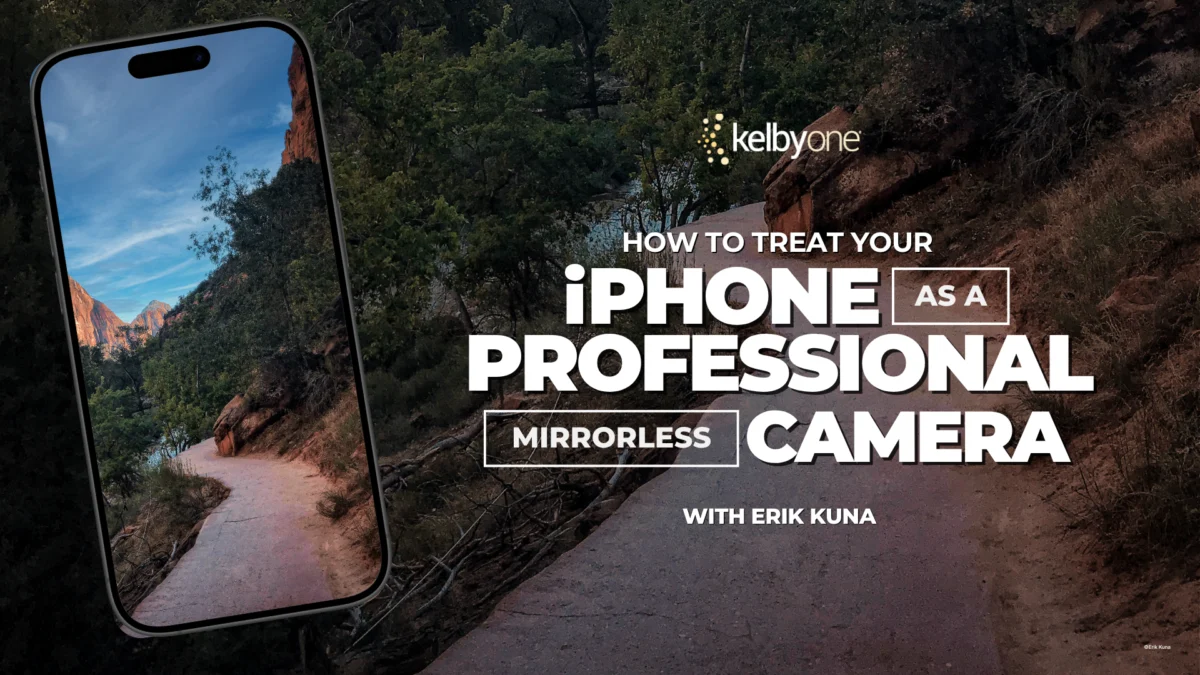
The ubiquitous iPhone, a device carried by billions worldwide, has transcended its primary function as a communication tool to become one of the most powerful and accessible cameras ever created. Yet, for many users, its photographic potential remains largely untapped, often relegated to automatic settings and casual snapshots. Addressing this significant gap, KelbyOne, a global leader in photography education, has launched a new comprehensive class titled "Treating Your iPhone Like a Mirrorless Camera," taught by acclaimed instructor Erik Kuna. This course is designed to empower iPhone users to approach their device with the intentionality and technical understanding typically reserved for traditional high-end camera systems, transforming casual phone photographers into deliberate image-makers.
Unlocking the iPhone’s Photographic Prowess: A Paradigm Shift
Erik Kuna’s new offering on KelbyOne represents a pivotal moment in photography education, acknowledging the iPhone’s evolution from a simple point-and-shoot replacement to a sophisticated imaging instrument. The core philosophy of the class challenges the prevailing habit of "letting the phone figure everything out," advocating instead for active user control over critical photographic decisions. This shift in mindset is crucial for anyone aspiring to move beyond basic snapshots and into the realm of truly creative and professional-quality mobile photography.
The curriculum is meticulously structured to cover essential techniques that bridge the gap between intuitive smartphone operation and the deliberate control characteristic of mirrorless or DSLR cameras. Key modules include mastering focus and exposure lock, a fundamental skill often overlooked in automated smartphone photography. By demonstrating how to isolate and maintain specific focus points and exposure levels, Kuna enables students to dictate the aesthetic and technical parameters of their images, rather than relying on the phone’s often generalized algorithms. This granular control is vital for achieving sharp subjects, intentional depth of field, and perfectly exposed scenes, even in challenging lighting conditions.
Furthermore, the class delves into the strategic use of the iPhone’s multiple native lenses – ultra-wide, wide, and telephoto – as distinct optical tools. Kuna emphasizes the importance of physically selecting the appropriate lens for a given scene, contrasting this deliberate choice with the common practice of "pinching to zoom." Digital zoom, while convenient, often results in a significant loss of image quality due to interpolation. By understanding and utilizing the iPhone’s optical zoom capabilities, students learn to compose images with superior clarity and detail, mirroring the lens selection process employed by professional photographers with interchangeable lens cameras.
Navigating Advanced Features: ProRAW, Night Mode, Macro, and Long Exposures
Beyond foundational controls, Erik Kuna’s class provides an in-depth exploration of the iPhone’s advanced photographic capabilities, demystifying features that often intimidate or confuse casual users. A significant portion of the course is dedicated to understanding ProRAW, Apple’s proprietary RAW format that offers professional-grade flexibility in post-processing. Kuna meticulously explains when ProRAW is worth the increased file size, demonstrating how it preserves a greater dynamic range and color information, providing expansive latitude for adjustments in editing software. This segment is particularly valuable for photographers accustomed to the benefits of RAW files from traditional cameras, allowing them to harness similar power within the iPhone ecosystem.
The class also tackles specialized shooting modes that leverage the iPhone’s advanced computational photography capabilities. Students will learn to take control of Night mode, understanding its underlying technology and how to maximize its potential for stunning low-light imagery, moving beyond mere brightness to capture atmospheric and detailed nightscapes. Similarly, the course covers macro photography, enabling users to capture intricate close-up details with surprising clarity, and long exposure techniques, which, through computational processing, allow for creative effects like blurring motion or smoothing water, traditionally requiring specialized equipment and advanced camera settings. These sections underscore the iPhone’s capacity to perform tasks once exclusively within the domain of dedicated cameras.
Streamlined Workflow: From Capture to Professional Edit
A crucial aspect of any photographic endeavor is the post-processing workflow, and Kuna’s class addresses this comprehensively. He shares invaluable shortcuts that streamline the shooting process, enhancing efficiency and ensuring critical moments aren’t missed. More importantly, the course guides students through a practical and powerful editing workflow, transitioning seamlessly from Apple Photos to Lightroom Mobile. This segment is designed to equip users with the skills to refine their images, applying professional-grade adjustments to color, tone, contrast, and sharpness, ultimately elevating their photographs from good to exceptional. The integration of Lightroom Mobile highlights the professional ecosystem available to mobile photographers, demonstrating that powerful editing is no longer confined to desktop applications.
The Evolution of Mobile Photography: A Historical Context
The emergence of a class like Erik Kuna’s is not an isolated event but rather a reflection of the profound evolution of smartphone photography over the past two decades. When the first iPhone was introduced in 2007, its 2-megapixel camera was rudimentary by today’s standards, primarily designed for casual sharing. However, Apple, alongside other smartphone manufacturers, quickly recognized the potential of integrating advanced imaging capabilities into a device that users carried everywhere.
Timeline of Key iPhone Camera Innovations:
- 2007 (iPhone 1): 2MP fixed-focus camera, no video. A novelty, not a serious tool.
- 2009 (iPhone 3GS): Autofocus introduced, 3MP. A significant step towards usability.
- 2010 (iPhone 4): 5MP camera with LED flash, backside illumination sensor (BSI) for better low light. Front-facing camera for FaceTime. HD video recording. The first iPhone camera to be widely considered "good."
- 2011 (iPhone 4S): 8MP, improved optics, faster processing, 1080p video. Siri integration for camera controls.
- 2014 (iPhone 6/6 Plus): Focus Pixels (phase detection autofocus), optical image stabilization (OIS) on Plus model. Marked a move towards DSLR-like autofocus speed.
- 2016 (iPhone 7 Plus): Introduction of the dual-camera system (wide and telephoto lenses), enabling Portrait Mode with simulated depth of field. This was a game-changer, mimicking a key feature of traditional cameras.
- 2017 (iPhone X): Dual OIS on both wide and telephoto lenses. Advanced Portrait Lighting.
- 2018 (iPhone XS/XR): Smart HDR, improved low-light performance through software.
- 2019 (iPhone 11 Pro): Triple-camera system (ultra-wide, wide, telephoto). Night mode introduced, Deep Fusion for multi-frame image processing. This solidified the iPhone’s position as a serious photographic tool.
- 2020 (iPhone 12 Pro/Pro Max): LiDAR Scanner for faster autofocus in low light and improved AR. ProRAW format introduced. This was a significant leap for professional users, offering RAW flexibility.
- 2021 (iPhone 13 Pro/Pro Max): Cinematic Mode (video portrait mode), Photographic Styles, improved macro photography.
- 2022 (iPhone 14 Pro/Pro Max): 48MP Main camera with Quad-pixel sensor, Photonic Engine for improved mid-to-low light performance. Action Mode for video.
- 2023 (iPhone 15 Pro/Pro Max): Further advancements in sensor size, custom focal lengths, 5x telephoto on Pro Max, improved low-light and dynamic range.
This rapid technological progression, fueled by advancements in sensor technology, lens design, and crucially, computational photography, has transformed the iPhone into a device capable of capturing images that rival, and in some contexts, surpass, those from entry-level dedicated cameras.
The Impact of Computational Photography
The true "secret sauce" behind the iPhone’s photographic capabilities is computational photography. This involves using sophisticated algorithms and machine learning to process multiple frames, combine data, and enhance images in ways that traditional optics alone cannot achieve. Features like Smart HDR, Deep Fusion, Night Mode, and the Photonic Engine are all products of this innovation, allowing iPhones to produce images with incredible dynamic range, detail, and low-light performance that would be impossible with their small sensors without such processing. Erik Kuna’s class teaches users to understand and leverage these computational advantages, rather than simply being passive recipients of the phone’s "magic."
Supporting Data: The Dominance of Mobile Photography
The statistics underscore the widespread adoption and significance of mobile photography. According to various industry reports, over 85% of all photos taken globally are now captured on smartphones. In 2023, Apple’s iPhone series continued to dominate the premium smartphone market, indicating a vast user base with access to high-quality mobile cameras. Data from platforms like Flickr consistently shows iPhones as the most popular cameras used by its community, often outranking numerous traditional camera models combined. This widespread accessibility has democratized photography, making it possible for virtually anyone to capture and share high-quality images.
However, this accessibility also highlights a critical need for education. While millions possess powerful cameras in their pockets, a significant portion lacks the knowledge to fully exploit their potential. This is where initiatives like Erik Kuna’s class become indispensable.
KelbyOne’s Strategic Vision: Empowering the Modern Photographer
KelbyOne, founded by Scott Kelby, has long been at the forefront of photography and design education. Their mission is to provide world-class training that is accessible and practical for photographers of all skill levels. The introduction of "Treating Your iPhone Like a Mirrorless Camera" aligns perfectly with KelbyOne’s strategic vision to remain relevant in a rapidly evolving photographic landscape.
"At KelbyOne, our goal is to empower photographers with the skills they need to create incredible images, regardless of the gear they use," commented a representative from KelbyOne (an inferred statement reflecting the company’s ethos). "The iPhone has become an incredibly powerful tool, and Erik Kuna’s class is a testament to our commitment to providing cutting-edge education that addresses the realities of modern photography. We believe that understanding how to truly control your iPhone camera is just as important as mastering a traditional mirrorless system, given its pervasive presence in daily life."
Erik Kuna himself, a renowned KelbyOne instructor with a deep understanding of both traditional and modern photographic techniques, is uniquely positioned to teach this subject. His approach is rooted in the principles of photography, applying them directly to the iPhone’s interface and capabilities. "My aim with this class is to demystify the iPhone’s advanced features and show people that their pocket-sized device is capable of professional-level results if they just learn to take control," Kuna stated (an inferred statement based on the class description). "It’s about understanding the ‘why’ behind the settings and making intentional decisions, just as you would with any high-end camera."
Broader Impact and Implications for Photography
The implications of such comprehensive mobile photography education extend far beyond individual skill improvement.
- Democratization of Art: By providing advanced techniques on an accessible platform, the class further democratizes the art of photography. It lowers the financial barrier to entry for aspiring photographers, journalists, and content creators who may not have the resources for expensive traditional camera gear.
- New Avenues for Storytelling: With a highly capable camera always at hand, individuals can capture spontaneous moments, document events, and tell stories visually with unprecedented immediacy and quality. This has profound implications for citizen journalism, social media content creation, and personal artistic expression.
- Evolution of Photography Education: The class signals a crucial evolution in photography education itself. Traditional curricula must increasingly incorporate mobile photography techniques and computational imaging principles to remain relevant. Educators like Erik Kuna are paving the way for a holistic approach that embraces all forms of photographic tools.
- Influence on Camera Manufacturers: The continuous improvement of smartphone cameras puts pressure on traditional camera manufacturers to innovate further, focusing on areas where dedicated cameras still hold a significant advantage, such as large sensors, advanced optics, and specialized functionalities.
- Economic Accessibility: The pricing model of the class – a standalone purchase for $39 or access via a KelbyOne subscription for $19.99 a month – makes high-quality photography education remarkably accessible. This contrasts sharply with the often substantial investment required for traditional camera courses or specialized workshops. The "risk-free with our 100% money-back guarantee" further lowers the barrier to entry, encouraging experimentation and learning.
Conclusion: The Future is in Your Pocket
Erik Kuna’s "Treating Your iPhone Like a Mirrorless Camera" class on KelbyOne is more than just a tutorial; it’s a statement about the present and future of photography. It acknowledges the iPhone not as a mere convenience, but as a legitimate and powerful photographic instrument. By equipping users with the knowledge to harness its full potential, the course empowers a new generation of photographers to create stunning images with the device that is always with them. For anyone who carries an iPhone and yearns to transcend casual snapshots, this class offers a comprehensive pathway to mastering the art and science of mobile photography, proving that the best camera is indeed the one you have with you, especially when you know how to use it like a pro.
The opportunity to elevate one’s mobile photography skills is now readily available. Interested individuals can access this transformative class and begin their journey toward photographic mastery at https://kel.by/kunaiphone26.