
The global creative industry is witnessing a fundamental shift as Shutterstock, a long-standing leader in the stock media sector, officially transitions from a traditional content repository into a comprehensive, AI-integrated creative ecosystem. This strategic evolution represents a move away from the legacy model of passive asset licensing toward a dynamic, human-led, AI-powered platform designed to meet the high-velocity demands of modern marketing, enterprise branding, and digital content production. By merging a library of over 700 million high-quality assets with sophisticated generative tools and streamlined workflows, Shutterstock aims to provide a "one-stop shop" for the entire creative lifecycle—from initial ideation and search to advanced editing, legal indemnification, and final deployment.
The Strategic Pivot: From Library to Ecosystem
For over two decades, Shutterstock served as a primary source for licensable images, vectors, and video clips. However, the rise of generative artificial intelligence has disrupted the traditional stock photography model, creating a dual-edged sword of infinite content generation and complex copyright concerns. In response, Shutterstock’s new platform architecture addresses the core friction points currently facing creative professionals: the need for rapid production, the preservation of brand authenticity, and the requirement for legal certainty in a landscape increasingly populated by "black box" AI models.
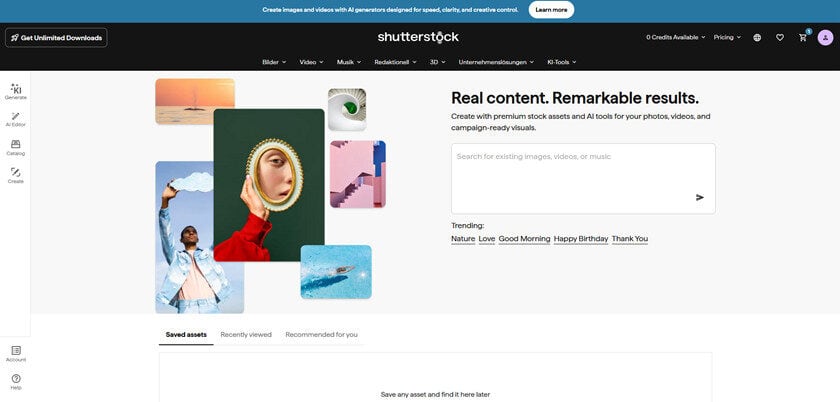
The platform’s new design is centered on a "human-in-the-loop" philosophy. Unlike standalone AI generators that often produce generic or hallucinated results, Shutterstock’s system utilizes its massive library of contributor-created content as the foundational data. Users can now discover an authentic image created by a professional photographer and then use integrated AI tools to adapt that image—changing colors, modifying backgrounds, or expanding the frame—while maintaining the high-resolution quality and commercial viability of the original asset.
Technical Innovations and Creative Workflows
The revamped platform introduces several high-performance features intended to reduce the technical barriers to professional-grade design. Central to this is the "Model Match" technology. This proprietary system acts as an intelligent router, automatically connecting a user’s specific text prompt to the AI model best suited for the task. Whether a user requires a photorealistic architectural rendering or a stylized vector illustration, Model Match selects the optimal underlying architecture, ensuring that the output is technically sound and visually consistent.
Furthermore, the platform has integrated advanced video generation and editing capabilities. As video content continues to dominate social media and advertising, the ability to generate B-roll or modify existing footage via AI has become a critical requirement for lean marketing teams. The new tools include:
- Conversational AI Search: Moving beyond keyword-based queries, the platform now understands complex natural language, allowing creators to describe moods, lighting conditions, and specific compositions.
- Inline AI Editing: Users can perform complex manipulations, such as "outpainting" (extending the borders of an image) or "inpainting" (adding or removing objects), directly within the Shutterstock interface without exporting to external software.
- Reference Tools: Features like "First Frame Reference" allow users to guide AI video generation using a specific image as a visual anchor, ensuring that generated clips match the aesthetic of an existing campaign.
- ChatGPT Integration: Recognizing that many creators start their journey in conversational interfaces, Shutterstock has launched a dedicated app within the ChatGPT ecosystem, allowing users to source and license assets without leaving their primary brainstorming environment.
A Chronology of Integration: The Path to AI Leadership
Shutterstock’s transition into an AI powerhouse is the result of a multi-year strategy involving high-profile acquisitions and industry-first partnerships. The following timeline illustrates the company’s proactive approach to the generative AI era:
- October 2022: Shutterstock announces a landmark partnership with OpenAI, becoming one of the first major stock providers to integrate DALL-E directly into its platform. Simultaneously, it launches the "Contributor Fund" to compensate artists whose work is used to train AI models.
- May 2023: The company acquires GIPHY from Meta, significantly expanding its reach into short-form mobile content and social expression.
- July 2023: Shutterstock signs a six-year agreement with OpenAI to provide high-quality training data, reinforcing its role as a critical infrastructure provider for the broader AI industry.
- Early 2024: The platform introduces "Creative AI," a suite of tools focused on ethical image generation and editing, backed by full commercial indemnification for enterprise clients.
- Present: The full relaunch of the Shutterstock platform as a connected creative environment, marking the culmination of its transition from a content vendor to a technology partner.
Commercial Confidence and Ethical Standards
One of the most significant hurdles for the enterprise adoption of AI is the risk of intellectual property (IP) infringement. Most public AI models are trained on scraped internet data without the consent of the original creators, leading to a "legal gray area" that many corporate legal departments find unacceptable.

Shutterstock has positioned itself as the "brand-safe" alternative. Every AI-generated or AI-modified asset on the platform is eligible for the same robust licensing and indemnification protections as traditional stock photos. This is made possible through a rigorous human review process and a "closed-loop" training system. By training its models exclusively on licensed content from its own library, Shutterstock ensures that every output has a clear provenance.
To maintain the health of its creative community, Shutterstock’s royalty model ensures that contributors are not bypassed by the technology. When a contributor’s image is used as a reference or as part of a training set for an AI-generated output that is subsequently licensed, the original artist receives a share of the revenue through the Contributor Fund. This ethical approach is designed to prevent the "cannibalization" of the professional photography market while still embracing the efficiencies of automation.
Market Data and Industry Implications
The shift toward AI-powered platforms is reflected in the broader economic data surrounding the creative industry. According to market research, the global generative AI in the design market is projected to grow at a compound annual growth rate (CAGR) of over 30% through 2030. Conversely, the traditional stock photography market has faced pricing pressure, necessitating a move toward high-value services.
Industry analysts suggest that Shutterstock’s pivot is a direct challenge to competitors like Adobe, whose Firefly AI is deeply integrated into the Creative Cloud. However, Shutterstock’s advantage lies in its massive, diverse, and rights-cleared dataset. For many agencies, the ability to source a "real" photo and an "AI-enhanced" version from the same platform provides a level of workflow continuity that was previously unavailable.
Furthermore, Shutterstock’s "Data Licensing & AI Services" business has emerged as a high-margin revenue stream. By licensing its library to tech giants for model training, the company has diversified its income beyond individual subscription plans. This B2B segment supports the development of next-generation AI systems, including autonomous driving simulations and medical imaging AI, where high-quality, accurately labeled visual data is a prerequisite.
Analysis of Future Impact
The transformation of Shutterstock signals a broader trend in the digital economy: the commoditization of basic content and the rising value of "creative orchestration." In the future, the role of the creative professional may shift from "maker" to "curator" and "director."
For marketing departments, this evolution means the "death of the placeholder." Previously, teams would use low-resolution watermarked images during the brainstorming phase, only licensing the final asset at the end of the project. With Shutterstock’s new tools, teams can iterate on licensed assets in real-time, creating "bespoke" content that is tailored to specific demographics or regional markets at a fraction of the cost of a traditional photo shoot.
However, this transition also raises questions about the future of entry-level photography and illustration. As AI becomes more adept at generating high-quality commercial imagery, the demand for "commodity" stock—such as simple studio shots of people shaking hands or generic office settings—is likely to decline. Professional creators will need to focus on high-concept, highly stylized, or journalistically significant content that AI cannot easily replicate.

By positioning itself as a bridge between human creativity and machine intelligence, Shutterstock is betting that the future of design is collaborative rather than competitive. The successful launch of this AI-powered platform suggests that the stock media industry is not being replaced by AI, but is instead being redefined by it. As businesses demand greater speed without sacrificing legal safety, the move toward integrated, ethical, and commercially-ready AI workflows is likely to become the new industry standard.