The landscape of global agriculture is currently undergoing a radical transformation, moving away from labor-intensive traditional practices toward a high-tech, data-driven era known as precision agriculture. For decades, farming was defined by the physical grit of manual labor and the heavy machinery of the industrial age, such as tractors and combine harvesters. However, a new protagonist has emerged in the skies above the world’s farmlands: the Unmanned Aerial Vehicle (UAV), commonly referred to as the drone. No longer restricted to military applications or recreational photography, drones have become indispensable tools for modern farmers, offering a bird’s-eye view that provides critical insights into crop health, soil conditions, and resource management. This shift represents more than just a convenience; it is a fundamental change in how humanity produces food in an era of increasing environmental pressure and population growth.
The Evolution of Agricultural Aerial Technology
The journey of drones in agriculture did not happen overnight. In the early 2000s, the use of remote sensing in farming was largely limited to satellite imagery or manned aircraft. While useful, these methods were often prohibitively expensive for individual farmers and were frequently hampered by cloud cover or low resolution. The mid-2010s marked a turning point as drone technology became more affordable and flight stabilization systems improved. By 2020, the integration of specialized sensors—such as multispectral and thermal cameras—transformed drones from simple flying cameras into sophisticated data-collection platforms.
Today, the agricultural drone market is one of the fastest-growing sectors in the robotics industry. Analysts suggest that the global smart agriculture market, which includes drones, is expected to grow at a compound annual growth rate (CAGR) of over 10% through 2030. This growth is driven by the urgent need to increase crop yields while minimizing the use of water, fertilizers, and pesticides.
Precision Monitoring and Real-Time Data Acquisition
One of the most significant advantages of drone technology is the ability to conduct high-resolution, real-time monitoring of vast tracts of land. Traditionally, a farmer would have to walk through fields to identify signs of stress, pest infestation, or irrigation leaks. In a farm spanning hundreds of hectares, this process is not only time-consuming but also prone to human error, as issues in the center of a large field might go unnoticed until it is too late to intervene.
Drones equipped with high-definition cameras can survey an entire farm in a fraction of the time it would take on foot. More importantly, when these drones are equipped with multispectral sensors, they can "see" what the human eye cannot. These sensors measure the reflectance of light from plants to calculate indices such as the Normalized Difference Vegetation Index (NDVI). A healthy plant reflects a specific pattern of near-infrared light; if a plant is stressed by drought or disease, its light reflectance changes. By analyzing this data, farmers can identify "problem zones" weeks before physical symptoms like yellowing leaves appear. This early detection allows for targeted intervention, saving crops that might otherwise have been lost.
Advanced Application Systems: Precision Spraying and Seeding
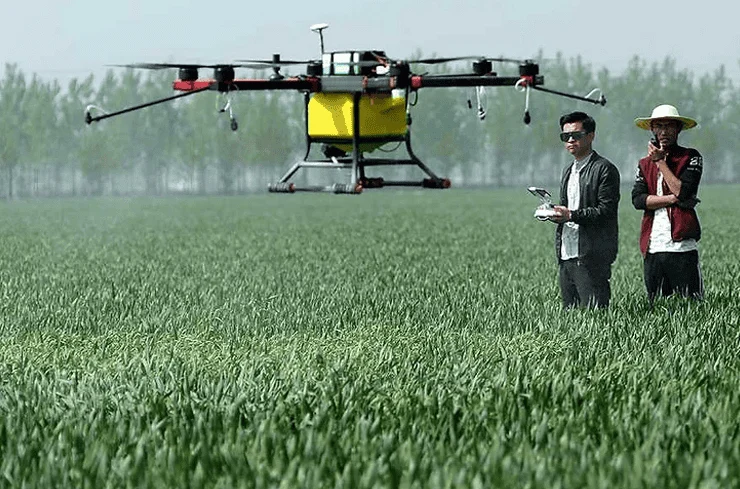
Beyond observation, drones are increasingly being used as active "workhorses" for the application of agricultural inputs. Crop-spraying drones, such as the DJI Agras series or XAG platforms, are equipped with sophisticated tanks and nozzle systems designed to deliver liquid fertilizers, herbicides, and pesticides with surgical precision.
The efficiency gains in this area are staggering. A single drone can spray a field up to 40 times faster than manual labor using backpack sprayers. Furthermore, because drones use GPS and LiDAR (Light Detection and Ranging) to maintain a consistent height above the crop canopy, they ensure a uniform distribution of chemicals. This precision significantly reduces "chemical drift"—the accidental spraying of non-target areas—and lowers the total volume of chemicals used. In many cases, drone-assisted spraying can reduce pesticide consumption by up to 30%, which provides both an economic benefit to the farmer and an environmental benefit to the local ecosystem.
In addition to spraying, specialized drones are now being used for "drone seeding." These UAVs can shoot seeds, along with nutrients and moisture-retaining gels, directly into the soil. This technology is particularly useful in reforestation efforts and for planting cover crops in difficult-to-reach terrain where traditional tractors cannot operate.
Economic Impact and Efficiency Data
The adoption of drone technology is increasingly supported by compelling economic data. According to industry reports, the use of drones in agriculture can lead to a return on investment (ROI) within a single growing season for high-value crops. For example, by optimizing fertilizer application based on drone-generated maps, farmers have reported reducing fertilizer costs by 15% to 20% while simultaneously increasing yields by 5% to 10%.
Labor shortages have also accelerated the adoption of these technologies. In many regions, including Southeast Asia and parts of North America, the aging farming population and a lack of manual labor have made it difficult to maintain traditional farming schedules. Drones fill this gap by automating tasks that previously required teams of workers. A task that once required five workers and an entire day can now be completed by one drone pilot in less than an hour.
Environmental Sustainability and Climate Resilience
As the world grapples with the effects of climate change, drones are proving to be vital tools for environmental stewardship. Precision agriculture allows for the "variable rate application" of resources, meaning water and chemicals are only applied where they are absolutely needed. This prevents the over-saturation of soil and reduces the runoff of nitrates and phosphates into local water supplies, a major cause of water pollution and algae blooms.
Furthermore, drones help farmers adapt to unpredictable weather patterns. In the event of a flood or a severe storm, drones can quickly assess damage for insurance claims and identify areas of the field that require immediate drainage or replanting. By providing a constant stream of data, drones enable farmers to make "climate-smart" decisions, ensuring the long-term viability of the land.
Navigating Challenges: Regulation, Cost, and Technical Literacy
Despite the clear benefits, the widespread adoption of drones in agriculture faces several hurdles. The primary barrier for many small-scale farmers is the initial capital investment. While prices have decreased, a professional-grade agricultural drone system, including sensors and data processing software, can still cost several thousand dollars. To mitigate this, many agricultural cooperatives and "drone-as-a-service" companies have emerged, allowing farmers to hire drone pilots on a contract basis rather than purchasing the equipment outright.
Regulatory frameworks also vary significantly by country. In the United States, the Federal Aviation Administration (FAA) requires commercial drone pilots to obtain Part 107 certification. In other regions, strict laws regarding beyond-visual-line-of-sight (BVLOS) flights and the aerial application of chemicals can slow down the deployment of autonomous systems.
Finally, there is the challenge of technical literacy. Operating a drone is only half the battle; the true value lies in interpreting the complex data and maps produced. This has led to a surge in educational programs and agricultural tech consultancies aimed at teaching farmers how to integrate "big data" into their daily operations.
The Future: AI Integration and Autonomous Swarms
The next frontier for drones in agriculture is the integration of Artificial Intelligence (AI) and "swarming" technology. Future systems will not just be piloted by humans but will operate as autonomous fleets. A "swarm" of drones could potentially work together to monitor and treat a thousand-acre farm simultaneously, communicating with each other to ensure total coverage without overlap.
AI algorithms are also becoming more adept at "predictive analytics." By combining drone data with historical weather patterns and soil sensors, AI can predict the exact day a pest outbreak is likely to occur or the optimal window for harvesting to ensure maximum sugar content in fruits. This level of foresight was unimaginable a generation ago.
Conclusion: A High-Tech Horizon for Global Food Security
The integration of drones into the world of agriculture is a testament to the power of human innovation in solving some of our most pressing problems. By bridging the gap between the sky and the soil, these aerial tools are helping to create a more efficient, sustainable, and productive food system.
While the image of a farmer might still evoke thoughts of a tractor in a dusty field, the reality of the 21st century is increasingly defined by the hum of propellers and the glow of a tablet screen. Drones have evolved from high-tech novelties into essential partners in the quest for global food security. As technology continues to advance and costs continue to fall, the presence of these "guardians of the sky" will only grow, ensuring that the future of agriculture is not just grounded in tradition, but elevated by technology. The benefits are clear: more food, less waste, and a healthier planet. In the modern agricultural landscape, the sky is no longer the limit; it is the starting point for a new era of prosperity.