In a significant move poised to redefine trust in the rapidly evolving landscape of artificial intelligence in creative industries, Aftershoot, a leading AI-powered post-processing platform, has publicly issued a set of binding commitments to the photography community. These commitments, articulated across three core pillars, explicitly outline the company’s philosophy and operational guidelines for the development, implementation, and utilization of AI within its product offerings. The announcement comes at a critical juncture for the photography sector, grappling with anxieties surrounding generative AI and its potential impact on professional livelihoods and creative control, a sentiment recently exacerbated by controversial developments from a direct competitor.
The proactive stance taken by Aftershoot, which currently serves nearly a quarter of a million photographers globally, directly addresses widespread concerns about AI’s role – particularly its capacity to either augment or displace human creative work. The company has explicitly pledged to "never build" features that could "undercut your business, reduce your creative control, or misuse your data against your will," a powerful declaration designed to reassure a community often wary of technological disruption.
The Genesis of Trust: Aftershoot’s Proactive Stance
Aftershoot’s public commitments are not merely aspirational statements but are presented as binding principles guiding its future trajectory. This strategic declaration is largely understood as a direct response to the broader industry dialogue and, more specifically, to recent events involving its competitor, Evoto. Earlier this year, Evoto garnered considerable backlash from professional photographers over its approach to generative AI, with many perceiving its tools as designed to potentially replace, rather than assist, human input in the broader photo workflow. Aftershoot’s carefully crafted commitments aim to clearly differentiate its philosophy and operations, positioning itself as a steadfast partner to photographers.
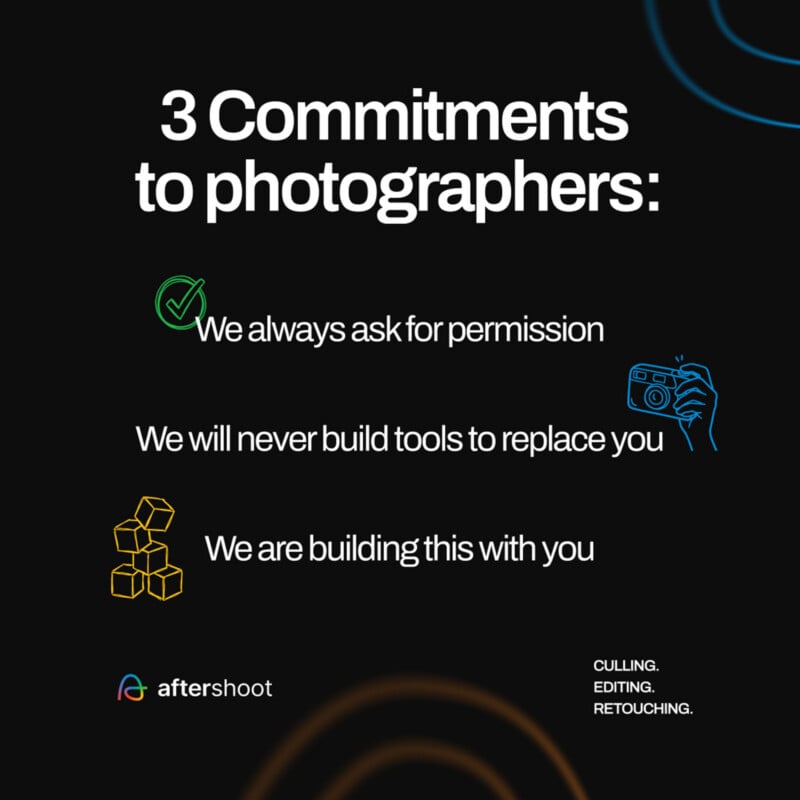
The three pillars of Aftershoot’s commitment are:
- AI as an Ally, Not a Replacement: Focusing product development solely on tools that enhance the post-shoot workflow without competing with core creative services.
- Unwavering Data Privacy and Ownership: Ensuring that photographer data is never misused, sold, or shared without explicit consent.
- Collaborative Innovation with the Community: Integrating active photographer feedback and expertise into every stage of product development.
These commitments collectively form a foundational promise of ethical AI development, seeking to foster a relationship of trust and transparency with its user base.
Commitment 1: AI as an Ally, Not a Replacement
The first and arguably most pivotal commitment from Aftershoot centers on its product and development scope, firmly establishing AI as a supportive assistant rather than a creative substitute. The company explicitly states its dedication to building tools exclusively for the post-shoot workflow, encompassing essential tasks such as culling, editing, and retouching. This distinction is crucial: Aftershoot aims to streamline the often time-consuming and repetitive aspects of photography post-production, freeing up photographers to focus on the artistic and client-facing elements of their craft.
For instance, AI-powered culling can sift through thousands of images from a single event, identifying and recommending the best shots based on technical quality, focus, and composition. This process, which could take a human photographer many hours, can be completed in minutes by AI, allowing the professional to dedicate more time to actual shooting, client interaction, or creative development. Similarly, AI-assisted editing tools can apply consistent styles, correct exposure, or perform initial skin retouching with remarkable speed, acting as a sophisticated assistant that executes instructions rather than conceiving the final aesthetic.
The company unequivocally states it "will not build features that compete with the creative work clients hire photographers for." This means Aftershoot will not venture into generative AI capabilities that could, for example, create entirely new scenes, add non-existent subjects, or fundamentally alter the core elements of a photograph in a way that bypasses the photographer’s original vision and capture. This approach stands in stark contrast to some emerging AI tools that offer capabilities like generating entire backgrounds, replacing subjects, or even creating images from text prompts, functionalities that directly challenge the traditional definition of a photographer’s output. By drawing this line, Aftershoot seeks to protect the professional photographer’s unique value proposition – their artistic vision, their ability to capture authentic moments, and their mastery of the photographic craft from pre-visualization to final delivery.
Commitment 2: Safeguarding Photographer Data and Creative Ownership
In an era where data is often described as the new oil, Aftershoot’s commitment to data privacy and ownership is paramount. With nearly nine billion photos processed across its platform since its inception, the company possesses an immense trove of photographic data. Its explicit promise is that "none of these images have ever been sold or shared with third parties," a crucial reassurance for professionals whose work often contains sensitive client information and intellectual property.
The platform does incorporate user learning features, which, by their nature, require images to be moved off the local device to train and refine the AI models for personalized results. However, Aftershoot emphasizes that these features are entirely optional and can be deactivated during the import process. This opt-in/opt-out mechanism provides photographers with explicit control over their data’s usage. Furthermore, for users who previously enabled these features but now wish to have their data removed from Aftershoot’s training sets, a straightforward deletion request process is available. This commitment to user control and transparency is vital for building and maintaining trust in an industry where privacy breaches or misuse of intellectual property can have severe professional repercussions.
The company’s new "transparency page" reinforces this pledge, articulating a clear understanding of the professional photographer’s concerns: "You’ve spent years, maybe decades, building a business on trust. The last thing you need is your software doing something shady with your images behind your back." This statement acknowledges the deep investment photographers make in their reputation and client relationships, underscoring Aftershoot’s intent to be a trustworthy technological partner. In an industry increasingly plagued by concerns over AI models being trained on copyrighted material without consent or compensation, Aftershoot’s clear policy on data usage and ownership serves as a crucial differentiator, safeguarding both client confidentiality and the photographer’s intellectual property rights.
Commitment 3: Collaborative Innovation with the Photography Community
The third pillar of Aftershoot’s commitment focuses on its development philosophy: a deeply collaborative approach with its user base. Co-founded by Justin Benson, a working photographer with over two decades of experience, the company is inherently grounded in the practical realities of the profession. This firsthand understanding is further augmented by a team of "in-house subject matter experts"—experienced photographers who rigorously vet new features before they are rolled out to the wider user community.
This commitment to involving photographers directly in refining its product roadmap ensures that new functionalities are genuinely useful, solve real-world problems, and align with the professional workflow. It moves beyond a typical software development cycle, where features might be conceived in isolation, to one where user needs and pain points are central to innovation. This collaborative model fosters a sense of partnership, reassuring photographers that Aftershoot is building tools for them, with them, rather than dictating how they should work.
Justin Benson elaborates on this ethos, stating, "I got into photography because I love it. Post-processing was eating the time I had to actually shoot. That’s still why we’re here – not to replace what you do, but to protect the time and energy it takes to do it well." This personal testimony resonates deeply with many photographers who find themselves increasingly burdened by administrative and post-production tasks, diverting precious time from creative endeavors and client engagement. By continually seeking input from its diverse user base – ranging from wedding photographers to portrait artists and commercial shooters – Aftershoot aims to create an AI ecosystem that genuinely empowers creativity and efficiency, rather than diminishing it.
Background Context: The Shadow of Generative AI and the Evoto Controversy
Aftershoot’s explicit commitments are best understood against the backdrop of growing apprehension within the creative industries regarding the rapid proliferation of generative AI. For photographers, in particular, the fear of job displacement, copyright infringement, and the devaluation of their unique artistic skills has become a palpable concern. Tools that can conjure photorealistic images from text prompts or manipulate existing photos beyond the realm of traditional editing raise fundamental questions about authorship, authenticity, and the very definition of photography.
The controversy surrounding Aftershoot’s competitor, Evoto, earlier this year served as a stark illustration of these anxieties. While specific details of Evoto’s actions are part of ongoing industry discussion, reports indicated that the company introduced generative AI features that many photographers perceived as blurring the line between assistance and outright replacement. These tools were reportedly capable of generating elements or even entire compositions, leading to widespread concern that such technologies could empower clients to bypass professional photographers for certain tasks, thereby undermining their business models. The outcry from the photography community was significant, highlighting a deep-seated desire for ethical boundaries and transparent practices from technology providers.
This incident underscored the urgent need for clarity from AI software developers regarding their intentions and operational ethics. Photographers, whose livelihoods depend on their unique vision and the trust of their clients, are particularly vulnerable to technologies that might commoditize their craft or exploit their creative output. The broader market for AI tools in photography, which includes established players like Adobe with its evolving AI features and specialized platforms like Luminar and Topaz, is experiencing rapid innovation, making clear ethical guidelines all the more critical.
Timeline of AI in Photography Post-Production
The integration of AI into photography post-production has evolved significantly over the past decade. Initially, AI capabilities were subtle, focusing on automated adjustments like white balance correction, smart cropping, or basic facial recognition for tagging. The mid-2010s saw the emergence of more sophisticated AI for noise reduction, sharpening, and intelligent content-aware filling.
By the late 2010s, AI culling tools, like Aftershoot’s, began to gain traction, promising to dramatically reduce the time spent selecting the best images from large shoots. This period also witnessed the rise of AI-powered editing presets and adaptive adjustments that could learn a photographer’s style. The current era, however, is dominated by the explosion of generative AI, exemplified by models capable of creating entirely new images or drastically altering existing ones. This rapid progression has created a dichotomy: assistive AI, which streamlines and enhances a photographer’s workflow, and generative AI, which has the potential to replace aspects of the creative process itself. Aftershoot’s commitments firmly place it in the former category, deliberately distinguishing its approach from the more contentious applications of generative AI.
Industry Reactions and Broader Implications
The announcement from Aftershoot is expected to be met with a largely positive reception from the photography community. Many professionals have been vocal about their desire for AI tools that genuinely assist them, rather than compete with them. This proactive move by Aftershoot sets a crucial precedent, potentially influencing other companies in the creative software space to adopt similar ethical frameworks.
Industry analysts suggest that such transparency and commitment to user empowerment will be vital for long-term success in the AI-driven creative market. In an environment rife with uncertainty, companies that explicitly align with the interests of their professional users are likely to garner greater trust and loyalty. This could lead to a shift in consumer choice, with photographers increasingly opting for platforms that demonstrate clear ethical guidelines and a collaborative development philosophy.
Moreover, Aftershoot’s commitments contribute significantly to the ongoing global dialogue about ethical AI, particularly in creative fields. They highlight the importance of clearly defining the boundaries of AI application, ensuring that technological advancement serves human creativity rather than overshadowing it. The debate about AI’s role in creative professions will undoubtedly continue, but Aftershoot’s stance provides a concrete example of how companies can navigate these complex waters by prioritizing user trust and professional integrity.
The Future of Photography and AI Partnership
Ultimately, Aftershoot’s comprehensive commitments underscore a vision where AI functions as a powerful, respectful partner to the photographer. The company aims to provide tools that amplify efficiency and allow creatives to reclaim valuable time, enabling them to dedicate more energy to the unique artistry and personal connection that define professional photography. As Justin Benson articulates, the goal is to "protect the time and energy it takes to do it well," rather than to usurp the creative act itself.
In a world where technological innovation often outpaces ethical frameworks, Aftershoot’s binding promises offer a beacon of clarity and accountability. It is now incumbent upon the photography community to evaluate these commitments and decide which companies genuinely align with their values and professional aspirations. The success of Aftershoot’s approach could very well shape the future trajectory of AI development in creative tools, fostering an ecosystem where technology truly serves humanity’s artistic endeavors, rather than threatening them. The critical importance of transparent policies and a deep understanding of user needs cannot be overstated, as they form the bedrock of sustainable and ethical technological advancement in the creative sphere.
Image credits: Aftershoot