By Michiel van Mens
The question of what elevates a street photograph from ordinary to exceptional has long been a subject of contemplation and debate within the photographic community. For years, this inquiry has occupied my own artistic and analytical pursuits, leading to extensive research and prior publications that explored the stylistic characteristics defining compelling street imagery. A significant conclusion drawn from this work was the vital role of visual contrast in creating photographs that resonate with viewers. However, as with many artistic endeavors, the full picture is more nuanced, and the absence of overt contrast does not preclude a photograph from being deeply impactful. This exploration delves further into the multifaceted nature of what constitutes a "good" street photograph, examining elements that extend beyond immediate visual discord.
The Foundation of Visual Contrast in Street Photography
My earlier research, particularly the investigation into "The Photographic Signature of the Street Photographer," identified visual contrast as a fundamental condition for impactful street photography. This contrast is not monolithic; it can manifest in various forms. Thematic contrast, for instance, can highlight social disparities or juxtapositions. Color contrast can create visual vibrancy and guide the viewer’s eye. Temporal contrast might capture fleeting moments that stand in stark opposition to the stillness around them. Contrast in action can depict a dynamic event against a static backdrop, or vice versa. Perhaps most powerfully, the juxtaposition of the unusual against the everyday can reveal the extraordinary within the mundane, a hallmark of keen observation.
This hypothesis was further tested through a comparative study conducted in conjunction with the exhibition "American Photography" at the Rijksmuseum in Amsterdam, scheduled for 2025. An analysis of visitor responses revealed a striking pattern: eight out of the ten most memorable photographs displayed a discernible visual contrast. This empirical observation led to the cautious conclusion, detailed in my article "The ‘Good’ Photographs of American Photography," that visual contrast is not merely a stylistic flourish but a significant criterion influencing how viewers perceive and retain a photograph.
Genre Specificity: The Differentiated Purpose of Photography
While visual contrast serves as a valuable tool across various photographic genres—journalistic, documentary, and street photography—the criteria for judging success differ significantly due to their distinct purposes. Understanding these distinctions is crucial to appreciating the unique demands placed upon street photography.
Journalistic news photography operates under the imperative of clarity and immediacy. Its primary function is to convey factual information, explain unfolding events, and make the subject matter instantly comprehensible. These images often serve as visual anchors for written articles, aiming for immediate understanding at a glance. Iconic news photographs, such as Robert Capa’s "The Falling Soldier" from the Spanish Civil War or Eddie Adams’ "Saigon Execution" (1968), achieve their lasting impact not by telling a complete story independently, but by powerfully visualizing a specific event or moment of historical significance. Aesthetics, while not entirely irrelevant, are secondary to the photograph’s informational and symbolic value.
Documentary photography, by its nature, is a serial endeavor. Photographers commit to presenting a narrative that unfolds across multiple images. The meaning of an individual photograph within a documentary series is deeply intertwined with its companions; it gains depth and context from the surrounding frames. Consequently, the evaluation of documentary work tends to focus on the cohesive narrative of the series as a whole, rather than the isolated merit of a single image. The subjective qualities of beauty or ugliness in an individual frame become less paramount.
Street photography, however, operates on a fundamentally different principle. Each street photograph is typically intended to stand alone, even when presented as part of a larger collection. The inherent goal is to render the often-overlooked aspects of everyday urban life as distinctive and meaningful. Lacking the support of an accompanying article or the embedded context of a curated series, a successful street photograph must possess sufficient intrinsic qualities to generate meaning for the viewer independently. This places a unique burden of self-sufficiency on the individual image.
The Power of Suggestion: When Questions Outweigh Answers
My earlier comparative data study, which identified highly memorable photographs from the "American Photography" exhibition, also highlighted instances where a clear visual contrast was absent, yet the images profoundly impacted viewers. Two such photographs were "Paul" by Bryan Schutmaat, from his series "Grays the Mountain Sends," and "Homegirls" by Amanda Lopez. "Paul" depicts a man in a light blue shirt, holding a glass of beer at a bar, while "Homegirls" presents a compelling portrait. Both images elicited a strong, memorable response from a significant portion of the exhibition’s visitors.
The common thread uniting these seemingly disparate photographs is their ability to evoke questions rather than provide definitive answers. They function as narrative springboards, initiating a story that the viewer is implicitly invited to complete. It is as if the photographer offers a glimpse into a moment, a scene, or a character, but deliberately halts the exposition, entrusting the viewer with the task of imagination.
This principle of suggestion is not unique to these specific examples but is a recurring theme observed in the work of many renowned street photographers. The true strength of a street photograph often resides in its implicit qualities—what is left unsaid, unseen, or unresolved. By employing suggestion rather than a literal or purely realistic depiction of urban life, street photographers can achieve a more profound and lasting connection with their audience.
This concept resonates with the observations of French philosopher Gilles A. Tiberghien, who, in a wall text for an exhibition of anonymous photographs collected by Marion and Philippe Jacquier at the Rencontres d’Arles in 2025, eloquently stated: "Each image could be the beginning of a story, a poem, a film, the starting point of a series of other images which, by crossing and re-crossing one another, would form a gigantic interchange of dreams and fictions." Tiberghien posits that every photograph possesses the potential to ignite a cascade of imaginative responses, weaving a complex tapestry of dreams and subjective interpretations.
In the realm of cinema, this technique of suggestion is known as suspense, a mastery exemplified by directors like Alfred Hitchcock. In his seminal film "Psycho" (1960), Hitchcock masterfully avoids explicit depiction of violence. Instead, the viewer’s imagination is engaged through subtle cues: the glint of a knife’s tip, the rustle of a shower curtain, the dark swirling water. The terror is felt not through direct observation but through the powerful evocation of what is happening just beyond the frame. Similarly, Stanley Kubrick’s iconic scene in "The Shining," where Jack Torrance breaches a bathroom door with an axe, relies on suggestion rather than explicit gore. The implied violence, amplified by the viewer’s mental projection, often proves more suspenseful and psychologically impactful than a literal portrayal.
Even in the absence of overt visual contrast, a street photograph can achieve a powerful hold on the viewer if it contains elements that stimulate imagination. The image effectively becomes a catalyst, inviting the viewer’s mind to participate in its creation of meaning. Street photographer Robert Doisneau beautifully articulated this sentiment: "The photographs that interest me, that I consider successful, are those that do not close the story, that do not tell it completely, but remain open—photographs that form a stepping stone toward a dream."
Fred Herzog’s "Man with Bandage": A Masterclass in Suggestion
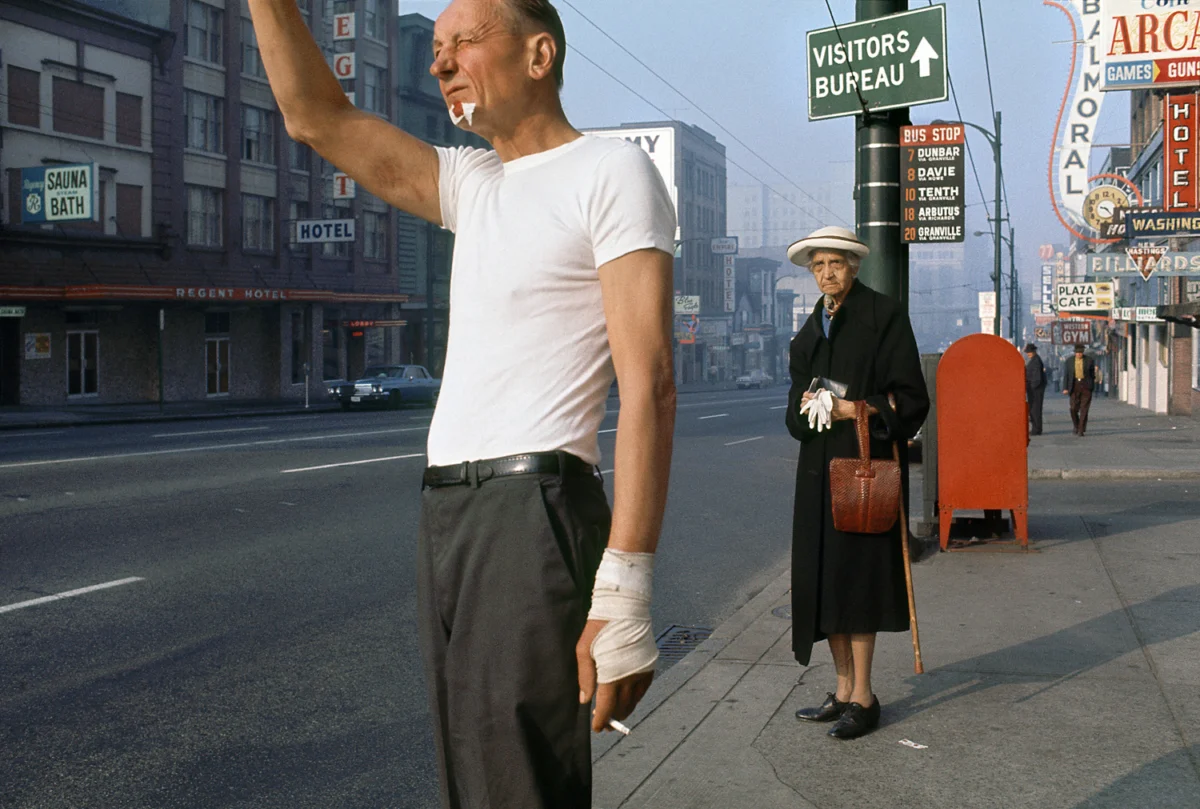
A compelling illustration of a photograph that transcends the need for explicit visual contrast, deriving its power from profound suggestive qualities, is Fred Herzog’s "Man with Bandage" (1968). Few images manage to pose as many questions while offering so few answers. The viewer is immediately drawn into a scene ripe with unspoken narrative. What is the woman in the background observing with such apparent intensity? What is the man’s purpose in this setting, and why the bandage adorning his chin? Is this a quiet Sunday morning, or does the scene hold a more complex temporal significance? The inscription on the sign, "Visitors Bureau," offers a potential direction, yet the photograph provides no definitive clues.
It is precisely this withholding of information that grants the viewer the freedom to engage their own imagination. "Man with Bandage" does not dictate a narrative; it invites one. The photograph encourages a prolonged and contemplative gaze, prompting the viewer to construct their own plausible scenarios and interpretations. This open-endedness is the very engine of its enduring power.
From Theory to Practice: Cultivating Suggestion in Street Photography
The principles of visual contrast provide street photographers with a framework for actively seeking out compelling visual juxtapositions. However, the art of suggestion offers an equally potent, if more nuanced, tool for enhancing the quality and impact of their work. By consciously employing techniques of suggestion, photographers can imbue their images with a deeper layer of engagement and mystery.

My analysis of numerous street photography books and portfolios has identified eight recurring strategies for cultivating suggestion:
-
Strategic Omission: Suggestion often begins with what is deliberately not shown. This mirrors cinematic techniques, such as in Steven Spielberg’s "Jaws," where the shark’s infrequent appearances, coupled with ominous music and frightened reactions, create a palpable sense of dread. In street photography, omitting key elements forces the viewer’s mind to fill the void, often with more potent imaginings than a direct portrayal could achieve.
-
The Power of Blur: Blur can effectively conceal information, drawing attention away from specific details or rendering them ambiguous. This can manifest as out-of-focus backgrounds that hint at unseen activity, or motion blur that suggests movement and transience within a static environment.
-
Juxtaposition of Inside and Outside: Photographs that simultaneously depict interior and exterior spaces, often captured through windows or shopfronts, create a sense of layered reality. This can evoke curiosity about the unseen lives within or the world beyond the frame.
-
The Element of the Unexpected: An image can become intriguing when an element within it seems out of place or incongruous. This disruption of visual expectation prompts questions about the context and the narrative it disrupts.
-
The Mystery of Distance: An event occurring across the street, just beyond clear visibility, can imbue a photograph with mystery. The distance creates an inherent intrigue, prompting the viewer to ponder what is unfolding just out of reach.
-
Playing with Proportions: The interplay between large and small elements within a single frame can generate visual tension and invite contemplation. Disparities in scale can subtly alter perception and create an unsettling or thought-provoking dynamic.
-
Estrangement and Surrealism: When reality appears slightly illogical or deviates from the expected norms, the image can evoke a sense of estrangement or surrealism. This subtle departure from the ordinary can unlock imaginative interpretations.
-
The Enigmatic Facial Expression: Human faces are potent conduits of emotion and narrative. A subtle, ambiguous, or compelling facial expression can powerfully trigger questions about the subject’s inner world and immediate circumstances.
Conclusion: The Synergy of Contrast and Suggestion
The pursuit of a "good" street photograph is not an exercise in mere chance; it is a deliberate craft that can be honed through understanding and practice. While the presence of clear visual contrast offers a strong foundation for an impactful image, the strategic application of suggestion opens up a deeper dimension of viewer engagement.
When a street photographer successfully visualizes a subject through suggestion, posing questions rather than offering concrete answers, the resulting image possesses the power to captivate and linger in the viewer’s mind. This approach encourages active participation, transforming the viewer from a passive observer into an imaginative collaborator.
The true apex of street photography is achieved when these two powerful elements—visual contrast and suggestion—are combined. This synergy creates an almost inexhaustible potential for producing images that are not only aesthetically compelling but also deeply resonant and memorable.
Furthermore, the street photographer can adopt the role of a "dramatist," actively orchestrating scenes that evoke the desired narrative and emotional response. This deliberate staging of "street theater" has been masterfully demonstrated by contemporary photographers such as Gregory Crewdson, whose series "Eveningside" exemplifies the profound artistic possibilities of this approach. By understanding and applying these principles, street photographers can move beyond simply documenting the world to actively shaping how it is perceived and interpreted, creating images that continue to engage and inspire long after the shutter has clicked.
About The Author: Michiel van Mens
Michiel van Mens’s journey into photography began during his military service, where he trained as a photographer and corporate journalist. This formative period provided him with invaluable practical experience, including extensive travel across Europe, the creation of photo essays, and hands-on work in the darkroom, culminating in the monthly production of a professional magazine. Post-service, his photographic explorations extended to Eastern Europe, with journeys to Poland, the Baltic States, and Ukraine, including significant expeditions to Crimea and Odessa, and a visit to the newly opened KGB prison in Vilnius. Inspired by the work of Ed van der Elsken, Van Mens initiated a long-term photo series in 1993 documenting Amsterdam’s Oud-West district, which led to several exhibitions and further solidified his artistic development, including his studies at the Photo Academy in Amsterdam.
Van Mens has been deeply involved in research pertaining to street photography. His earlier publication, "The Photographic Signature of the Street Photographer in Six Stylistic Characteristics," served as a condensed preview of his forthcoming book, slated for release in the fall of 2025. This book is the culmination of his extensive personal research into the visual styles of globally recognized street photographers. A key finding from this research is the identification of six commonly recurring stylistic traits that constitute a photographer’s signature style in street photography. This concept was further explored in his recent article, "The ‘Good’ Photographs of American Photography," which established a correlation between one of these six traits and the memorability of photographs.
With Thanks & Gratitude To Michiel Van Mens. To see and learn More, visit his Street Photography Portfolio & follow him on Instagram.
Images Courtesy of The Estate of Fred Herzog at Equinox Gallery.