
The integration of high-resolution sensors and advanced computational photography into mobile devices has fundamentally altered the landscape of street photography. Once the exclusive domain of professionals equipped with expensive 35mm film cameras, the art of capturing the "decisive moment" is now accessible to anyone with a smartphone. As the urban environment becomes increasingly visual, the shift toward monochrome aesthetics has regained prominence, offering a timeless quality that strips away the distractions of modern color palettes. This transition toward black and white street photography is not merely a stylistic choice but a strategic one, emphasizing form, light, and narrative over chromatic saturation. Industry experts and mobile photography enthusiasts alike suggest that the iPhone, due to its ubiquity and sophisticated software, has become the premier tool for this specific genre.
The Evolution of Street Photography: From Film to iPhone
To understand the significance of current mobile photography techniques, one must look at the chronology of the medium. Street photography reached its zenith in the mid-20th century with figures like Henri Cartier-Bresson and Robert Frank, who utilized the portability of the Leica camera to document life in its rawest form. The transition to digital photography in the early 2000s initially prioritized color accuracy and resolution. However, the last decade has seen a resurgence in black and white imagery, driven largely by the mobile revolution.
Since the launch of the first iPhone in 2007, Apple has progressively enhanced its camera hardware. The introduction of the "Noir" filter and the "Photonic Engine" in later models has provided photographers with tools that mimic the high-contrast look of traditional silver halide film. Data from photography platforms like Flickr and Instagram indicate that "Street Photography" remains one of the most used hashtags, with a significant percentage of top-performing images being monochrome. This data suggests a global preference for the emotional weight and clarity that black and white provides in chaotic urban settings.
1. Intentionality Through In-Camera Filtering
A primary strategic recommendation for street photographers is to utilize the iPhone’s built-in filters during the capture phase rather than applying them post-factum. By selecting the "Noir" filter within the Camera app, the photographer is forced to see the world in shades of gray, highlights, and shadows. This method aligns with the psychological principle of "perceptual narrowing," where removing the distraction of color allows the brain to focus more acutely on composition and lighting.
Technically, iPhone filters are non-destructive. This means that while the viewfinder displays a monochrome image to aid in composition, the device retains the full color data of the RAW or HEIF file. If a photographer later decides that a scene would be more impactful in color, the transition can be made within the Photos app’s editing suite. This flexibility provides the "best of both worlds": the discipline of shooting for black and white and the safety net of digital data retention.
2. Minimalism and the Strategic Use of Negative Space
In the context of a dense urban environment, visual clutter is the primary obstacle to a successful photograph. The most effective black and white images often adhere to the principles of minimalism. By isolating a single subject against a vast, empty background—referred to in art theory as "negative space"—the photographer can command the viewer’s attention with surgical precision.
Finding negative space in a city requires a change in perspective. Open squares, public parks, and modern cultural sites offer the necessary "blank canvases." Statistical analysis of award-winning street photography often shows a correlation between high-impact images and a low "element count." To achieve this, photographers are encouraged to use tools like Google Maps Street View to scout locations with large, unobstructed surfaces or dramatic architectural voids before even arriving at the scene.
3. Leading Lines and the Architecture of Depth
Leading lines are a foundational element of visual literacy, used to guide the viewer’s eye through the frame toward a specific focal point. In black and white photography, these lines become even more pronounced because there are no competing colors to break the geometric flow. The urban landscape is inherently linear, offering an abundance of roads, bridges, tunnels, and railings.
For maximum impact, professional street photographers recommend positioning these lines so they originate from the corners of the frame. This creates a sense of structural integrity and leads the eye from the foreground deep into the background, adding a three-dimensional quality to a two-dimensional medium. Spiral staircases represent the pinnacle of this technique, providing curved leading lines that create a sense of motion and mathematical beauty.
4. Pattern Recognition in Modern Facades
The human brain is evolutionarily wired to seek out patterns and repetition. In the urban landscape, this manifests as rows of windows, pillars, arches, or the corrugated surfaces of modern skyscrapers. When color is removed, these patterns become the primary subject of the image, transforming a standard building into an abstract work of art.
Data regarding architectural trends suggests that modern "brutalist" and "minimalist" buildings are particularly well-suited for black and white documentation. These structures rely on shadow and light to define their shape, which is exactly what a monochrome sensor captures most effectively. By waiting for a human subject to enter these patterned scenes, the photographer introduces a "break" in the repetition, which creates a powerful focal point and provides a sense of scale.
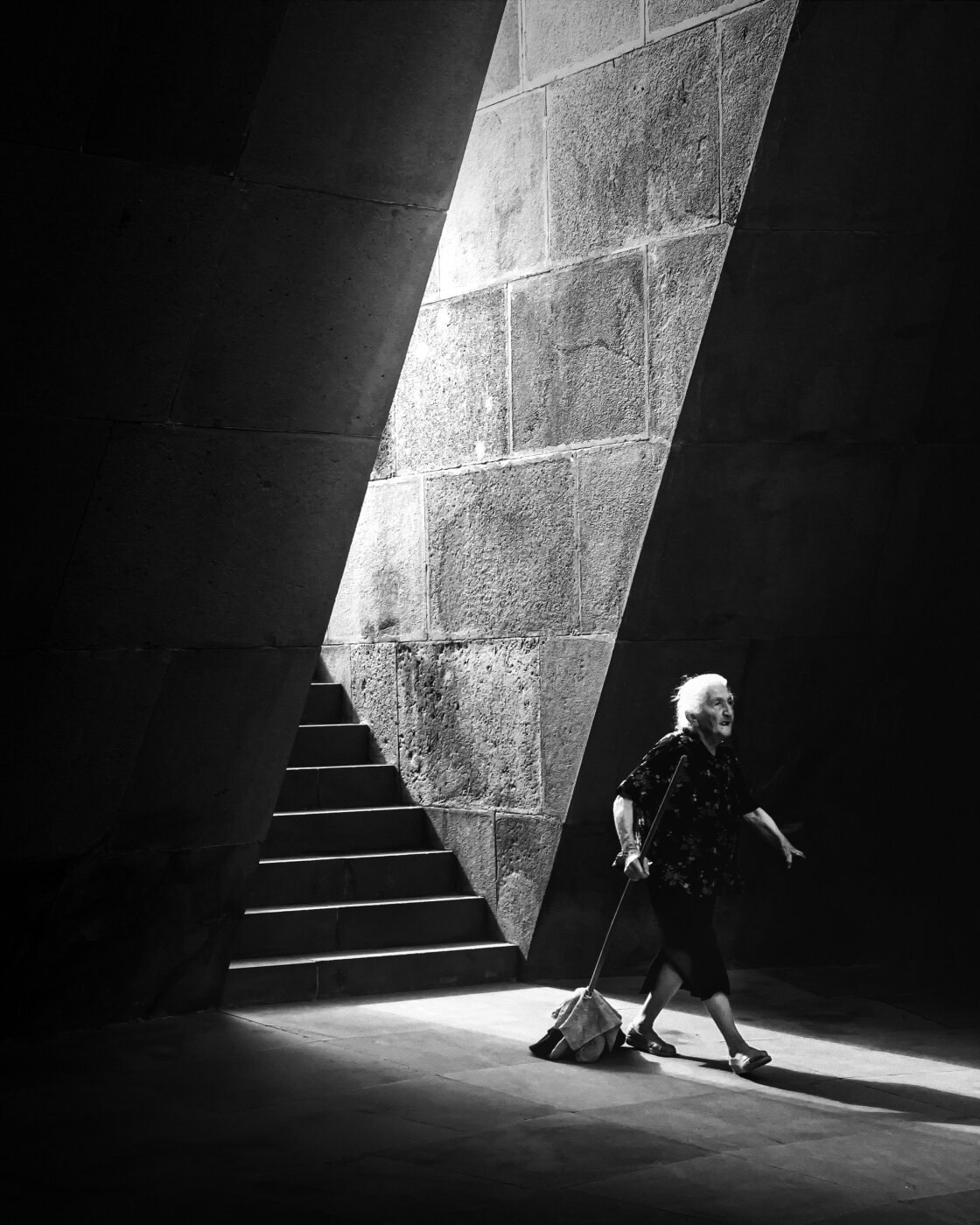
5. Architectural Framing and Exposure Control
Framing is a compositional technique where the photographer uses elements within the scene—such as an archway, a window, or a doorway—to create a "frame within a frame." This technique serves to insulate the subject from the rest of the environment, creating a more intimate narrative.
When shooting from a dark interior toward a bright exterior (a common scenario for framing), exposure management becomes critical. Modern iPhones allow for precise Exposure Value (EV) adjustments. By swiping up in the Camera app and selecting the "+/-" icon, photographers can manually reduce exposure to prevent "blown-out" highlights in the background. According to technical benchmarks, the iPhone’s HDR (High Dynamic Range) capabilities are highly effective, but manual intervention is often required to maintain the "moody" aesthetic essential for high-quality black and white street photography.
6. The Physics of Silhouettes and Backlighting
Silhouettes are among the most evocative forms of street photography, relying on the total absence of detail within the subject to create mystery. To achieve this, the light source must be positioned directly behind the subject. The "Golden Hour"—the period shortly after sunrise or before sunset—is the ideal time for this, as the low angle of the sun provides a strong, directional light source.
From a technical standpoint, creating a silhouette involves underexposing the image so that the subject falls into complete shadow. The iPhone’s computational photography algorithms often try to "brighten" these shadows to preserve detail, so the photographer must manually override this by tapping the subject and dragging the sun icon downward. This technique is particularly effective in black and white because it emphasizes the "graphic" nature of the human form.
7. Chiaroscuro: Utilizing Shadows as Subjects
Shadows are not merely the absence of light; in black and white photography, they are tangible elements of the composition. The term "chiaroscuro," popularized during the Renaissance, refers to the dramatic contrast between light and dark. In a street photography context, long shadows cast by pedestrians during the late afternoon can become more interesting than the pedestrians themselves.
Urban environments with high-rise buildings create "canyons" of light, where small pockets of sunlight hit the pavement while the rest remains in deep shadow. Photographers who master this "spotlight effect" can capture cinematic images that feel staged, despite being entirely candid. This method requires patience, as the photographer must find the light pocket first and wait for a subject to walk through it.
8. Digital Post-Processing and Image Hygiene
The final stage of incredible street photography occurs in the digital darkroom. While the iPhone’s "Noir" filter provides a strong starting point, professional-grade apps like Adobe Lightroom Mobile allow for granular control over the image’s "tonal curve." Increasing contrast, deepening shadows, and adjusting the "clarity" slider can add a level of grit and texture that defines the street photography genre.
Furthermore, the concept of "image hygiene" involves removing distracting elements that could not be avoided during the shoot. Modern AI-powered "Healing" tools allow photographers to remove litter, stray power lines, or distracting signage with a single brush stroke. As the saying goes in the design world, "the cleaner the image, the stronger the message."
Analysis of Broader Impact and Implications
The rise of iPhone street photography has significant implications for both the art world and historical documentation. Because nearly everyone now carries a high-quality camera, we are currently living in the most documented era in human history. Street photography acts as a sociological record of fashion, architecture, and human behavior.
However, this democratization of the medium has also led to a "saturation of the visual field." With millions of images uploaded daily, the value of a photograph is no longer determined by the ability to capture a clear image, but by the ability to compose a meaningful one. The 8 tips outlined above represent a move toward "slow photography"—a deliberate, thoughtful approach to documentation that prioritizes art over convenience.
Official responses from photography institutions, such as the International Center of Photography (ICP), have increasingly recognized mobile photography in their galleries and competitions. This validation confirms that the tool is secondary to the vision of the photographer. As AI and sensor technology continue to evolve, the gap between the iPhone and professional DSLR cameras will continue to shrink, further cementing the smartphone’s role as the primary instrument for documenting the human condition in the 21st century. By mastering these monochrome techniques, photographers can ensure their work stands out in an increasingly crowded digital landscape, offering a timeless perspective on the ever-changing urban world.