The global landscape of digital media and stock content is undergoing a fundamental transformation as Shutterstock, a long-standing leader in the creative industry, officially transitions from a traditional licensable asset repository to a comprehensive, human-led, AI-powered creative platform. This strategic pivot represents more than a simple update to the company’s interface; it signifies a systemic shift in how brands, agencies, and individual creators interact with visual media. By integrating high-fidelity human artistry with advanced generative artificial intelligence, Shutterstock aims to resolve the tension between the speed of modern marketing and the necessity for authentic, legally compliant creative output.
The core of this evolution lies in a unified ecosystem where discovery, adaptation, and refinement occur within a single workflow. Traditionally, creative professionals were required to source an image from a library, export it to external editing software, and potentially use separate generative tools for modifications—a fragmented process that often led to inconsistencies in brand voice and legal vulnerabilities. Shutterstock’s new platform architecture collapses these silos, offering an end-to-end environment where a user can identify a human-contributed asset and immediately utilize AI-driven tools to modify, extend, or reimagine that asset for specific campaign requirements.
The Strategic Evolution: From Stock Library to AI Ecosystem
To understand the significance of this transition, it is essential to examine the chronology of Shutterstock’s trajectory. Founded in 2003 by Jon Oringer, Shutterstock revolutionized the industry by introducing the subscription-based model for stock photography. For nearly two decades, the company focused on the breadth and depth of its library, which eventually grew to encompass hundreds of millions of images, videos, and music tracks. However, the emergence of generative AI in 2022 presented a disruptive challenge to the stock media industry.
While many competitors initially viewed generative AI as a threat to traditional licensing, Shutterstock adopted an early-mover strategy characterized by ethical integration. In late 2022, the company announced a high-profile partnership with OpenAI to integrate DALL-E directly into its platform. This was followed by the establishment of the "Contributor Fund," a pioneering initiative designed to compensate the artists and photographers whose work was used to train the company’s AI models. The current evolution into a full-scale AI-powered creative platform is the culmination of this multi-year roadmap, moving beyond experimental tools into a production-ready infrastructure.
Technological Pillars of the New Platform
The revamped platform is built upon several proprietary technological advancements designed to bridge the gap between prompt-based generation and professional-grade creative control.
Model Match and Precision Controls
A primary challenge in the generative AI space is the unpredictability of outputs. Shutterstock’s "Model Match" technology serves as an intelligent routing system that automatically pairs a user’s creative prompt with the specific AI model best suited for the task. This eliminates the guesswork for users who may not be experts in prompt engineering, ensuring that the visual style remains consistent with the intended output.
Furthermore, the platform introduces "First Frame Reference" and "Content Reference" capabilities. These features allow creators to upload or select an existing image to serve as a structural or stylistic anchor for new AI-generated content. This ensures that the AI does not deviate from established brand guidelines, maintaining the visual "DNA" of a campaign across different media formats.

Integrated AI Video Generation
As video continues to dominate digital consumption—with some estimates suggesting video content accounts for over 80% of all internet traffic—Shutterstock has prioritized AI-powered video generation. The platform now allows users to generate high-definition video clips from text prompts or to extend existing video assets using AI. This capability is particularly significant for social media managers and digital advertisers who require a high volume of motion content but often lack the budget for traditional film shoots.
Conversational Search and Inline Editing
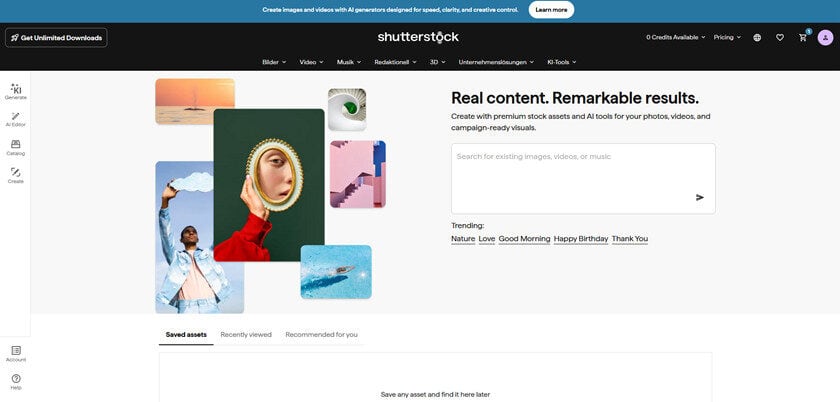
The search experience has been redesigned from a keyword-based system to a conversational AI interface. This allows users to describe complex creative visions in natural language. Once an asset is found or generated, "inline editing" tools enable real-time modifications. Users can swap backgrounds, remove objects, or expand the canvas of an image without ever leaving the Shutterstock environment.
Data and Economic Implications for the Creative Industry
The shift toward AI-integrated platforms is supported by significant market data. The global stock media market, valued at approximately $3.9 billion in 2022, is projected to reach nearly $5 billion by 2028. However, the growth is increasingly driven by the demand for "smart" content rather than static files. According to industry surveys, over 70% of creative professionals are now using AI tools in some capacity to accelerate their production timelines.
Shutterstock’s financial strategy has also evolved to reflect this. By positioning itself as a provider of "clean" data for AI training, the company has opened a new revenue stream: Data Licensing & AI Services. This division provides rights-cleared datasets to technology giants and AI developers, ensuring that the next generation of large language models (LLMs) and visual transformers are trained on high-quality, ethically sourced material. This dual-sided business model—serving both the creators of AI and the users of AI—provides Shutterstock with a unique competitive advantage in the enterprise market.
Commercial Confidence and the Legal Framework
One of the most significant barriers to the corporate adoption of generative AI has been the "black box" nature of many AI models, which often utilize scraped data without clear copyright provenance. This has led to high-profile litigation involving several major AI developers. Shutterstock has addressed this concern by offering "commercial-ready" licensing and indemnification.
Because Shutterstock’s generative models are trained on its own massive library of licensed content, the company can provide legal assurances that many open-source or un-vetted AI tools cannot. Every AI-generated image on the platform is subject to the same rigorous standards as traditional stock content, including human review and metadata tagging. This level of "commercial confidence" is vital for Global 2000 companies that cannot risk copyright infringement in their global advertising campaigns.
The Role of the Human Contributor
Central to Shutterstock’s narrative is the assertion that AI should serve as an "accelerator" rather than a replacement for human creativity. The company maintains that the most effective creative work is "human-led." This philosophy is reflected in the platform’s workflow, which encourages users to start with authentic, contributor-created assets before applying AI enhancements.
The Contributor Fund remains a cornerstone of this relationship. By ensuring that photographers and illustrators receive royalties when their work contributes to the training of models or the generation of new assets, Shutterstock is attempting to create a sustainable ecosystem. This approach has received a cautious but generally positive response from the creative community, which has long feared the commoditization of art by autonomous machines.

Broader Impact and Future Outlook
The transformation of Shutterstock into an AI-powered creative platform is likely to trigger a ripple effect across the professional services sector. As these tools become more accessible, the barrier to entry for high-quality visual production will continue to lower. Small and medium-sized enterprises (SMEs) that previously could not afford custom photography or high-end design agencies can now produce professional-grade visuals in-house.
For large agencies, the impact will be seen in the "democratization of iteration." Creative teams can now test dozens of visual variations for a single campaign in the time it previously took to develop one concept. This shift moves the value of the creative professional away from technical execution and toward strategic curation and conceptual thinking.
Looking forward, Shutterstock’s integration into third-party environments, such as its specialized app within ChatGPT, indicates a future where creative assets are no longer sought out on a destination website but are instead summoned within the tools where work is already happening. As AI continues to evolve from a novelty into a utility, Shutterstock’s transition positions it as a vital piece of infrastructure for the digital economy—a bridge between the vast history of human visual expression and the hyper-efficient future of machine-assisted design.
The success of this pivot will ultimately depend on the platform’s ability to maintain the delicate balance between technological innovation and ethical responsibility. However, by providing a "connected creative platform" that prioritizes commercial safety and contributor compensation, Shutterstock has established a blueprint for how legacy media companies can navigate the complexities of the AI era. This evolution is not merely a change in product offering; it is a redefinition of what it means to be a creative partner in the 21st century.