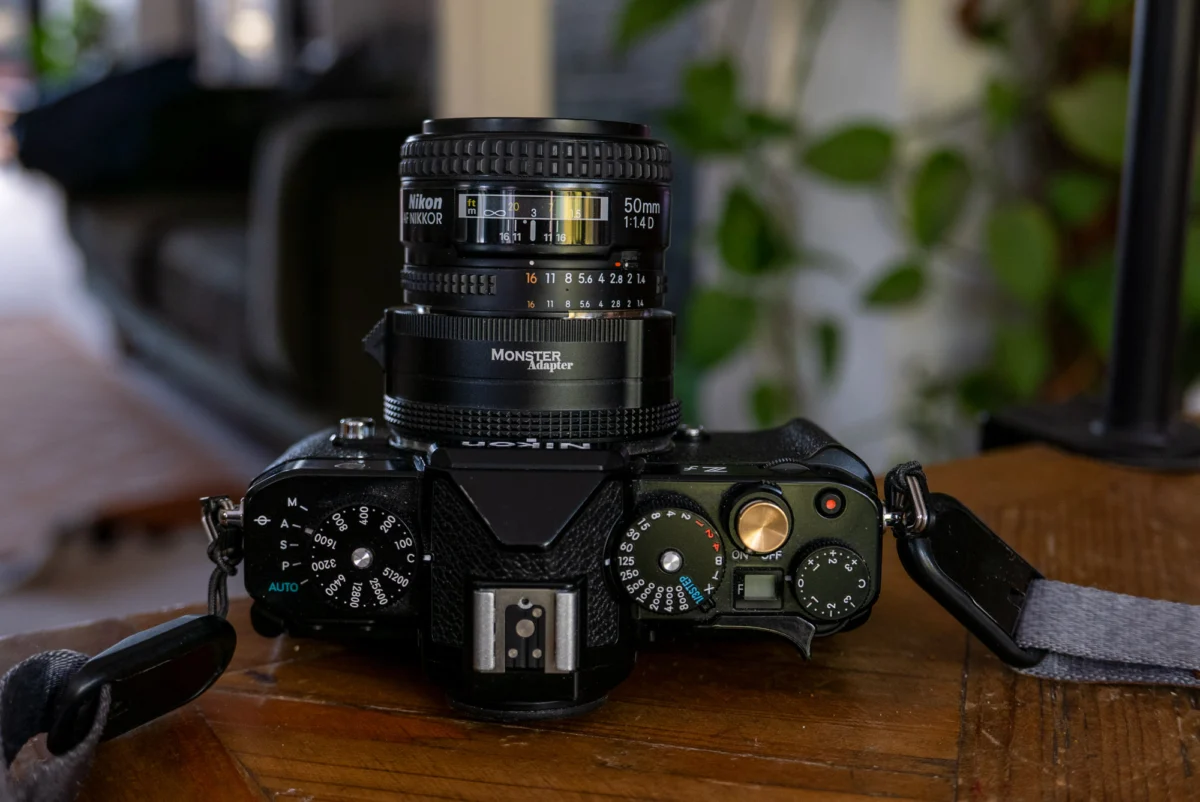
The evolution of camera technology has frequently left legacy hardware behind, particularly as manufacturers transition from mechanical systems to electronic interfaces. One of the most significant casualties of Nikon’s transition from the F-mount to the Z-mount was the loss of autofocus support for "D-series" lenses, which rely on a mechanical screw-drive system powered by a motor inside the camera body. While Nikon’s official FTZ adapters provide seamless integration for newer AF-S and AF-P lenses, they lack the internal motor required to drive older AF-D optics. The emergence of the MonsterAdapter LA-FZ1, specifically with the release of firmware version 1.2, represents a pivotal development for enthusiasts seeking to utilize classic Nikkor glass on modern mirrorless bodies like the Nikon Zf.
The Technological Architecture of the MonsterAdapter LA-FZ1
The MonsterAdapter LA-FZ1 is not a traditional passive or simple electronic pass-through adapter. It is a complex piece of engineering that includes a built-in autofocus motor designed to interface with the mechanical coupling of Nikon AF-D lenses. This allows the adapter to act as a bridge, translating the sophisticated digital autofocus signals from a Z-series camera into the physical rotational movement required to move the lens elements.

The release of firmware version 1.2 has been identified as a critical milestone for the adapter’s stability and compatibility. Prior iterations of such adapters often struggled with "hunting"—a phenomenon where the lens moves back and forth without locking onto a subject—or failed to communicate effectively with the camera’s IBIS (In-Body Image Stabilization) and EXIF data systems. The LA-FZ1 aims to resolve these issues, providing a functional solution for a lens library that spans over three decades of optical history.
Historical Context: The Nikon 50mm f/1.4 AF-D
The Nikon 50mm f/1.4 AF-D, released in 1995, remains a staple of the "nifty fifty" category. Built with seven elements in six groups, it was the successor to the original AF version, adding the "D" (Distance) chip to help the camera’s metering system calculate flash exposure more accurately. For nearly twenty years, this lens was the standard for low-light photography and portraiture within the Nikon ecosystem until the advent of the AF-S 50mm f/1.4G.
Despite its age, the AF-D version is prized for its compact form factor, physical aperture ring, and a specific optical "character" that many modern, clinically sharp lenses lack. However, its reliance on a camera’s internal motor meant that for the first several years of the Nikon Z system’s existence, these lenses were relegated to manual focus only. The LA-FZ1 changes this dynamic, potentially revitalizing thousands of units currently sitting in the secondary market.

Performance Metrics in Standard Lighting Environments
Technical evaluations conducted on the Nikon Zf platform indicate that the 50mm f/1.4 AF-D, when paired with the LA-FZ1, performs with surprising efficiency under optimal lighting conditions. While it cannot match the near-silent and instantaneous focus speeds of modern Viltrox or Nikkor Z-mount lenses—which utilize stepping motors (STM) or voice coil motors (VCM)—the combination achieves what technicians define as "expected operational standards."
In static subject testing, the adapter allows the Zf’s autofocus system to engage the lens’s screw-drive mechanism with enough torque to find focus quickly. The Nikon Zf, equipped with the Expeed 7 processor, provides a significant advantage here. The camera’s ability to recognize subjects (eyes, faces, animals) allows the adapter to receive high-quality data, minimizing the time spent seeking focus. Users have reported that for street photography and environmental portraits, the focus speed is comparable to using the lens on a professional-grade film SLR, such as the Nikon F100.
Low-Light Challenges and Sensor Communication
The performance of adapted legacy glass often degrades as ambient light levels drop. During testing in low-light environments, such as indoor recreation centers or evening settings, the LA-FZ1 experiences an increase in focus hunting. This is largely attributed to the nature of screw-drive technology; the mechanical play in the gears makes micro-adjustments more difficult than the electronic pulses used by modern lenses.

However, the integration with the Nikon Zf’s 3D tracking system provides a buffer against total failure. While the hit rate decreases, the camera’s advanced algorithms can often compensate for the adapter’s mechanical limitations. Switching from 3D tracking to a single-point AF mode in low light has been noted as a successful workaround to ensure accuracy, albeit at the cost of speed. This suggests that while the hardware is limited by 1990s mechanical standards, the 2020s software in the camera body is doing much of the heavy lifting.
Dynamic Subject Tracking and the "Dog Test"
To push the limits of the MonsterAdapter LA-FZ1, technical assessments included high-speed subject tracking—specifically, animals moving toward the camera. This is traditionally the most difficult task for any autofocus system, as it requires constant, rapid adjustments to the focal plane.
Data suggests that when shooting wide open at f/1.4, the hit rate for fast-moving subjects drops significantly. In a controlled test of a dog running toward the lens, the success rate was measured at approximately 20%. In contrast, native Z-mount lenses or high-end third-party options like Viltrox typically maintain an 80% to 90% hit rate in similar conditions.

The disparity is a physical reality of the hardware. The motor inside the LA-FZ1 must physically turn a screw that moves the entire optical block of the 50mm lens. This mechanical inertia cannot compete with the lightweight internal focusing elements of modern optics. Nevertheless, the fact that the adapter achieves any successful frames in a high-speed tracking scenario is a testament to the sophistication of the MonsterAdapter firmware.
Technical Specifications and Setup Recommendations
For photographers looking to integrate the LA-FZ1 into their workflow, specific camera configurations are recommended to maximize the adapter’s potential:
- AF Activation: Decoupling autofocus from the shutter button (using "back-button AF") allows for more precise control over when the screw-drive motor engages.
- Focus Mode: Continuous AF (AF-C) is generally preferred, as it allows the adapter to make the small micro-adjustments necessary to maintain focus on a subject.
- Aperture Control: The LA-FZ1 allows the camera to control the aperture electronically, provided the lens’s physical aperture ring is set to its highest f-number (usually marked in orange).
Market Implications and Consumer Reaction
The success of the MonsterAdapter LA-FZ1 has notable implications for the photography equipment market. First, it preserves the value of "orphan" lenses—high-quality glass that was previously incompatible with modern autofocus systems. This creates a sustainable alternative to buying expensive native mirrorless glass, particularly for hobbyists or professionals who prefer the aesthetic of older coatings and optical formulas.

Industry analysts note that third-party manufacturers like MonsterAdapter are filling a niche that major corporations have deemed too small or technically difficult to pursue. While Nikon has focused on pushing users toward the superior optical performance of the S-Line Z lenses, the demand for "character glass" remains high. The LA-FZ1 caters to this demographic, proving that there is a viable market for hardware that bridges the generational divide.
Analysis of Firmware v1.2 and Future Prospects
The transition from earlier firmware versions to v1.2 represents a shift from "experimental" to "usable" for the LA-FZ1. The improvements in stability and the reduction of communication errors between the lens and the Zf body suggest that software optimization can mitigate some of the inherent flaws of mechanical screw-drive systems.
However, there is a ceiling to what can be achieved. The physical wear on 30-year-old lenses, the noise of the screw-drive motor, and the battery drain caused by powering an external motor are factors that firmware cannot entirely resolve. Future updates may focus on refining the "settling" behavior of the AF—how the lens behaves once it is near the point of focus—to reduce the slight jittering sometimes observed in continuous focus modes.

Conclusion: A Success for Legacy Integration
The Nikon 50mm f/1.4 AF-D, when paired with the MonsterAdapter LA-FZ1 and the Nikon Zf, stands as a successful example of cross-generational hardware synergy. While it does not transform a 1995 lens into a 2024 powerhouse, it restores the lens to a level of functionality that meets the "expected way" of working for most photographic applications.
For users whose priority is the optical signature of classic Nikkor glass over the clinical perfection of modern optics, the LA-FZ1 is an essential tool. It demonstrates that with sufficient engineering effort and software refinement, the gap between the mechanical past and the digital future can be bridged, allowing legendary lenses to continue their service in the mirrorless era. As firmware continues to evolve, the boundary between "legacy" and "obsolete" continues to blur, much to the benefit of the global photography community.