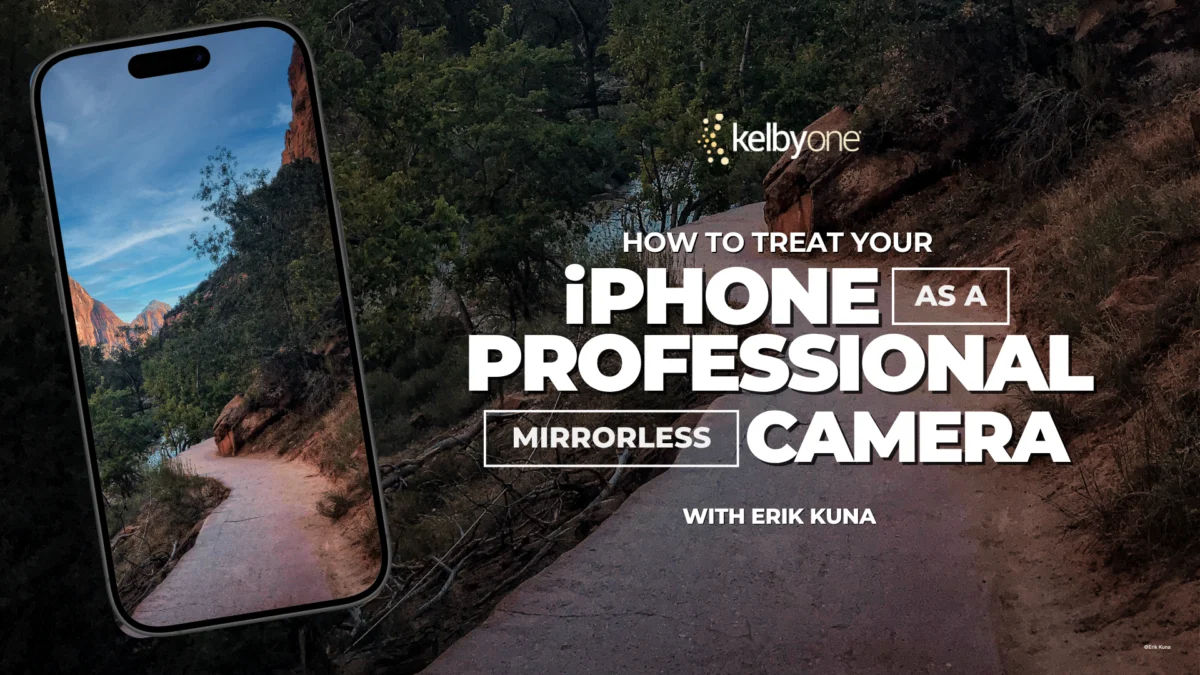
KelbyOne, a leading online platform for creative education, has announced the launch of a new comprehensive photography class designed to transform how users approach their iPhone cameras. Titled "Treating Your iPhone Like a Mirrorless Camera," the course, led by acclaimed photographer and educator Erik Kuna, aims to empower iPhone owners to move beyond simple point-and-shoot photography and harness the advanced capabilities of their devices to create stunning, professional-quality images. This initiative reflects a growing trend in the photography industry, where the lines between traditional cameras and high-end smartphones are increasingly blurring, necessitating a more sophisticated understanding of mobile photographic tools.
The Vision: Bridging the Gap Between Smartphone and Professional Photography
At the core of Erik Kuna’s new KelbyOne class is a paradigm shift: encouraging iPhone users to view their device not merely as a convenient snapshot tool, but as a powerful, pocket-sized mirrorless camera capable of producing exceptional results. This philosophy challenges the common misconception that professional-grade photography is solely the domain of expensive, dedicated camera equipment. Instead, Kuna posits that with the right knowledge and intentional decision-making, the iPhone can serve as a highly capable creative instrument. The class is meticulously structured to guide participants through the process of taking deliberate control over their photographic output, moving away from relying on the phone’s automatic settings to actively making creative choices. This approach is particularly relevant in an era where smartphone cameras boast computational photography features that often surpass the capabilities of entry-level traditional cameras in certain scenarios.
Meet the Instructor: Erik Kuna, A Luminary in Photography Education
Erik Kuna is a highly respected figure in the photography and creative education landscape, known for his engaging teaching style and profound technical expertise. As a prominent instructor for KelbyOne, Kuna has a long-standing reputation for demystifying complex photographic concepts and making them accessible to a wide audience, from enthusiastic amateurs to seasoned professionals seeking to refine their skills. His background often encompasses diverse areas of photography, including studio lighting, portraiture, landscape, and increasingly, mobile photography. Kuna’s ability to translate advanced photographic principles into practical, actionable steps for iPhone users makes him an ideal guide for this specialized course. His previous works and contributions to KelbyOne’s extensive library have consistently received high praise for their clarity, depth, and practical application, solidifying his position as a trusted educator in the field.
Key Pillars of Professional iPhone Photography Unveiled
The "Treating Your iPhone Like a Mirrorless Camera" class delves into several critical areas, each designed to elevate a user’s photographic acumen. These modules are not just about learning features; they are about understanding the ‘why’ behind each technique, fostering a more thoughtful and deliberate approach to image-making.
1. Mastering Focus and Exposure Control: One of the most fundamental aspects of photography is precise control over focus and exposure. Kuna demonstrates how to effectively lock both focus and exposure on the iPhone, a crucial technique for ensuring sharp subjects and balanced lighting, especially in challenging conditions or when recomposing a shot. This moves beyond the iPhone’s default auto-focus and auto-exposure, which can often be unpredictable or prioritize unintended elements within a scene. By learning to manually set and lock these parameters, photographers gain artistic command, ensuring that the camera captures exactly what they intend.
2. Strategic Lens Selection vs. Digital Zoom: Modern iPhones, particularly the Pro models, come equipped with multiple optical lenses – typically ultra-wide, wide, and telephoto. Kuna emphasizes the critical importance of selecting the appropriate optical lens for a given scene rather than resorting to the detrimental practice of "pinching to zoom." Digital zoom, which essentially crops and interpolates pixels, invariably leads to a significant loss of image quality. Understanding when to switch to the ultra-wide for expansive landscapes, the wide for everyday scenes, or the telephoto for portraits and distant subjects is a cornerstone of professional mobile photography, preserving image fidelity and composition.
3. Demystifying ProRAW: When Quality Trumps File Size: Apple ProRAW, introduced with the iPhone 12 Pro series, represents a significant leap in mobile photography, combining the computational benefits of Apple’s image processing with the flexibility of a traditional RAW file. Kuna’s class provides an in-depth explanation of ProRAW, detailing its advantages and, crucially, when its larger file size is justified. ProRAW files retain far more image data than standard JPEGs or HEICs, offering significantly greater latitude for adjustments in post-processing, particularly for recovering highlights and shadows, fine-tuning white balance, and enhancing colors without introducing artifacts. This capability is invaluable for situations with high dynamic range, complex lighting, or when photographers anticipate extensive editing.
4. Unleashing Advanced Modes: Night, Macro, and Long Exposure: The iPhone’s computational photography prowess shines in its specialized modes, which Kuna teaches users to fully control rather than passively activate.
- Night Mode: Rather than simply letting the iPhone decide, Kuna guides users on understanding how Night Mode works (capturing multiple frames and merging them), and how to manually adjust its exposure duration to achieve optimal results in low-light environments, balancing noise reduction with detail preservation.
- Macro Photography: With the introduction of dedicated macro capabilities in recent iPhone Pro models (starting with iPhone 13 Pro), users can capture intricate details of small subjects. The class explores techniques for achieving sharp, well-lit macro shots, transforming everyday objects into captivating photographic subjects.
- Long Exposures: While not a native real-time long exposure feature like traditional cameras, the iPhone’s Live Photos, combined with specific editing techniques or third-party applications, can simulate long exposures for creative effects like silky water, light trails, or blurring moving subjects. Kuna illustrates these methods, expanding the creative palette available to iPhone photographers.
5. Streamlined Workflow: Shortcuts and Post-Processing Excellence: Beyond capturing the image, a professional workflow involves efficient organization and powerful editing. Kuna shares valuable shortcuts within the iOS ecosystem that can significantly speed up the photographic process, from quickly launching the camera in a specific mode to accessing frequently used settings. The class culminates in a straightforward yet effective editing workflow, guiding participants from initial adjustments within Apple Photos – ideal for quick tweaks and organization – to the more robust and non-destructive editing capabilities of Adobe Lightroom Mobile. This segment underscores the importance of post-processing in refining images and realizing the photographer’s creative vision, seamlessly integrating the phone’s capture abilities with professional-grade editing tools.
The Evolution of Smartphone Photography: A Timeline of Innovation
The emergence of such a specialized course underscores the remarkable evolution of smartphone camera technology over the past two decades. Early camera phones, dating back to the late 1990s and early 2000s, offered rudimentary imaging capabilities, primarily for novelty and basic communication. However, with the advent of the first iPhone in 2007, and subsequent generations, smartphone cameras began a rapid ascent in quality and sophistication.
Key Milestones:
- 2007 (Original iPhone): A fixed-focus 2-megapixel camera, marking the beginning of smartphone photography as a mainstream feature.
- 2010 (iPhone 4): Introduction of an LED flash and a front-facing camera, paving the way for selfies and video calls.
- 2014 (iPhone 6/6 Plus): Introduction of optical image stabilization (OIS) on the Plus model, significantly improving low-light performance and video stability.
- 2016 (iPhone 7 Plus): The dual-camera system debuts, introducing optical zoom (2x telephoto) and Portrait Mode, utilizing computational photography to simulate shallow depth of field.
- 2018 (iPhone XS/XR): Smart HDR significantly enhances dynamic range by merging multiple exposures.
- 2019 (iPhone 11 Pro): The triple-camera system becomes standard on Pro models, adding an ultra-wide lens. Night Mode is introduced, revolutionizing low-light performance through computational imaging. Deep Fusion further improves detail and texture in medium-light conditions.
- 2020 (iPhone 12 Pro): LiDAR Scanner enhances autofocus in low light and enables more realistic augmented reality. ProRAW is introduced, offering professional-grade RAW flexibility.
- 2021 (iPhone 13 Pro): Cinematic Mode brings rack focus capabilities to video. Macro photography is introduced via the ultra-wide lens’s autofocus.
- 2022 (iPhone 14 Pro): Introduction of a 48-megapixel main sensor with pixel binning, enabling improved low-light performance and 2x optical quality zoom from the main sensor. Photonic Engine further enhances image quality.
- 2023 (iPhone 15 Pro): Advanced 5x telephoto on Pro Max, and enhanced computational photography features leveraging the A17 Pro chip.
This timeline illustrates a consistent trajectory towards integrating advanced optics, larger sensors, and increasingly sophisticated computational photography algorithms, making the iPhone a legitimate contender in many photographic scenarios. This technological progress directly fuels the need for educational resources like Kuna’s class, enabling users to fully leverage these powerful tools.
KelbyOne’s Commitment to Accessible Creative Education
KelbyOne has established itself as a premier destination for online creative education, offering a vast and continuously expanding library of courses across photography, Photoshop, and Lightroom. Their mission revolves around making professional-level instruction accessible to a global audience, empowering individuals to hone their creative skills and achieve their artistic aspirations. The inclusion of "Treating Your iPhone Like a Mirrorless Camera" further solidifies KelbyOne’s commitment to staying at the forefront of industry trends, recognizing the omnipresence and growing capability of smartphone cameras. The platform’s reputation for high-quality video production, expert instructors, and practical, project-based learning makes it an ideal environment for users to delve into specialized topics like advanced mobile photography. KelbyOne’s comprehensive subscription model, offering unlimited access to its entire library for a monthly fee, represents a significant value proposition for continuous learners, reflecting a broader shift in educational consumption towards subscription-based platforms.
Target Audience and Broader Implications
This class is designed for a diverse audience. It’s perfect for the casual iPhone user who wants to take better photos of their everyday life, family, and travels. It’s also invaluable for aspiring mobile photographers and social media content creators who rely on their iPhone for high-quality visual content. Furthermore, even professional photographers who traditionally use DSLRs or mirrorless cameras can benefit, learning how to effectively utilize the camera they always have with them as a powerful supplementary tool or a primary camera for specific projects.
The broader implications of such educational initiatives are significant. They contribute to the democratization of photography, lowering the barrier to entry for creating compelling imagery. As more individuals learn to master their smartphone cameras, the overall quality of user-generated content across social media, personal blogs, and digital platforms is likely to rise. This, in turn, fuels innovation in mobile camera technology and software, creating a positive feedback loop that benefits both consumers and the industry. It also challenges traditional notions of what constitutes "professional" photography, emphasizing skill and intentionality over equipment cost.
Accessing the Course: Investment in Photographic Excellence
The "Treating Your iPhone Like a Mirrorless Camera" class by Erik Kuna is available for immediate access. Individuals can purchase the standalone course for $39, offering a focused investment in enhancing their mobile photography skills. Alternatively, those seeking a more comprehensive learning experience can subscribe to KelbyOne for just $19.99 a month, gaining unlimited access to this course alongside KelbyOne’s entire extensive library of photography and creative software tutorials. KelbyOne stands behind the quality of its education with a 100% money-back guarantee, allowing prospective students to try the platform risk-free. This flexible access model ensures that high-quality photography education remains accessible to a wide range of budgets and learning preferences. The course can be viewed directly via the link: https://kel.by/kunaiphone26.
In conclusion, Erik Kuna’s new KelbyOne class represents a timely and essential resource for anyone looking to unlock the full photographic potential of their iPhone. By fostering a mindset that treats the iPhone as a sophisticated creative tool rather than a mere convenience, the course empowers users to take control of their images, embrace advanced techniques, and ultimately produce photographs that truly reflect their artistic vision. This initiative not only enhances individual photographic capabilities but also reflects and contributes to the ongoing evolution of photography in the digital age.