The Evolution of Social Media Content Standards
The trajectory of social media marketing over the last decade has seen a dramatic shift in user expectations. In the early 2020s, "authentic" or "lo-fi" content was often sufficient to build a community. However, by 2026, the market has reached a saturation point where professional-grade aesthetics are the baseline for consumer trust. Industry data indicates that users are 40% more likely to engage with a brand that utilizes high-resolution, professionally composed imagery compared to those using over-saturated, low-quality free stock photos.
The primary challenge facing modern marketers is the "generic trap." Free image repositories, while accessible, offer a limited selection of assets that are frequently overused across the web. This leads to a dilution of brand identity, as a single popular image may appear on the feeds of hundreds of competing businesses simultaneously. Shutterstock addresses this by providing a library of over 400 million assets, ensuring a level of exclusivity and variety that free platforms cannot replicate.

A Deep Dive into the Shutterstock Creative Ecosystem
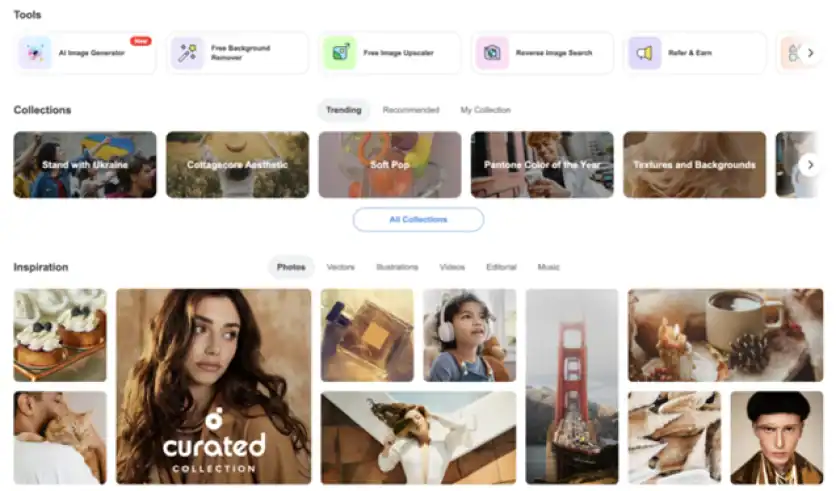
Shutterstock has transitioned from a traditional stock photo agency into an integrated creative suite designed for rapid content production. Central to this evolution is the "Creative Flow" suite, an AI-powered design platform that eliminates the need for external editing software in many social media workflows.
AI Integration and Generative Tools
By 2026, Shutterstock has fully integrated ethical AI tools into its platform. These tools allow marketers to generate custom variations of existing images or create entirely new visuals based on text prompts, all backed by a contributor fund that ensures artists are compensated for the use of their styles in AI training. For social media managers, this means the ability to "expand" an image to fit different aspect ratios—such as turning a landscape photo into a vertical 9:16 format for Instagram Stories—without losing quality or context.
The Creative Flow Suite Features
The Creative Flow suite offers several specific advantages for social media marketing:

- Background Removal: A one-click tool that allows for the isolation of subjects, facilitating the creation of "cut-out" style graphics popular in YouTube thumbnails and TikTok overlays.
- Smart Resizing: Automatically adjusts a single design into multiple formats for LinkedIn, X (formerly Twitter), Instagram, and Facebook, significantly reducing the time required for cross-platform campaigns.
- Template Library: Access to thousands of pre-designed layouts that can be customized with premium assets, ensuring that even non-designers can produce high-quality posts.
The Short-Form Video and Audio Revolution
The dominance of short-form video content on platforms like Reels and TikTok has necessitated a change in how stock libraries are utilized. Static images are no longer sufficient to sustain a comprehensive social strategy. Shutterstock has responded by aggressively expanding its video and music libraries to meet these demands.
High-Resolution Video Assets
Shutterstock offers a vast repository of 4K and 8K video clips, including vertical-optimized footage specifically filmed for mobile-first platforms. In an era where "b-roll" footage is essential for storytelling, having access to professional cinematography can elevate a standard video post into a high-production-value advertisement. Data from 2025 suggests that videos utilizing professional b-roll see a 25% increase in average watch time, a key metric for algorithmic promotion.
Audio and Soundscapes
Sound is an integral part of the social media experience. Shutterstock’s music library includes thousands of tracks across various genres, all of which are cleared for commercial use. This is a critical advantage over free music libraries, which often carry hidden licensing restrictions that can lead to copyright strikes or the muting of videos on platforms like YouTube and Instagram.

Comparative Analysis: Shutterstock vs. Free Alternatives
To understand the value proposition, a direct comparison between free stock sites and a Shutterstock subscription is necessary.
| Feature | Free Stock Sites (CC0) | Shutterstock Subscription |
|---|---|---|
| Asset Variety | Limited; high duplication across brands | 400M+ (Images, Video, Music, 3D) |
| Editing Tools | Usually none; requires third-party apps | Integrated Creative Flow Suite (AI-powered) |
| Legal Safety | High risk; unverified model/property releases | Full commercial coverage and indemnification |
| Video Quality | Primarily 1080p; limited vertical options | 4K/8K and vertical-native footage |
| Search Accuracy | Basic keyword matching | AI-driven semantic and visual search |
Legal Protections and Commercial Safety
One of the most overlooked aspects of social media marketing is the legal risk associated with image usage. Free stock sites often operate under Creative Commons Zero (CC0) licenses, which do not always guarantee that model releases or property releases have been obtained. If a brand uses an image of a person without their explicit consent for a commercial advertisement, the brand—not the free stock site—is legally liable.
Shutterstock provides a layer of legal protection that is essential for established brands and agencies. Every image in the library undergoes a rigorous vetting process to ensure all necessary releases are on file. Furthermore, Shutterstock offers varying levels of indemnification, protecting the user from potential copyright or privacy lawsuits. In the litigious environment of 2026, this "peace of mind" is often cited by corporate marketing departments as the primary reason for maintaining a premium subscription.

Economic Implications and Return on Investment (ROI)
For small businesses and independent creators, the cost of a Shutterstock subscription is a significant consideration. However, an analysis of the "Time-to-Market" metric reveals a clear ROI.
Time Savings
A social media manager using free tools may spend several hours searching for an image, downloading it, editing it in a separate program, resizing it manually for different platforms, and then uploading it. With Shutterstock’s integrated tools, this process is condensed into minutes. If a manager’s time is valued at $50 per hour, saving just four hours a month more than covers the cost of a standard subscription.
Engagement and Conversion Rates
Unique, high-quality visuals directly impact the bottom line. Marketing campaigns utilizing premium, less-common assets typically see higher Click-Through Rates (CTR) in paid social advertisements. When a user stops scrolling because they see a unique, high-impact visual, the likelihood of a conversion increases. In competitive sectors like e-commerce or SaaS, even a 1% increase in CTR can result in thousands of dollars in additional revenue.

Broader Impact on the Creative Industry
The shift toward premium libraries also reflects a broader movement toward ethical content consumption. By using a paid service, marketers support the global community of photographers, videographers, and musicians who contribute to the platform. In 2026, corporate social responsibility (CSR) extends to how brands source their digital assets. Utilizing platforms that fairly compensate creators has become a point of pride for many ethical brands.
Conclusion: Is the Investment Justified?
The determination of whether Shutterstock is "worth it" depends entirely on the scale and goals of the marketing entity. For a hobbyist or a casual user, free tools remain a viable, albeit limited, option. However, for any entity utilizing social media as a serious business tool, the advantages of a premium library are undeniable.
The combination of a massive, unique asset library, integrated AI-powered editing tools, 4K video capabilities, and comprehensive legal protection creates a robust infrastructure for modern content creation. In the visual-first economy of 2026, the cost of generic, low-quality content is far higher than the price of a premium subscription. By investing in high-quality assets, brands can ensure they not only capture the attention of their audience but also build the professional credibility necessary for long-term growth.