The intricate world of deep-sky astrophotography, once the exclusive domain of dedicated enthusiasts armed with complex, multi-component setups, is undergoing a profound transformation. A new generation of compact, integrated devices known as "smart telescopes" has emerged, fundamentally altering the landscape for aspiring celestial photographers. This paradigm shift is now being formally addressed and demystified through a new educational initiative: a comprehensive class led by renowned photographer and educator Erik Kuna, designed to guide newcomers through the capabilities and practical applications of these innovative instruments.
The Dawn of Accessible Astrophotography
Historically, capturing breathtaking images of distant galaxies, swirling nebulae, and shimmering star clusters necessitated a significant financial investment, a steep learning curve, and countless hours dedicated to mastering intricate technical processes. Traditional astrophotography rigs typically comprised a high-quality equatorial mount for precise tracking, a specialized astronomical telescope, a dedicated cooled camera, an auto-guiding system, and a suite of complex software for acquisition, stacking, and processing. The integration of these disparate components, along with the precise polar alignment, focusing, and guiding required, presented formidable barriers to entry for many potential enthusiasts.
The introduction of smart telescopes has dramatically lowered these hurdles. These all-in-one units integrate sophisticated optics, high-resolution sensors, automated tracking mechanisms, and intelligent software into a single, user-friendly package. Their hallmark features include automated object finding (Go-To capabilities), precise celestial tracking to counteract Earth’s rotation, automatic focusing, and perhaps most impressively, live stacking of multiple short exposures directly within the device to produce detailed, noise-reduced images in near real-time. All these complex functions are often controllable via a smartphone or tablet application, putting the power of deep-sky imaging directly into the hands of the casual observer. Crucially, many models are now available for under $1,000, a price point that was previously unthinkable for a complete deep-sky imaging solution.
Erik Kuna’s Masterclass: Bridging Innovation and Application
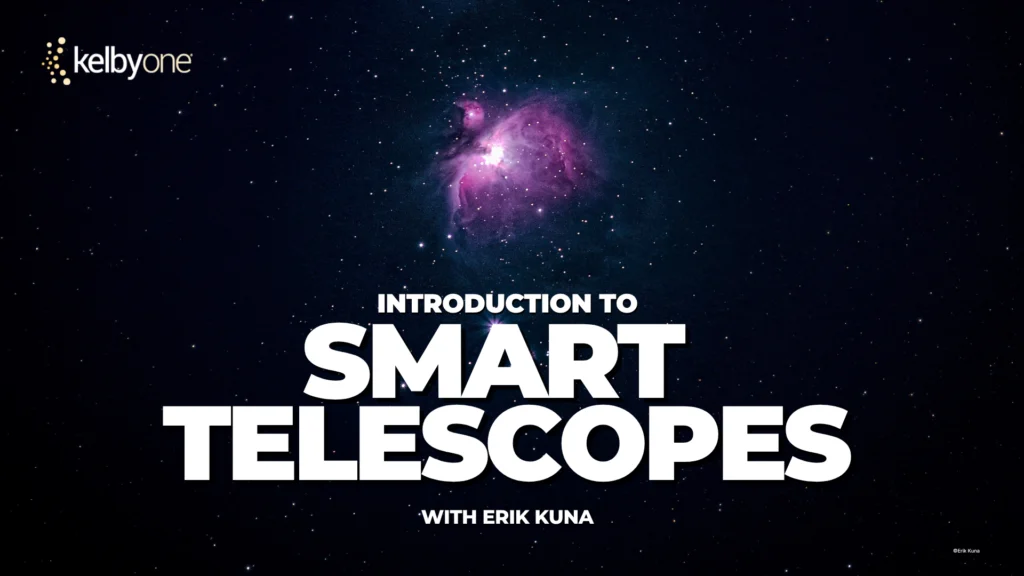
Recognizing the burgeoning interest and the need for clear, practical instruction, KelbyOne, a leading online platform for creative education, has partnered with Erik Kuna to launch his new class, "Introduction to Smart Telescopes." Kuna, a respected figure in the photography community known for his clear teaching style and technical expertise, is ideally positioned to guide students through this evolving technological frontier.
The class is structured to provide a holistic understanding of smart telescopes, moving from foundational concepts to practical application. Kuna meticulously explains the underlying principles of how these devices operate, detailing the synergy between their integrated hardware and intelligent software. He illuminates the types of celestial objects — primarily galaxies, nebulae, and star clusters, which are often referred to as "deep-sky objects" — for which smart telescopes are exceptionally well-suited. Equally important, Kuna addresses the limitations of these devices, clarifying what they are not designed to do, ensuring that students approach the technology with realistic expectations. This critical distinction helps users understand where a smart telescope excels and where more specialized equipment might still be necessary, such as for high-resolution planetary imaging or advanced scientific research.
A significant portion of the curriculum is dedicated to guiding prospective buyers through the selection process. Kuna outlines key considerations when choosing a smart telescope, emphasizing how personal photographic goals and preferred deep-sky targets should inform the decision. This segment is invaluable for navigating a market that, while still relatively nascent, is growing rapidly with various manufacturers offering different specifications and capabilities.
The class then transitions to practical, hands-on instruction. Kuna leads students through their inaugural night of smart telescope operation, covering everything from initial setup and calibration to image acquisition and basic post-processing techniques. This step-by-step approach is designed to build confidence and ensure a smooth, rewarding first experience for users, mitigating the common frustrations associated with traditional astrophotography’s steep learning curve.
A Chronology of Astrophotography Evolution
The journey to accessible astrophotography has been a long one, marked by several key technological leaps:
- Early 20th Century: Astrophotography was primarily the domain of professional observatories, using large, fixed telescopes and long photographic exposures on glass plates.
- Mid-20th Century: Amateur astrophotography began to emerge with film cameras attached to manually guided telescopes. Challenges included film reciprocity failure and the difficulty of precise tracking.
- 1980s-1990s: The advent of affordable Schmidt-Cassegrain telescopes and the first consumer CCD cameras started to democratize imaging, though still requiring complex mounts and significant technical skill. Computer control began to simplify telescope pointing.
- 2000s: Digital SLR cameras (DSLRs) became increasingly popular, offering a more accessible entry point than dedicated CCDs. Autoguiding systems, initially expensive, began to become more widespread and affordable. Software for image stacking and processing became more powerful.
- 2010s: The rise of dedicated astronomical CMOS cameras, offering faster frame rates and lower noise, further enhanced amateur capabilities. The concept of "plate solving" (automatically determining a telescope’s exact pointing direction) became integrated into software, streamlining setup.
- Late 2010s – Present: The "smart telescope" era truly begins. Companies like Vaonis (Vespera, Stellina), Unistellar (eVscope), ZWO (Seestar), Celestron (Origin), and DwarfLabs (Dwarf II) introduce fully integrated, automated systems designed for ease of use, often controlled by mobile applications. These devices represent the culmination of decades of technological advancement, packaging complex processes into user-friendly interfaces.
Supporting Data and Market Implications
The rise of smart telescopes is not merely a niche trend; it reflects broader shifts in consumer technology towards integration, automation, and user-friendliness. While specific market share data for smart telescopes is still emerging, industry analysts indicate a significant growth trajectory within the broader consumer optics and astronomy equipment markets. The market for consumer telescopes alone was valued at over $200 million in 2022 and is projected to grow steadily, with smart telescopes being a key driver of this expansion, particularly among younger demographics and those new to the hobby. The average price point of sub-$1,000 for many smart telescope models stands in stark contrast to traditional setups that can easily run into several thousands of dollars, making deep-sky imaging accessible to a much wider audience. This price point, combined with simplified operation, is attracting individuals who previously found the hobby too daunting or expensive.
Inferred Statements and Industry Reactions
The emergence of comprehensive educational resources like Erik Kuna’s class underscores the industry’s recognition of this technological shift.
A representative from KelbyOne might logically infer: "We’ve observed an unprecedented surge of interest in astrophotography, particularly with the advent of smart telescopes. Our partnership with Erik Kuna is a strategic response to provide accessible, expert-led education that empowers our members to fully leverage these exciting new tools. It aligns perfectly with our mission to democratize creative learning."
Erik Kuna himself, elaborating on his motivation, could be inferred to state: "My goal with this class is to demystify deep-sky photography for everyone. Smart telescopes are game-changers, but like any new technology, there’s a learning curve to truly maximize their potential. I want to equip students with the knowledge to select the right device, understand its capabilities and limitations, and confidently capture their first stunning images of the cosmos without the traditional headaches."
Industry experts also acknowledge the impact. An astronomical equipment analyst might infer: "The smart telescope segment represents a significant disruption, lowering the barrier to entry for astrophotography in a way we haven’t seen before. While dedicated enthusiasts will always pursue high-end, modular systems, these integrated solutions are expanding the market considerably, fostering new interest and potentially driving future innovation across the entire industry."
Broader Impact and Future Outlook
The implications of smart telescopes and the educational initiatives supporting their adoption extend beyond individual hobbyists:
- Democratization of Science and Education: Smart telescopes can serve as powerful educational tools in schools and community centers, making astronomy and STEM subjects more engaging and accessible. Their ease of use facilitates citizen science projects, allowing a wider public to contribute to astronomical observations.
- Innovation in Optics and Software: The competitive landscape is spurring manufacturers to innovate rapidly, leading to advancements in sensor technology, optical designs, and AI-driven processing algorithms that could benefit the entire astrophotography community.
- Changing Landscape for Traditional Manufacturers: Established telescope and camera manufacturers are adapting by either developing their own smart telescope lines or focusing on advanced modular systems for the professional and high-end amateur markets.
- Community Growth: A more accessible entry point means a larger, more diverse community of astrophotographers, fostering collaboration, sharing of techniques, and a broader appreciation for the night sky.
- Environmental Awareness: By making celestial wonders more accessible, smart telescopes can also indirectly contribute to increased awareness about light pollution and the importance of preserving dark skies.
In conclusion, smart telescopes represent a pivotal moment in the history of amateur astronomy, transforming a once challenging and costly pursuit into an accessible and immediate experience. Erik Kuna’s "Introduction to Smart Telescopes" class on KelbyOne is a timely and essential resource, providing the guidance necessary for enthusiasts to navigate this exciting new frontier. By bridging the gap between innovative technology and practical application, Kuna’s class empowers a new generation of deep-sky photographers to effortlessly capture the universe’s awe-inspiring beauty, proving that the cosmos is now within reach for almost anyone with a curious mind and a smartphone.