The raw power of a 12,000-pound dolphin, orcas, exploding from the frigid waters of Norway’s Arctic coastline is a spectacle that commands profound respect. For wildlife photographer Paul Nicklen, this moment, captured after weeks of challenging expeditions, represents not just a photographic triumph but a profound connection with the untamed spirit of the ocean. This account delves into the meticulous planning, the unforgiving environment, and the sheer serendipity that culminated in the iconic "Dawn Patrol" image, offering a window into the dedication required to document these magnificent marine mammals in their natural, often brutal, habitat.
The Long Wait: Weeks of Arctic Vigil
The journey to witness and photograph the orcas of Norway was not a fleeting one. Nicklen and his team dedicated weeks to tracking these elusive apex predators through the dark, often turbulent, waters of the Norwegian Arctic. The region, particularly during the winter months, presents a formidable environment for both wildlife and those who seek to observe it. Daylight is a precious commodity, with the sun rarely climbing above the horizon. Even the fleeting "evening" light, a mere pink glow, often occurred around midday, leaving the majority of the day shrouded in darkness.
"The days were dark," Nicklen recounts. "The sun rarely, if ever, climbed above the horizon, and that was on a good day. We would see a pink glow in the evening – and by evening, I mean high noon. The rest of the time, it was dark. It was cold. It was moody." This pervasive gloom, coupled with the rough seas, meant that sightings of the distinctive black fins slicing through the water were often brief and challenging to photograph. The inherent difficulty of the conditions underscored the significance of any sustained encounter.
A Shift in the Arctic Calm: The Dawn Patrol Emerges
The turning point arrived unexpectedly one morning. While following a pod of orcas from a distance, a palpable shift occurred. Initially, the group appeared quiescent, with only the imposing figures of large males visible. This initial stillness was characteristic of Norwegian orcas, which, unlike their counterparts in British Columbian waters known for their acrobatic breaches, are rarely observed leaping from the water. Their behavior tends to be more focused and less performative.
However, the calm was shattered by an unseen trigger. A sudden, collective excitement rippled through the pod, evident even from afar. "Then, one morning, as we were following a pod of orcas, something wonderful happened," Nicklen states. "The group was away from us, in the distance. At first, it seemed as if nothing was happening. We could see there were a few big males in the group, but aside from that everything appeared to be quiet."
This sudden surge in activity signaled a feeding frenzy. The orcas were engaged in a high-stakes hunt, a behavior that ignites their predatory instincts and transforms their demeanor. For Nicklen and his team, this was the moment they had been patiently waiting for. "We came alive, our senses suddenly alert and active, as if flicked on by a switch," he describes. The boat’s engine revved, accelerating to match the pod’s speed, a delicate maneuver to maintain observation without disturbing the animals.
The Symphony of the Hunt: A Dancer in the Waves
The pursuit became a ballet of apex predators and dedicated observers. The boat, traveling at approximately 20 knots, was carefully paced to keep alongside the orcas. Crucially, for the first time in weeks, the conditions offered a rare respite. The seas calmed, and the water’s surface became more cooperative, allowing for clearer visibility and more stable photography.

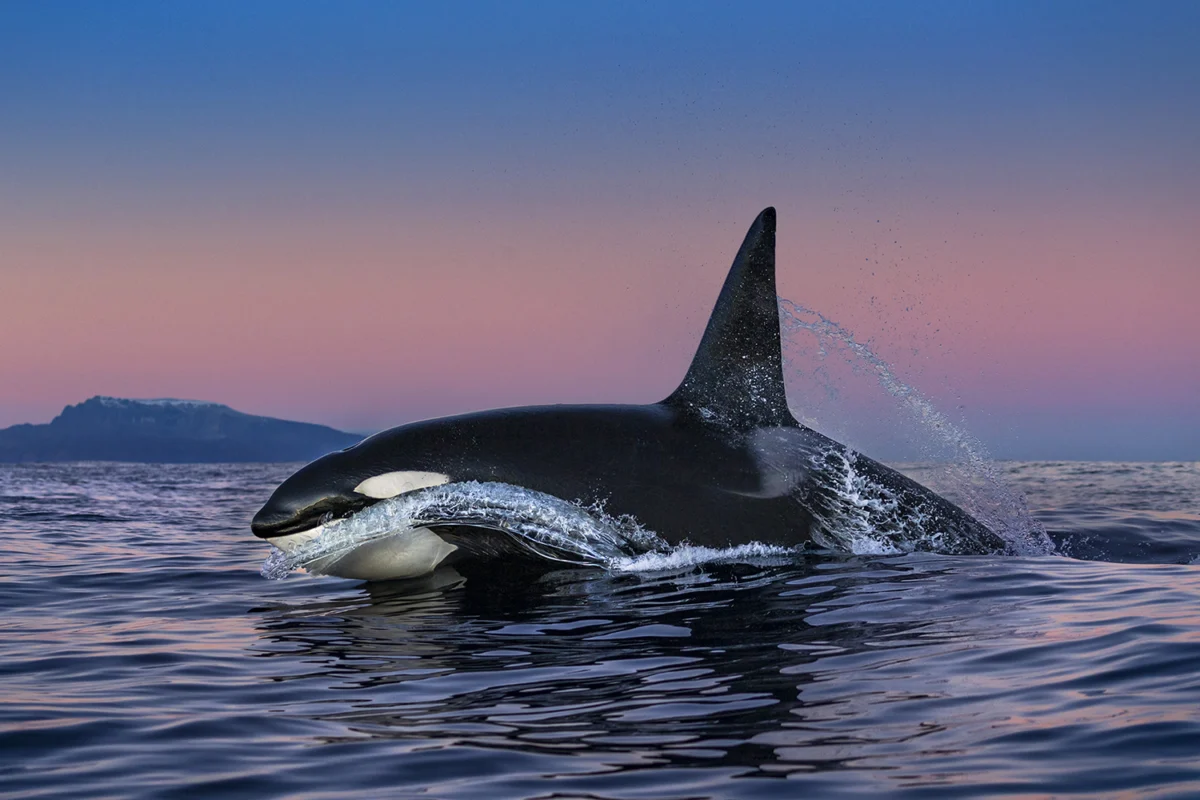
"Things were coming together. The conditions were calm – for once – and the water was cooperating," Nicklen observes. It was during this opportune moment that a particularly massive male orca began to porpoise with extraordinary speed and power. The image captured is one of sheer dynamism, with explosions of water erupting from the creature’s body with each forceful leap.
The Photographer’s Dilemma: Light, Speed, and the Perfect Shot
Capturing such an event under the low-light conditions of the Arctic winter presents immense technical challenges for a photographer. The dim, moody light requires a delicate balance between achieving a fast enough shutter speed to freeze the rapid motion and not underexposing the image.
"The light is almost always low in these kinds of situations," Nicklen explains. "You have to make a tricky calculation, and do it quickly. You want a shutter speed that is fast enough to freeze a snapshot in time, otherwise the action will be blurred." The sky, painted with hues of pink and orange against a backdrop of towering, snow-capped mountains, provided a dramatic, albeit challenging, canvas.
The orca itself was a marvel of natural engineering: an estimated 12,000 pounds, 25 feet in length, with a dorsal fin reaching six feet tall and pectoral fins the size of a car hood. Its powerful movements were so intense that keeping the entire frame in view through the camera’s viewfinder became a feat in itself.
The technology of the time, using single-lens reflex cameras, added another layer of complexity. "With single-lens reflex cameras, it was always hard to tell I was getting the shot or not," Nicklen admits. "I was shooting at ten frames a second, which means that ten times every second I was blind because the mirror has to lift, the shutter has to rise, and the image is exposed. Essentially, I had no clue if I had captured the shot or not." This period of blindness between frames meant that the photographer relied on instinct and the hope that the sequence of rapid shots would include the defining moment.
The Moment of Revelation: Unveiling the "Dawn Patrol"
The intense activity lasted only a fleeting moment, a "split second that passes by in the blink of an eye." Yet, in that brief interval, Nicklen believes he captured something extraordinary. The true test, however, came after the orcas had moved on, and the adrenaline subsided.
Sitting in the back of the boat, the photographer reviewed his shots on the camera’s LCD screen. The anxiety of not knowing whether the shot was successful was palpable. "In the past, I would have worried that this shot was not going to be sharp, with all this low, moody light and such an explosion of speed," he confesses.
But on this occasion, something remarkable had aligned. The boat’s driver, Goran, had expertly paced their vessel, and the orca’s movements had been perfectly captured. The resulting image, later titled "Dawn Patrol," was breathtaking. "I immediately saw that the whole package was there. It was beautiful," Nicklen exclaims. The frame captured the water streaming off the orca’s body, the subtle play of light and shadow, and the raw power of its leap.

A Masterpiece of Nature and Technique
The true revelation came when Nicklen zoomed in on the orca’s eye. He had anticipated that the extreme motion and low light would render this detail blurry, but to his astonishment, it was perfectly sharp. "I thought there was no way I would be able to zoom in on the eye of the orca. There was no way it would be sharp. And yet, when I tapped that button, I saw that the eye was sharp. The whole image was sharp," he states, a sense of wonder still evident in his words. He meticulously scrolled through the frames, searching for any flaw, any indication of failure, but found none.
This experience underscores the profound connection between the natural world and the photographer’s ability to translate its essence into a tangible form. "These are the gifts of nature that transform the beauty of the natural world into your camera," Nicklen reflects. "You realize, in that moment of clarity and epiphany, that you have captured this perfect little bottle of light and time that will live on forever."
The Broader Context: Orca Conservation and Research
The "Dawn Patrol" image is more than just a stunning photograph; it is a testament to the importance of ongoing research and conservation efforts for orca populations worldwide. Orcas, also known as killer whales, are highly intelligent and social animals facing numerous threats, including pollution, declining prey populations, and habitat degradation.
Norway’s fjords are a critical feeding ground for a specific population of orcas, primarily the transient orcas that follow herring migrations. These orcas are known for their cooperative hunting strategies, which can involve sophisticated techniques to herd and disorient their prey. Understanding these behaviors, as documented by Nicklen’s work, contributes valuable data for scientists studying orca ecology and social structures.
Organizations like the Norwegian Orca Survey and various marine research institutes actively monitor these populations. Data collected includes population estimates, dietary analyses, and behavioral observations, all of which are crucial for developing effective conservation strategies. The challenges faced by Nicklen and his team—the harsh weather, the limited light, the elusive nature of the animals—highlight the dedication of those involved in marine research and photography, whose work often extends beyond mere documentation to become vital tools in the fight for conservation.
The visual impact of the "Dawn Patrol" photograph serves as a powerful reminder of the majesty and vulnerability of these ocean giants. By showcasing the orcas in their natural, dynamic environment, Nicklen’s work aims to foster a deeper appreciation for marine ecosystems and inspire action to protect them. The enduring image serves as a beacon, illuminating the critical need to safeguard these magnificent creatures and the fragile environments they inhabit for generations to come.