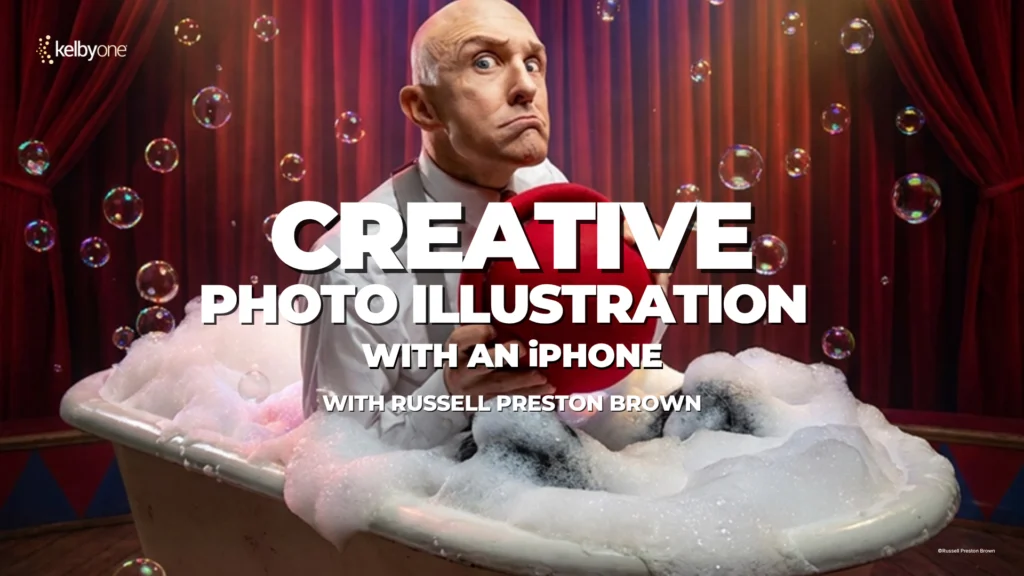
A groundbreaking new class from Adobe’s distinguished creative director, Russell Preston Brown, is set to redefine the landscape of photo illustration, demonstrating that powerful visual narratives no longer demand an elaborate studio setup but can originate from the ubiquitous smartphone and a single light source. This innovative course, hosted on the KelbyOne platform, showcases how foundational photographic principles, combined with the cutting-edge capabilities of Adobe Lightroom, Photoshop, Adobe Firefly, and Generative Fill, can transform simple captures into complex, imaginative works of art. The class specifically features professional bubbleologist Kirk Marsh as its model, providing a dynamic and visually rich subject for the experimental approach.
The Paradigm Shift in Photography: From Studio to Smartphone
The evolution of photography has seen remarkable shifts, from cumbersome large-format cameras to the compact DSLRs and mirrorless systems of today. However, perhaps no development has democratized image creation more profoundly than the advent of high-quality smartphone cameras. According to recent industry reports, over 1.4 trillion photos were taken globally in 2023, with the vast majority captured on mobile devices. This statistic underscores the immense potential of the smartphone as a primary photographic tool, a reality that Russell Preston Brown keenly addresses. His new class leverages the iPhone’s advanced camera system, specifically its capability to shoot 48-megapixel raw files, offering a high-fidelity starting point traditionally associated with professional-grade cameras. This decision is not merely a nod to convenience but a strategic embrace of accessible technology, challenging the notion that professional-grade imagery is exclusive to expensive gear.
The premise of the course directly confronts the traditional barriers to entry in professional photography—cost, complexity, and specialized equipment. By demonstrating that compelling images can begin with an iPhone, a tripod, and one continuous light source, Brown effectively lowers the threshold for aspiring photographers and seasoned professionals alike to experiment and innovate. This approach resonates with a broader trend in the creative industry, where accessibility and efficiency are increasingly valued alongside artistic merit.
Mastering Light with Minimalist Gear: The Foundation of Illustration
At the heart of any great photograph is light. Brown’s class meticulously unpacks how to manipulate a single continuous light source to achieve various classic lighting patterns that form the bedrock of portrait photography. Students will learn to create split lighting, which dramatically divides the face into light and shadow; Rembrandt lighting, characterized by a small triangle of light on the shadowed side of the face; loop lighting, where the nose shadow loops down towards the corner of the mouth; and butterfly lighting, which creates a butterfly-shaped shadow under the nose, often used for glamorous portraits.
The decision to use a continuous light source, as opposed to flash, further simplifies the setup, making it easier for beginners to visualize and control the light without the complexities of flash synchronization and power adjustments. A tripod is introduced as an essential tool for stability and precise framing, particularly when working with raw files and preparing for post-production enhancements. This methodical approach to on-camera capture ensures that even with minimal equipment, the initial photographs possess the necessary quality and structure to support extensive creative manipulation later. The class emphasizes that strong fundamentals in photography remain paramount, regardless of the tools used, providing a robust foundation before delving into digital enhancements.
The Digital Darkroom: AI’s Transformative Power in Post-Production
Where Brown’s class truly distinguishes itself is in the post-capture phase, moving the captured iPhone raw files into Adobe Lightroom and Photoshop. This is where the "fun really starts," as Brown himself suggests, and where the lines between photography and digital art begin to beautifully blur. Lightroom serves as the initial hub for organization, basic adjustments, and raw file processing, ensuring optimal color, tone, and detail from the 48-megapixel captures.
The true innovation, however, comes alive within Photoshop, particularly through the integration of Adobe Firefly and Generative Fill. Introduced to the public in 2023, Adobe Firefly is a family of creative generative AI models designed to be safe for commercial use, trained on a diverse dataset of licensed content. Generative Fill, powered by Firefly, allows users to non-destructively add, extend, or remove content from images using simple text prompts. Brown demonstrates how to leverage these powerful AI tools to build upon what was initially captured in-camera. This includes adding lighting effects that were not physically present during the shoot—perhaps a dramatic rim light, a soft glow, or a specific environmental illumination—and creating entirely new elements for the scene. Crucially, Brown illustrates how to integrate these AI-generated elements seamlessly without altering the original subject, Kirk Marsh, thus maintaining the integrity of the photographic capture while expanding the creative possibilities of the surrounding scene.
This application of AI represents a significant leap in creative workflow. Historically, adding complex elements or lighting effects would require elaborate compositing, 3D rendering, or even re-shooting. Generative Fill streamlines this process, allowing artists to rapidly iterate on ideas and bring imaginative concepts to fruition with unprecedented speed and flexibility. It transforms Photoshop from a mere editing tool into a powerful creative co-pilot, empowering users to envision and execute complex scenes that might have once been prohibitively difficult or time-consuming.
Russell Preston Brown: A Legacy of Innovation and Education
Russell Preston Brown is a name synonymous with innovation and creative exploration within the Adobe ecosystem. As a Senior Creative Director at Adobe, Brown has spent decades pushing the boundaries of digital imaging, consistently demonstrating the artistic potential of Adobe’s software. Known for his vibrant personality, engaging teaching style, and an uncanny ability to simplify complex techniques, he has inspired generations of photographers and designers worldwide. His workshops and presentations are legendary for their blend of technical expertise and artistic vision, often featuring theatrical elements and a playful approach to learning.
Brown’s commitment to showcasing emerging technologies, from early Photoshop versions to the latest AI features, has solidified his reputation as a visionary educator. His new class is a testament to this ongoing dedication, placing cutting-edge AI tools directly into the hands of photographers and illustrating their practical application in a creative context. He consistently advocates for experimentation and the blending of traditional artistic principles with modern digital workflows, encouraging creators to see tools like Generative Fill not as replacements for skill, but as extensions of imagination.
KelbyOne’s Role in Creative Education
The choice of KelbyOne as the platform for this course further emphasizes its accessibility and educational value. KelbyOne, founded by renowned photographer and educator Scott Kelby, has established itself as a premier online training resource for photographers, designers, and creatives. Known for its high-quality instruction and practical, results-oriented curriculum, KelbyOne provides a global audience with access to experts like Russell Preston Brown. The platform’s commitment to offering structured learning paths, coupled with the ability to watch select lessons for free, aligns perfectly with the goal of democratizing advanced creative techniques. This partnership ensures that Brown’s insights into AI-powered photo illustration reach a broad and engaged community eager to embrace new technologies.
The Art of Bubbleology: Kirk Marsh’s Unique Contribution
The selection of Kirk Marsh, a professional bubbleologist, as the model for the class adds an extraordinary layer of visual interest and creative potential. Marsh is celebrated for his unique performance art, where he manipulates soap bubbles into breathtaking, ephemeral sculptures. This dynamic and visually captivating subject matter provides Brown with rich material to demonstrate both the initial photographic capture and the subsequent digital enhancements. The iridescent qualities of bubbles, their delicate forms, and their fleeting nature present inherent challenges and opportunities for lighting, composition, and post-production. Marsh’s involvement underscores the collaborative nature of creative projects and highlights how unusual subjects can inspire truly original artistic outcomes, pushing the boundaries of what is traditionally photographed.
Democratizing Creativity: Implications for the Industry
The implications of Russell Preston Brown’s new class extend far beyond individual learning. It signals a broader shift in the creative industry, where the barriers to high-quality image creation are rapidly diminishing.
- Accessibility: The class proves that professional-level photo illustration is no longer contingent on owning expensive cameras, lenses, or studio lighting equipment. This democratizes the creative process, empowering a wider range of individuals to produce stunning visuals.
- Efficiency: Generative AI tools significantly reduce the time and effort required for complex image manipulation. This efficiency can lead to faster project turnaround times for professionals and more rapid iteration for artists experimenting with new ideas.
- Creative Freedom: By providing tools that can generate elements and effects with unprecedented ease, artists gain greater creative freedom to explore ambitious concepts that might have been technically or logistically challenging in the past. The ability to "add lighting that wasn’t there during the shoot" or "create elements for the scene" without extensive manual compositing unlocks new realms of artistic expression.
- Blurring Lines: The course exemplifies the blurring lines between traditional photography, digital art, and AI-generated content. This fusion is creating a new hybrid art form that combines the authenticity of a captured moment with the boundless possibilities of digital manipulation.
- Skill Evolution: While AI automates certain tasks, it also elevates the importance of artistic vision, prompt engineering, and the ability to integrate AI-generated content cohesively. Photographers are encouraged to evolve their skill sets to include these new digital proficiencies.
Industry analysts suggest that the integration of AI into creative workflows, as demonstrated by Brown, will continue to accelerate. Market reports project significant growth in the creative AI software market, driven by tools like Adobe Firefly, which enhance productivity and foster innovation. Adobe itself has consistently emphasized its commitment to empowering creators through technology, positioning Firefly as a tool to augment human creativity rather than replace it.
Ethical Considerations and the Future of Image Creation
While the creative potential of generative AI is immense, its rapid adoption also brings important discussions regarding ethics, authenticity, and intellectual property. Adobe has proactively addressed some of these concerns by training Firefly on licensed content and public domain material, aiming to provide a commercially safe solution. Furthermore, the class, by focusing on enhancing original photographic captures rather than generating images from scratch, grounds the creative process in an initial moment of human observation and skill. This approach offers a model for responsible AI integration, where the technology serves as an extension of the photographer’s vision rather than a substitute.
The future of photo illustration, as championed by Russell Preston Brown, appears to be one of unprecedented accessibility and boundless creativity. By starting with a great photograph, even one taken with a device in every pocket, and marrying it with the imaginative power of generative AI, artists can truly transform "a strong photograph and a little imagination" into "something completely different." This class is not just a tutorial; it’s a manifesto for the next era of digital artistry, proving that the tools for creating extraordinary images are more accessible than ever before.
For those eager to dive into this transformative learning experience, two lessons from Russell Preston Brown’s "Creative Photo Illustration with an iPhone" course are available for free viewing on KelbyOne, offering a tantalizing glimpse into the future of image creation.