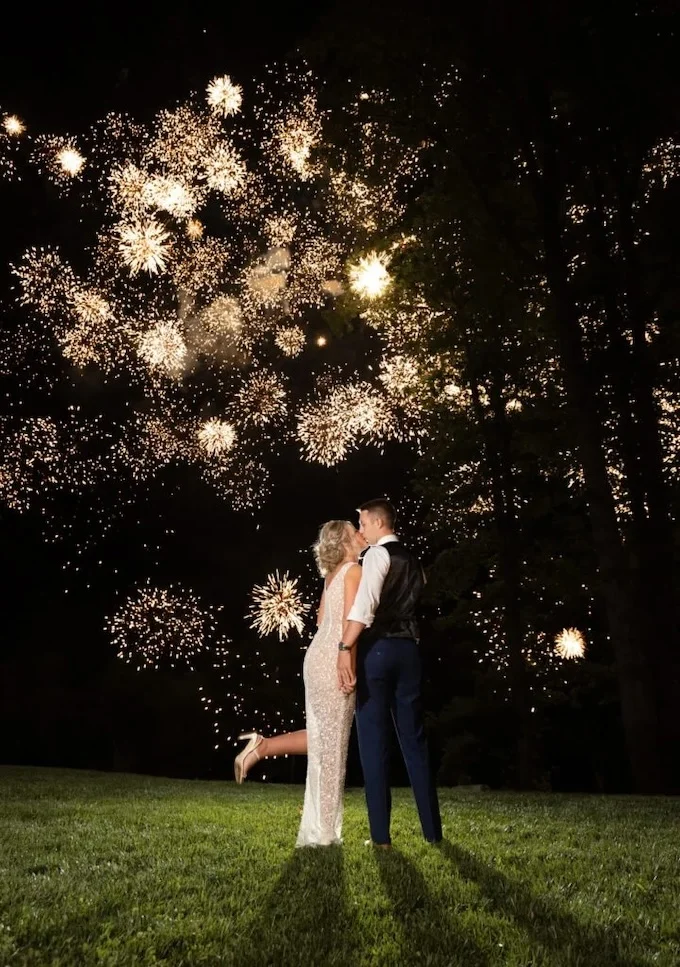
Fireworks, often synonymous with national holidays and grand celebrations, have increasingly found a unique and dramatic place in the realm of wedding photography. Beyond the expected bursts of light at theme parks and sporting events, these pyrotechnic displays offer photographers an unparalleled opportunity to create truly epic and memorable couples portraits. The ephemeral nature of fireworks, combined with the emotional significance of a wedding, presents a captivating challenge and a rewarding canvas for skilled visual storytellers. This comprehensive guide delves into the essential techniques and considerations for photographers aiming to capture the dazzling spectacle of fireworks alongside the intimate connection of a couple, transforming a fleeting moment into a timeless piece of art. The images accompanying this article are courtesy of the talented photographers at Wedding Maps, shared with their explicit permission, showcasing the potential of this unique photographic approach.

The fleeting nature of fireworks demands meticulous planning and efficient execution. Typically, a fireworks display lasts a mere five to eight minutes, sometimes even less. This condensed timeframe necessitates that photographers be exceptionally prepared, with their equipment and strategy in place well before the first spark ignites. The objective is to maximize every second, ensuring that the technical demands of capturing fireworks do not detract from the artistry of couples portraiture.
Strategic Location Scouting: The Foundation of a Stunning Shot
The initial and perhaps most crucial step in any successful fireworks portrait session is strategic location scouting. When a wedding timeline includes a fireworks display, photographers must proactively seek information about the planned pyrotechnics. Direct communication with the couple, the wedding planner, and the venue staff are invaluable resources for pinpointing the exact location and timing of the fireworks. This advance knowledge allows for thorough reconnaissance of potential shooting spots.

The definition of the "best" angle is subjective and depends entirely on the desired photographic outcome. Photographers might seek an expansive, unobstructed view to capture the fireworks filling the entire sky, with the couple as a silhouetted focal point against the luminous backdrop. Alternatively, a more nuanced approach might involve utilizing foreground elements such as trees, buildings, or architectural features to frame the shot, adding depth and context. Effective composition is paramount, and dedicating time to scouting ensures that the chosen location will enhance, rather than detract from, the final image. This pre-planning phase is non-negotiable for achieving impactful results.
Mastering Dynamic Range: RAW Files and Exposure Settings
Photographing fireworks inherently involves navigating challenging lighting conditions. The ambient light is significantly diminished, while the brilliant explosions of fireworks can easily lead to blown-out highlights if exposure settings are not carefully calibrated. To preserve the maximum amount of detail in both the dark shadows and the bright bursts, capturing images in RAW format is imperative. RAW files retain significantly more image data than compressed JPEG files, offering greater flexibility during post-production for recovering details in both the brightest and darkest areas of the image.

Understanding RAW vs. JPEG:
- RAW Files: These are uncompressed or minimally compressed image files that capture all the data recorded by the camera’s sensor. This unadulterated data provides a vast range of information, allowing photographers to make extensive adjustments to exposure, white balance, and color without significant degradation of image quality. This is especially critical when dealing with the extreme contrast between dark ambient light and bright fireworks.
- JPEG Files: These are compressed image files where some data is discarded to reduce file size. While convenient for immediate sharing, this compression limits the latitude for post-processing adjustments. Attempts to recover details in overexposed or underexposed areas of a JPEG can result in artifacts and a loss of sharpness.
Optimizing Exposure Settings for Fireworks:

A recommended starting point for exposure settings when photographing fireworks for couples portraits involves a balance between capturing the ambient scene and the ephemeral light of the fireworks:
- Aperture: A mid-range aperture, such as f/8 or f/11, is often ideal. This range provides a good balance of depth of field, ensuring that both the couple and the fireworks are reasonably sharp, while also controlling the amount of light entering the lens.
- Shutter Speed: This is the most critical setting for fireworks. A slower shutter speed, typically between 5 to 10 seconds, is necessary to capture the trails of light and the full explosion of the fireworks. Shorter exposures (2-5 seconds) will reveal less detail and fewer fireworks.
- ISO: Keeping the ISO as low as possible (e.g., ISO 100 or 200) is crucial to minimize digital noise, especially in the darker areas of the image. The slow shutter speed will compensate for the low ISO by allowing sufficient light to enter the sensor over a longer period.
Utilizing the Histogram:

Reviewing the camera’s histogram is an essential tool for fine-tuning exposure. The histogram displays the tonal distribution of the image. Photographers should aim to avoid having the data heavily concentrated on the far right side of the graph, which indicates clipped highlights and lost detail in the fireworks. Conversely, an image with too much data clustered on the far left signifies underexposed shadows, rendering the couple and the foreground too dark. The goal is to achieve a balanced histogram that captures the full dynamic range without sacrificing critical details.
The Art of White Balance Management
Setting the correct white balance is crucial for achieving natural-looking colors and a cohesive aesthetic. When photographing fireworks, the "Tungsten" white balance setting (often around 3200 Kelvin) can serve as an excellent starting point. This setting is designed to counteract the warm, orange cast of incandescent lighting, which can often complement the colors of fireworks.

If artificial light, such as flash or continuous lighting, is used to illuminate the couple, it is advisable to incorporate a CTO (Color Temperature Orange) gel onto the light source. This gel helps to match the color temperature of the artificial light to the warm tones of the fireworks. The white balance can then be adjusted within the camera or during post-production to achieve the desired color rendition for the couple and the overall scene. Experimentation is key, as individual creative visions will dictate the precise Kelvin temperature and gel combinations.
Lens Selection: Framing the Spectacle
The choice of lens for a fireworks couples portrait session is dictated by several factors, primarily the desired field of view and the constraints of the shooting environment.

- Wide-Angle Lenses: These lenses are excellent for capturing the grandeur of the fireworks and ensuring the couple is prominently featured within the expansive sky. A wide-angle lens allows for a broader perspective, encompassing both the subjects and the dramatic pyrotechnics. However, when working with a couple, maintaining communication can be challenging if the photographer is too far away with a very wide lens.
- Zoom Lenses: A zoom lens can offer versatility. If a tighter shot of the couple is desired, a zoom lens can be used to compress the scene, making the fireworks appear larger and more impactful in the frame. However, using a zoom lens for wide shots can sometimes make it difficult to maintain consistent framing and communicate effectively with the subjects due to the distance. If space is limited, a zoom lens might be the only practical option, but photographers should be mindful of its limitations.
It is often a good strategy to shoot with a slightly wider perspective than initially intended and then crop the image in post-production if necessary. This approach ensures that no critical elements are missed during the limited shooting window.
Embracing Long Exposures for Dynamic Light Trails
To effectively capture the beauty and motion of fireworks, employing long exposure techniques is essential. A slower shutter speed allows the camera to record the light trails created by the fireworks as they streak across the sky. Exposures ranging from 5 to 10 seconds can yield stunning results, showcasing the movement and ephemeral nature of the pyrotechnics. Shorter exposures, in the 2 to 5-second range, will capture less of the fireworks’ intricate details and trails.

Crucially, long exposures necessitate the use of a tripod to prevent camera shake and maintain sharpness. Even the slightest movement can result in a blurred image. To further minimize any vibration when pressing the shutter button, photographers should utilize a cable release, a remote control, or the camera’s built-in timer delay (a 2-second delay is usually sufficient). These tools ensure that the camera remains perfectly still during the exposure.
Illuminating the Subjects: A Critical Element
Unlike traditional fireworks photography, where the focus is solely on the pyrotechnics, couples portraits demand deliberate and effective lighting of the subjects. This is where the art of wedding photography truly intersects with the science of capturing fireworks. The advantage here is that, with ample time before the display, photographers can meticulously set up their lighting, fine-tuning flash power and exposure settings to achieve the desired balance between the ambient light of the fireworks and the illumination of the couple.

The standard approach is to light the couple as one would for any other portrait session. This involves setting the flash power and exposure to achieve a harmonious blend of artificial and ambient light. A common and effective placement for the primary light source is approximately 45 degrees to the side of the couple and slightly above, directed downwards. This creates flattering contours and avoids harsh shadows.
For added depth and dimension, a backlight can be introduced to further define the couple’s silhouettes against the night sky. Alternatively, modifiers such as snoots or grids can be employed to precisely control light spill, ensuring that the light is focused exclusively on the couple, thereby preventing overexposure of the foreground and maintaining the dramatic contrast with the fireworks. The specific lighting setup will ultimately depend on the photographer’s creative vision and the desired mood of the portrait.

The Necessity of Manual Focus
Autofocus systems can struggle significantly in low-light conditions and when faced with rapidly changing light sources like fireworks. To ensure that the couple remains sharp and in focus, it is imperative to switch the lens to manual focus (MF). If the camera offers a live view function, photographers can use this to accurately focus on the couple before the fireworks begin. Once focus is achieved, it is essential to confirm that manual focus is indeed selected and to refrain from touching the focus ring thereafter. This ensures a consistently sharp subject throughout the shooting process.
The Art of Compositing: Building a Masterpiece
For photographers seeking ultimate control over the final image, creating a composite is a highly effective technique. This approach involves capturing separate images of the couple and the fireworks and then merging them in post-production. The use of a tripod is non-negotiable for this method, as it ensures that the camera’s position remains consistent across all exposures.

The process begins by capturing a perfectly lit and posed portrait of the couple. This "base" image should be technically flawless, with the subjects well-exposed and their expressions captured. Following this, the photographer will then capture multiple exposures of the fireworks display, aiming to capture various bursts and patterns.
Post-Production Workflow: Lightroom and Photoshop

-
Lightroom: Begin by importing all captured images into Adobe Lightroom or a similar photo editing software. It is crucial to edit the batch of images intended for the composite in a consistent manner. The most efficient workflow involves editing the couple’s portrait first, meticulously adjusting exposure, color balance, and contrast to achieve the desired aesthetic. Once satisfied, this set of edits can be applied as a batch process to all the other fireworks images, ensuring uniformity.
-
Photoshop: The next step involves transferring the edited images to Adobe Photoshop. Stack all the images into a single document, with the couple’s portrait as the base layer. To seamlessly blend the fireworks into the scene, set the blend mode of the fireworks layers to "Lighten." This blend mode selectively reveals the brightest pixels of the upper layers, effectively layering the fireworks over the couple. From this point, layer masks can be used to meticulously edit out any unwanted elements from each fireworks layer, ensuring a clean and cohesive final image. This technique allows for the creation of a single, dramatic image that combines the intimacy of the couple with the explosive beauty of fireworks, even if they didn’t perfectly align during the live shoot.

Photographing Sparklers: A Wedding Day Essential
While not technically "fireworks" in the grand sense, sparklers are a popular and often requested element in wedding photography, particularly for grand exit shots. Their inclusion adds a festive and romantic glow to wedding day portraits.
Utilizing Larger Sparklers:

When recommending sparklers to couples for their photos, advise them to opt for the longer, 36-inch varieties over the shorter 10-inch versions. The extended burn time of larger sparklers provides a significantly greater window of opportunity for photographers to pose the couple, capture multiple shots, and create dynamic light trails with the sparkler art. This extra time is invaluable for achieving well-composed and engaging images.
Adjusting ISO and Aperture for Sparkler Light:

Sparklers, as a light source, are relatively weak. To compensate for this, photographers will need to adjust their camera settings accordingly.
- Boosting ISO: Increasing the ISO is often necessary to achieve a well-exposed image, especially in low-light conditions.
- Wide Aperture: Utilizing a wide aperture (e.g., f/1.4 to f/2.8) allows more light to enter the lens, further aiding in brightening the exposure.
Recommended Settings as a Reference:

- Moving Subjects: For dynamic shots where subjects are in motion, a balance is needed. Aperture: f/1.8-f/4, ISO: 400-1600, Shutter Speed: 1/60s – 1/200s. The faster shutter speed freezes motion, while the higher ISO and wider aperture compensate for the light.
- Static Subjects: For stationary subjects, the shutter speed can be lowered to allow for more light and to capture the trails of the sparklers more effectively. Aperture: f/2.8-f/5.6, ISO: 200-800, Shutter Speed: 1 second – 10 seconds. This allows for longer exposure to capture the sparkler trails and potentially a slight motion blur of the subjects if they move subtly.
Safety First: The Importance of a Safety Bucket
Handling sparklers involves working with open flames. Therefore, safety must be a top priority. Always have a substantial bucket of water readily available to safely extinguish used sparklers. This simple precaution ensures that the wedding day remains incident-free and that the photographic session is conducted responsibly.

Conclusion: Igniting Unforgettable Memories
The integration of fireworks and sparklers into couples portraiture offers a unique and powerful avenue for photographers to elevate their craft. By understanding the technical nuances of capturing these dynamic light sources, combined with the artistry of couples photography, professionals can create images that are not only visually stunning but also deeply evocative. The planning, technical precision, and creative execution discussed herein provide a robust framework for photographers aiming to harness the magic of pyrotechnics to immortalize love stories. The accompanying gallery of images serves as a testament to the breathtaking possibilities, offering a wealth of inspiration for those embarking on their own journey to capture couples bathed in the radiant glow of a thousand sparks.