The rapid integration of generative artificial intelligence into the creative industry has fundamentally altered the speed at which visual content is produced, moving from a model of scarcity to one of absolute abundance. While marketers can now transform a rudimentary concept into a diverse array of high-fidelity images within seconds, this technological leap has introduced a critical secondary challenge: the distinction between an aesthetically pleasing image and one that is commercially viable. As companies move beyond the experimental phase of AI adoption, the focus is shifting from the novelty of generation to the rigors of commercial readiness, governance, and brand safety.
The Paradigm Shift in Creative Production
For decades, the primary constraint in visual marketing was production capacity. Orchestrating a traditional campaign required a sequence of high-cost maneuvers, including hiring photographers, securing talent, scouting locations, and managing extensive post-production timelines. The introduction of stock photography in the late 20th century provided the first major efficiency gain, allowing brands to bypass bespoke shoots for non-hero content.
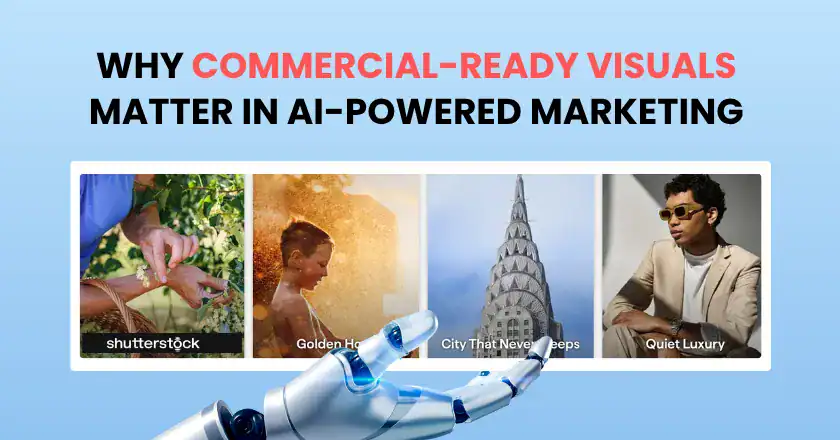
Generative AI (GenAI) has accelerated this trajectory by orders of magnitude. Creative teams can now iterate on backgrounds, lighting, and compositions without the need for manual retouching. However, this ease of creation has shifted the bottleneck from "production" to "selection and verification." The central question for modern marketing departments is no longer whether they can create enough content to fill their channels, but whether that content is legally, technically, and ethically fit for public consumption.
Defining Commercial Readiness in the Age of AI
A visual asset is considered "commercial-ready" only when it satisfies a complex matrix of legal, technical, and brand-specific requirements. In the context of AI-generated imagery, this readiness is categorized into four primary pillars:
1. Legal and Intellectual Property Indemnification
The most significant hurdle for AI-generated visuals is the ambiguity of copyright and provenance. Commercial-ready assets must have a clear lineage of ownership. Many open-source AI models are trained on datasets that include copyrighted material without explicit permission, creating a "black box" of legal risk. Conversely, commercial-ready platforms like Shutterstock or Adobe Firefly have moved toward "ethical AI" models trained on licensed datasets, often providing customers with legal indemnification against potential copyright claims.

2. Technical Scalability
While a 72-DPI image may look impressive on a smartphone screen, it is not commercial-ready if it cannot scale for high-resolution print, outdoor advertising, or 4K video displays. Commercial-ready visuals require specific metadata, color profiles (CMYK vs. RGB), and resolution depths that many standard AI outputs fail to provide without secondary processing.
3. Brand Coherence and Consistency
AI tools are notorious for "drift," where successive prompts result in variations in lighting, color temperature, and character features. A visual is not ready for a campaign if it deviates from the established brand guidelines. Maintaining a unified visual language across 50 different social media assets requires a level of control that raw AI generation rarely achieves on its own.
4. Cultural and Ethical Suitability
AI models often reflect the biases inherent in their training data. Commercial readiness involves a rigorous review for cultural sensitivity, diversity, and the absence of "hallucinations"—distorted limbs, nonsensical background text, or physics-defying architecture—that could undermine a brand’s professional reputation.

A Chronology of Visual Marketing Evolution
To understand the current state of the industry, one must look at the timeline of visual asset management:
- Pre-1990s (The Bespoke Era): Almost all commercial imagery was custom-produced. High barriers to entry meant only large corporations could afford high-quality visual storytelling.
- 1990s–2010s (The Stock Revolution): Digital libraries democratized access to professional photography. Agencies began to rely on "ready-to-use" assets, significantly lowering campaign costs.
- 2022–2023 (The Generative Explosion): The release of tools like DALL-E, Midjourney, and Stable Diffusion allowed for the instantaneous creation of synthetic media, leading to a surge in experimental marketing content.
- 2024–Present (The Governance Era): Organizations are now implementing "AI Guardrails." The focus has turned to integrating AI into established professional workflows, emphasizing licensing, provenance, and human-in-the-loop oversight.
Supporting Data: The Rising Demand for Volume
The necessity for commercial-ready visuals is driven by the sheer volume of content required by modern digital ecosystems. According to industry reports, the average multi-channel brand now requires 10 to 20 times more visual assets than it did a decade ago to satisfy the demands of personalized advertising, localized social media, and rapid-refresh display cycles.
Market analysis suggests that the generative AI in advertising market is expected to grow at a CAGR of over 30% through 2030. However, a survey of enterprise CMOs revealed that while 70% are using AI for "brainstorming" and "concepting," less than 25% have a formal process for approving AI-generated images for use in paid media. This gap highlights the urgent need for platforms that bridge the gap between "generated" and "ready."

The Hybrid Model: Stock Media as the Foundational Layer
The prevailing industry sentiment is shifting away from the idea that AI will entirely replace traditional photography. Instead, a hybrid model is emerging. In this workflow, professionally produced stock media serves as the "source of truth"—providing the structure, lighting, and human authenticity that AI often struggles to replicate from scratch.
AI is then utilized as an "editing layer" rather than a "creation layer." For example, a marketer might license a professionally shot image of a family in a living room (ensuring all model releases and property rights are intact) and then use AI to change the season from summer to winter, or to swap the product on the coffee table. This ensures the foundation of the image is legally sound and technically high-quality, while the AI provides the flexibility to adapt the asset for different markets.
Industry Response and Official Perspectives
Major players in the creative industry have begun to formalize their stance on commercial readiness. Platforms such as Shutterstock have integrated AI tools directly into their licensed libraries, allowing users to "generate with confidence." These organizations have established contributor funds to compensate the original photographers whose work trains the models, thereby addressing the ethical concerns of the creative community.

Legal experts in the field of intellectual property have noted that the U.S. Copyright Office’s current stance—which generally denies copyright protection to works produced solely by machines—makes the "human-plus-AI" workflow essential. By starting with a licensed human-made image and using AI for modifications, brands are in a much stronger position to claim ownership and protection of their campaign assets.
Broader Impact and Implications for Global Marketing
The move toward commercial-ready AI visuals has profound implications for global marketing strategies. Localization, which previously required separate photoshoots for different demographic regions, can now be achieved through "modular" production. A core campaign can be adapted for a dozen different countries by using AI to adjust cultural cues, clothing styles, and environments, provided the underlying assets are cleared for international use.
However, this scalability comes with the risk of "creative fatigue." As AI-generated aesthetics become more prevalent, the value of "authentic" human-captured moments may actually increase. Professional photography is not losing its value; rather, it is evolving into a high-end "raw material" for a more complex, AI-assisted production pipeline.

Conclusion: The Strategic Value of Certainty
In an era where visual content is effectively infinite, the strategic advantage lies in certainty. Brands that can move an asset from the "idea" stage to the "published" stage without legal friction or technical failure will outperform those bogged down by the unpredictability of unverified AI outputs.
The future of marketing is not a choice between human creativity and machine generation. It is the sophisticated integration of both, underpinned by a rigorous standard of commercial readiness. As AI continues to evolve, the ability to discern which visuals are truly ready to represent a brand will become one of the most vital competencies in the creative industry. The goal is no longer just to create; it is to deploy with confidence.