The digital landscape of political communication was once again at the forefront of public discussion this week, following President Donald Trump’s sharing of what numerous independent experts and media organizations have confirmed to be a digitally altered photograph on his social media platform, Truth Social. The image depicts a modified scene from the arrival ceremony of Chinese President Xi Jinping at Joint Base Andrews in Maryland on Wednesday, September 23, 2026. This incident has raised significant questions regarding the manipulation of public imagery, the role of fact-checking in the digital age, and the deliberate shaping of political narratives through visual media.
The Diplomatic Context: A High-Stakes Arrival
President Xi Jinping’s visit to the United States on Wednesday was not merely a ceremonial affair; it represented a critical moment in the complex and often fraught relationship between the world’s two largest economies and geopolitical rivals. Against a backdrop of ongoing tensions concerning trade imbalances, technological competition, human rights issues, and strategic interests in regions like the South China Sea and Taiwan, the arrival ceremony at Joint Base Andrews carried immense symbolic weight. Joint Base Andrews, located just outside Washington D.C., has historically served as the primary port of entry for foreign heads of state visiting the U.S., a tradition that imbues such arrivals with a sense of formal diplomacy and national prestige.
The arrival ceremony itself is a meticulously choreographed event designed to convey respect and strength. Typically, it involves a red-carpet welcome, a military honor guard, and often a flyover by U.S. military aircraft, symbolizing the host nation’s military prowess and welcoming gesture. For a leader of President Xi’s stature, every detail, from the expressions of the dignitaries to the backdrop of the aircraft, is scrutinized by global media and political observers. The perception of power, composure, and diplomatic standing is paramount, particularly when two leaders of such global significance meet.
A Tale of Two Images: Discrepancies Emerge
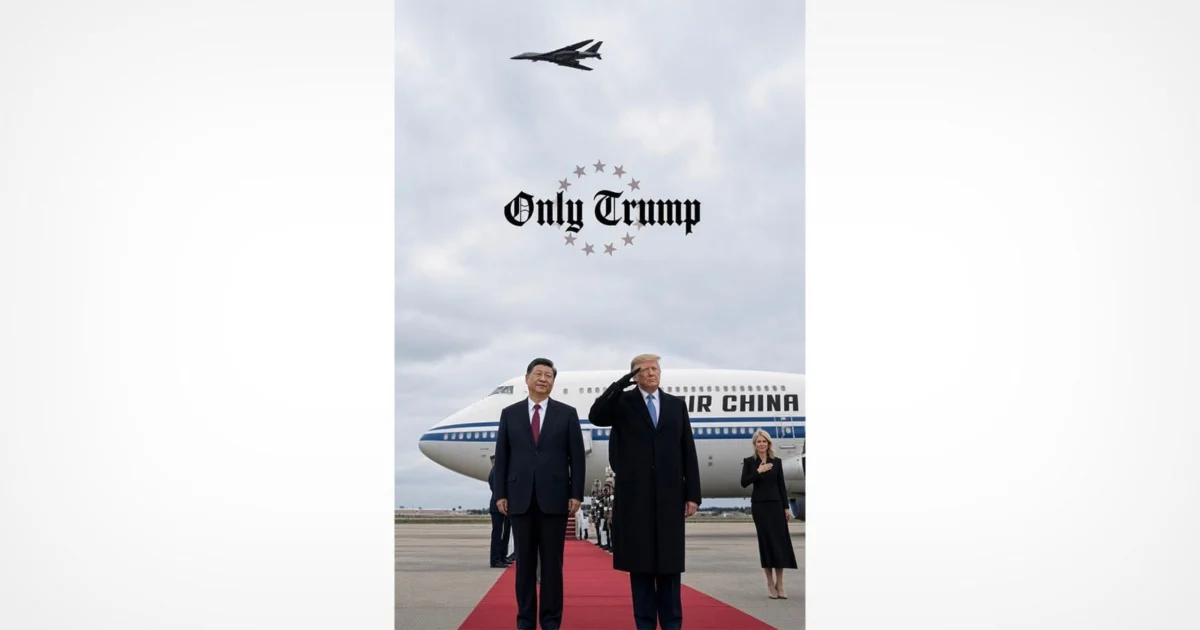
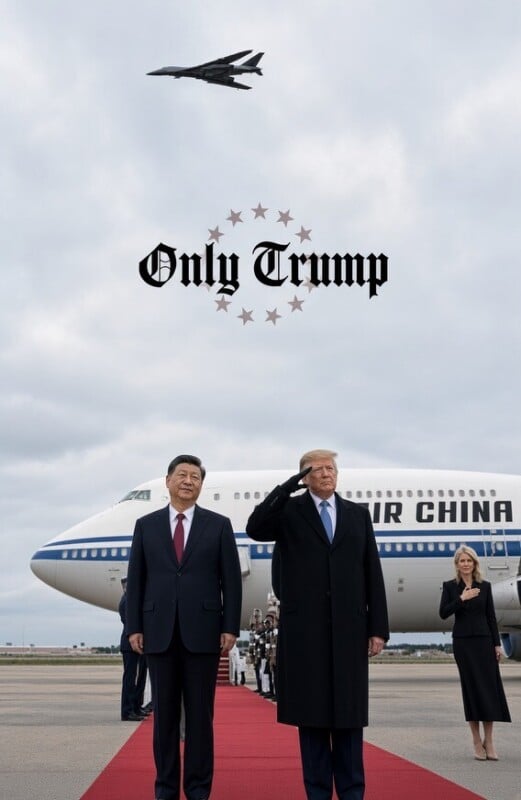
The photograph in question was posted by President Trump to his Truth Social account, presenting a starkly different tableau compared to authentic images and videos captured by reputable news agencies. In Trump’s version, he is seen standing on the red carpet alongside President Xi, offering a crisp, stoic salute as a military bomber streaks across the sky overhead. The image projects an aura of unwavering composure and presidential dignity.
However, this carefully curated image stands in stark contrast to the original photographic and video evidence from the event. Getty Images, a globally recognized source of journalistic photography, released a picture of the exact same moment that reveals a different reality. In the Getty image, President Trump is captured with a distinct grimace, a reaction widely attributed to the powerful, ear-splitting roar of the military jet conducting the flyover. This visceral, human reaction to the intense noise was corroborated by numerous other media outlets, including Reuters and the Associated Press, whose photographers and videographers documented the event from various angles.
Video footage further solidified the discrepancy. A clip shared by the New York Post on X (formerly Twitter) vividly captured Trump’s reaction, describing it as "priceless" and emphasizing his visible discomfort during the flyover. Conversely, Chinese state media, including the South China Morning Post, notably highlighted President Xi Jinping’s unwavering composure throughout the flyover, subtly framing it as a testament to his stoicism and leadership under pressure. This difference in reactions, and the subsequent portrayal, underscores the geopolitical undercurrents even in seemingly minor moments of diplomatic protocol.
Forensic Analysis: Unpacking the Digital Alterations
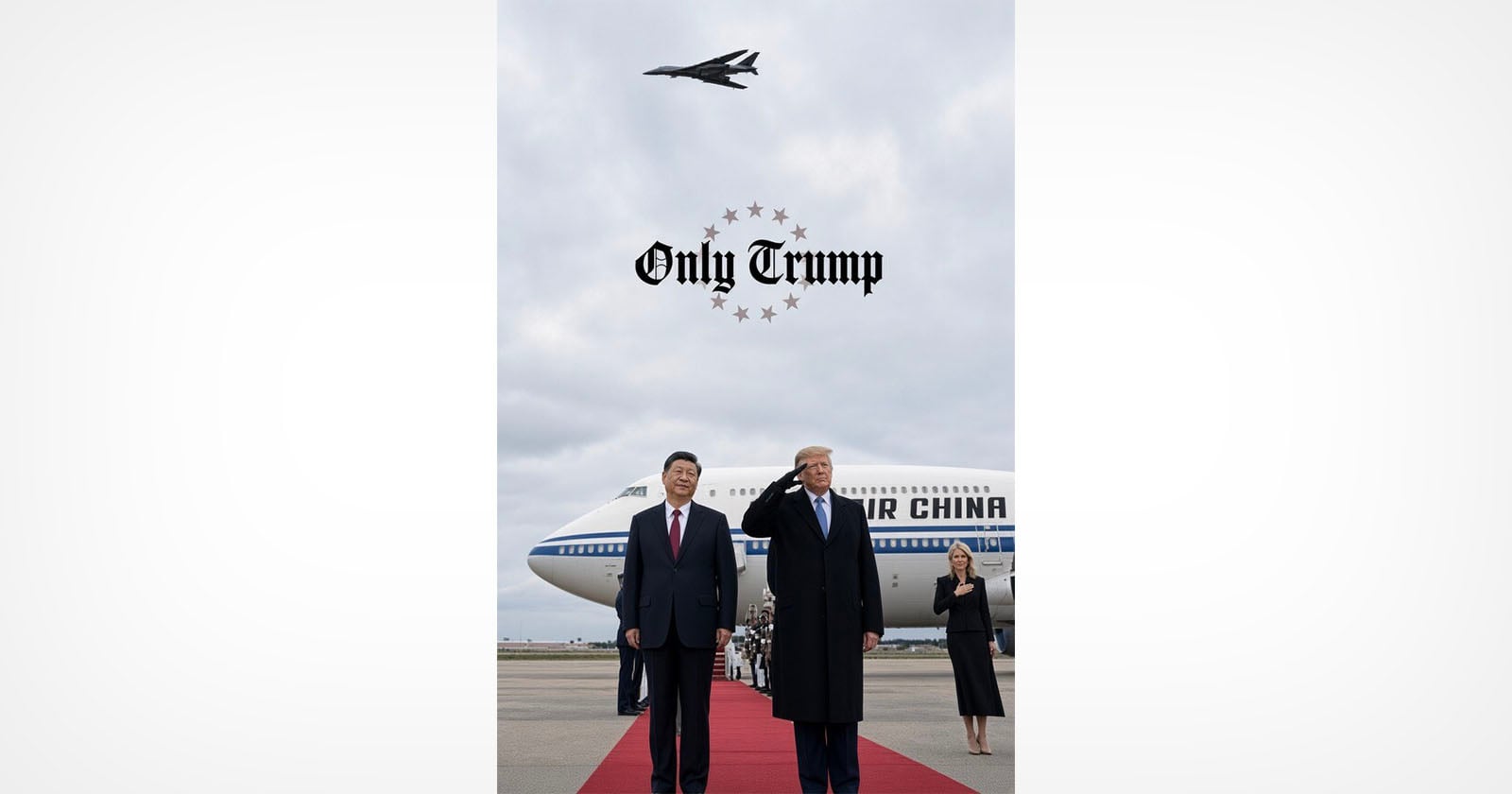
The stark differences between the Truth Social image and verified media reports immediately prompted investigations by fact-checking organizations. BBC Verify, a dedicated unit for debunking misinformation, conducted a comprehensive analysis and definitively concluded that the image shared by President Trump was indeed digitally altered. Their investigation meticulously identified several glaring inconsistencies:
-
The Glove Anomaly: In Trump’s version of the image, he is depicted wearing only one black glove on his left hand. However, all other authenticated images and video footage from Wednesday’s event at Joint Base Andrews clearly show President Trump wearing a black glove on each hand. This detail, seemingly minor, became a critical piece of evidence pointing to deliberate manipulation, as removing one glove would require precise digital editing.
-
The Replaced Aide: Perhaps one of the most striking alterations involved the individual standing behind President Trump to his right. In reality, the Chief of Protocol, Monica Crowley, a high-ranking official responsible for diplomatic arrangements and often seen accompanying the President during such events, was positioned there. Crowley’s role is significant in maintaining diplomatic decorum and ensuring the smooth execution of international engagements. However, in the Truth Social version, Crowley was replaced by a different woman. Journalist Aaron Rupar, commenting on X, pointed out that the altered figure bore a strong resemblance to Natalie Harp, an aide to President Trump who has been colloquially dubbed the "human printer" due to her frequent presence at his side, often carrying printed materials. This substitution suggests a deliberate effort to control who appears in the immediate vicinity of the President, potentially for optics or to include individuals perceived as more loyal or aligned with a particular public image.
-
Aircraft Markings and Hair Detail: Further scrutiny by BBC Verify revealed additional inconsistencies. The Air China plane, serving as a prominent backdrop to the leaders, displayed certain red markings in authentic photos that were conspicuously absent in the Truth Social version. Moreover, the style and appearance of President Trump’s hair in the altered image differed noticeably from how it appeared in the widely distributed news agency photographs and video footage from the same event. These "cosmetic edits," as described by experts, contribute to the overall impression of a doctored image designed to present a specific, idealized appearance.
Henry Farid, co-founder of GetReal Security and an expert in digital forensics, commented on these findings, telling the BBC, "The changes are the types of cosmetic edits that you often see to ‘clean up’ photos." He further elaborated, "Given the other obvious edits, it is clear that this image has been modified. So that increases the chance that all of these differences are due to digital or AI editing." Farid’s statement underscores the sophistication of modern photo manipulation techniques, including those potentially leveraging artificial intelligence, which can seamlessly alter details to create a desired visual narrative.
Broader Implications: Truth, Perception, and Political Messaging
The incident involving the doctored photograph is not an isolated event but rather indicative of a larger trend in political communication, particularly in the era of widespread digital media and social platforms. The motivation behind such an alteration can be inferred as an attempt to project an image of unwavering strength, composure, and control, thereby aligning with a desired political persona. By removing the grimace and presenting a stoic salute, the image sought to eliminate any perception of vulnerability or discomfort during a high-profile diplomatic event, especially one where the Chinese President was noted for his calm demeanor.
This deliberate manipulation of an image from a state-level diplomatic event carries significant implications for several reasons:
-
Erosion of Trust: When high-profile political figures share demonstrably false or altered images, it contributes to a broader erosion of public trust in official communications. In an information environment already saturated with misinformation and disinformation, such actions make it more challenging for the public to discern truth from fabrication, further fueling cynicism towards both political leaders and traditional media.
-
Narrative Control: The incident highlights a concerted effort to control and shape narratives through visual means. In an age where images often speak louder than words, altering a photograph to align with a preferred story (e.g., "President Trump is always composed and strong") becomes a potent tool for political messaging, regardless of factual accuracy.
-
The Challenge for Journalism: The prevalence of digitally altered content places an increasing burden on journalists and fact-checkers. Their role in verifying the authenticity of images and videos becomes more critical than ever, requiring sophisticated tools and expertise to combat visual deception effectively. Organizations like BBC Verify exemplify the essential work being done to uphold media integrity.
-
Diplomatic Optics: While unlikely to cause a major diplomatic incident, the alteration of an image from a joint appearance with a foreign head of state could be perceived in various ways internationally. It might be seen as trivializing a formal diplomatic occasion or as an attempt to control the narrative surrounding the U.S. President’s appearance, potentially impacting subtle diplomatic perceptions.
A Historical Perspective on Image Manipulation
The manipulation of images for political purposes is not a new phenomenon; it has a long and storied history, predating the digital age. From the airbrushing of Stalin’s purged rivals out of official photographs in the Soviet Union to early photographic composites used for propaganda, political figures and regimes have long understood the power of visual media to shape public perception and historical memory. What has changed dramatically in the 21st century is the ease, accessibility, and sophistication of the tools available for such manipulation, thanks to advancements in digital editing software and, more recently, artificial intelligence. AI-powered tools can now generate highly realistic, yet entirely fabricated, images and videos (deepfakes) with minimal effort, making the challenge of discerning authenticity exponentially greater. This incident serves as a stark reminder that while the technology evolves, the underlying impulse to control perception through visual distortion remains a constant in political discourse.
The Indispensable Role of Fact-Checkers
In this increasingly complex media landscape, the work of independent fact-checkers and traditional news organizations is more critical than ever. The rapid identification and debunking of the doctored image by outlets like BBC Verify, supported by the consistent reporting from news agencies such as Getty Images, Reuters, and the Associated Press, underscore the importance of robust journalistic practices. These organizations provide a crucial bulwark against the spread of misinformation, ensuring that the public has access to verified information, even when it contradicts narratives promoted by powerful figures. Journalists like Aaron Rupar, who quickly highlighted the discrepancies, also play a vital role in bringing such issues to public attention and facilitating broader scrutiny.
Conclusion: Navigating the Digital Truth
The incident involving President Trump’s doctored photograph is a potent illustration of the ongoing battle for truth in the digital age. It highlights how visual media can be selectively altered to craft a desired narrative, potentially misleading the public and distorting the record of significant events. As technology for image and video manipulation becomes more advanced and accessible, the onus falls on both media organizations to rigorously verify content and on the public to cultivate a critical eye towards the images they consume. This episode serves as a powerful reminder that in an era dominated by digital communication, the integrity of visual information is paramount for maintaining informed public discourse and holding powerful figures accountable. The continued vigilance of independent media and fact-checking bodies remains indispensable in navigating this complex landscape and upholding the principles of factual reporting.